Passing the CES test for Engine Cadet(Crew Evaluation System by Ocean Technologies Group / Seagull) is your ticket to securing a first sea contract. Manning agencies and ship owners demand top scores—often 80% or higher—to verify your technical foundation and safety awareness. The standard online assessment consists of 40 to 60 multiple-choice questions with a 60-minute time limit, covering engine room operations, auxiliary systems, MARPOL compliance, and electrical safety.
However, you do not need to gamble with your future or risk staying on shore. Therefore, we created this targeted preparation guide featuring real test questions and verified answers. As a result, by leveraging a structured ces reviewer for engine cadet, you will master engine room safety rules, build true confidence, and pass your Seagull evaluation on your very first try.
What Is the CES Test for Engine Cadet?
The Crew Evaluation System (CES), originally developed by Seagull and now managed by Ocean Technologies Group, is a universally recognized online assessment tool utilized by leading manning agencies and shipowners worldwide. For aspiring Engine Cadets, passing this exam is a critical milestone that demonstrates your technical competence, safety awareness, and readiness for a first sea contract. The test evaluates whether a candidate possesses the foundational knowledge required by international STCW standards before stepping into an active engine room environment.
Engine Room Safety & MARPOL Compliance: Emergency response procedures, fire-fighting systems, Personal Protective Equipment (PPE) standards, and strict MARPOL regulations, including Oily Water Separator (OWS) operation.
Auxiliary Machinery & Systems: Operational principles, maintenance, and monitoring of centrifugal pumps, fuel oil purifiers, air compressors, heat exchangers, and steering gear.
Diesel Engine Fundamentals: Basic mechanical principles governing main two-stroke and four-stroke marine diesel engines, scavenge space maintenance, and cooling water circuits.
Electrical Safety & Workshop Skills: Safe electrical isolation (Lockout/Tagout), basic circuit troubleshooting, hand tool safety, benchwork, and precision measuring instruments like micrometers and calipers.
CES Test Questions and Answers for Engine Cadet
1 BQDK Which of the following fluids usually has the lowest density at normal ambient temperatures?
Correct Answer: B) Lubricating oil.
2 JYTJ When checking the closed butt gap clearance of new piston rings prior to fitting onto the piston it is normal to try the rings in the liner so that the gap can be measured. From the options given select the best part of the liner to use to carry out these checks
Correct Answer: C) Near the bottom of the liner.
3 FYKG One cylinder of a diesel engine is operating with a high exhaust gas temperature. From the options given, select the one most likely to cause this condition.
Correct Answer: C) Fuel injection valve opening pressure is too low.
4 QVEY The Base Number of a lubricating oil is an indication of which of the following?
Correct Answer: D) The alkalinity of the oil.
5 NRAA A power card taken from a diesel engine cylinder using a mechanical indicator has a flat top. Which of the possible actions given in the options is most likely to correct this irregularity on the power card?
Correct Answer: B) Change the indicator spring for one with a higher rating.
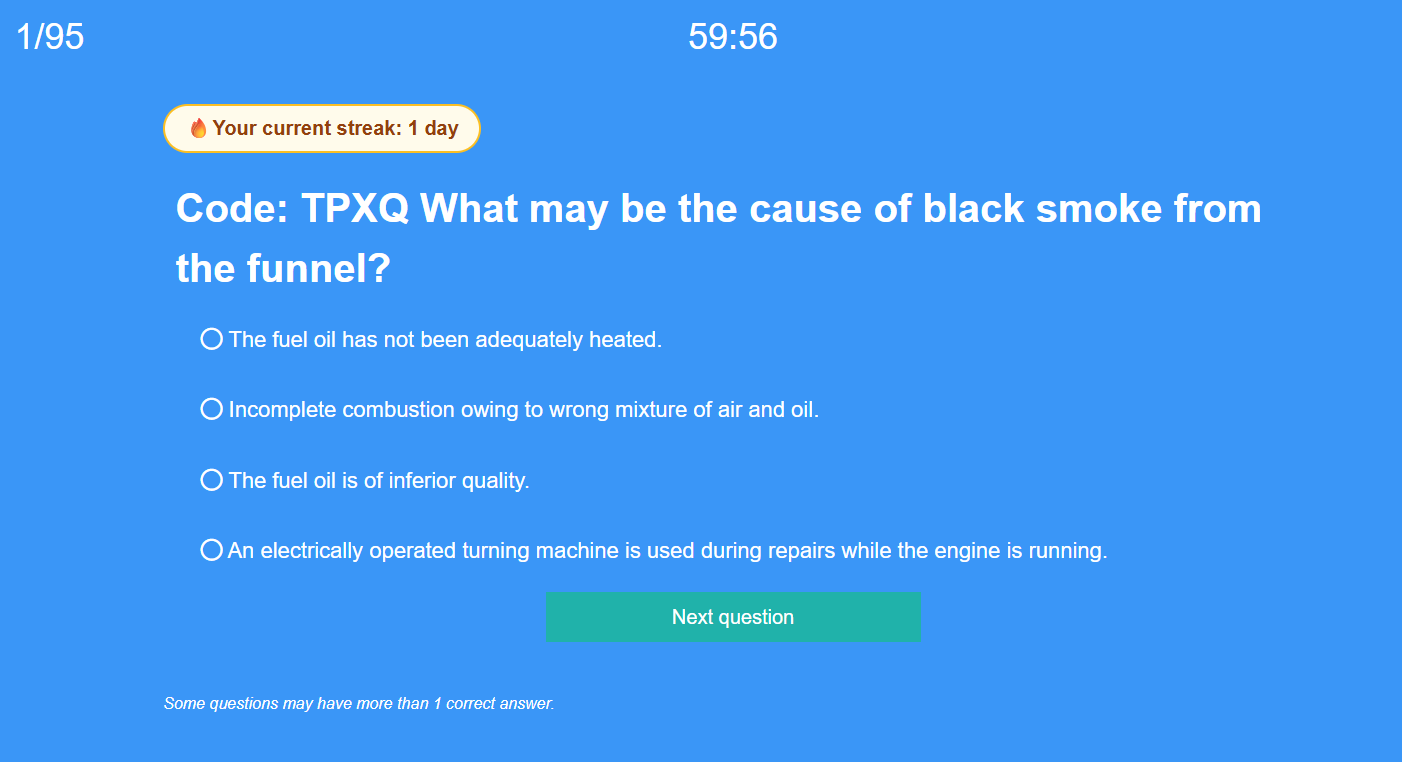
Want to test your readiness under real exam conditions?
Practice with our interactive exam simulator featuring instant scoring and full question explanations.
6 RISB A power card from a slow speed diesel engine cylinder is abnormal with a low height and the body of the diagram thicker than normal. What is the most likely cause of this?
Correct Answer: D) Fuel timing is retarded.
7 YUNF What will you do if you have a flash-back during gas welding?
Correct Answer: C) Close the valves oxygen first.
8 LCFH What would be a typical separating temperature range for purifying mineral oil based lubricating oil in a centrifuge?
Correct Answer: C) 65-85 °C.
9 NXCD In accordance with SOLAS and other international regulations, certain important machinery functions, such as operation and control of the steering gear and propulsion machinery, must be tested at specified times. When should these tests be carried out?
Correct Answer: D) Prior to arrival and departure from port and following maintenance.
10 DYBF What is the purpose of a scum valve often fitted to a steam boiler?
Correct Answer: A) To allow removal of any oil or scum which collects on the surface of the water in the boiler steam drum.
To find the exact answer to a test question, use the global search on our website, Sea-Man. See the detailed instructions in the video below.
How to Prepare for and Pass the CES Engine Cadet Test on Your First Try
- Train with an Interactive Engine Cadet Reviewer: Avoid memorizing static text documents. Utilizing an interactive engine cadet reviewer online lets you practice under actual test conditions, building quick answer recognition, mastering screen pacing, and eliminating pre-exam anxiety before taking your official manning evaluation.
- Master High-Weight Safety Regulations: Focus heavily on mandatory safety topics, including MARPOL Annexes (especially Annex I for oil pollution and Annex V for garbage management), SOLAS emergency routines, and electrical Lockout/Tagout (LOTO) safety. Safety questions carry high weighting in the final score algorithm.
- Study Visual Diagrams and Workshop Tools: Make sure you can visually identify engine room components under pressure. Thoroughly review schematic layouts for centrifugal pumps, heat exchangers, and oily water separators, alongside reading precision instruments like micrometers and vernier calipers.
- Simulate Real Time Constraints: The CES exam allocates roughly one minute per question. Practicing with a timer ensures you maintain a steady pace without getting stuck on complex questions.
Also, for effective preparation for CES, use the Sea-Man Tests app, which offers preparation, exam, and marathon modes, as well as a question search function.
You can download the Sea-Man Tests app here: Sea-Man Tests
❓
Frequently Asked Questions
The standard CES test session typically consists of 40 to 60 questions, depending on the specific test profile assigned by your shipping company.
Most international manning agencies require a minimum score of 70% to 80% overall, with higher passing thresholds required for safety-critical modules like MARPOL and SOLAS.
You are generally allowed 60 minutes to complete the exam, which averages to about 1 minute per question.
Yes, you can take free practice modules and demo tests directly on Sea-Man.org using our interactive trainer. Seagull CES Test Answers – Free Online Trainer for Seafarers
Yes, Ocean Technologies Group uses a dynamic system that randomly pulls questions from a vast database based on your assigned rank profile, meaning every attempt presents a unique combination of questions.
You can download full PDF answer databases for CES, CBT, SETS, and Mintra tests directly to your phone or laptop from Sea-Man.org to prepare seamlessly anywhere without an active connection.
Related Tests and Preparation Guides
Gain full access to the updated CES question database, timed exam simulations, and detailed answer keys across all maritime ranks.


