CV for seaman when applying for a shipboard job, it is not enough to simply send a crewing company a list of previous workplaces. A crewing officer must quickly understand what position the seafarer is applying for, what types of vessels they have worked on, what experience they have gained, and whether their qualifications match the vacancy requirements.
- Why a Seafarer’s CV Is Important for Employment
- What a Crewing Company Employee Needs to Understand from a Seafarer’s CV
- What Real Crewing Companies Require
- Recommended Structure of a Maritime CV
- Mistakes That Can Prevent Employment
- Checklist: What to Check Before Sending a CV
- Check Your Seafarer’s CV Before the Next Submission to Crewing
A well-prepared seafarer’s CV helps present professional experience clearly and speeds up the initial screening of candidates. What matters is not so much the design of the document as the accuracy of the information:
- positions held;
- duration of service in each rank;
- types and characteristics of vessels;
- experience with cargoes, power plants, and valid certificates.
Different shipping and crewing companies may use different application forms and hiring procedures. However, the basic requirements for candidate information largely coincide. Let’s examine what exactly should be included in a résumé, how to present sea service, and which mistakes are best avoided.
Why a Seafarer’s CV Is Important for Employment
In most cases, an employer’s first contact with a candidate begins not with an interview but with a review of the application form or résumé. Initial screening determines whether the seafarer is suitable for a specific vacancy and whether it is worth proceeding to the next stage of selection.
A typical employment process looks like this:
- Receipt of CV and application form. The crewing company receives information about the candidate, their qualifications, and previous work experience.
- Primary screening. A crewing officer matches the information in the résumé against the requirements for the position, vessel type, and contract conditions.
- Further assessment. If the candidate meets the main requirements, document checks, professional tests, interviews, and reference requests may follow.
- Decision. The employer evaluates how well the candidate fits a specific vessel and crew.
This approach is confirmed by the practice of real companies. For example, OSM Thome uses a database of registered candidates and a structured-data matching system. Crewing staff can search for seafarers by rank, certificates, experience on specific vessel types, sea-time requirements, and expected start date. After shortlisting, interviews and professional experience checks are conducted.
Another example is Christiania Shipping. The company’s website has a dedicated application procedure for seafarers. The form requires the rank applied for, contact details, readiness date, and uploading of the application and CV. This shows that the employer needs not only the content of the résumé but also the ability to quickly determine the position the candidate is targeting and when they can start work.
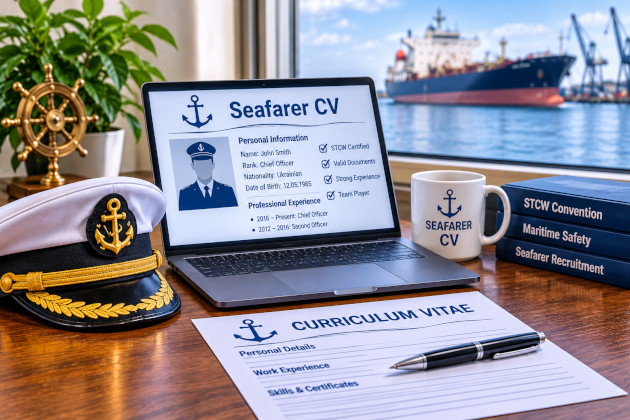
Therefore, a CV is not a formality for the HR department. It is the document by which the employer assesses a seafarer’s professional suitability for a vacancy before any personal contact.
What a Crewing Company Employee Needs to Understand from a Seafarer’s CV
When reviewing a résumé, a crew recruiter evaluates more than just rank and total sea time. They need to understand how well the candidate’s experience matches the requirements of a specific vessel, whether the candidate can perform the duties of the stated rank, and whether they are ready to work in an international crew.
Christiania Shipping’s recruitment procedure lists specific CV screening criteria:
- English language knowledge and mixed-crew experience;
- stability of previous sea service;
- experience with particular cargo types, main engines, and vessels of comparable size;
- and qualification documents.
Let’s examine what information should be reflected in the résumé under these headings.
Rank/Position
At the beginning of the CV, clearly state the position the seafarer is applying for (Master, Chief Officer, Second Officer, Chief Engineer, Second Engineer, ETO, AB, etc.).
If the candidate has held several ranks, the career progression should be visible in chronological order. For example, the move from Second Engineer to Chief Engineer should be clear from the Sea Service section. This allows the recruiter to see the candidate’s current professional level and determine whether their experience matches the vacancy.
Sea Service/Experience in Rank
Total sea time and time served in a specific rank are different indicators. A seafarer may have ten years of sea service but only a few months in the rank they are applying for.
Therefore, the CV must show the dates of each contract, the rank held, the vessel name, and the vessel type. It is especially important to highlight experience in the target rank separately.
For example, if a vacancy requires at least 12 months as Second Engineer, several years of total sea time alone does not confirm compliance with that requirement.
Vessel Type/Vessel Size
Experience on different vessel types is not always interchangeable. Work on a bulk carrier, container ship, oil tanker, or gas carrier involves different operations, equipment, and crew-training requirements.
Indicate the vessel type and its size – DWT (deadweight) or GT (gross tonnage). These parameters help the employer match the candidate’s previous experience with the characteristics of their own fleet.
Christiania Shipping’s procedure specifically mentions experience on vessels with DWT comparable to the company’s ships. A simple entry such as “Bulk Carrier” or “Tanker” may therefore be insufficient.
Cargo Experience
For Masters, deck officers, and other specialists involved in cargo operations, experience with specific cargo categories is important.
For the tanker fleet this means experience with crude oil, petroleum products, chemicals, or liquefied gases. For bulk carriers – dry bulk cargoes; for container ships – organisation and control of container operations.
It is advisable to indicate not only the vessel type but also the specific cargo specialisation. Christiania Shipping’s procedure lists cargo-type experience as a separate evaluation criterion for deck officers and pumpmen.
Engine Experience
For engineers and electro-technical officers, information about the main engine and other engine-room equipment is highly relevant.
Simply stating “Second Engineer” and the vessel name does not always reveal which installations the candidate worked with. An employer may specifically need experience with a particular main-engine manufacturer or model.
Therefore, the CV should state the manufacturer and model of the main engine, and, where relevant, details of auxiliary engines, automation systems, and other specialised equipment.
Christiania Shipping’s procedure treats main-engine experience as a separate criterion for engine officers and electricians.
English Knowledge/Mixed Crew Experience
English is essential for communication among crew members, interaction with shore services, and performance of duties on board. Its importance is especially noticeable in international crews, where seafarers of different nationalities use English as the common working language.
It is advisable to state the level of English if it has been confirmed by testing, and to note mixed-crew experience.
For the employer this provides additional information about how familiar the candidate is with international working conditions and how well they can interact with colleagues of different nationalities.
Christiania Shipping’s procedure explicitly lists English knowledge and mixed-crew experience among primary screening criteria. These details should therefore not be omitted from the résumé.
Sea Service Stability
When evaluating a CV, recruiters look not only at the total length of sea service but also at the employment history. They may note the length of contracts, regularity of sea employment, gaps between contracts, and reasons for leaving previous companies.
A seafarer who has worked for several years with the same shipping company and completed successive contracts presents a clear professional history. Numerous short periods with different employers may raise additional questions.
Christiania Shipping’s procedure names “Stability in previous companies” as one of the screening criteria. Other published crew-selection guidelines also mention sea-service stability, reasons for leaving companies, and gaps between contracts.
This does not mean that gaps or changes of employer automatically lead to rejection. There may be legitimate reasons for a break in service or a move to another company. What matters is that contract dates are stated accurately and that any periods without sea employment can be explained if necessary.
Certificates/CoC
The recruiter must understand whether the candidate holds a valid Certificate of Competency corresponding to the rank held or applied for.
For officers, state the CoC, its level, and expiry date. Also list valid STCW certificates, mandatory courses, and any additional documents required for the specific rank or vessel type.
Information in the résumé must match the original documents. The employer may verify authenticity and validity.
Availability
Even an experienced specialist may be unsuitable for a particular vacancy if they cannot join the vessel within the required timeframe.
Therefore, the CV should state the exact availability date or the expected date of release from current commitments. If the date is not yet known, it is better to say so explicitly rather than leave the section blank.
Contact Information
Full name, a current telephone number with international country code, and a working e-mail address must appear at the top of the résumé.
Check that the contacts work and that the name is written identically in the CV and in the seafarer’s documents. This simplifies communication and subsequent verification of information.
What Real Crewing Companies Require
Requirements for seafarers can be checked against official application forms, vacancy announcements, and published crew-selection rules. Below are examples from three international companies and the verification practice of Danica Crewing.
OSM Thome: up-to-date CV and supporting documents
OSM Thome invites seafarers to register a profile in its recruitment system, enter experience and certificates, upload a CV, and apply for suitable vacancies.
An official Expression of Interest for Marine & Technical Officers on passenger cruise vessels lists the following documents to be attached:
- current CV;
- passport;
- Seaman’s Book (if applicable);
- Certificate of Competency (CoC);
- STCW certificates;
- valid medical certificate;
- additional technical certificates and licences;
- references or sea-service confirmations (if available).
Requirements also include experience in the relevant rank or a closely related field, good English, communication skills, and teamwork ability. Experience on passenger vessels and work in a multicultural environment are considered advantages.
This example shows that when preparing a CV it is important not only to list previous contracts but also to ensure that qualifications and claimed experience are supported by documents.
Columbia Shipmanagement: qualifications, experience, and readiness
Columbia Shipmanagement accepts applications from seafarers even when there is no open vacancy matching the profile.
In its General Application form the company asks candidates to submit a CV and add useful information about professional qualifications, work experience, and the earliest possible availability date. The application is intended to allow contact when a suitable vacancy appears.
Specific sea-time and document requirements depend on the rank and vessel type. Therefore, when responding to a vacancy, the conditions of that particular advertisement should be followed rather than assumed company-wide standards.
The practical conclusion for a seafarer is straightforward: the CV should clearly present qualifications, experience in the specific rank, and availability date for a new contract.
Christiania Shipping: CV screening and rank data
Christiania Shipping uses its own online application form. Candidates must enter:
- name;
- contacts;
- country of residence;
- rank applied for;
- readiness date;
and upload a PDF CV.
The company wants to see from the outset which position the seafarer is targeting and when they can start work.
The public form does not list the full set of evaluation criteria. However, the internal recruitment procedure states that every CV undergoes screening. Attention is paid to:
- English knowledge and mixed-crew experience;
- stability of previous sea service;
- cargo-type experience;
- main-engine experience (for engine officers);
- experience on vessels of comparable DWT;
- experience in the specific rank;
- tanker/chemical-tanker experience (where relevant);
- Certificate of Competency;
- authenticity of competence documents.
For the seafarer this means one practical thing: the CV must allow the recruiter to find answers to these questions quickly. If an engine officer does not state the main engine, or a deck officer does not show cargo type and DWT, it becomes harder for the recruiter to match the experience with the vacancy – even if the actual experience exists.
What these companies have in common
Despite differences in hiring procedures, four main groups of criteria recur:
- Experience – total sea time and duration of service in the specific rank.
- Qualifications – CoC, STCW, and other required documents.
- Vessel suitability – type, size, specialisation, equipment, and operational characteristics.
- Readiness for employment – possible join date.
These are the details that should be easy to find in a résumé so that a crewing officer does not have to search the entire document for them.
Recommended Structure of a Maritime CV
There is no universal template mandatory for every shipping and crewing company. Some employers accept free-format résumés; others use their own application forms and electronic profiles. For independent preparation the following structure can be used.
1 Personal/Contact Information
- full name;
- date of birth (if required by the employer);
- nationality;
- country of residence;
- telephone number with international code;
- e-mail address.
Do not overload this section with information unrelated to employment. Passport and other personal data should be transmitted through the secure channels provided by the employer when they are genuinely required.
2 Rank/Position
State the current qualification and the rank applied for. If considering several employment options, it is better to prepare separate versions of the CV with the appropriate emphasis on experience.
3 Availability
Indicate the date from which you can join a crew. If necessary, add information about the current contract and its expected completion date.
4 Certificates & Qualifications
List the CoC, STCW documents, medical certificate, additional courses, and specialised endorsements. For each document it is useful to state the expiry date where applicable.
5 Sea Service
This is one of the most important sections of a maritime CV. It is most convenient to present it as a table, with each contract occupying a separate row.
Example layout (illustrative data only):
| Rank | Vessel | Vessel Type | DWT/GT | Engine | Sign-on | Sign-off |
|---|---|---|---|---|---|---|
| 2nd Engineer | Ocean Star | Bulk Carrier | 58 000 DWT | MAN B&W | 10.03.2025 | 15.07.2025 |
| 3rd Engineer | Sea Horizon | Container | 35 000 GT | Wärtsilä | 12.05.2024 | 18.09.2024 |
| 4th Engineer | Blue Wave | Tanker | 42 000 DWT | MAN B&W | 05.01.2024 | 20.04.2024 |
All vessel names, dates, and particulars in the table are purely illustrative.
This format allows a quick overview of the seafarer’s career, assessment of contract lengths, and comparison of experience with vacancy requirements.
For deck personnel the Engine column can be marked N/A and cargo specialisation or other relevant experience added instead. For engineers it is important to state the main-engine manufacturer and model as accurately as possible.
6 Education/Maritime Training
State the educational institution, specialisation, year of graduation, and any additional professional training. Courses related to specific vessel types or equipment can be listed here or under certificates.
7 Additional Relevant Skills
Note foreign-language knowledge, experience with shipboard information systems, technical software, planned maintenance systems (PMS), and other equipment relevant to the rank.
For officers, information about crew-management experience, work organisation, and interaction with shore services can also be useful.
8 References
If available, contacts of former employers, superintendents, or managers who can confirm professional experience may be listed. Consent should be obtained before including third-party contact details.
It is not necessary to give every section equal length. For ratings the emphasis may be on practical skills and certificates; for senior officers – on rank experience, team management, and responsibility for shipboard operations.
Mistakes That Can Prevent Employment
Even an experienced seafarer can lose the chance of an interview if the résumé contains inaccuracies or does not allow quick assessment of qualifications.
- Hiding important information in long paragraphs. Do not describe the entire sea service as continuous text. A Sea Service table is far more convenient for checking ranks, vessels, and contract dates.
- Sending an outdated CV. After every contract the information on sea service, rank, certificates, and availability should be updated. If the document does not reflect the latest changes, the crewing officer may form an incorrect picture of the candidate.
- Exaggerating experience. Do not claim a higher rank than that actually held or attribute experience on vessels with which the candidate has never worked.
- Including unverified information. Data on sea service, ranks, and qualifications must match documents and employment records. Discrepancies can be discovered during verification.
A telling example is Danica Crewing Specialists. In March 2024 the company published a warning about an increase in cases of seafarers providing inaccurate information about sea service and ranks held. Danica stated that it continues to check documents, conduct professional assessments, and verify candidate information. Its published recruitment policy also mentions verification of certificate authenticity and the possibility of contacting previous employers for references.
- Making the document visually complicated. Multicoloured elements, decorative fonts, complex tables, and a large volume of secondary information hinder reading. A simple format with clear headings and consistent date presentation is preferable.
The main rule: a CV should not advertise the candidate; it should present professional experience accurately and clearly.
Checklist: What to Check Before Sending a CV
Before sending a résumé to a crewing company, go through this short list:
- Name, surname, and current contacts appear at the top of the document.
- The rank applied for is clearly stated.
- All contracts are entered in the Sea Service section.
- Sign-on and sign-off dates are shown
- Vessel types and sizes (DWT/GT) are correctly indicated.
- Experience in the specific rank is highlighted.
- For engine-room personnel, main-engine details are provided.
- Relevant cargo experience is reflected.
- CoC and STCW certificates are up to date.
- Availability date is stated.
- Information in the CV matches supporting documents.
- The file is saved as PDF and has a clear file name.
If the résumé is being sent in response to a specific vacancy, additionally check that it reflects exactly the skills, experience, and documents listed in the employer’s requirements.
Check Your Seafarer’s CV Before the Next Submission to Crewing
Even with substantial sea service and the necessary certificates, an incorrectly prepared résumé can hinder initial screening. It is important not merely to list previous contracts but to show why your experience matches the requirements of a particular rank.
Not sure whether your CV is ready for review by a crewing company?
Sea-Man can help review a maritime CV, identify missing or unclearly presented information, and prepare an updated version of the résumé for the next application.
Check your CV before the next submission to crewing.


