Resume for seaman must be properly prepared. Even an experienced seafarer with a strong employment record may wait a long time without receiving replies to submitted CVs. The reason is not always a lack of qualifications or the absence of suitable vacancies. Sometimes, the problem lies in how the information is presented in the CV: important details are outdated, professional experience is described too briefly, and essential information is difficult to find among less relevant details.
- Why Even a Good Seafarer’s CV May Fail the Initial Screening
- 10 Common Mistakes in a Seafarer’s CV Before Sending It to a Crewing Agency
- The CV Has Not Been Updated for a Long Time
- The Candidate’s Desired Position Is Unclear
- Sea Service Is Described Too Briefly
- Relevant Experience with Specific Vessel Types or Cargoes Is Not Mentioned
- The CV Lacks Information About Engines and Technical Equipment
- Certificates and Documents Are Unclear or Outdated
- The Availability Date for the Next Contract Is Missing
- The CV Contains Too Much Irrelevant Information
- The CV Contains Exaggerated or Inaccurate Experience and Qualifications
- The CV Is Technically Difficult to Open and Use
- Checklist: What to Check Before Resubmitting Your CV
During the initial screening process, a recruiter needs to quickly understand whether a candidate meets the job requirements, what experience they have, and when they are available to join a vessel. If the CV does not provide clear answers to these questions, evaluating the candidate becomes more difficult.
Let’s look at the shortcomings that may prevent your CV from making a good impression and what you should check before sending it out again.
Why Even a Good Seafarer’s CV May Fail the Initial Screening
Having sea service experience, the required certificates, and experience on different types of vessels does not guarantee that a recruiter will be able to properly assess a candidate based on their CV. Even a qualified professional can make the initial screening process more difficult if their CV is poorly prepared or lacks sufficient information.
The most common problems are related to several factors:
- Outdated information. The last contract, current rank, document expiry dates, or availability date for the next voyage may have changed, but the CV still contains the old information.
- Insufficient information. The seafarer lists ranks and vessel names but does not provide contract durations, vessel types, or details of their professional experience.
- Relevant experience is not properly highlighted. The CV does not clearly identify vessel types, cargoes carried, equipment, or technical systems that may be important for a particular vacancy.
- Inconsistencies in the information. Contract dates do not match the sea service records, the rank differs from the one stated in the documents, or certificate validity dates raise questions.
- Poor structure. Contact details, the desired position, the Sea Service Record, and document information are arranged in such a way that the recruiter has to spend extra time looking for the necessary details.
These shortcomings do not necessarily mean that a candidate will be rejected. However, they can make it more difficult to assess their qualifications and suitability for a vacancy. Therefore, before sending your CV again, it is important to check not only its content but also how quickly and easily an employer can find the required information.
10 Common Mistakes in a Seafarer’s CV Before Sending It to a Crewing Agency
Even if you have the required sea service experience and valid documents, certain shortcomings in your CV may make the initial assessment of your application more difficult. Let’s look at ten common mistakes you should check before sending your CV to a crewing agency.
The CV Has Not Been Updated for a Long Time
After completing the last contract, a seafarer’s rank, experience, document validity dates, and availability for the next voyage may have changed. If the CV still contains outdated information, the employer will not be able to get an accurate picture of the candidate’s current professional status.
For example, a seafarer may have been promoted to Second Officer, but the CV still lists their rank as Third Officer. Alternatively, their medical certificate or one of the mandatory certificates may have expired, even though the CV shows it as valid.
Keeping information up to date is also important when using electronic candidate databases. OSM Thome allows seafarers to register a profile and upload their CV, while Danica Crewing enables candidates to create and update their resumes through its own platform.
How to fix it. Before submitting your CV, make sure it reflects your current professional status. Update:
- Your latest rank and details of your completed contract;
- Total sea service and employment dates on vessels;
- Valid certificates and documents;
- Contact details;
- Your availability date for the next contract.
Do not simply change the date at the top of the document. If you have obtained a new certificate, upgraded your qualifications, or gained experience on another type of vessel since your last update, this information should also be included in your CV.
Example.
Before: Second Officer – 2023-2024.
After: Second Officer – M/V Ocean Star, Container Vessel, 2025-2026. Contract completed. Available from December 2026.
The second version provides not only the rank and employment period but also the latest vessel and availability for employment. (The dates and status in this example are fictional.)
The Candidate’s Desired Position Is Unclear
A recruiter should not have to guess which position a seafarer is applying for. A CV may list several ranks without specifying which position the candidate is currently seeking.
This can be particularly confusing when a seafarer has experience in different positions or has recently been promoted. For example, the CV lists duties associated with both Third Officer and Second Officer, but the desired rank is not stated at the beginning of the document.
The candidate’s rank is important even at the candidate search stage. In the OSM Thome system, searches are also conducted based on the positions required by shipowners and operators.
How to fix it.
State your desired position at the top of your CV, next to your name and contact details. Use the commonly accepted English job titles:
- Master;
- Chief Officer;
- Second Officer;
- Third Officer;
- Chief Engineer;
- Second Engineer;
- Third Engineer;
- ETO (Electro-Technical Officer);
- AB (Able Seafarer).
If you are applying for several positions, make sure each one matches your documented experience, valid certificates, and the job requirements. If necessary, prepare separate versions of your CV for different positions.
Example.
Unclear: Position: Officer/Engineer.
Clearer: Position Applied For: Second Officer (2/O).
This allows the recruiter to immediately understand which vacancy should be used to assess the candidate’s experience and qualifications.
Sea Service Is Described Too Briefly
The Sea Service Record section is one of the most important parts of a seafarer’s CV. This is where an employer evaluates previous experience, including ranks, vessel types, contract durations, and suitability for the job requirements.
An entry such as “2/E – Ocean Star – 2025” provides too little information. It does not show what type of vessel the candidate worked on, how long the contract lasted, or which vessel characteristics may be relevant to future employment.
For example, two seafarers with the same Second Engineer experience may have completely different backgrounds: one may have worked on bulk carriers, while the other has experience on chemical tankers or gas carriers. This difference may be significant for a particular vacancy.
How to fix it.
List each contract separately. Whenever possible, include:
- Vessel name;
- Vessel type;
- Rank;
- Contract start and end dates;
- Shipowner or company name;
- DWT or other vessel specifications, if relevant to the vacancy;
- Main engine and equipment details, if they are important for an engineering position.
You do not need to turn every entry into a detailed description of all your duties. The goal is to provide the recruiter with enough information to assess your sea service experience.
Example.
Before: Main Engine: [exact model and power, if known].
After: Main Engine: MAN B&W 6S50ME-C.
All details in this example are illustrative. In a real CV, you should specify the actual engine model and equipment characteristics you worked with on board.
Relevant Experience with Specific Vessel Types or Cargoes Is Not Mentioned
Sea service experience alone does not always show how suitable a candidate is for a particular vacancy. An employer may require experience on specific types of tankers, gas carriers, bulk carriers, or container vessels.
For example, experience on a chemical tanker should not automatically be considered equivalent to experience on an LNG tanker. The cargoes carried, equipment, safety procedures, and vessel operating requirements are different.
Christiania Shipping’s internal crew selection procedure includes preliminary screening of every candidate’s CV. The assessment criteria include experience with specific cargo types (for deck officers and pumpmen), as well as experience on chemical tankers and other tankers in relevant positions. Therefore, a general statement such as “I have tanker experience” may not be sufficient. The recruiter needs to understand exactly which vessels and cargoes the candidate has worked with.
How to fix it.
Do not limit yourself to general statements such as “worked on tankers” or “have experience on cargo vessels“. Specify the vessel type and, where applicable, the type of cargo carried, provided this information is accurate.
For example:
- Oil Tanker;
- Chemical Tanker;
- LNG Carrier;
- LPG Carrier;
- Bulk Carrier;
- Container Vessel;
- General Cargo Vessel;
- Offshore Support Vessel.
If you have experience handling specific cargo categories, list this separately. However, never claim experience on vessels or with cargoes you have not actually worked with.
Example.
Before: Tanker experience – 24 months.
After: Chemical Tanker – 2 contracts, 12 months total sea service.
If your experience relates to specific chemical cargoes or particular operations, you can include these details as well, provided they accurately reflect your actual experience.
The CV Lacks Information About Engines and Technical Equipment
For marine engineers and electro-technical officers, simply listing the rank and vessel type may not be sufficient. When recruiting an engineer, an employer may consider experience with specific types of main engines, auxiliary machinery, and shipboard systems.
For example, two Second Engineers may have the same amount of sea service but have worked with different manufacturers and models of main engines. If a vacancy requires specific technical experience, the recruiter needs to understand how closely the candidate’s skills match those requirements.
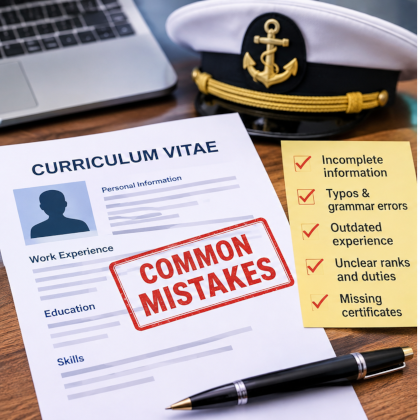
Typical mistakes in a seafarer’s CV.
In Christiania Shipping’s selection procedure, Main Engine Experience is listed as a separate assessment criterion. It refers to experience with main engines and is applied when screening candidates for engineering positions, including electro-technical officers. Therefore, an entry such as “Second Engineer – Bulk Carrier” without specifying the manufacturer and model of the main engine may not provide the recruiter with enough information to assess the candidate’s technical background.
How to fix it.
Add technical information to your Sea Service Record if it is relevant to your position:
- Main engine manufacturer and model;
- Main engine power;
- Fuel type, if relevant to the vacancy;
- Types of Auxiliary Engines;
- Experience with automation systems;
- Maintenance and repair experience;
- Specific equipment you have worked with directly.
There is no need to list every piece of equipment in the engine room. Highlight the systems and machinery that demonstrate your qualifications and match the requirements of a potential employer.
Example.
Before: Second Engineer – Bulk Carrier.
After: Second Engineer – Bulk Carrier. Experience with MAN B&W 6S50ME-C main engine, auxiliary generators and planned maintenance system.
The engine model is provided for illustrative purposes only. Your CV should contain the actual details of the vessel you worked on.
Certificates and Documents Are Unclear or Outdated
Having the required qualifications is one of the conditions for being eligible to work on board. However, even valid documents may raise additional questions if their names, expiry dates, or current status are not clearly stated in the CV.
For example, the entry “STCW certificates available” does not tell the recruiter exactly which certificates and courses the seafarer holds. Similarly, listing a CoC without specifying the rank and validity period may require the recruiter to request additional information.
OSM Thome job advertisements specifically list the Certificate of Competency (CoC), STCW documents, training courses, work experience, and medical certificate among the requirements for candidates. The exact requirements depend on the position and vessel type.
How to fix it.
Create a separate section called Certificates & Documents. Include:
- Certificate of Competency (CoC) and its level;
- Mandatory STCW certificates and documents;
- Additional training courses required for your position;
- Medical Certificate;
- Seafarer’s Identity Document and other documents, if required for employment.
For documents with limited validity periods, specify their expiry dates. If a document is being renewed, do not mark it as valid.
Before submitting your CV, compare your list of documents with the requirements of the specific vacancy and make sure you can provide them upon request.
Example.
Before: STCW certificates – available.
After:
Certificate of Competency: Second Engineer – valid until [date].
Basic Safety Training – valid until [date].
Advanced Fire Fighting – valid until [date].
Medical Certificate – valid until [date].
The names, dates, and list of certificates in this example should be replaced with the candidate’s actual information.
The Availability Date for the Next Contract Is Missing
Even if a seafarer fully meets the requirements of a vacancy, they may not be available to join at the required time. For example, an employer may be looking for a Second Engineer to join a vessel in two weeks, while the candidate will only be available in two months.
If availability is not specified, the recruiter will have to contact the seafarer to clarify this information. When urgent recruitment is required, the absence of such details may complicate the consideration of the application.
On its official General Application page, Columbia Shipmanagement explicitly asks candidates to provide their earliest availability date. A similar field, Date of readiness, is included in the application form of Christiania Shipping.
How to fix it.
Add a separate line near the top of your CV:
Availability: Available from [date].
If you are still completing your current contract, specify its expected completion date or your estimated availability to join a vessel. If the date may change, indicate this honestly.
It is also useful to update your availability after every contract or whenever your plans change.
Example.
Before: Availability: Not specified.
After: Availability: Available from 15 December 2026.
The date is provided for illustrative purposes. Only state a date when you will actually be ready to start working.
The CV Contains Too Much Irrelevant Information
A longer CV does not necessarily make a candidate more convincing. If the document contains lengthy descriptions of hobbies, personal qualities, general responsibilities, and information unrelated to maritime employment, important details may get lost.
A recruiter primarily needs to see the candidate’s rank, sea service, vessel types, qualifications, and certificates. If they have to go through several pages of secondary information to find these details, the CV becomes inconvenient to use.

This problem often occurs when candidates use a generic office CV template without adapting it to the maritime industry.
How to fix it.
Review every section and keep only the information that helps demonstrate your professional suitability.
The following details should be easy to find:
- Full name and contact details;
- Desired position;
- Brief professional profile;
- Sea Service Record;
- Certificates & Documents;
- Education and professional training;
- Availability.
You do not necessarily need to remove the Personal Information section or additional skills, but they should not take up more space than your professional experience.
Also, avoid generic descriptions such as “hard-working“, “responsible“, and “good team player” unless they are supported by specific professional achievements or relevant experience.
Example.
Instead of a long paragraph about personal qualities:
I am a hardworking, responsible and motivated person with good communication skills …
Use a short professional profile:
Second Engineer with 6 years of sea service on bulk carriers. Experience in engine room operations, planned maintenance and machinery troubleshooting.
The details in this example are illustrative. Your description should accurately reflect your actual sea service and duties.
The CV Contains Exaggerated or Inaccurate Experience and Qualifications
Some candidates try to make their CVs more attractive by exaggerating their sea service, listing unverified ranks, or adding experience with equipment they have never actually operated. This can create problems during the verification of documents and previous employment.
Example of a seafarer’s CV.
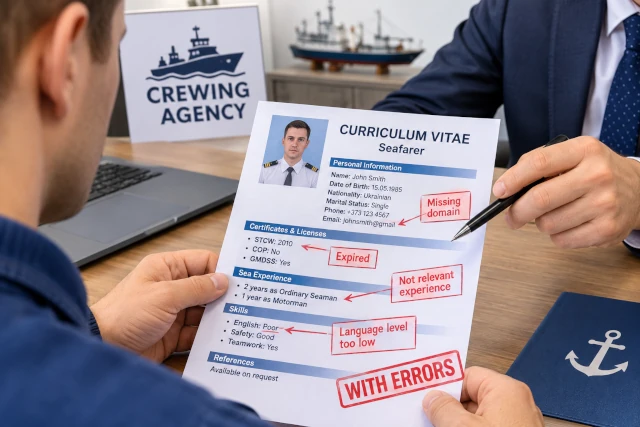
Example of a recruiter pointing out mistakes in a seafarer’s CV.
Danica Crewing Specialists warns about the growing number of so-called “polished applications” – CVs containing exaggerated or falsified sea service records and ranks. The company emphasizes that it continues to carefully screen candidates, conduct professional assessments, and verify submitted documents. Danica’s recruitment policy also states that the company may contact previous employers and carry out additional checks to confirm a seafarer’s qualifications and experience.
How to fix it.
Make sure all information in your CV matches your documents and actual work experience on board:
- Ranks and contract dates match your confirmed sea service;
- Vessel names and types are stated correctly;
- Duties correspond to the position held;
- Technical experience is not exaggerated;
- Certificates are not presented as valid if they have expired;
- Promotions are included only after they have actually taken place.
If you performed certain duties of a Chief Engineer or Chief Officer but officially held a different rank, do not change your rank in the CV. If necessary, describe the additional responsibilities separately.
Example.
Inaccurate version:
Chief Engineer – 2025, although the candidate actually worked as a Second Engineer.
Correct version:
Second Engineer – 2025. Assisted Chief Engineer with engine room operations, maintenance planning and machinery inspections.
The second version demonstrates additional experience without misrepresenting the candidate’s actual rank.
The CV Is Technically Difficult to Open and Use
Even a well-prepared CV can make a poor impression if the file cannot be opened, the text is difficult to read, or the information is arranged chaotically.
Marine officers – future captains approaching the final stage before going to sea.
Different employers may have their own requirements regarding application formats. For example, Christiania Shipping specifies PDF as the required format for CV uploads in its application form. Therefore, before submitting your CV, you should check not only its content but also the technical requirements of the application process.
How to fix it.
Before sending your CV, carry out a simple technical check:
- The CV opens without errors;
- The main text is readable at normal zoom;
- Tables and dates are correctly aligned;
- Contact details and email address are correct;
- Links, if included, work properly;
- The file is saved in a format accepted by the employer;
- The file name is clear and professional.
- There are no outdated dates, someone else’s personal details, or editor comments left in the document.
Save the final version as a PDF unless the employer requires another format.
Example.
Poor file name: CV_final_new_updated_2.pdf.
Better file name: Ivan_Petrov_Second_Engineer_CV_2026.pdf.
The file name and position should correspond to the actual candidate and their current CV.
Checklist: What to Check Before Resubmitting Your CV
After correcting the mistakes, do not rush to send your CV to every crewing agency. Check the document once again, taking into account the requirements of the vacancies you intend to apply for.
Use this short checklist:
- The CV contains up-to-date information about the latest contract.
- The desired position is stated at the beginning of the document.
- The Sea Service Record includes contract dates, vessel names, and vessel types.
- Relevant experience with cargoes and equipment is described in sufficient detail.
- Information about engines and technical systems matches your actual experience.
- CoC, STCW, and medical documents are listed with their current validity dates.
- The availability date for the next contract is specified.
- The document contains no unnecessary information that makes it difficult to assess your professional experience.
- All information can be verified through documents and references.
- The PDF opens correctly, is readable, and meets the employer’s requirements.
Remember that one universal CV may not be equally suitable for every vacancy. If you are applying for a position on a chemical tanker, in the gas carrier sector, or on a bulk carrier, highlight the experience that is relevant to the selected vessel type.
Even minor inaccuracies in a CV can make the initial assessment of a candidate more difficult. Therefore, before submitting another application, try looking at your document from a recruiter’s perspective:
- Is the desired position easy to find?
- Is the sea service clearly described?
- Are the documents up to date, and can the seafarer be contacted quickly?
If you have identified several of the problems listed above or are unsure whether your CV is properly prepared, send it to Sea-Man for review. We will examine your existing CV, point out which details should be added or corrected, and help you prepare the document for your next round of applications.
Not sure whether your CV is properly prepared? Send it to Sea-Man for review.

- Marine and Offshore Crew Recruitment – OSM Thome.
- Applicant Registration – OSM Thome.
- Expression of Interest | Marine & Technical Officers | Passenger Cruise Vessels – OSM Thome Job.
- Expression of Interest | India – OSM Thome Jobs.
- Beware polished applications – Danica Crewing Specialists, 20 марта 2024 года.


