* Some questions may have more than 1 correct answer.
Use the search below to find question.
Amount of questions: 356.
Right answers marked with this sign .
According to basic principles regarding fire protection the ship is to be divided in zones by structural and thermal boundaries. (SOLAS II-2/2.2.1)
In main vertical zones.
In main zones according to utilization (Accommodation, Machinery, Cargo).
In main horizontal zones.
In mixed zones for flexibility.
What device can be used by a tug to get a line aboard a disabled vessel in bad weather, when it is dangerous for the tug to get too close?
A rocket line.
A heaving line.
A grapnel.
An anchor buoy.
For the same engine revolutions, what happens to a vessel's water speed in shallow water compared to deep water?
Slower than deep water.
Don't know.
Faster than deep water.
Remains the same as deep water.
A vessel has a right-handed fixed pitch propeller, what should happen to its heading, if the propeller was put full astern?
The bow should swing to starboard.
The bow should swing to port.
The heading will remain unchanged.
The vessel will spin in place.
Abdominal Thrust is the name for a technique which involves applying a series of thrusts to the upper abdomen in an attempt to force air out of a choking casualty's lungs. How to perform this technique?
Stand behind the casualty. Clench your fist with the thumb inwards in the center of upper abdomen. Grasp your fist with your other hand and pull quickly inwards.
Remove the obstruction and restore normal breathing.
Wait for emergency services to arrive.
Encourage the casualty to cough vigorously.
It is important that a compress is done correctly. One of the alternative signs, after completed compress bandage, shows that the bandage may be too tight. Which one?
Swelling below the bandage and heavy pain.
Blue colour of the skin above the bandage.
Increased warmth around the bandage.
Numbness in the fingers or toes.
The ship is navigating in dense fog where the visibility is less than one mile. The Arpa radar is set on a range of 12 miles on a course of 314 degrees and own ship has a vector as shown. What is the vector mode selected on theArpa?
True vectors.
Don't know.
Relative vectors.
Manual vectors.
How can an ARPA best assist the bridge team to steer a suitable course to make good the entrance to a channel?
Alter course so that own-ship's ground stabilised true vector passes through the entrance to the channel.
Don't know.
Follow the predicted track of other vessels in the vicinity.
Steer a constant heading regardless of environmental conditions.
Inmarsat Telex Service code "33" can be used:
When technical problems are experienced with the Inmarsat-terminal.
To ask for radio medical advice.
To report an emergency situation.
To request weather updates.
When a satellite receives a “distress alert” from a Cospas-Sarsat EPIRB, the relay of the “distress alert” can be delayed because the satellite cannot immediately contact a:
LUT before the satellite is actually seen by this ground station.
LES before the satellite is actually seen by this ground station.
Ground control center.
Monitoring station.
The ship-shore HF-telephone-channel 2228 consists of the frequencies 22081.0 kHz and 22777.0 kHz. In case of manual operation, one should tune the receiver on:
22777.0 kHz.
Don't know.
22081.0 kHz.
22777.5 kHz.
Testing a SART is permitted:
At sea, outside territorial waters, and in port or harbour.
Only at sea, outside territorial waters.
Only in designated testing zones.
Never without prior authorization.
How long does it take for a fixed low expansion foam fire-extinguishing system of an engine room to discharge a 15 cm thick layer of foam on the largest single area over which oil fuel is liable to spread?
Less than 5 min.
You cannot find such a system in the engine room.
More than 10 min.
Between 5 and 10 min.
How much liferaft capacity should be provided on a conventional cargo ship of more than 85 meters in length?
100 % of the complement if it can be readily launched on either side of the ship. If it cannot be readily launched on either side, 100 % must be provided on each side.
50 % of the complement on each side of the ship.
75 % of the complement on one side.
25 % of the complement on each side.
At the pre-cargo conference, the terminal loading master has indicated that a booster pump will be used to assist the discharging of a cargo of Caustic Soda solution, as the receiving tank is several kilometres away. Upon starting the cargo discharge you notice that the back pressure drops sharply. This indicates that:
The booster pump has been started and engaged.
Don't know.
The discharge line is blocked.
There is a leak in the cargo system.
When a fire breaks out in the engine room, who is in charge of the fire fighting operations?
The Chief Engineer.
The first person to arrive at the scene.
The Master of the ship.
The senior deck officer on duty.
You are to load a cargo of Cyclohexanol to tanks 2, 3 and 4 centre and 2 and 4 wing tanks. The lines to these tanks are all connected at the manifold with flexible hoses and are all capable of being isolated with the exception of 2 centre, which has therefore been designated as the last tank to load. As you complete loading in the tanks, you would:
Close the appropriate manifold cross-over valves and tank loading valves as each tank finishes. Continue to monitor the cargo levels in the finished tanks to ensure that the valves are not passing.
Close only the corresponding manifold cross-over valves as the tanks finish, so that the pressure in the lines equalises with the pressures in the tanks. Re-check the ullages at the end of loading as they will have changed as the trim of the ship has changed.
Keep all valves open until all tanks are loaded.
Only monitor the ullages as the loading proceeds.
You have recently discharged a cargo of Methylene Chloride from tank 4 port. How will the atmosphere in the tank normally be tested for remaining (very low level) traces of vapour to ensure safe conditions before a tank entry certificate is issued?
By sampling through a gas detector tube.
Don't know.
By using an electronic atmosphere monitor.
By visual inspection of the tank's interior.
What can be a cause of error observed on a gyro compass reading?
Incorrectly set latitude and speed values.
Fluctuations in the magnetism around the compass.
Low battery voltage.
Poor weather conditions.
What is the direction of wind associated with an anticyclone (area of high pressure) in the Northern Hemisphere?
Clockwise around the high pressure.
Don't know.
Counterclockwise around the high pressure.
From east to west.
How can an approximate value of the initial transverse Metacentric Height (GM) be found from the Curve of Statical Stability (GZ curve)?
Drawing a tangent to the curve through the origin and erecting a perpendicular through the angle of heel of 57.3 degrees.
Don't know.
Measuring the area under the curve.
Using the maximum angle of heel from the curve.
What do you call the wide rung on a pilot ladder that prevents the ladder from twisting?
The wide rung on a pilot ladder that prevents it from twisting is called a "Spreader".
The wide rung on a pilot ladder that prevents it from twisting is called a "Wide step"
The wide rung on a pilot ladder that prevents it from twisting is called a "Long rung"
The wide rung on a pilot ladder that prevents it from twisting is called a "Ani-twist rung"
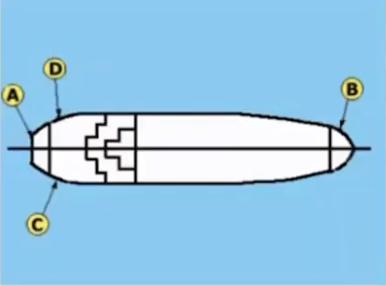
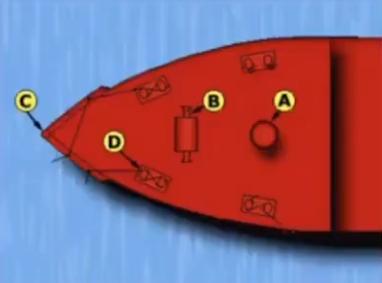
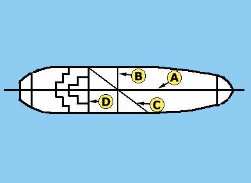
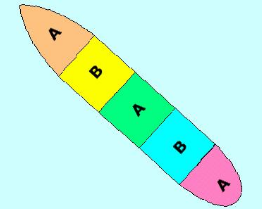
On the diagram, what is the area at the forward end of the vessel shown by the letter "A"? It is normally raised by one deck above the main deck.
Fo'csle or Forecastle.
Poop.
Crows nest.
Forward bridge.
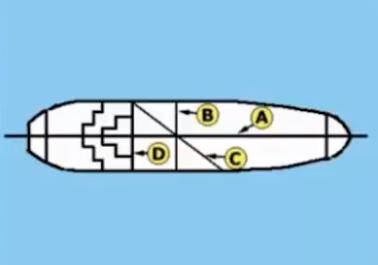
Where is the "PORT QUARTER", in the figure?
The Port quarter is D in the figure.
The Port quarter is A in the figure.
The Port quarter is B in the figure.
The Port quarter is A in the figure.
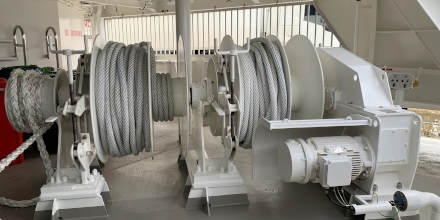
What is name of the machine shown, used to heave on the ropes during mooring and unmooring?
Winch.
Crane.
Windlass.
Capstan.
Which is the "CAPSTAN" in the figure?
The Capstan is indicated by A in the figure.
The Capstan is indicated by B in the figure.
The Capstan is indicated by C in the figure.
The Capstan is indicated by D in the figure.
In the diagram, which letter is indicating the position "MIDSHIPS"?
Midships is indicated by B in the figure.
Midships is indicated by D in the figure.
Midships is indicated by C in the figure.
Midships is indicated by A in the figure.
When keeping a lookout, what would be the correct understanding of the question "What is the aspect of the other ship"?
The question is requesting some indication of what lights or part of the vessel is seen.
The question is requesting where on the horizon the other ship was sighted.
The question wants to know what type of ship has been sighted.
The question is requesting some idea of how far away the other ship is from your own ship.
What is understood by the term "take the helm"?
Take over the steering of the ship.
Take over heaving of a rope.
Change the place where the lookout is standing.
Take a message to another officer.
Would there ever be the need for two lookouts on the Bridge watch?
Yes, possibly whne there is dense fog and heavy traffic.
Every night there should be two lookouts, one on each bridge wing.
Never necessary.
No, one lookout is sufficient even in fog.
The flow diagrams that appear in the Annex II Procedures and Arrangements Manual, which guide the user through the methods to be followed in cleaning a tank after containing a Noxious Liquid Substance are called:
Cleaning and Disposal Procedures.
Cleaning and Pumping Diagrams.
Tank Cleaning Flow Charts.
Waste Management Procedures.
Liquid nitrogen systems and cylinder storage are common on board methods of nitrogen supply for chemical tankers. Other systems that may also be found are:
Membrane or Pressure-Swing Adsorption generators.
Distillation Plant.
Refrigeration Systems.
Vaporization Units.
The special list of cargo loaded on board a ship that needs to be prepared for reporting and other administrative purposes, is referred to as:
Manifest.
Stowage Plan.
Cargo Declaration.
Bill of Lading.
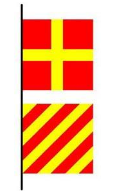
What does this two flag hoist mean, as mentioned in the International Regulations for Preventing Collisions at sea?
It is a distress signal.
Don't know.
It indicates a safe harbor.
It signals a man overboard situation.
You are approaching the port entrance. What do these lights mean?
A vessel may proceed only when it has received specific orders to do so.
A vessel may proceed only when it has received specific orders to do so, except that vessels which can safely navigate outside the main channel need not comply with this message.
Vessels are required to anchor and wait for further instructions.
The port is closed for all incoming traffic.
In ship's stability what is understood by the term "In stable equilibrium"?
Stable equilibrium exists when the vessel returns with G below M after an external heeling force is removed.
Stable equilibrium means the vessel is floating upright and has zero GM.
A vessel is in stable equilibrium when it is at rest in any position.
The vessel has a large GM which allows it to remain upright.
Once a ship (equipped with self-stowing auto-tension winches) is moored alongside a loading or discharging berth, how is it recommended that the winches are set?
All winches to be left with the manual brake on and out of gear.
The "spring" winches be left in the auto-tension mode and all other winches with the manual brake on.
All winches should be left engaged and ready for operation.
Only the mooring winches should be set with the manual brake off.
A vessel has a right-handed fixed pitch propeller, what should happen to its heading, if the propeller was put full astern?
The bow should swing to starboard.
The bow should swing to port.
The heading will remain unchanged.
The vessel will spin in place.
In a canal without water flow, if a vessel was approaching a bank at an angle, what would be the probable effect on it?
The vessel's bow is pushed away from the bank.
The vessel’s bow is attracted by the bank.
The vessel will remain parallel to the bank.
The vessel will rotate towards the bank.
What is the probable cause of an error in the position shown on a GPS receiver set into "2D" fixing?
Incorrect height of the antenna set into the receiver.
The limit set on the HDOP figure is too great.
The receiver is not calibrated.
There are too few satellites visible.
What is the correct understanding of the term "Bending moments" when applied to ships?
The longitudinal Bending Moment at any section within the ship is the total moments tending to alter the longitudinal shape of the ship.
All of the suggested answers.
Bending moments refer to the forces acting perpendicular to the length of the ship.
They are only relevant when the ship is in motion.
By “collect call” is meant:
A call for account of the receiver.
A call to collect the charges in office.
A request for a return call.
A call made while stationed at a central office.
With help of DSC a ship wants to contact a coast-station to have a question for a telephone call. One has to choose from the following DSC-frequencies:
TX: 8415.0 kHz RX: 8436.5 kHz.
TX: 8415.0 kHz RX: 8415.0 kHz.
TX: 8436.5 kHz RX: 8415.0 kHz.
TX: 8500.0 kHz RX: 8436.5 kHz.
Which class of emission is used for VHF DSC transmissions?
G2B.
J3E.
F1B.
A3E.
Distress MF communications should normally be operated:
In J3E mode – on simplex basis.
In J3E mode – on duplex basis.
In F1B mode – on simplex basis.
In A3E mode – on duplex basis.
Is it compulsory for a cargo ship to be divided into main vertical zones?
No, it is not.
Yes, it is.
It depends on the cargo type.
Only for passenger ships.
The thermal insulation provided to the wearer of an anti-exposure suit is sufficient to ensure that the wearer's body core temperature does not fall at a rate of more than:
1,5 °C per hour after the first 0,5 h immersion in calm water at a temperature of 5 °C.
1,5 °C per hour after the first 2,5 h immersion in calm water at a temperature of 5 °C.
2,0 °C per hour after the first 1 h immersion in calm water at a temperature of 5 °C.
1,0 °C per hour after the first 1 h immersion in calm water at a temperature of 5 °C.
Noise level called "the injurious area" starts at:
100 dB.
400 dB.
85 dB.
90 dB.
How much water would you allow per person as officer in charge of the lifeboat, following an abandon ship operation?
Nothing for the first 24 hours, then 1/2 litre per day (more in the tropics).
Nothing for the first 24 hours, then 1/4 litre per day (more in the tropics).
1 litre per day from the start.
1/2 litre per day from the start.
What is the minimum number of channels required for the portable two-way VHF's for survival craft?
Channels 6, 13 & 16.
Channels 16 & 12.
Channels 8, 9 & 16.
Channel 16 only.
You have just finished discharging several grades of chemicals. Why is it important that the Chief Officer has considered "solubility" when planning the tank-cleaning programme?
Because it will have indicated if the cargo residues can be cleaned with water alone, or if a chemical additive will be needed to help break them down.
Because it will have indicated if hydrocarbons will still be present on the tank bulkheads after initial cleaning and that a chemical additive may need to be circulated or sprayed afterwards to remove them.
Because it determines the type of pump that should be used for cleaning.
Because it affects the temperature at which cleaning should occur.
On modern chemical tankers, nitrogen is often used to achieve a super-dry atmosphere within a cargo tank prior to loading. Sometimes however, equipment delivering a special air supply is fitted and available for this same purpose. What does this equipment do?
It supplies de-humidified air.
It injects nitrogen into the air.
It increases the temperature of the air supplied.
It filters out all oxygen from the air.
What immediate action should be taken if a ship unexpectedly runs aground and stops?
Stop engine(s).
Sound the General Alarm.
Drop anchor immediately.
Notify the coast guard.
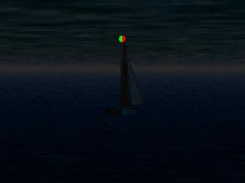
You are on a power-driven vessel underway in open water. You sight these lights on the port bow, on a steady bearing. The distance is closing. What are you looking at and what action will you take in compliance with the International Regulations for Preventing Collision at Sea?
This is a power-driven vessel engaged in towing, less than 50 metres in length, length of tow under 200 metres and the tow, both being restricted in their ability to manoeuvre, seen from the starboard side. Under rule 18, I am required to keep clear and will take appropriate avoiding action.
Don't know.
This is a fishing vessel; I will maintain my course and speed.
This is a sailing vessel; I will give way as required.
What is the colour and characteristic of a "towing light", as defined in the International Regulations for Preventing Collisions at Sea?
Yellow, fixed, seen over an arc of 135 degrees and so arranged as to display 67,5 degrees from right aft on each side of the vessel.
White, fixed, displayed as an additional light on the foremast over an arc of 225 degrees, from right ahead to 22,5 degrees abaft the beam on each side of the vessel.
Green, flaring, displayed only when under way.
Red, flashing, indicating a vessel at anchor.
The special list of cargo loaded on board a ship that needs to be prepared for reporting and other administrative purposes, is referred to as:
Manifest.
Stowage Plan.
Cargo Declaration.
Bill of Lading.
Which option gives the correct meaning of the letters GB and the number 5 in the chart cell identifier GB50344?
A chart made by the UKHO for harbour usage.
A British chart, number 5 in the series.
A general chart, number 5 for coastal navigation.
A global chart, number 5 in the international series.
Which option best describes how an operator establishes what an isolated danger symbol represents, when seen on the chart display of an ECDIS?
Interrogate it and ask for a pick or information report.
Check the chart symbols catalogue to ascertain the meaning.
Refer to the ECDIS manual for clarification.
Ask another operator for their interpretation.
What is the maximum allowed suction head for fire pumps? (SOLAS II-2/4.3.3.2.5)
3.0 meters.
6.0 meters.
4.5 meters.
7.5 meters.
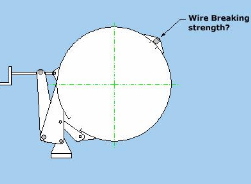
It is important that the brake holding capacity of a self-stowing winch drum should notexceed the breaking strength of the wire or rope wound onto it. A certain percentage ofextra strength is therefore recommended for the wire or rope over the brake holdingcapacity of the winch. So, for a winch of brake holding capacity of 60 tons you wouldorder a wire of breaking strength:
75 tons.
100 tons.
80 tons.
90 tons.
The positions of the ship provided by the GPS should always be confirmed by other means, when possible. Which of the following suggested methods would be the most accurate?
The bearing of three distinctive shore objects on the radar.
The range and bearing of a single distinctive shore object on the radar.
Visual bearings of two distinctive shore objects.
The ranges of three distinctive shore objects on the radar.
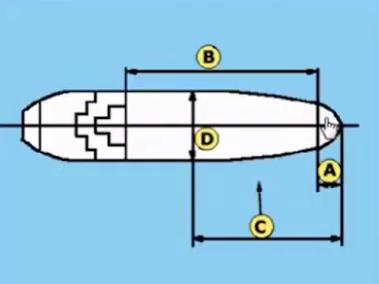
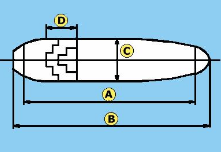
In the figure, which letter gives the correct understanding of the term \"LENGTH OVERALL\"
Length Overall is indicated by B, in the figure.
Length Overall is indicated by A, in the figure.
Length Overall is indicated by C, in the figure.
Length Overall is indicated by D, in the figure.
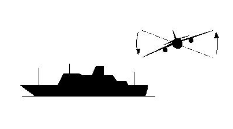
Signals are often used by aircraft engaged in search and rescue operations to direct ships towards a casualty. This aircraft flies across your stern, rocking his wings. What is the meaning of the signal?
Proceed immediately towards the casualty.
The assistance of your vessel is no longer required.
Maintain your present course and speed.
Alter course towards the aircraft and stand by for further instructions.
What can be used to reduce the effect of the state of sea-waves?
Mineral Oil.
Hydraulic Oil.
Vegetable / Fish Oil.
Diesel Oil.
The Urgency Message from a ship is used to notify other traffic of a situation where theship is not in imminent danger, but where the development of the situation is uncertainand may need assistance in the near future. What is the telephony urgency message like?
PAN-PAN.
MAYDAY.
SECURITÉ.
PAN-PAN MEDICO.
A ship is being overtaken by another ship while proceeding along a river. What should be the required procedure?
The overtaking vessel should request permission by sounding one prolonged blast followed by two short blasts on the whistle.
The overtaking vessel should sound two short blasts followed by two prolonged blasts on the whistle before commencing the overtaking manoeuvre.
The overtaking vessel should overtake without signalling, provided that the other vessel maintains its course and speed.
The overtaking vessel should request permission from the other ship by sounding two prolonged blasts followed by two short blasts on the whistle or by direct VHF contact.
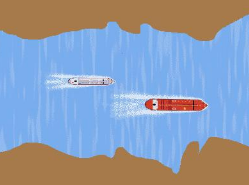
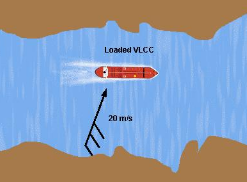
A partially loaded ship is steaming slowly ahead in shallow, confined waters as illustrated in the diagram. Which of the suggested answers are the most critical external influences experienced by the vessel?
The effects of wind and current only.
All of the suggested answers are critical.
The effects of shallow water and bank suction only.
The effects of propeller wash and rudder forces only.
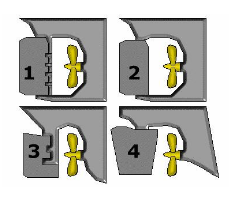
Which of the following answers correctly specify the following most common rudders? a) UNBALANCED, b) BALANCED, c) SEMI-BALANCED and d) UNDERHUNG BALANCED ... i.e. The number in the picture is related to the letter adjacent to the name of the rudder.related to the letter adjacent to the name of the rudder.
1 = b, 2 = a, 3 = d and 4 = c.
1 = c, 2 = d, 3 = a and 4 = b.
1 = d, 2 = c, 3 = b and 4 = a.
1 = a, 2 = b, 3 = c and 4 = d.
Small oil spills on deck can be kept from going overboard by doing what?
Opening the scuppers.
Washing the oil directly overboard with seawater.
Plugging the scuppers.
Increasing the deck drainage rate.
You are in a position as illustrated. What is the instantaneous oil discharge limit accordingto MARPOL?
30 L/nm.
15 L/nm.
20 L/nm.
50 L/nm.
A casualty suddenly loses consciousness and falls to the ground letting out a strange cry.The pasient is red-blue in the face and froth may appear around the mouth. You are witnessing a major epileptic attack. What should you do?
Restrain the casualty firmly and place an object in the mouth to prevent tongue biting.
Give the casualty water immediately and attempt to make them stand and walk.
Hold the casualty down during the seizure and place them on their back afterward.
Loose tight clothing, ask all unnecessary bystanders to leave and carefully place something soft under the head. If casualty is unconscious, place the person in Recovery position.
In order to maintain the condition of the steel surface, stainless steel tanks on chemicaltankers are periodically given an acid-based treatment. What name is given to this process?
Pickling.
Passivation.
Galvanizing.
Cathodic protection.
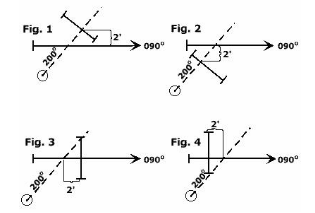
Which of the four figures illustrated shows the correct position line for the following situation: Latitude 50°00\'N, Longitude 30°00\'W, Time 1200 GMT. Course steered: 090° True, Speed: 12 knots, bearing of the sun: 200°, Intercept correction: 00°02\' Towards (observed altitude - computed altitude).
Figure 1 is correct.
Figure 2 is correct.
Figure 3 is correct.
Figure 4 is correct.
What is correct UTC in this example? Approx. Pos: N49°51\' W35°23\', zone +2, Local Time 0900.
08 00.
11 00.
10 00.
13 00.
What possible reason could there be for the identification mark associated with a Racon not being visible on the radar screen?
All of the suggested answers.
The Racon is transmitting on a different radar band.
The radar range scale is unsuitable for detecting the Racon response.
The Racon is temporarily switched off or malfunctioning.
Which is the fore and aft \"CENTRE LINE\", in the figure?
The Fore and aft Centreline is indicated by B, in the figure.
The Fore and aft Centreline is indicated by C, in the figure.
The Fore and aft Centreline is indicated by D, in the figure.
The Fore and aft Centreline is indicated by A, in the figure.
What is a contingency plan for ships?
Plan for routine maintenance operations.
Plan for cargo loading and discharge procedures.
Plan for safety preparedness.
Plan for normal navigation and watchkeeping duties.
An alarm signal consisting of seven short blast followed by one prolonged blast is sounded by the ship\'s whistle and alarm bells. What are you to do?
Go to your muster station for the fire drill.
Go to your lifeboat station.
Report immediately to the bridge for further instructions.
Proceed to the engine room and stand by for orders.
What is the correct lifting technique?
Legs bent, back straight, using leg muscles to lift.
Legs straight, back bent, using back muscles to lift.
Legs bent, back rounded, using back muscles to lift.
Legs straight, back straight, using arm muscles to lift.
A burn may occur when electricity of high current and voltage passes through the body.Most damage occurs at the points of entry and exit of electricity. What is the treatment ofelectrical burns?
Apply an adhesive dressing directly over the burn and press firmly.
Apply antiseptic cream and massage the affected area.
Cover the burn with a wet cloth and tightly wrap it with a bandage.
Place sterile dressing over the burn and secure with a bandage.
In making VHF communication or test transmission you must:
Transmit continuously for one minute before identifying your vessel.
Identify yourself only after receiving a reply from the other station.
Identify yourself with your call sign and/or ship\'s name.
Use the vessel\'s IMO number instead of the call sign or ship\'s name.
The prescribed test of an approved portable VHF radio set (portophone) must be done once a:
Week.
Three months.
Month.
Six months.
The word NAVTEX is spelled conform the International Phonetic Alphabet:
By the term “Stand by” the operator of a coast-station means that one should:
Continue transmitting until the coast station responds.
Change to the designated working frequency immediately.
Contact another coast station for further instructions.
Wait until the coast-station calls again.
When on HF band a DSC distress alert is received, you have to listen to:
The DSC calling frequency in the band in which the alert was received.
The radio telephony distress frequency on VHF Channel 16.
The radio telephony distress frequency in the band in which the DSC distress alert was received.
The DSC distress frequency on the MF band.
The first time you send a DSC distress alert via the HF-band, you prefer?
4 MHz band.
8 MHz band.
12 MHz band.
16 MHz band.
For a DSC-connection (no ‘distress alert’) with another vessel the following frequencies are used:
TX: 2189.5 kHz, RX: 2189.5 kHz.
TX: 2177.0 kHz, RX: 2187.5 kHz.
TX: 2177.0 kHz RX: 2177.0 kHz.
TX: 2187.5 kHz, RX: 2177.0 kHz.
At sea red rocket signals are seen. This is not reported by radio. You have to begin the distress alert procedure via VHF with the term:
PAN-PAN RELAY.
MAYDAY RELAY.
SECURITÉ RELAY.
MAYDAY.
On a MF/HF-transmitter-receiver there is a volume control. Another name for this is:
AF-gain.
RF-gain.
LF-gain.
HF-gain.
What mode must be used on the MF/HF transmission when making a radiotelephone call:
J3E.
H3E.
F1B.
A1A.
The position that is determined by built in GPS-receiver in an Inmarsat-EPIRB has anaccuracy of about:
50 meters.
500 meters.
200 meters.
1 kilometre.
Who is ultimately responsible for the voyage plan?
The Chief Officer.
The Master.
The Second Officer.
The Officer of the Watch.
Can an ECDIS be used for voyage planning?
Normally the ECDIS could be used, but only in conjunction with radar and GPS.
Normally the ECDIS could be used, but in conjunction with electronic charts from any source.
Normally the ECDIS could be used, but only for monitoring the voyage and not for planning.
Normally the ECDIS could be used, but in conjunction with paper charts.
Can the OOW be the sole lookout?
During daylight when visibility and traffic conditions are restricted.
During daylight when visibility and traffic allows.
During hours of darkness when visibility is good.
At any time when the vessel is in open waters.
What is the purpose of the «SQUELCH» on a VHF transmitter/receiver?
\"reduce the \"\"noise\"\"in the background\".
Increase the strength of the received signal.
Improve the clarity of transmitted speech.
Reduce interference from other VHF channels.
Which word will precede a distress message?
PAN-PAN.
MAYDAY.
SECURITÉ.
MAYDAY RELAY.
For how long time should a VHF survival craft transceiver be able to operate on its batteries?
4 hours.
6 hours.
12 hours.
8 hours.
For how long should the self-contained air support system on a totally enclosed lifeboathaving its engine running be capable of providing safe and breathable air?
5 minutes.
10 minutes.
15 minutes.
20 minutes.
Which of the following parameters does an explosimeter measure?
The percentage of the LEL in the ambient air.
The percentage of oxygen in the ambient air.
The concentration of toxic gases in the ambient air.
The percentage of the UEL in the ambient air.
Which of the following is a characteristic that is required for a \"class A\" bulkhead or deck?
It stops the spreading of smoke and flames during 30 minutes.
It prevents the passage of flames for two hours.
It stops the spreading of smoke and flames during one hour.
It limits the spread of heat and smoke for 90 minutes.
Which deck is the \"bulkhead deck\"?
The lowest deck to which transverse bulkheads are carried.
The uppermost continuous deck below the main deck.
The deck immediately above the machinery space.
The uppermost deck to which transverse bulkheads are carried.
Give the meaning of the following symbol.
Radar reflector.
Radar beacon.
Radar transponder.
Satellite transponder.
A hand flare must have a burning period of at least ...
30 seconds.
1 Min.
45 seconds.
2 minutes.
With an increase in temperature, the volume of a liquid chemical will do which of the following?
Expand.
Contract.
Remain constant.
Decrease in proportion to the temperature increase.
You are at the mainfold with the cargo surveyor, drawing samples at the start-up of cargo.A sample of 2-Ethyl Hexanol is off colour. The surveyor instructs you to open the manifold valve and start loading. What will you do?
Open the manifold and commence loading as instructed by the surveyor.
Keep the manifold closed and report the situation directly to the Master.
Keep the manifoild closed, report the situation to the Chief Officer.
Start loading at a reduced rate while monitoring the cargo sample.
At the pre-cargo conference, the terminal loading master has indicated that a boosterpump will be used to assist the discharging of a cargo of Caustic Soda solution, as the receiving tank is several kilometres away. You start the discharge, but after a few minutes, you observe the back pressure drops sharply. What is this an indication of?
The booster pump being stopped or disengaged.
The booster pump being started and engaged.
The receiving tank being full and the discharge line being isolated.
The cargo pump losing suction due to a low tank level.
Under ISM, what is a \"non-conformity\"?
An observed situation where a specified requirement has been fully complied with.
An observed situation where objective evidence indicates a potential future failure to meet a requirement.
An observed situation where the vessel’s normal procedures are followed without any deviation.
An observed situation where objective evidence indicates the non-fulfilment of a specified requirement.
What is the main theme of modern safety practice?
Making use of routine inspections as the primary means of improving safety.
Making use of safety drills as the main means of preventing accidents.
Making use of Risk Assessment as a means to improving safety.
Making use of incident reporting as the sole means of improving safety.
What is the approximate content of oxygen in air?
18 %.
21 %.
23 %.
25 %.
When making a new pilot ladder onboard the ship, which of the following ropes would be best suited as the side ropes on which the steps are fastened?
Uncovered sisal rope.
Covered manila rope.
Uncovered polypropylene rope.
Uncovered manila rope.
The ship is involved in a collision, what is the immediate action by the Officer of theWatch after the incident has taken place?
Sound the General Alarm and maintain normal engine speed.
Inform the Master and continue the voyage at reduced speed.
Sound the General Alarm and stop engines.
Stop engines and commence damage assessment without sounding the General Alarm.
Which Security Levels requires the highest security alert?
Security Level 3.
Security Level 1.
Security Level 2.
Security Level 4.
Which of these weapons are widely available and commonly used by criminals and terrorists to further their aims?
Stun gun.
Gun.
Hunting bow.
Crossbow.
Chemical tankers commonly use \"closed gauging systems\". What is the particular safety design feature of such equipment?
It allows the contents of a tank to be measured only after the tank has been fully ventilated.
It requires the operator to open a small inspection hatch before taking each measurement.
It allows tank measurements to be taken only when cargo operations have been stopped.
It allows the contents of a tank to be measured without any lids being opened, so protecting the operator from the possible release of any harmful vapours.
What is the purpose of the special two-way valves mounted on towers at a given height above the cargo deck of a chemical tanker?
When appropriately set, they automatically prevent excessive pressure in a cargo tank by venting vapours through the cargo lines and relieve excessive vacuum.
When appropriately set, they automatically maintain a constant pressure in a cargo tank by recirculating vapours into the tank and relieve excessive vacuum.
When appropriately set, they automatically prevent excessive pressure in a cargo tank (carrying harmful vapours away at a safe height) and relieve excessive vacuum.
When appropriately set, they automatically prevent excessive pressure in a cargo tank by venting vapours into the atmosphere at deck level and relieve excessive vacuum.
The following chemical cargoes are all \"carcinogens\": Acrylonitrile, Aniline, Benzene, Chloroform, Epichlorohydrin and Toluene. What is a \"carcinogen\"?
A substance capable of causing acute poisoning.
A substance capable of inducing cancer.
A substance capable of causing genetic mutations.
A substance capable of causing severe skin irritation.
Special \"additives\" are sometimes blended with, or added to, chemical cargoes to prevent Polymerization, decomposition or oxidation while they are in the ship\'s tank on a long voyage. What general term is given to these additives?
Inhibitors.
Catalysts.
Stabilizers.
Neutralizers.
Many chemical tankers are fitted with deep well centrifugal cargo pumps. What is theprocess by which any leakage of cargo or hydraulic oil into the pump cofferdam is detected?
Ventilation.
Drainage.
Purging.
Pressure testing.
Where can the size of the Magnetic Compass Error be found?
Catalysts, which accelerate the chemical reaction taking place in the cargo.
By taking a transit bearing of two fixed geographical positions and comparing it with the bearing of the same points on the chart.
Stabilizers, which maintain the chemical properties of the cargo during transportation.
Preservatives, which prevent the cargo from becoming contaminated or deteriorating.
The compass binnacle on the ship has various specific functions, which of the followinganswers reflect its most important functions?
To provide support for the compass and allow adjustment of the compass heading.
To protect the compass from external influences and provide a stable mounting arrangement.
All of the answers provided.
To house the compass equipment and provide access for maintenance and correction of compass errors.
In the Beaufort Scale of Wind Force, what is the Beaufort number associated with the wind force known as a \"Gale\"? This should not be confused with a \"Near Gale\" or \"Strong Gale\".
Eight (8).
Seven (7).
Nine (9).
Ten (10).
What is the correct understanding of the term \"Isobar\"?
An \"Isobar\" is a line joining places of equal temperature.
An \"Isobar\" is a line joining places of equal pressure.
An \"Isobar\" is a line joining places of equal humidity.
An \"Isobar\" is a line joining places of equal wind speed.
When using the echo sounder in a river the soundings indicated may be incorrect, what would be the most probable cause of the error?
The temperature of the water.
The salinity of the water.
The pressure of the water.
The density of the water.
A ship moving through heavy seas is affected by the water pressure at the bows causing an effect known as \"Panting\". What structure in the forward region of the ship combats the effects of \"Panting\"?
Transverse frames and brackets.
Panting beams and stringers.
Forepeak bulkheads and side girders.
Deck beams and longitudinal stiffeners.
What are the four categories to which noxious liquid substances carried in bulk areassigned under MARPOL Annex II?
\"X\",\"Y\" and \"Z\", plus \"OS\" (other substances).
“A”, “B” and “C”, plus “D” (miscellaneous substances).
“X”, “Y” and “Z”, plus “N” (non-hazardous substances).
“X”, “Y” and “Z”, plus “N” (non-hazardous substances).
When loading chemical cargoes in the United States, temperatures are often supplied indegrees Fahrenheit. What does 60 degrees Fahrenheit equate to on the Celsius scale?
12.8 degrees C.
16.7 degrees C.
15.6 degrees C.
18.3 degrees C.
The pumping and piping arrangement for a chemical tanker constructed after 1st January2007 and carrying substances of categories \"X\", \"Y\" or \"Z\" must ensure that the maximum quantity of residues retained in a cargo tank and its associated piping must not exceed which of the following amounts?
50 litres.
75 litres.
100 litres.
150 litres.
Who must sign (and countersign) entries in a Cargo Record Book which documents cargo and cleaning operations on a chemical tanker?
Each completed operation shall be signed and dated by the master, while each page is countersigned by the officer in charge.
Each completed operation shall be signed and dated by the officer in charge and, if applicable, by the surveyor, while each page is countersigned by the master.
Each completed operation shall be signed and dated by the surveyor, while each page is countersigned by the chief officer.
Each completed operation shall be signed for and dated by the officer or officers in charge and, if applicable, by a surveyor appointed by the competent authority of the State in which the ship is unloading. Each completed page shall be countersigned by the master of the ship.
In what way can dehumidified air be made more efficient for the drying of cargo tanks on a chemical tanker?
By cooling it.
By increasing its pressure.
By heating it.
By reducing its circulation rate.
How are chemical tanker cargo tanks classified under the IBC Code?
A vessel such as a parcel chemical tanker, with a high inbuilt level of subdivision will typically not have a problem with which particular feature of stability which will need to be accounted for on other tankers that have large, unrestricted tanks?
Free Surface Effect.
Longitudinal stability.
Wind heeling effect.
Trim by the stern.
What are we seeing here?
A power-driven vessel less than 20 metres> in length, displaying the standard navigation lights, seen head-on.
A sailing vessel less than 20 metres> in length, displaying the optional combined lantern in lieu of standard sailing lights, seen head-on.
A sailing vessel less than 20 metres> in length, displaying standard sailing lights, seen from the port bow.
A sailing vessel less than 20 metres> in length, displaying the optional combined lantern, seen from the stern.
What is the name given to the risk assessment program developed by OCIMF, under which tankers are inspected, and the results made available to potential charterers through a database of records?
The Ship Inspection Report Programme (SIRE).
The Tanker Management and Self Assessment (TMSA) programme.
The Chemical Distribution Institute (CDI) Inspection Programme.
The Vessel Inspection Questionnaire (VIQ) programme.
What kinds of checks must be carried out on slings, wires and other items of lifting equipment before they are used in routine operations?
They must be visually inspected and tested under load to confirm their working condition before use.
They must be checked for correct certification and inspected only after any lifting operation is completed.
They must be examined for visible damage and replaced immediately regardless of their condition or suitability for the task.
They must be visually inspected and ascertained, so far as is possible, as being in good working order and fit for purpose.
You are proceeding up a river, with berths on both banks. You see this flag hoist on a vessel moored on a berth ahead. What does it mean?
You should proceed at moderate speed when passing me.
You should stop your vessel before passing me.
You should proceed at slow speed when passing me.
You should keep as far away from me as practicable when passing.
What would be the correct form of response to the question: What kind of assistance do you require?
My vessel has a fire in the engine room and we require medical assistance.
My vessel has a fire in the accommodation and we require fire-fighting assistance.
My vessel has a machinery failure and we require navigational assistance.
My vessel has a medical emergency on board and we require fire-fighting assistance.
Crude oil is carried in a ...
Chemical tanker.
Container ships.
Gas tankers.
VLCC.
NLS (Chemicals) are carried in ...
ULCC.
VLCC.
Chemical Tankers.
Bitumen Tankers.
A Crude oil Tanker carries ...
Petrol.
Crude oil.
Aviation Fuel.
Kerosene.
A Chemical tankers carries ...
Sulphuric Acid.
Iron ore.
Steel coils.
Palm oil.
A Product Tanker carries ...
Benzene.
Diesel Oil.
Ammonia.
LPG.
Double hull Tankers are Constructed as per ...
SOLAS regulations.
MLC.
STCW convention.
MARPOL rules and Regulations.
In an Oil and Chemical Tanker Hazardous Area contains ...
Aft peak tank.
Cargo Tanks.
Engine room.
Galley.
In an Oil and Chemical Tanker-Pump room contains ...
Cargo Pumps.
Ballast water.
Cargo hose Crane.
Inert gas Plant.
Ships carrying Chemicals in bulk are classed into ...
Four TYPES.
One type.
Two Types.
Three types.
Design of Chemical Tankers should be ...
Single hull.
Double hull.
Only Double Bottom.
Only Double side.
Pipelines for Segregated Ballast system passes through ...
Both Cargo Tanks and Ballast Tanks.
Accommodation spaces.
Ballast tanks only.
Engine room.
Cargo Drop valves are used to fill up the ...
Cargo tanks.
Ballast Tanks.
Double bottom Tanks.
Pump room.
UTI tapes is used to manually measure ...
Ullage.
Interface of Cargo and water.
Temperature.
All three answers.
A chemical tanker intended to transport of the IBC Code products with sufficiently severe environmental and safety hazards which require a moderate degree of containment to increase survival capability in a damaged condition is a ...
Type-1 Ship.
Type-2 Ship.
Type-3 Ship.
Type-4 Ship.
Purpose of Deck Seal is to prevent cargo vapours entering into ...
Cargo Control Room.
Engine room.
Bridge.
All three answers.
Cargo tanks of a chemical tanker intended to transport of the IBC Code products with very severe environmental and safety hazards are coated with specialized Coatings of ...
Phenolic epoxy paint.
Zinc paint.
Enamel paint.
All three answers.
Inert Gas pipeline is used for ...
Venting of Ballast Tanks.
Venting of Cargo Tanks.
Venting of Aft peak tank.
Pump room.
Submersible Cargo pumps are located in ...
Pump room.
Inside Forepeak tank.
Inside Cargo Tanks.
Inside Ballast Tank.
A chemical tanker intended to transport of the IBC Code products with appreciably severe environmental and safety hazards which require significant preventive measures to preclude an escape of such cargo is a ...
Type-3 Ship.
Type-2 Ship.
Type-4 Ship.
Type-1 Ship.
For a Ship Type-2 Chemical Tanker the capacity of each cargo tank should not be more than ...
1 200 cubic metre.
Not Regulated.
1 250 cubic meter.
3 000 cubic meter.
One positive Charge and Another positive charge (Similar Charges) ...
Repel Each other.
Attract each other.
Neutral to each other.
None.
Crude oil is a mixture of hydrocarbons which under normal atmospheric conditions are ...
Solid.
Liquid.
Gaseous.
All three answers.
The lowest temperature at which the liquid will give off sufficient vapour to form a flammable gas mixture with air, near the surface of the liquid is called as the ...
Toxicity of the Liquid.
Reactivity.
Flash point of the Liquid.
Corrosivity of liquid.
One Negative Charge and Another positive charge (Oppositely Charges) ...
Repel Each other.
Attract each other.
Neutral to each other.
None.
There is a need for taking cargo samples for the ...
Chemical analysis.
Physical analysis.
Cargo Quality.
All three answers.
Physical and Chemical properties of cargoes are given in ...
MSDS /ICS Cargo Data sheet.
BWMP.
COW Manual.
Cargo Loading Manual.
\"Pour Point” Temperature is used to decide ...
COW.
Cargo heating.
Deballsting.
Stripping of Cargo tanks.
Static Electricity hazards involves ...
Positive charge.
Negative charge.
Discharge/Release of Energy.
All three answers.
A cargo is called a high volatile cargo when the Flash point of cargo is ...
Above 60 deg C.
Above 70 deg C.
Below 60 deg C.
Above 80 deg C.
In chemicals a BASE is a substance that can accept a ________________ from another substance.
Hydrogen ion (H+).
Oxygen ion.
Carbon ion.
None.
At Atmospheric pressure Heavier Hydrocarbon molecules (More number of Carbon atoms) will have a ...
Low Melting temperature.
Low boiling Temp.
High Boiling Temp.
High Melting temp.
Hydrocarbon Molecules with Carbon atoms ranging from C5 to C22 are ...
Solids.
Plasma.
Liquids.
Gases.
A crude oil is called SOUR Crude oil when Sulphur content in the Cargo is ...
Less than 0,5 %.
Less than 0,2 %.
Less than 0,3 %.
More than 0, 5%.
Acids has got a PH value of ...
More than 7,0.
Below 7,0.
More than 8,0.
None.
Hydro carbon Molecules contain ...
Hydrogen & Carbon atom.
Oxygen and Carbon atom.
Hydrogen & Oxygen atom.
None.
An alkali is any substance that produces OH- ions in water with PH Value of ...
Less than 6.
More than 7.
Less than 7.
None.
Non accumulator oils are those oils with an Electrical Conductivity ...
More than 50 pS/m.
Less than 50 pS/m.
More than 120 pS/M.
None.
An Inhibitor is a substance that added in cargo to keep it ....
Stable.
To prevent the onset of Reaction.
To Increase Boiling Temp.
To increase the rate of the reaction and promote cargo decomposition.
Which gas is used for making the tank atmosphere inert on chemical tankers?
Flue Gas.
Nitrogen Gas.
Oxygen.
Helium gas.
Category \"X\" Chemicals are a ___________ HAZARD to Human health and Marine Environment.
Minor.
No Hazard.
Major.
All three answers.
SMS stands for ...
Ship Management System.
Safety Management System.
Society Management System.
None.
OCIMF stands for ...
The Oil Companies International Marine Forum.
Indian Oil companies Marine Forum.
Oil & Chemical companies Marine forum.
None.
SIRE stands for ...
Safety Inspection Report Exchange.
Ship Inspection Report Exchange.
Ship Internal audit Report Exchange.
None.
TMSA stands for ...
Tanker Management & Self Audit.
Tanker Monitoring & Self Audit.
Tanker Management & Self-Assessment.
Tanker Movement & Self-Assessment.
ISM Code stands for ...
Indian Ships Management code.
International Ship Monitoring code.
International Society Management code.
International Safety Management code.
By definition, Safety culture is the __________, ___________ s, _________ and values that employees share in relation to safety in the workplace.
Attitude.
Beliefs.
Perception.
All three answers.
The ISM code is the standard for establishing a SYSTEM for the ....
Safe Operation of the Vessel.
Safe Management of the vessel.
Environmental Protection.
All three answers.
Safety Management System(SMS) is a documented system for the company and their vessels describing the operation and improvement process through ...
Procedure-When to do what.
Instructions-What and how to do it.
Authority-Who regulates & Delegates works.
Responsibility-Who is to do it.
All four.
Advantage of using the SMS ...
High Performance.
Safe operation.
Effective Maintenance.
All three answers.
Main Ship board Safety Manual should describe Functions and procedures for ships ....
Operation.
Maintenance.
Administration.
All three answers.
\"Tanker Cargo Operation Manual” is required as per ...
MLC.
MARPOL.
SOLAS (ISM Code).
STCW.
Familiarization Training on board Oil or Chemical Tanker includes ...
Saturday BBQ party.
Equipments for Cargo operations.
SOPEP/SMPEP equipments.
LSA and FFA.
The BTOCTCO course is required as per the ...
ISM (SOLAS).
MLC.
STCW.
All three answers.
If there is any violation of MARPOL regulations or when safety is compromised to whom to report in the sequence ...
Duty Officer /Engineer.
Head of the Department.
Head of the Ship (Master).
DPA of the Company.
All four answers.
Before joining a ship which is the SMS manuals the ships staff should read ...
Main Ship board Safety Manual.
Cargo Handling Manual.
Emergency Manual.
Environmental Manual.
All four answers.
How many elements are there for Self-assessment in the TMSA?
10.
12.
8.
6.
4.
CDI (Inspection for Chemical Tankers) stands for ...
Corporate Dancing Institute.
Cargo Distribution Institute.
Chemical Distribution Institute.
Cargo Distribution Institute.
International Distribution of Chemicals.
When you are doing a Cargo operation duty or a Maintenance job which are all the elementsyou have to consider ...
Quality.
Safety.
Pollution Prevention.
Environmental Protection.
All four answers.
In case of Accidents and Incidents the ship staff should co-operate for ...
Investigation.
Experience Feedback.
Report to Shore based Office.
Circulate the Circulars.
All four answers.
Which are the publications to Refer for Reduction of Accidents and Incidents on board Tankers?
ISM code.
SOLAS/MARPOL.
COSWP for merchant seaman.
Tanker publications kept in Ships Library.
All four answers.
Hazards associated with Tanker Operations are ...
Reactivity hazards.
Health hazards.
Electrostatic hazards.
Environmental hazards.
All four answers.
Skin contact with liquid petroleum causes ____________ and __________because of the removal of essential natural skin oils.
Dermatitis.
Irritation.
Fever.
Diarrhoea.
Persons have varying susceptibility to oxygen deficiency but that all will suffer if the oxygen content drops below ____________% by volume.
14 %.
18 %.
16 %.
21 %.
In Oil, Chemical and Gas Tankers The \"Flammability Diagram\" is used for ...
Tank Preparation for Cargo Loading & Discharging.
Gas freeing operation.
Purging to reduce O2 concentration.
Purging to reduce Hydrocarbon content.
All four answers.
Inhalation of petroleum vapor will produce_______, the main symptoms being headache/eye irritation and dizziness, with very high concentrations leading to paralysis, insensibility and very possibly death.
Narcosis.
Body Pain.
Influenza.
Colour Blindness.
The reasons of oxygen deficiency in an enclosed space could be:
Chemical reactions and Combustion.
Rusting & Drying Paint.
An inert atmosphere.
Displaced oxygen due to presence of cargo vapour.
All four answers.
The main hazard associated with inert gas is its low ________content, and that it may alsocontain______ gases.
Oxygen Content.
Toxic gases.
Ammonia gases.
Hydrocarbon Gases.
The action to be taken in an Emergency (Oil or Chemical contacts) is indicated in the ___________, in the form of “If this happens do this”.
ISM manual.
Cargo Data Sheets.
Ship\'s Contingency plan.
Chemical Tanker Manual.
Environmental Hazards includes ...
Physical Hazards.
Cultural Hazards.
Biological Hazards.
Chemical Hazards.
All four answers.
Which are the following properties the Hydrogen Sulphide gas has?
Very low odour threshold and its smells like a rotten egg.
Very toxic, corrosive and flammable gas.
It dulls the sense of smell.
It is colourless and heavier than air.
All four answers.
If oxygen content is less than __________% an atmosphere may be extremely dangerous unless it is known which gas has replaced the oxygen.
8 %.
16 %.
21 %.
20 %.
Which Toxic Gasses are present in Inert gas?
CO.
SO2.
NO2.
NO.
All four answers.
Chemical reactivity hazards can be manifest through:
Materials which become chemically unstable for a variety of reasons.
Intended chemical reactions that get out of control for a variety of reasons.
Unintended chemical reactions that take place due to accidental mixing of chemicals that are normally separate.
All three answers.
There are four different types of Hazard control for cargo tank spaces, what are they?
Inerting.
Padding.
Drying.
Ventilation.
All four answers.
In chemical Tankers which chart is used to show chemical combinations believed to be dangerously reactive in the case of accidental mixing.
Compatibility Chart.
Cargo Data sheet chart.
MSDS Chart.
None.
In the Flammability Diagram “TOO RICH Atmosphere“ has ...
More Oxygen molecules Than Hydrocarbon.
More Hydrocarbon molecules than Oxygen.
Equal amount of Hydrocarbon and Oxygen.
None.
\"Pollution\" is defined as an inconvenience or damage, caused by human activities, to ______and__________, __________, _______and to our environment as a whole, by spreading of Hydrocarbons and chemical compounds to Air, Water or land.
Animals.
Humans.
Plants.
Atmosphere (Air).
All four answers.
The Stages of potential static Electricity hazards are ...
Charge separation /Generation.
Accumulation of Charge and Potential.
Electrostatic discharge (Spark discharge).
All three answers.
What are the Signs of Vapour Leaks and Clouds?
A pool of liquid on deck and Persistent bubbling.
A dense white cloud.
Fog on the deck.
An unusual noise / hissing sound.
All four answers.
In the Flammability Diagram “TOO LEAN Atmosphere\" has ...
More Hydrocarbon molecules than Oxygen.
Equal amount of Hydro carbon and Oxygen.
More Oxygen molecules Than Hydrocarbon.
None.
Corrosion Hazards - Corrosive materials include acids, alkalis (bases or caustics) and halogens.
Acids.
Alkalis (bases or caustics).
Halogens.
All three answers.
Which are all the ways Chemical cargo may react:
With itself (self-reaction).
With Air and water.
With another cargo.
With Other Materials.
All four answers.
On Tankers the sources of ignition are:
Direct heat.
Mechanical sparks.
Chemical energy.
Electrical energy & Electrostatic discharge.
All four answers.
On board Tankers Safety measuring instruments (Gas Detectors) may be of ...
Personal type.
Portable type.
Fixed types.
All three answers.
“Enclosed spaces” means a space which has:
Limited openings for entry and exit.
Inadequate ventilation.
Is not designed for continuous worker occupancy.
All three answers.
Personal Protective Equipments (PPE) on board Tankers for Enclosed space entry should be available for ...
Foot.
Hand.
Eye, Ear, Nose and Face.
Body.
All four answers.
As per SOLAS regulations which gas detecting sensors should be available on board?
Flammable Gases (Hydrocarbon).
H2S.
Oxygen.
Carbon Monoxide.
All four answers.
Which space has permanent arrangements for hoisting an injured person with a rescue line?
Fore peak tank.
Pump-rooms.
Aft peak tank.
DB tanks.
Combustible Gas Indicator (CGI) / Explosimeter cannot be used in ...
Inerted Atmosphere.
Too rich Atmosphere.
Space containing 100 % hydrocarbon by Volume.
All three answers.
On chemical tankers, there must be respiratory and eye protection equipment for every person on board, for purposes of emergency escape. What are the Respiratory (Breathing) equipments available on board?
EEBD/ELSA.
SCBA/CABA.
Oxygen Resuscitator.
All three answers.
A cargo tank is called gas free only when ...
NIL - Toxic gases.
H2Sppm - NIL.
21 % Oxygen.
Hydrocarbon - NIL.
All four answers.
Electrical Safety Precautions on board Tankers include ...
Ground the phase conductors or circuit parts before touching them where the possibility of induced voltages or stored electrical energy exists.
Visually verify, where possible, that the appropriated circuit disconnecting device is indeed open.
Ensure the workers use certified high voltage gloves and Helmets.
Ensure insulation mats are provided at all the switch board and junction boxes.
All four answers.
Warnings for use of Resuscitator are ...
Keep away from smoke, open flames, oil and grease.
Lung rupture may occur.
Don\'t use the Resuscitator in a toxic or hazardous atmosphere.
Never override the Pressure Relief Valve unless medical and professional assessment indicates the necessity.
All four answers.
Tank scope is used to measure the % volume of Hydrocarbon in ...
Cargo with Inerted Atmosphe.
Too rich Atmosphere.
LEL/LFL more than 10 %.
Space containing 100 % hydrocarbon by Volume.
All four answers.
Rescue Equipment from Pump room bottom includes ...
Lifeline.
Harness.
Breathing Apparatus.
Single sheave swivel blocks.
All four answers.
Chemical absorption tubes (Dragger Tubes) are used to measure ...
Toxic gasses in Cargo Tanks.
Oxygen content in Fuel tanks.
Hydrocarbon content.
LEL/LFL in Ballast tanks.
Before Entering Pump room what are the checks to be made ...
Ventilation /Light on.
Atmosphere checked.
Communication equipment in place.
Check list /Work permit/Entry permit signed.
All four answers.
Multi gas detectors are used to measure a combination of gases of ...
CO.
H2S.
H/C and % LEL.
O2 %.
All four answers.
What are the publications and documents to be used for hot work on board Tankers?
ISGOTT.
Company SMS manual.
ISM checklists.
Education and Qualification of the person involved in hot work.
All four answers.
Personal Protective Clothing includes ...
Woolen bonnet/Chemical Suit/Cover all.
Gloves and Boots.
Helmets.
Goggles, Ear Muffs, Nose Mask, Face Mask.
All four answers.
The_____________ concerns the ship, the terminal and all personnel and is to be completed jointly by the responsible officer and the terminal representative while vessel is at the berth for cargo operation.
Enclosed space Check list.
Ship/shore safety checklist.
Arrival Check list.
COW check list.
The____________ sheets must be placed at various spaces frequented by the ship’s staff to enable them to familiarize themselves with the cargo properties.
Cargo Stowage plan.
BWMP.
MSDS.
Cargo Loading plan.
The firefighting procedures are given in ship’s ...
Cargo Loading Plan.
Emergency and Contingency plan.
GA Plan.
SOPEP/SMPEP.
The____________ must inform the Cargo Officer and / or the Master in any event of a fire emergency situation at the earliest opportunity during Cargo operation.
Loading master.
The Cargo Surveyor.
The Stevedores.
Duty Officer.
The fire fighting agents on board tankers are ...
Foam.
CO2.
Water.
Dry chemical powder.
All four answers.
The fire hazards associated with NLS (Chemicals) ...
Some cargoes give out oxygen when on fire, thereby supporting the fire.
Some chemical fires, the source of ignition may be heat from a reaction within the cargo itself or through mixing with other chemicals.
Some chemicals are miscible in water and hence their presence may not be recognized.
Some chemicals evolve large volumes of toxic vapours when heated. Some chemicals have a low auto ignition temperature. There is a risk of re-ignition of these chemicals.
All four answers.
Water is the most common cooling agent. This is largely because water possesses very good heat absorbing qualities and is available in ample quantities at terminals and on ships.
Heat radiating.
Heat absorbing.
Heat distributing.
Heat spreading.
Foam is an aggregation of small bubbles, of _______________ than oil or water, which flows across the surface of a burning liquid and forms a coherent smothering blanket. It will also reduce the surface temperature of the liquid by the absorption of some heat.
Higher Specific gravity.
Zero specific gravity.
Lower specific gravity.
Very heavie.
Carbon dioxide is an excellent smothering agent for extinguishing fires, when used in conditions whereIt will not be widely diffused. Carbon dioxide is therefore effective in _______________such as machinery spaces, pump rooms and electrical switch rooms where it can penetrate into places that cannot be reached by other means.
Ballast Tank Areas.
Cargo Tank Ares.
Open Deck Areas.
Enclosed areas.
Dry chemical powder is discharged from an extinguisher as a free flowing cloud. It is most effective in dealing with a fire resulting from an oil spill on a jetty or on the deck of a chemical tanker and can also be used in confined spaces. It is especially useful on________________ escaping from leaking pipelines and joints.
Burning liquids.
Water.
Large Solid fire.
Large Oil fire.
Medium expansion foam is used for Applicator foam. It has an expansion ratio fromabout________________ it is made from the same concentrates as high expansion foam, but its aeration does not require a fan.
5:1 upto 12:1.
160:1 upto 200:1.
15:1 up to 150:1.
300:1 upto 550:1.
DCP fire fighting systems of a chemical Tanker - Consists of ...
Piping Arrangement.
Hand hose lines.
A manifold at the Powder container.
Fire-extinguishing unit with two or more monitors.
All four answers.
Spill containment in relation to fire-fighting operations: The actions to be taken in case of anoil/chemical spillage and pool fire are ...
Prompt initiation of the ESD.
Restrict sources of ignition to ignite the vapour.
Foam gently spread over the pool fire.
Jets of water should never be directed onto burning liquid.
All four answers.
The use of portable foam fire extinguishers: - A fire extinguisher, flame extinguisher, or simply an extinguisher, is an active fire protection device used to _________________ small fires, often in emergency situations. It is not intended for use on an out-of-control fire.
Spread and re -Ignite.
Stop and start.
Extinguish or Control.
None.
Fire Detection and Protection System consists of ...
Flame / smoke detectors.
Inert gas system.
Heat Detectors.
Gas detectors.
All four answers.
High expansion foam are used for Firefighting purpose. What is the expansion ratio of the Foam?
None.
Below 200:1.
Above 100:1 up to 150:1.
Above 200:1.
On board OIL / Chemical Tankers fire prevention is done by ...
Stopping cargo operations during lightning & thunderstorms.
Use of Approved electrical equipments.
Use of Spark arrestors / flame screens.
Keeping tanks under positive pressure and inerted.
All four answers.
The expansion Ratio of Foam means : The Ratio of ______ of Foam formed to the Volume of solution used to generate the Foam ...
Area.
Heigh.
Dept.
Volume.
Chemical foam is formed by mixing together a solution of ...
An alkali (usually sodium bicarbonate).
An acid (usually aluminum sulfate).
Water.
Stabilizer.
All four answers.
AR-AFFF a term used in Fire Fighting system. What it stands for ...
Alcohol Reused - Aqua Film Farming Foam.
Alcohol Resistant-Aqueous Film Forming Foam.
Aqueous Resistance-Alcohol filling Forming Foam.
None.
Heat Exchangers for Cargo Heating are located ...
Inside Ballast tanks.
Inside Cargo Tanks.
On Cargo Deck space.
Inside Slop Tanks.
Reasons for tank cleaning:
Change in Cargo.
Man entry for Inspection /Repair work.
Preparation for Shipyard.
Charterer / Terminal Requirements.
All four answers.
Operations in Tanker includes ...
Load on Top.
Slop Discharge.
Purging & Gas freeing.
All three answers.
Cargo Heating coils (Steam Heating) are placed ...
Inside cargo Tanks at the bottom.
Inside Ballast Tanks.
In Pump room.
In DB tanks.
Depending upon the tanker design for a particular intended cargo carriage, which are the following parameters need to be accounted for:
Loading /Discharging Rate.
Pumping Capacity.
Piping Arrangement.
Venting Capabilities.
All four answers.
Prior to the Cargo Query / Loading operation which document should be supplied by Terminal/Displayed on board?
Cargo stowage plan.
MSDS/Cargo Data sheet.
Fire Control plan.
BWMP.
The phases of Tank cleaning procedures in Chemical tankers includes ...
Prewash & Main wash.
Freshwater wash/Rinse.
Gas freeing and Drying.
Inspection and Testing.
All four answers.
Precautions during COW:
Pump room Entry Checklist.
Hydrocarbon 100 %.
Cargo officer not in CCR.
De-bottom of cargo tank.
The two methods for testing steam heating coils on board Tankers are:
Steam Testing.
Hydraulic Testing.
Gas testing.
Weight testing.
During cargo operation While on Deck watch, the watch keeper should keep an eye on ...
Manifold Pressure.
Status of cargo Valves (Open, close, Throttled).
Status of Vent valves.
Cargo Loading /Discharging Rate.
All four answers.
During COW bottom wash, the Machines are to be programmed for an angle of ...
0-45-0 deg.
90-135-90 deg.
45-90-45 deg.
None.
Ullages of cargo tanks are taken by ...
Opening ullage port.
Opening Tank dome.
Closed ullaging using UTI tapes.
By sounding rod.
Dilution (Mixing) and Displacement (Layering) are two methods of ...
Changing Ballast.
Changing Tank Atmosphere.
Changing Cargo.
None.
Cargo Samples are to be collected at ...
One foot of cargo tank immediately after Cargo loading.
Running sample at Manifold.
Cargo tanks after completion of Loading.
All three answers.
For protection of Cargo Tanks from damage during Loading and Discharging operation Venting system is fitted on board. What are all this venting system?
Mast Riser.
P/V valve.
Inert gas.
P/V Breaker.
All four answers.
Cargo Loading Arm from the Terminal is connected to the Tanker at ...
BOW - Windlass.
Midship - Manifold.
Stern - ETA.
None.
What type of heating system is available on tankers?
Steam Heating - Bottom Heating coils.
Steam Heating - Heat Exchangers on Deck.
Thermal Heating.
All three answers.
Tank washings (Oily water Mixtures) are to be transfer to the ...
Slop /Residue Tank.
Ballast Tank.
Pump room Bilge.
Fore peak tank.
When ballasting is in progress Visual inspection of Overboard discharge to be carried out to avoid ...
Any Fish from Ballast tank is thrown out.
Accidental release of Oil to sea.
Leakage of Inert gas.
None.
There is a possibility of movement of Cargo loading arm at the Manifold due to ...
Change in Tide.
Change in Free board.
Slack in Mooring ropes.
Due to Bad weather (Very Strong wind & Heavy swell).
All four answers.
The Ship’s Master must ensure that the__________ is authorized to stop cargo in the event of an emergency or if in the opinion of the Duty Officer such stoppage is necessary to prevent an emergency situation.
Head of the Department.
Deck watch keepers.
Duty Officer.
Duty Engineer.
Emergencies on tanker means, it is ...
An unexpected occurrence.
Requires Immediate Action.
To avoid.
Any Possible loss of Life, Damage to Ship, Cargo and Environment.
All four answers.
Emergency Shut Down Devices (ESD) for Cargo Pumps are fitted at ...
CCR.
Manifold (Both sides).
Entrance of Pumproom.
Pump room Bottom platform.
All four answers.
All equipment which may be needed in an emergency must be maintained in good order andalways be ready for use, and the list of important items are:
Fire-fighting equipment & Breathing apparatus.
Protective clothing.
Communication systems & Alarm System.
Arrangement plans.
All four answers.
An emergency organization should be set up which will come into operation in the event of an emergency. The purpose of this organization will be in each situation to:
Raise the alarm and muster at designated station.
Locate and assess the incident and possible dangers.
Organize manpower and safety equipment.
All three answers.
The elements of Emergency Organization are ...
First Aid Team.
Technical Team.
Back up team.
Emergency Team and Command Team.
All four answers.
Cargo Tank High Level Alarms (HLA) are installed at ___________ % volume of Cargo Tanks.
98 %.
100 %.
99 %.
95 %.
Planning and Preparation are essential for dealing successfully with emergencies, theInformation which should be readily available for the above purpose:
Type of cargo and its disposition.
Location of other hazardous substances.
GA Plan of the ship.
Stability Information and Location of LSA /FFA.
All four answers.
Preliminary Action during EMERGENCY - The person who discovers the emergency must _________and pass on information about the situation to the officer on duty who, in turn, must alert the emergency organization. While this is being done, those on the scene should attempt immediate measures to control the emergency until the emergency organization takes effect.
Go for Rest hour.
Raise the alarm (Reporting).
Call next watchman.
None.
In addition to Emergency Alarm signals, other alarm signals are also given in case of:
High concentration of toxic or flammable vapour.
Unacceptable condition in cargo tanks or cargo system.
A CO2 discharge in engine-room or pump-rooms.
A high level of oxygen in inert gas.
All four answers.
First-aid treatment should be carried out using the ______________ Publication.
Tanker Manual.
MFAG.
INTERCO.
LSA Manual.
High Level Alarms (HLA) for Cargo Tanks are fitted at ___________ % volume of Cargo Tanks.
98 %.
100 %.
95 %.
99 %.
Personnel in the vicinity of the emergency should take ______________to try and control the incident until the emergency team can take over.
Suggestions from Other staff.
Appropriate action.
Out Equipments & Throw.
No action.
In order to handle the Emergency All crew members should know the location of all safety equipment, such as ...
Breathing apparatus.
First-aid kits.
Tank evacuation equipment.
LSA/FFA with Instructions to use.
All four answers.
All personnel on board should know their place in the emergency organization and their duty in case an emergency procedure is being initiated. This list is called ...
Crew List.
Duty List.
Muster list.
Visitor list.
As per SOLAS (ISM) regulation, for which emergencies Drills should be carried out onboard and Each and Every Ship\'s staff should participate In the Emergency drills.
Abandon ship.
Fire.
Oil Pollution.
Security.
All four answers.
SHIPBOARD MARINE POLLUTION EMERGENCY PLAN (SMPEP) for Chemical Tankers is required as per ...
Regulation 4 Chapter III of SOLAS 74/88.
Regulation 10 chapter V of STCW 78/95/2010.
Regulation 16 of Annex II of MARPOL 73/78.
None.
In case of Pollution Emergency what a ships staff should do ...
Report to the Next Level of HR & Stop all operation.
Proceed to Muster station.
Do duties as per Muster list /Assigned.
Cleanup operation, Record keeping and Review.
All four answers.
SOPEP as required by MARPOL stands for _______________________________ and used on board Oil Tanker.
Ship Operator Pollution Emergency Plan.
Ship board Oil Pollution Emergency Plan.
Shore Oil Pollution Emergency Plan.
None.
The correct emergency procedures for accidents involving Dangerous chemicals are givenIn the __________________.
ICS or other Cargo Data Sheets.
MSDS.
IMDG code.
Cargo Loading Manual.
The Oil/ Chemical pollution procedures are given in ship’s ________________________.
Cargo Loading Plan.
GA Plan.
SOPEP/SMPEP.
LSA & FFA plan.
In the case of oil or NLS spill, the first living receptors who may come in contact with the spill are the____________, including the various fish species.
Humans.
Marine life.
Birds.
Domestic Animals.
The _______________is the international body responsible for controlling marine pollution.
WHO.
Flag states.
IMO.
ILO.
To protect the Marine Environment IMO has adopted _________________ convention.
MARPOL 73/78.
SOLAS 74/88.
STCW 78/95/2010.
MLC 2006.
There are _________ Annexes in MARPOL convention.
III.
II.
V.
VI.
Annex ___________ of the MARPOL convention contains regulations for control of pollution by noxious liquid cargoes carried in bulk or tank washings from such cargoes.
II.
I.
VI.
III.
In order to comply with the requirements for Protection of Marine life, __________ procedures must be observed during ballasting, decanting and tank cleaning operations.
Slop Discharging.
COW.
Cargo Heating.
Load on Top (LOT).
Most crude carriers must: _____________their cargo tanks to minimize oily wastes.
Mix their Cargo.
Tank wash.
Discharge.
Crude oil wash.
Sea Chest valves not in use during Cargo operation or Always should be___________ by double valves or blanked off.
Open.
Throttled.
Closed.
5 % OPEN.
Regulation 16 of Annex II of MARPOL 73/78 requires every ship of 150gt and above that is certified to carry Noxious Liquid Substances in bulk to carry on board a ___________________ For Noxious Liquid Substances not later than 1st January 2003.
SMPEP.
Damage Stability Manual.
SOPEP.
COW Manual.
For Chemical Tankers: For the purpose of discharging slops containing cargo residues into the sea, Annex II divides NLS on chemical tankers into__________ pollution based categories.
Three.
One.
Two.
Four.
Pollution-prevention procedures during the operations include keeping a watch on alarms and instrumentation with the following:
Levels in cargo, slop or ballast tanks.
Cargo or Ballast hoses or hard arms.
Spill pans and scuppers.
Pumps, valves, gaskets, connections and hatches.
All four answers.
The SOPEP/SMPEP equipments consist as per___________ manual.
Tanker operational.
SOPEP/SMPEP.
Ship Design & Construction.
Cargo Operation.
NLS categories are _____________and a cargo of category X represents the most pollutant and a cargo of category Z the least pollutant.
1, 2, 3 and 4.
X, Y, Z and OS.
A, B, C and D.
I, II, III, & IV.
The list of Authorities or Persons to be contacted in an event of an oil / NLS pollution incident is listed in the _______________ manual.
SOPEP/SMPEP manual.
Cargo operation Manual.
P & A.
SMS Manual.
Shipboard Oil Pollution Emergency Plan (SOPEP) approved by the Administration is to be carried on every oil tanker of 150 grt and above and every ship other than an oil tanker of 400 grt and above as required by ...
Regulation 10 of Chapter II of SOLAS.
Regulation 3 of section V of STCW.
Part a of MLC.
Regulation 26 of Annex I of MARPOL.
As per MARPOL Annex II - Regulations for the Control of Pollution by NLS in Bulk, Chapter 5 - Operational discharges of residues of noxious liquid substances : Every ship certified to carry substances of category X, Y or Z shall have on board a______________ Manual approved by the Administration. The Manual shall have a standard format in compliance with appendix 4 to this Annex. In the case of a ship engaged in international voyages on which the language used is not English, French or Spanish, the text shall include a translation into one of these languages.
Cargo Loading.
COW.
Procedure & Arrangement (P & A).
Operation.
The main purpose of the P & A Manual is to identify for the ship’s officers the _____________and all the operational procedures with respect to cargo handling, tank cleaning, slops handling and cargo tank ballasting and ballasting which must be followed in order to comply with the requirements of this Annex.
Physical arrangements.
Design.
Construction.
Painting.
The procedures and point of contact on the ship for coordinating shipboard action with National and Local authority is in case of Oil /Chemical pollution incidents is shown in ______________manual.
SMS Manual.
P & A Manual.
SOPEP/SMPEP Manual.
Cargo Operation.
Pollutants in the Marine Industry includes ...
Oil & Chemicals.
Garbage and Paint.
Sewage & Dangerous cargo.
Ballast water, Smoke.
All four answers.
Tanker - Torrey Canyon: The world’s first major oil tanker disaster: Torrey Canyon marked anumber of firsts: It was a first-generation cape size supertanker of 297 meters l.o.a., the largest vessel ever to be wrecked, the biggest oil spill in history until that time, UK\'s worst environmental accident ever and first major tanker disaster to attract such an enormous media coverage, drawing universal attention to the dangers of dispersants. Accident details: At a glance Type of accident: Grounding Vessel(s) involved: Torrey Canyon (oil tanker) Date: 18 March 1967 Place: off England Fatalities: None Pollution: Major Torrey Canyon is considered the accident that led IMO to adopt ________, the landmark convention on pollution prevention from ships and the second pillar of shipping\'s regulatory framework. A major area of focus in this case was the oil spill response.
MLC.
STCW.
SOLAS.
MARPOL.
Adequacy of procedures controlling tank cleaning and enclosed space entry on board STOLT SKUA. As the airborne concentration of Benzene during stages of the tank cleaning process could be expected to exceed 1 ppm, but were not expected to reach 50 ppm, crew were routinely issued with filter masks for protection when performing cargo operations on deck when carrying cargoes containing benzene. Amongst other requirements ...
Procedures required that a tag be permanently attached to the entrance to each tank.
Any ships staff can enter to the Tank at any time.
Procedures required that NO tag REQUIRED to be permanently attached to the entrance to each tank.
None.
Tanker - The Amoco Cadiz tanker ran aground due to a steering gear failure on March 16, 1978, three miles from the coast of Brittany, France. It split in three before sinking, creating the largest oil spill of its kind in history to that date – 1.6 million barrels. Public outcry and political pressure resulted in significant updates to both MARPOL and SOLAS, and the addition of safety and pollution audits that led to in 1982 to the Paris Memorandum of Understanding (Paris MoU), which established Port State Control. The beauty of port state control is that it has enabled an international port inspection system that makes it impossible for non-compliant ships to hide. It also led to the International Convention on the_______ in 1978.
SOLAS 74/88.
STCW 1978.
MARPOL 73/78.
MLC.
NON TANKER Ship - The capsizing of the M. V. Herald of Free Enterprise in 1987 minutes after leaving the harbor in Zeebrugge, Belgium. Incredibly, the bow door was left open, resulted in the loss of 193 out of the 539 passengers and crew. It also led to the adoption of the Guidelines on Management for the Safe Operation of Ships and for Pollution Prevention, or the ______________________Code, which was designed to prevent damage to life and the environment at sea, by requiring each vessel to have a working, audited, Safety Management System (SMS). It also required shipping companies to have a license to operate.
LSA Code.
FFA Code.
STCW Code.
International Safety Management (ISM) code.
TANKER - The Exxon Valdez ecological disaster of 1989, which led to the first Port state establishment of policy with international repercussions - the ________________________in the US, which mandated that all tankers entering US waters be double hulled - a requirement that eventually became the rule internationally, especially following several oil spills in European waters. OPA greatly increased federal oversight of maritime oil transportation, toughened liability and provided greater environmental safeguards. It also put the spotlight on drug abuse in the merchant marine and led to related programs and reforms.
ISM Code.
PORT state Control.
Oil Pollution Act (OPA) of 1990 in the US.
None.
The most famous disaster of all, the Titanic, with 1,517 dead, struck the first blow for real international cooperation on safety regulations, codified as the International Convention for the _____________________and adopted in 1914. The primary safety book from which most other policies and regulations sprang, SOLAS is updated on a regular basis and is considered the safety bible for the maritime industries.
MARPOL.
Safety of Life at Sea (SOLAS).
Life Saving Appliances Code.
FFA Code.
The 1934 sinking of the Morro Castle off the New Jersey coast, which left 126 dead, also left quite a safety legacy in its wake. The ship, which went up in flames, not only led to new fire suppression, protection and control regulations and equipment requirements, it served as the impetus for both the US Merchant Marine Act of 1936, which created the Maritime Commission, and the adoption of a significant______________ in 1948. It also led to federally mandated officer training requirements and eventually, to the establishment of the federal maritime academy at Kings Point, NY.
Upgrade to SOLAS.
Upgrade to STCW.
Upgrade to Marpol.
None.
Tanker - Prestige (2002) and Erika (1999): Both casualties and spills happened in almost the same spot off the northwest coast of France and Spain, and both became a huge political issue, leading to_________, the European equivalent of OPA 90 “It was the final nail in the coffin,” says Simon Bennett, Director External Relations for the International Chamber of Shipping (ICS), an international trade association for the shipping industry representing shipowners and operators. Those incidents “led to a massive acceleration of the schedule to faze out_________ tankers.”
EMSA.
Eur - PSC.
Eur-OPA.
single-hulled.
The US Coast Guard considers the EXXON Valdez to be one of the largest human-caused disasters and cites as contributing causes to the accident, ineffective___, poor____ watch keeping, inoperable radar, reduced_____, and lack of shore side_____ and loss of situation_____, among other things.
Lookout.
Navigational.
Manning.
Supervision.
All four answers.
The US responded with the Oil Pollution Act (OPA) 90, essentially the first time a Port State had acted on its own to create and enforce rule that would affect global shipping. OPA created a comprehensive program to address prevention, response, liability and compensation for oil pollution incidents within US waters. It set requirements for construction, crew licensing and manning, created the national Oil Spill Liability Trust Fund (up to $1B per spill incident), mandated contingency planning and the development of disaster response plans from tankers, ties driving records with mariner licenses and mandated post-casualty drug and alcohol tests. It also decreed that all tankers entering US water after a certain date be_______________.
Double Hulled.
Single Hulled.
Double Sided.
Double Bottomed.
Incident Summary. At 0845 on September 16, 1990, the tanker vessel - MT ABC‖ caught fire and exploded during offloading operations at the Total Oil Company refinery on the Xxx River near Bay City, Michigan. A wake from a passing bulk carrier apparently caused the parting of the MT ABC‘s transfer hose, grounding cable, and all but one of its mooring lines. Residual gasoline in the broken transfer hose was believed to have been ignited by a spark on the dock. The MT ABC‘s stern swung around into the Xxx River and grounded perpendicular to the direction of the river flow. The grounding resulted in a crack in the vessel‘s hull from the manifold on the starboard side to 75 feet aft of the manifold on the port side. What is/are main cause of fire and explosion on board MT ABC?
Wake from a passing bulk carrier.
Parting of the MT ABC‘s transfer hose.
Residual gasoline in the broken transfer hose ignited by a spark on the dock.
All three answers.
Threshold Limit Value (TLV). The time-weighted average concentration of a substance to which nearly all workers may be repeatedly exposed, for a normal ______ workday or 40-hour work week, day after day, without adverse effect.
14 HRS.
8 HRS.
10 HRS.
24 HRS.
Upper Flammable Limit (UFL). The concentration of a hydrocarbon gas in air above, which there is ______ air to support and propagate combustion. Also referred to as upper explosive limit (UEL).
Sufficient air.
Sufficient Water vapour.
Insufficient air.
Insufficient water.
Pressure / Vacuum Relief Valve (P/V Valve) - A device, which provides for the flow of the small volumes of vapour, air or inert gas mixtures, caused by______________ in a cargo tank.
Ullage variations.
Sounding variations.
Thermal variations.
None.
Lower Flammable Limit (LFL). The concentration of a_____ gas in air below, which there is insufficient hydrocarbon to support and propagate combustion. Also referred to as lower explosive limit (LEL).
Oxygen.
Carbon monoxide.
H2S gas.
Hydrocarbon.
Inert Gas - A gas or a mixture of gases, such as flue gas, containing insufficient__________ to support the combustion of hydrocarbons.
Hydrocarbon.
Oxygen.
Water particle.
Nitrogen oxide.
Purging. The introduction of inert gas into a tank already in the inert condition with the object of:
Further reducing the existing oxygen content.
Reducing the existing hydrocarbon gas content to a level below which combustion cannot be supported if air is subsequently introduced into the tank.
Further reducing Ullage of the tank.
None.
Cold Work. Work which cannot create a source of ___________.
Temperature.
Ignition.
Pressure.
Toxic gasses.
Topping Off. The operation of completing the loading of a tank to a required___________.
Ullage.
Sounding.
Temperature.
Interface.
Flashpoint. The lowest_____________ at which a liquid gives off sufficient gas to form a flammable gas mixture near the surface of the liquid. It is measured in the laboratory in standard apparatus using a prescribed procedure.
Volume.
Pressure.
Gasses.
Temperature.
Inert Gas System (IGS). An inert gas plant and inert gas distribution system together with means for preventing_____ of cargo gases to the machinery spaces, fixed and portable measuring instrument and control devices.
Forward flow.
Downward movement.
Back flow.
Upward Movement.
Flammable Range - (also referred to as \"Explosive range\"). The range of _______gas concentrations in air between the lower and upper flammable (explosive) limits. Mixtures within this range are capable of being ignited and of burning.
Hydrocarbon gas.
Oxygen gas.
Inert gas.
H2S gas.
Entry Permit. A document issued by a__ permitting entry to a space or compartment during a specific time interval.
Company person.
Ships staff.
Responsible person.
Duty officer/Engineer.
Antistatic Additive. A substance added to a petroleum product to raise its electrical conductivity above________ Pico Siemens / meter (PS / m) to prevent accumulation of static electricity.
40 ps/m.
110 ps/m.
100 ps/m.
50 ps/m.
Flame Arrester. A permeable matrix of metal, ceramic or other __________materials, which can cool a deflagration, flame and any following combustion products below the temperature required for the ignition of the unreacted flammable gas on the other side of the arrester.
Heat-resisting.
Heat radiating.
Heat conducting.
None.
Bonding. The connection together of metal parts to ensure _________continuity.
Thermal.
Heat.
Electrical.
Plasma.
Earthing (also referred to as \"Grounding\"). The____________ connection of equipment to the main body of the earth to ensure that it is at earth potential. On board ship the connection is made to the main metallic structure of the ship which is at earth potential because of the conductivity of the sea.
Electrical.
Thermal.
Mechanical.
None.
Flame Screen. A portable or fitted device incorporating one or more corrosion resistant wire woven fabrics of very small mesh used for _____________ from entering a tank or vent opening or, for a short time, preventing the passage of flame. (Not to be confused with flame arrester.)
Preventing Heat.
Preventing Liquid.
Preventing Sparks.
Preventing Gasses.
Gas-Free. A tank, compartment or container is gas-free when _________________ has been introduced into it to lower the level of any flammable, toxic, or inert gas to that required for a specific purpose, e. g. hot work, entry, etc.
Sufficient Liquid Cargo.
Sufficient Fresh Air.
Insufficient Fresh Air.
Sufficient Inert gas.
Hazardous Area. An area on board Tankers /Shores which for the purpose of the installation and use of electrical equipment is regarded as________________. Such hazardous areas are graded into hazardous zones depending upon the probability of the presence of a flammable gas mixture.
Safe.
Not causing Harm.
Not a danger.
Dangerous.
Volatile Petroleum. Petroleum having a flash point below ________________ (140 degree F) as determined by the closed-cup method of testing.
60 degrees C.
50 degrees C.
4O degrees C.
None.
Category \"Z\" Chemicals are a ___________ HAZARD to Human health and Marine Environment.
No Hazard.
Minor.
Major.
None.
Accumulator Oils are ...
Jet Fuel.
Kerosene.
Residual Black Oil.
None.
The purpose of Vetting Inspection (SIRE) is to focus on the importance of meeting satisfactory Tanker ___, ___ and __ standards.
Quality.
Safety.
Maintenance.
All three answers.
Category \"OS\" Chemicals are Substances considered as ___________ Harm to Human health and Marine Environment.
Minor.
No Hazard.
Major.
None.
Tanker management and self assessment (TMSA) is a tool to help vessel operator‘s to_____, _____ and ________ their management systems. This provides a standard framework to assess a ship operator‘s ______.
Assess.
Measure.
Improve.
Management System.
All four answers.
Asphyxiation means: - The state or process of being deprived of__________, which can result in unconsciousness or death; suffocation.
Carbon Dioxide.
Oxygen.
Water.
None.
The tanks of Chemical Tankers may be constructed or coated with various different types of materials and it is important to check with the ________ manual and the Paint Manufacturers Coating Resistance list prior to commencing Tank Cleaning Operations in order to ascertain the tank coating materials and any limitations in regard to temperature, use of cleaning chemicals etc. which may be applicable to the vessel.
P&A Manual.
Cargo Loading Manual.
Paint Manual.
None.
True Vapour Pressure (TVP). The true vapour pressure of a liquid is the absolute________ exerted by the gas produced by evaporation from a liquid when gas and liquid are in equilibrium at the prevailing temperature and the gas / liquid is effectively zero.
Temperature.
Pressure.
Volume.
None.
Pressure Surge. A sudden increase in the____________ of the liquid in a pipeline, brought about by an abrupt change in flow velocity.
Volume.
Temperature.
Pressure.
None.
Welcome to the website where you can pass online the CES test on the subject «Deck, Operational, Chemical Tanker». Practice like this will help you as a marine specialist improve your knowledge with the help of online studying and appraisal practice. CES based on practical information and marine specialists experience.
CES tests developed for evaluating seaman basic knowledge by Seagull Company (rebranded as «OTG»), is an evaluating online-tool, used for revealing any professional preparation needed in specific fields of knowledge, defined by STCW.
Version: 6.0.17.
Test type: STCW.
Department: Deck.
Level: Operational.
Vessel: Chemical tanker.
CES tests have proven themselves as good tools for the selection and recruitment process, as well as advancing the level of knowledge of the current officers and crew. Ocean Technologies Group use various subjects for question creation, which includes:
Crowd and Crisis Management;
Integrated Navigation System (INS);
Ballast water management;
Handling and Stowage;
Vessel operation management and safety;
Marine engineering;
Maintenance and repair, etc.
Current test contains Seagull CES questions on the subject «Deck, Operational, Chemical Tanker». Those questions can be used for competence verification specialist capable of preventing accidental situations related with transporting safety, or also for self-examination.
«Deck, Operational, Chemical Tanker» subject includes theoretical and practical information about advanced training for work on any type of vessel. The test evaluates both knowledge and skills required for working with marine engines on various types of vessels.
On this site Crew Evaluation System Test on the subject «Deck, Operational, Chemical Tanker» contains 58 questions you need to answer with no possibility to go back to previous question. Therefore, we recommend carefully reading each question and making decision with no hurry. In case you have some difficulty answering, you have also possibility to request a hint.