CES – Survival Craft Assistance Techniques Answers (Deck, Operational)
Join Our Telegram (Seaman Community)
* Some questions may have more than 1 correct answer.
Use the search below to find question.
Amount of questions: 447.
Right answers marked with this sign .
The purpose of deep tanks on general cargo ships is:
To increase ship speed by improving hull hydrodynamics.
To carry a range of specialized liquid cargo.
To store ballast water only for stability during storms.
To provide additional accommodation space for crew.
You are the OOW in charge of loading operations on general cargo vessel. It suddenly starts to rain. You should:
Continue cargo operations but reduce loading rate.
Cover cargo with tarpaulins and keep operations going.
Cease all cargo operations and resume only after the rain has stopped.
Move cargo operations to the opposite side of the vessel.
A burn may occur when electricity of high current and voltage passes through the body. Most damage occurs at the points of entry and exit of electricity. What is treatment of electrical burns?
Apply ice directly to the burn to cool the tissue immediately.
Rub ointment or oil into the burn area to prevent drying.
Place sterile dressing over the burn and secure with a bandage.
Break any blisters and clean the wound with alcohol.
The center of flotation of general cargo vessel is:
The point where the ship’s weight is considered to act vertically downward.
The centroid of the ship´s waterplane area.
The point through which all buoyant forces act (center of buoyancy).
The highest point of stability above the keel (metacentre).
If you use chemicals for cleaning up an oil-spill on the water, what would the chemicals do?
They would freeze the oil into solid lumps for easy collection.
They would burn off the oil on the water surface.
They would disperse or dissolve the oil into the water.
They would convert the oil into drinking water.
The term «consignee» is referred to as?
The person or company who sends the goods for shipment.
The shipping agent responsible for arranging cargo stowage.
Any person, organization or government entitles to take delivery of a consignment.
The master of the vessel carrying the cargo.
What would you call the wreckage of a yacht floating in the sea?
Jetsam.
Flotsam.
Lagan.
Debris.
What is advisable for a person entering a padlocked refrigerated room?
He should leave the door slightly open to avoid locking himself inside.
He should take the padlock inside the room.
He should remove the door seal to ensure ventilation.
He should close and lock the door from inside for safety.
Are there any restriction on entry into cargo holds at sea?
No restrictions apply if the vessel is in open sea.
Entry is only allowed during daylight hours.
Permission must be obtained from Chief Officer.
Entry is allowed only after the vessel is fully loaded.
What should be carried out before entering the pump room?
Enter immediately if no alarms are sounding.
Switch off all ventilation to prevent fumes spreading.
Notify the Chief Officer or officer on duty and run the ventilation for at least 15 minutes.
Enter only after dark when temperatures are lower.
What is the two letters signal, to be used by flags, radiotelephony or radiotelegraphy meaning «calling all ships»?
SOS.
QD.
CQ.
QR.
On general cargo ship, the rose box is fitted:
At the discharge side of the ballast pump.
At the suction ends of cargo hold bilge pipes.
Inside the engine room fuel oil system.
At the overflow point of the cargo tanks.
When handling drugs …
Wear skin protection and facemask.
Eat and drink to maintain energy during handling.
Handle them without gloves to avoid contamination.
Store them in open containers for easy access.
With a pilot ladder, the lowest spreader shall be the 5th step from the bottom. At what interval should there be further spreaders upwards on the ladder?
At intervals not exceeding 5 steps.
At intervals not exceeding 12 steps.
At intervals not exceeding 9 steps.
At intervals not exceeding 15 steps.
A «Standard format for search and rescue situation reports» (SITREPs) should be used by a vessel in distress. The SITREP can be compiled as a short form (urgent essential details). Which of the following information shall be included when using the «short form»?
Full cargo manifest details.
Weather on-scene.
Engine maintenance history of the vessel.
List of crew certifications onboard.
How can an ARPA best assist the bridge team to steer a suitable course to make good the entrance to a channel?
By setting CPA alarms only and ignoring vector display.
By continuously switching between relative and true motion modes.
By using radar only in relative motion without plotting targets.
Alter course so that own-ship’s ground stabilized true vector passes through the entrance to the channel.
The stowage factor of a consignment of car parts is given by shippers as 3,00 cubic metres/metric tonne. The amount of space required to load 100 tonnes of this type of cargo on a General Cargo Vessel is:
30 cubic metres.
300 cubic metres.
3,000 cubic metres.
100 cubic metres.
The Stowage Factor of a cargo commodity after loading in a general cargo vessel is calculated by:
Multiplying the weight of cargo by the volume of the ship.
Dividing the tonnage of cargo by the volume used.
Dividing the volume of the space used by the tonnage of the commodity loaded.
Adding volume and tonnage together and dividing by two.
The term «segregation» is referred to as:
The planned, separated stowage of cargoes that may react dangerously with each other in the event of leakage or other damage.
The removal of damaged cargo from the ship after loading.
The grouping of all cargoes in the same hold for stability purposes.
The arrangement of cargo only according to weight distribution.
A distress alert on board may only be transmitted on explicit order of:
The Chief Engineer.
The Officer of the Watch.
The Captain.
Any licensed radio operator on board.
Which of these procedures should crew follow when conducting a bomb search?
Run quickly through all spaces to complete the search faster.
Stand quietly in various spots around the space, listening for unusual sounds like the tick tock of a clock mechanism.
Open and move all luggage and cargo to check underneath.
Use metal tools to tap bulkheads and decks aggressively.
The crane on a General Cargo Ship is designed for Grab Service with a hoisting load of 16 tonnes including grab weight. Grab weight: 8 tons, Grab cubic: 10 m3. You are going to discharge a cargo of dry minerals having a stowage factor of between 0,7-0,8 t/m3. What will be the maximum weight of the cargo you are allowed to have in each grab?
6 tons.
10 tons.
8 tons.
12 tons.
Which one of the listed requirements regarding the stowage of a survival craft corresponds to present SOLAS regulations?
Each survival craft shall be stowed in the engine room for quick access.
Each survival craft shall be stowed on the open deck without covering for faster launch.
In a secure and sheltered position and protected from damage by fire or explosion.
Each survival craft shall be stowed below the waterline to ensure stability.
When using an echo sounder in fresh water, the sounding indicated has a small error, what is the cause of this?
The temperature of the sea water.
The density of the water.
The speed of the vessel.
The magnetic variation in the area.
What is the correct understanding of the term ‘a ship with good directional stability’?
A ship that immediately turns when the rudder is placed amidships.
A ship that requires constant rudder corrections to maintain course.
A ship moving forwards with the rudder amidship, will continue in a straight line.
A ship that drifts sideways even in calm conditions.
The greatest limitation of the fixed pressure water-spraying fire-extinguishing system is danger of …
Electrical short-circuiting in machinery spaces.
Damage to cargo sensitive to water.
Reduction of visibility and access during fire-fighting.
All answers are correct.
When a fire breaks out in the accommodation, cargo holds or on deck, who is in charge of the fire fighting operations?
The Master.
The Chief Officer.
The Chief Engineer.
The Officer of the Watch.
When a fire breaks out in the engine room, who is in charge of the fire fighting operations?
The Master.
The Chief Officer.
The Chief Engineer.
The Safety Officer.
When a fire breaks out in the accommodation, cargo hold or on deck, who is in charge of the fire fighting operations?
The Officer of the Watch.
The Master.
The person who is designated in the muster list.
The Chief Engineer.
Where do you find what your duties are during a lifeboat drill?
Muster list.
In the cargo plan.
In the engine log book.
In the ship’s stability booklet.
A number of standard 20 foot containers are to be loaded on the deck of general cargo vessel. Key considerations when loading are to ensure that these containers are:
Stowed randomly to optimize space usage.
Stowed with doors aft, custom and security seals checked intact and clear access to lashing.
Stowed only in the forward part of the vessel regardless of stability.
Loaded without checking seals to speed up operations.
On general cargo vessel, the cargo lashing plan should comply with:
The ship’s stability booklet only.
The port state control checklist.
The cargo securing manual requirements.
The charter party agreement only.
How much water would you allow per person as officer in charge of the lifeboat, following an abandon ship operation?
2 litres per day immediately after abandonment.
1 litre per day from the first hour.
Unlimited water rationing depending on availability.
Nothing for the first 24 hours, then 1/2 litre per day (more in the tropics).
For how long and at what speed is a fully loaded lifeboat designed to operate in calm weather?
4 knots for 12 hours.
8 knots for 48 hours.
6 knots for 24 hours.
10 knots for 6 hours.
After checking for open airway, giving the first two inflations and checking the pulse to make sure that the heart is beating, what is the rate of inflations given until natural breathing is restored?
6-8 times per minute.
12-16 times per minute.
20-25 times per minute.
30-40 times per minute.
Which among the following list is required for lifeboat equipment according to present regulations?
Be secured in a manner as not to interfere with abandonment procedures.
Be stored loosely inside the lifeboat for quick access during launch.
Be placed only in the engine compartment of the lifeboat.
Be kept outside the lifeboat for easier inspection.
Which of the following statements applies to fire doors in main vertical zone bulkheads and stairway enclosures in passenger ships?
They must be kept permanently open for passenger movement.
They must be manually operated only and have no self-closing mechanism.
They must be automatically self-closing and capable of being released remotely.
All the alternatives are correct.
If one wishes to make a collect call from a vessel to shore subscriber, one must:
Dial the number directly without operator assistance.
Request for call.
Use distress frequency only.
Send a written message via email system onboard.
What name is given to the point that sketches out the turning circle of a vessel?
Centre of buoyancy.
Metacentre.
Hydrodynamic pivot point.
Centre of gravity.
Is a vessel’s turning diameter affected by the depth of water?
No, water depth has no effect on turning diameter.
The turning diameter will be increased in shallow water.
The turning diameter will be reduced in shallow water.
The vessel cannot turn in shallow water at all.
Who can contact the designated person with their safety concerns?
Only the Master of the vessel.
Only officers on board.
All crewmembers.
Only the Chief Engineer and Chief Officer.
B Class divisions in ships are constructed so that they are capable of preventing the passage of flame to the end of a standard fire test held for:
15 minutes.
60 minutes.
90 minutes.
30 minutes.
What is a class «A» division?
A bulkhead made of aluminium without insulation.
A bulkhead constructed of wood with fire-retardant paint.
Bulkhead constructed of steel, suitably stiffened and insulated so as to be able to meet a prescribed fire test of one hour duration.
A removable partition used only for cargo separation.
Your vessel is not in distress and not taking part in distress operation. How would you impose radio silence on vessels which are interfering the distress traffic?
Silence radio.
Seelonce distress.
Pan pan.
Mayday relay.
A rocket parachute flare reaches an altitude of …
Not less than 300 m.
Not less than 150 m.
Not less than 600 m.
Not less than 50 m.
«RECEIVED MAYDAY» is used in a:
Transmission of a routine safety message.
Receipt of a distress alert.
Cancellation of a navigation warning.
Weather forecast acknowledgment.
When loading cargo in tween decks of a General cargo vessel, it must be ensured that:
Cargo is loaded only on one side of the vessel for stability.
All cargo is placed without regard to weight distribution.
The load is within the maximum allowed loading for the deck.
Tween decks are used only for dangerous goods.
A ship turns around a theoretical point known as the hydrodynamic pivot point. Where is its position when a vessel is stopped in the water?
At the bow of the vessel.
At the stern of the vessel.
Midships below the keel.
Unless a vessel is turning it does not exist.
The ship is slowing down after being at hull speed. What will happen to the position of the hydrodynamic pivot point?
It moves towards the bow.
It moves towards midships.
Nothing, as the hydrodynamic pivot point only occurs in a turn.
It moves towards the stern.
What should be clearly marked on the cowl ventilators of a general cargo vessel?
The name of the vessel and port of registry only.
The open and closed positions with the last date testing.
The cargo type intended for the ventilated space.
The maximum wind speed allowed during operation.
Once the cargo holds of general cargo ship have been opened to discharge logs, it must be ensured that:
All cargo lashings are removed before opening the hatch covers.
Hold oxygen levels are measured and considered safe, prior to allowing persons to enter the hold.
Ventilation fans are switched off during cargo operations.
Crew members enter the hold immediately after opening to speed up discharge.
What kind of measure is the division of the vessel in upright areas by using thermic and structural separations?
It is only a preventive measure.
It is both a prevention and protection measure.
It is only a firefighting measure.
It is purely a detection measure.
What is important to check when transferring a position from the GPS receiver to a paper chart?
That the chart datum is also WGS84 or there are corrections.
That the ship’s speed and course are correctly plotted.
That the compass deviation has been recently updated.
That the radar is aligned with the chart display.
What is the correct setting of the «Anti-sea clutter» control on the radar?
Completely eliminate all sea returns on the radar display.
Set to maximum to ensure no interference is visible.
A few sea returns remaining around the own-ship position.
Turned off at all times during navigation.
Which routine procedures should be carried out before cold work commences?
Ensure all machinery is running at full capacity.
Carry out procedures to instructions for cold work including filling in forms and having them signed.
Begin work immediately if no flammable materials are nearby.
Only inform the engine room without completing documentation.
What kind of permits have to be obtained before starting cold work in tanks?
Cold work permit + permit for entry.
Only a hot work permit is required.
No permits are required if the tank is empty.
Only permission from the Chief Engineer is sufficient.
Which of the following hull shapes would normally provide a directionally stable ship?
A hull with a very wide stern and flat bottom.
A hull with very narrow part.
A hull with a short length and large beam.
A hull with a high freeboard and large superstructure.
What kind of warning signs should be placed on manholes into void spaces?
Signs indicating high temperature inside the space.
Signs showing the space is safe for entry without precautions.
Signs indicating presence of fresh water inside.
Warning signs that indicate lack of oxygen inside.
Which of these types of information is considered sensitive?
The name of the ship’s catering company.
The color of the vessel’s hull.
Voyage itinerary and departure and arrival times.
The number of chairs in the crew mess room.
What is the maximum allowed suction head for the pumps? (SOLAS II-2/4.3.3.2.5)
3,0 metres.
4,5 metres.
6,0 metres.
10,0 metres.
The implications of delay caused in loading operations on general cargo ship, due to delays caused by the ship’s crew in opening the cargo hatches would be:
Additional cost charged to owners account.
No financial consequences, as delays are always tolerated by charterers.
Reduction of port dues for the vessel.
Automatic cancellation of the charter party.
A life jacket or immersion suit light has a luminous intensity of, and is capable of working at minimum for a period of:
0,5 candelas, 4 hours.
0,75 candelas (about 0,6 miles range at normal meteorological sight), 8 hours.
1,5 candelas, 2 hours.
2,0 candelas, 12 hours.
On a general cargo vessel, the cargo lashing plan should comply with:
The ship’s engine room operating manual requirements.
The port authority commercial guidelines only.
The cargo securing manual requirements.
The captain’s personal preference during loading.
Two vessels are meeting each other in confined waters. What would be the initial effects of interaction between the two vessels?
The bows of the ships will be pushed towards each other.
The bows of the ships will be pushed away from each other.
Both vessels will immediately stop moving due to suction.
No interaction effects occur in confined waters.
A general cargo vessel is best suited for carrying:
Only bulk liquids such as crude oil.
Only passengers and vehicles.
Only containerized refrigerated cargo.
Pallets, tinned foodstuffs and chemicals in drums.
For how long time should a SARSAT COSPAS EPIRB be able to operate on its batteries?
24 hours.
48 hours.
12 hours.
72 hours.
With an EPIRB:
You must check the date the battery must be replaced.
You must test it weekly during voyage.
It does not require any maintenance or checks.
The battery is replaced only after activation in an emergency.
New MARPOL regulations came into effect from July 93 stating that the previous instantaneous rate of discharge of oil content (60 litres per nautical mile) was changed to:
90 litres per nautical mile.
15 litres per nautical mile.
30 litres per nautical mile.
10 litres per nautical mile.
The term «Fresh Water Allowance» can be defined as:
The total weight of fresh water a ship can carry in its tanks.
The number of millimetres by which a vessel’s True Mean Draught changes when she passes from salt water to fresh water, or vice versa.
The difference between summer and winter freeboard marks.
The correction applied to cargo weight when loading in port.
What does this two flag hoist mean, as mentioned in the International Regulations for Preventing Collisions at Sea?
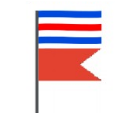
Vessel is not under command.
Vessel is restricted in ability to manoeuvre.
It is a distress signal.
Vessel is requesting pilot assistance.
Super-refraction effects the performance of some bridge devices on the vessel. What should the bridge watchkeeper look out for?
Abnormal ranges of VHF radio and very long range radar detection.
Loss of gyrocompass accuracy only.
Increased engine vibration at high speed.
Automatic activation of AIS alarms only.
What is the correct understanding of the term «Angle of loll» when applied to ship stability?
The angle of maximum heel during cargo operations.
The angle at which a ship is fully upright and stable.
The angle the ship will lie at when the ship has a negative GM.
The angle used for calculating freeboard corrections.
What type of fire integrity must be provided for an engine control room?
A-0.
A-60.
B-15.
C-30.
What would be the correct definition of the term «Squat»?
Squat is the reduction of underkeel clearance and the possible change of trim of a ship when it moves through shallow water due to reduction in water pressure.
The increase in ship speed due to shallow water effect.
The rolling motion of a vessel in heavy seas.
The vertical rise of a vessel when entering deep water.
Which is the correct term given to the company providing stores and provisions to ship in port?
Stevedore.
Ship chandler.
Pilotage service.
Classification society.
An alarm signal consisting of seven short blasts followed by one long blast is sounded by the ship’s whistle and the alarm bells. What are you to do?
Remain at your work station until further notice.
Proceed to the engine room immediately.
Move to the bridge for instruction.
Go to your lifeboat station (muster station).
Among working conditions listed below which one is required for every propulsion engine of lifeboat?
Starting achieved within 10 minutes at any temperature above 0 °C.
Starting achieved within 2 min of commencing the start procedure at an ambient temperature of -15 °C.
Engine must run continuously for at least 24 hours without stopping.
Engine can only be started after preheating for 1 hour.
What precautions are necessary to prevent soot fires in the exhaust boiler?
Regular soot blowing and maintenance of exhaust gas cleaning systems.
Monitoring exhaust gas temperatures and keeping them within safe limits.
Ensuring proper combustion and avoiding prolonged low-load operation.
All the mentioned alternatives.
A vessel where the engine personnel are in charge of all technical installations on board is due for a voyage to a cold climate area. Are any special precautions to be implemented with regard to fireline/pumps and use of same?
No special precautions are required in cold climates.
Only insulation of accommodation spaces is necessary.
All the mentioned alternatives.
All fire systems can be left as normal without checks.
A report to the bridge states that a person has fallen overboard, who should the OOW immediately inform?
Only the engine room.
Master and engine room.
Port authorities only.
No one until the ship stops completely.
You are proceeding up a river, with berths on both banks. You see this flag hoist on a vessel moored on a berth ahead. What does it mean?

You are required to stop immediately.
You should alter course to starboard immediately.
You should proceed at slow speed when passing me.
You must anchor and wait for permission to proceed.
The inspection and measurements at the end of a bulk carrier’s loading operation, that determines the weight of cargo lifted based on the observed draughts, any list, hog or sag, the dock water density and the calculation of ballast and consumables on the vessel, is referred to as the:
Stability calculation.
Cargo tally report.
Draught Survey.
Load line verification.
The smoke detector (fire indicator) indicates a fire in a cargo hold loaded with general cargo; this is immediately followed by a heavy smell of fire. What action should be taken first?
Close the ventilation system and other openings to the hold in order to choke the fire.
Immediately open the hatch covers to inspect the cargo hold.
Increase ventilation to disperse smoke.
Wait for shore fire brigade before taking any action.
Two mooring lines are pretensioned equally and have the same length, same breaking strength and same directional load. However, one is made of wire (with a full load elastic elongation of about 1,5 % of its length) and the other made of nylon (with a full load elongation of about 30 % of its length). If a gust of wind increases the load on the line, how will it be shared?
The nylon rope takes almost all of the extra load due to its elasticity.
The load is shared equally between wire and nylon rope.
Wire takes 95 % of the extra load, rope takes 5 % of the extra load.
The wire takes no additional load due to its stiffness.
A cargo hold containing such cargo as nitrates, chlorates etc. which produces oxygen under the influence of heat catches fire while the vessel at sea. How would you deal with this?
Seal the hold and stop all cooling immediately.
Use large quantities of water as soon as possible.
Open the hatch to increase ventilation and disperse gases.
Inject CO2 and continue normal cargo operations.
The vessel enters a turn at full speed and the engine set full ahead. If the engine speed is reduced during the turn, will there be any change in the turning diameter?
No, the turning diameter will remain exactly the same.
The vessel will immediately stop turning.
The turning diameter will decrease significantly.
Yes, the turning diameter will increase slightly if the engine speed is reduced.
A vessel is to be crash stopped without major change to its heading. What is the most effective method to achieve this?
Reduce engine power, use high frequency rudder cycling.
Put the engine full astern immediately and keep the rudder amidships.
Stop the engine and turn the rudder hard over to one side.
Maintain full ahead and apply alternating rudder only at the end of the manoeuvre.
The responsibility for safety and security rests with everybody on board the vessel. General housekeeping rules should be followed. Which of the listed rules is the most important?
Always wear headphones in machinery spaces.
Do not use loose garments, belts, ties or scarves near winches and moving machinery.
Keep doors open in all machinery spaces for ventilation.
Remove all safety signs when work is completed.
When a pollution incident occurs there is a plan for actions to be undertaken. State which of following priority sequences to be considered:
Clean up – report – stop pumps.
Report – stop pumps – clean up.
Stop pumps – report – clean up.
Report – clean up – stop pumps.
A general cargo ship is being loaded in Singapore for Hong Kong; which is the preferred order of loading for the following cargo types in the same hold?
Top stow: Steel slabs, Middle stow: CKDs, Bottom stow: Machinery parts on pallets.
Top stow: Machinery parts, Middle stow: Steel slabs, Bottom stow: CKDs.
Top stow: Pallets, Middle stow: CKDs, Bottom stow: Steel slabs.
Top stow: CKDs (packaged cars), Middle stow: Pallets machinery parts, Bottom stow: Steel slabs.
What is the minimum number of immersion suits that are required to be provided for each open lifeboat under SOLAS rules?
One per lifeboat, regardless of capacity.
One for every two persons in the lifeboat.
One for each person.
Only for the coxswain and crew.
What is the minimum equipment needed for entering a tank or void space that is not gas free or does not contain sufficient oxygen?
Self contained breathing apparatus in addition to normal safety equipment.
A portable fire extinguisher and safety helmet.
Only a gas detector and protective gloves.
Emergency escape breathing device only.
If a ship in deep water requires 2 nautical miles to crash stop, what will be the crash stopping distance in shallow water for the same start speed?
A shorter distance.
The same distance as in deep water.
A greater distance.
Exactly 1 nautical mile.
What types of fire extinguisher shall be used in the engine room?
Water fire extinguishers only.
Fire extingisher equipped for powder or CO2 only.
Foam extinguishers for all types of fires.
Any portable extinguisher available on board.
B class divisions in ship are constructed so that they are capable of preventing the passage of flame to the end of a standard fire test held for:
15 minutes.
60 minutes.
30 minutes.
45 minutes.
All waste receptacles shall be of non-combustible materials, built and equipped with:
Ventilation openings on both sides.
Drain holes in the bottom for cleaning.
No openings in sides and bottom.
Plastic covers with side openings.
What can be done to minimize the reduction of GM due to free surface?
Increase the number of slack tanks.
Reduce the number of slack tanks.
Keep all ballast tanks half full.
Transfer cargo to upper decks.
For how long time must the printout from the Oil Discharge Monitoring Equipment (ODME) be retained onboard?
One year.
Five years.
Three years.
Six months.
If a person has been overcome by fumes from toxic cargoes such as acetone cyanohydrin and has ceased breathing, you would:
Give the person water immediately.
Move the person and leave them to recover naturally.
Keep the person in the same area until medical assistance arrives.
Wait for a resuscitator to be brought form the ship’s first aid locker and use it.
On a general cargo ship, the first row of steel coils must be:
Loaded directly on the tank top without dunnage.
Stowed on top of timber blocks laid lengthwise.
Loaded on dunnage laid athwart ships.
Secured only with chains without any dunnage.
The three main reasons for using dunnage for loading cargo on general cargo ship are:
To increase ship speed, improve stability, and reduce fuel consumption.
To spread loads, to assist in securing and to allow good ventilation.
To separate cargo types, prevent corrosion only, and reduce weight.
To waterproof the cargo hold completely.
Which statement(s) is true of a gasoline spill?
It sinks quickly to the bottom of the sea.
It reacts with water to form solid residue.
It is visible for a shorter time than a fuel oil spill.
It remains visible longer than heavy fuel oil.
For how long should a tank be ventilated when people are working inside?
Only until entry is first made.
For as long as people are working in the tank.
For 10 minutes before entry only.
Only during the initial inspection.
If a nylon mooring rope is immersed in water it undergoes:
An increase in strength of 20 %.
No change in strength.
A decrease in strength of 20 %.
A complete loss of elasticity.
Where do you find instructions for tasks and duties in case of an emergency?
In the muster list.
In the cargo plan.
In the ship’s logbook.
In the engine room manual.
Which type of vessel suffers from the greatest squat effects?
Vessel with a low block coefficient.
High-speed passenger vessel.
Small fishing vessel.
Vessel with a high block coefficient.
What would the master require of the chief officer?
To handle all navigation duties alone.
The master would require the chief officer to organize a lifeboat drill.
To take over engine room control.
To manage radio communications only.
In deep water, a fixed pitch, right-handed propeller is set from full ahead to full astern. What should happen to the vessel\'s heading?
The vessel will turn to port.
The vessel will maintain a straight course.
The vessel will probably shear to starboard.
The vessel will immediately stop without any yawing.
What sound signal shall be used on ship\'s whistle when there is a man overboard?
One short blast repeatedly.
Five short blasts repeatedly.
Three long blasts repeatedly.
Two long blasts followed by one short blast.
Is it necessary to have a visual and audible signal if an automatic sprinkler begins to work?
No, only a visual signal is required.
Yes.
No, only an audible signal is required.
Only if the vessel is carrying passengers.
What is recognized as the main hazard when entering a void space?
Excess noise levels.
High temperature only.
Excess lighting inside the space.
Lack of oxygen.
As regard the launching and recovery arrangements for rescue boats which is required among the following?
Rescue boats must be stored only on the weather deck.
Means shall be available to prevent any discharge of water on to survival craft during abandonment.
Rescue boats may be launched only in port.
Recovery arrangements are not required if liferafts are available.
To minimize environmental effects, what is the best heading of a ship when launching a rescue boat?
The ship should head directly into the wind and sea.
The ship should stop completely with no regard to wind direction.
The ship should steer about 30 degrees off the prevailing weather and sea with the boat to be launched on the leeside.
The ship should turn stern to the sea for better stability.
How many sources of power must a fire detection and fire alarm system be provided with?
At least two sources of power.
One source of power only.
Three sources of power.
Only emergency generator power.
Having a CO2 alarm during normal working hours, what immediate action should be taken?
Continue working and investigate the alarm.
Wait for confirmation from the bridge before reacting.
Get out of the engine room as soon as possible.
Switch off the alarm system manually.
When a chain stopper is applied to a wire, what is important about the first hitch used on the wire?
It must be a bowline knot.
It must be non-locking cow hitch.
It must be a clove hitch only.
It must be a rolling hitch with multiple turns.
Which position is the best to stop bleeding from the nose?
Lying flat on the back with head tilted backwards.
Sitting on a chair, leaning forward, with two fingers pressing the nose together.
Standing upright with head tilted backwards.
Sitting upright without applying pressure.
An optical fire detector head is activated by:
Increase in temperature only.
The presence of carbon monoxide gas.
The visible smoke that is result of combustion.
Flames directly contacting the detector.
Shortly after entering the cargo hold of a General Cargo ship to discharge logs, two dockers are seen to collapse. As an OOW you would immediately:
Enter the hold immediately to rescue them without protection.
Wait to see if they recover before taking action.
Stop cargo operations and inform port authorities only.
Sound general alarm, call emergency services ashore and prepare rescue team with self-contained breathing apparatus.
According to basic principles regarding fire protection the ship is to be divided in zones by structural and thermal boundaries. (SOLAS II-2/2.2.1) In:
Main vertical zones.
Cargo zones only.
Engine room compartments only.
Horizontal watertight zones.
The thermal insulation provided to the wearer of an anti-exposure suit is sufficient to ensure that the wearer’s body core temperature does not fall at a rate of more than:
0,5 °C per hour after the first 1 hour immersion.
1,0 °C per hour after 2 hours immersion.
1,5 °C per hour after the first 0,5 hour immersion in calm water at a temperature of 5 °C.
2,5 °C per hour in all conditions.
Which of the answers best summarizes the information that should be provided to the bridge officers, in an effective voyage plan?
Only charted courses and waypoints.
All the suggested answers.
Weather forecasts and fuel consumption only.
Cargo details only.
How many pyrotechnic signals must be carried in each lifeboat?
2 Rocket parachute flares/4 hand flares/2 buoyant smoke signals.
6 Rocket parachute flares/4 hand flares/1 buoyant smoke signal.
3 Rocket parachute flares/3 hand flares/3 buoyant smoke signals.
4 Rocket parachute flares/6 hand flares/2 buoyant smoke signals.
How many hands held distress flares are carried in each lifeboat?
4.
8.
6.
10.
What is understood by the term «dew point» of the air?
The temperature at which water vapour in the air forms into water droplets.
The temperature at which air becomes completely dry.
The temperature at which air pressure becomes zero.
The temperature at which seawater freezes.
A faint is a brief loss of consciousness of no more than momentary duration caused by a temporary reduction in the flow of blood to the brain. How to prevent anyone from fainting?
Make the person stand still until it passes.
Lay the person flat and give food immediately.
Tell the person to sit down and lean forward with the head between the knees taking deep breaths.
Encourage the person to walk around to improve circulation.
What are the ideal conditions required to satisfactorily conduct an inclining experiment?
Calm water, no wind and minimal movement onboard.
Ship in light condition with clean and dry tanks.
Accurate weights available for shifting and measuring heel.
All of the suggested answers.
What features of the vessel hull, equipment and cargo causes error on a vessel’s standard magnetic compass?
Wind pressure acting on the compass bowl.
Sea state and wave motion only.
Permanent and induced magnetism found in steel or iron on-board.
Electrical interference from radar only.
When having a fire alarm during normal working hours, what immediate actions should be taken?
Ignore the alarm until confirmation is received.
Act according to instruction given in the fire plan.
Continue working and wait for further notice.
Switch off all alarm systems to avoid panic.
What is the approximate content of oxygen in air?
10 %.
15 %.
21 %.
30 %.
The freeboard of lifeboat, measured from the waterline to the lowest opening through which the lifeboat may become flooded:
Should exceed 1,5 % of the lifeboat length when loaded with 50 % of the number of persons the lifeboat is permitted to accommodate, these persons being seated to one side of the centreline.
Should be equal to 5 % of the lifeboat length under all loading conditions.
Should not exceed 1 % of the lifeboat length regardless of loading.
Is not regulated under SOLAS requirements.
What are class C bulkhead?
Bulkheads that are completely fire-tight and insulated for 60 minutes.
Bulkheads made of steel only with no insulation required.
Bulkheads constructed of approved non-combustible materials but do not meet any of the requirements relative to smoke and flame nor limitations relative to temperature rise.
Bulkheads designed only for watertight subdivision.
Which of these are indications that a parcel is suspicious?
The parcel is clearly labelled and expected by the recipient.
The parcel is addressed to no one in particular, arrives unexpectedly and seems heavy for its size.
The parcel is delivered by known shipper with prior notice.
The parcel is lightweight and properly documented.
Where shall shoreside fire-fighting personnel find necessary information to control a fire on board a cargo ship in an emergency situation?
In the cargo manifest only.
In the engine room logbook.
In the fire control plans or booklet that must be stored in a watertight prominently marked container outside the deck house.
In the bridge navigation chart folio.
Where would you find out which fire sections are enclosed by a «A» or «B» class divisions on a ship?
In the cargo stowage plan.
On a ship’s fire control plans.
In the ship’s stability booklet.
In the engine room operating manual.
Which of the following is allowed as a fire-extinguishing medium for fixed gas fire-extinguishing system aboard ships?
Water mist only.
Foam concentrate.
Carbon dioxide.
Dry sand system.
What is the minimum number of fire control plans that should be permanently stored in a prominently marked weathertight enclosure outside the deckhouse for the assistance of shore side fire fighting personnel?
At least one.
One copy only.
At least two copies.
Three copies are required.
What precautions must be taken before entering an enclosed space?
Only check temperature inside the space.
Enter immediately with a safety helmet.
Space thoroughly ventilated, oxygen and gas readings taken, communication set up, permit to work completed, crewmember standing by, with rescue gear.
Ensure lighting is sufficient and proceed without testing atmosphere.
Which deck is the «bulkhead deck»?
The lowest continuous deck of the ship.
The weather deck only.
The tank top inside the engine room.
The uppermost deck to which transverse bulkheads are carried.
A tug is moving towards the bow of the ship to make fast and is in the vicinity of the ship’s shoulder. What specific danger should be considered when making this approach to the bow?
Only the risk of collision with the ship’s hull.
Only the effect of wind on the tug.
All the alternatives answers.
Only the risk from propeller wash.
If the bridge watchkeeper is not keeping a proper lookout, why are they likely to be held responsible for a collision?
Because collisions are always unavoidable at sea.
Under the rules a proper lookout should be maintained at all times and by all available means.
Because lookout is only required in restricted visibility.
Because radar replaces the need for a visual lookout completely.
Two ships are meeting in restricted channel as illustrated. Which of the following actions would be the most suitable to take on both vessels as they approach and pass each other?
Maintain full speed ahead and hold course without alteration.
Slow down if possible without losing steerage and be prepared for prompt application of rudder to counteract any swing as they approach and pass each other.
Stop engines completely and drift past each other.
Alter course sharply toward the nearest bank to increase clearance.
What is the correct procedure to extinguish a soot fire in the exhaust boiler?
Increase engine load immediately to cool the boiler.
Stop the engine completely and flood the exhaust system with seawater.
Reduce speed and use soot blowers if fitted.
Shut all ventilation and leave the fire to burn out naturally.
What is the ideal humidity in a working environment?
40-60 %.
10-20 %.
25-35 %.
80-95 %.
What can be a cause of error observed on a gyro compass reading?
Excess wind pressure on the mast.
Incorrectly set latitude and speed values.
Magnetic interference from cargo.
Heavy rolling of the vessel only.
How much lifeboat capacity should be provided on conventional cargo ship of more than 85 meters in length?
50 % of the ship’s complement in total.
75 % of the ship’s complement on one side only.
100 % of the ship’s complement on each side.
100 % of the ship’s complement on board in total lifeboat capacity only once.
How much water per person is provided in a lifeboat not equipped with a desalting apparatus?
1 liter.
2 liters.
5 liters.
3 liters.
Where shall manually operate call points in fixed fire-detection and alarm system be located in accommodation spaces? (SOLAS II-2/13.2.1)
Only on the bridge and engine control room.
In cargo holds only.
At exits and in corridors.
Only inside cabins and mess rooms.
Which PPM is allowed for discharging of «bilge water» overboard?
5 PPM.
15 PPM.
10 PPM.
25 PPM.
What is the definition of clean ballast as per MARPOL Annex I?
Ballast water taken from freshwater sources only.
Ballast water with no suspended solids.
Ballast with an oil content of less than 15 ppm.
Ballast water treated with chemicals onboard.
How do you know how many people a lifeboat is supposed to hold?
The number of persons should be clearly stated on outside of the boat’s bow.
By checking the ship’s cargo plan.
By estimating based on boat size.
By checking the engine room logbook.
The special list of a cargo loaded on board a ship that need to be prepared for reporting and other administrative purposes, is referred to as:
Stowage plan.
Manifest.
Load line certificate.
Cargo tally sheet.
For the IMDG Code loaded on the deck of a general cargo vessel, the information available on the bridge of the vessel shall include:
Only cargo plan.
Only cargo manifest.
Cargo plan, cargo manifest and emergency schedule information from IMDG Code.
Only IMDG labels and placards.
With reference to operations on a general cargo ship, lateral drag refers to:
The vertical lifting of cargo during hoisting.
The twisting of cargo due to wind pressure.
The rotation of cargo in the hold during loading.
The sideways movement of heavy load after it has been transferred to ship’s lifting gear.
After just leaving a berth, which is the best way to quickly assess the compass error?
By checking the engine RPM against speed.
By comparing echo sounder readings.
By taking a transit bearing of two fixed geographical objects.
By using radar range rings only.
Which one of the listed requirements for stowage of rescue boats corresponds to present SOLAS regulations?
So that neither the rescue boat nor its launching arrangements will interfere with any survival craft at any other launching station.
So that they are always fully submerged for easy launching.
So that they are stored only inside enclosed cargo holds.
So that they are launched only by shore personnel.
Where on board can you find information regarding the different types of safety equipment, such as location, quantity, etc.?
In the cargo stowage plan.
The ship’s safety plan.
In the engine room logbook.
In the ballast water management plan only.
The fire control plan is called the safety plan and shall be posted onboard. In port, a copy of this plan shall in addition be available from somewhere else. Where must this copy be available?
In the engine control room.
On the bridge only.
At the gangway.
In the chief officer’s cabin.
The strength of the wind is related to the air pressure gradient between different pressure systems, which one of the following statements is correct?
The closer isobars on a weather map are together, the greater is the pressure gradient.
The wider the spacing between isobars, the stronger the wind.
Wind is not affected by pressure gradients.
Wind strength depends only on temperature, not pressure.
Which of the following precautions should be taken when work is to be carried out on a radar transceiver unit?
Increase radar power to improve safety.
Keep radar running on standby during maintenance.
A «not to be used» sign on all radars and breakers pulled for the radar system to be worked on.
Only switch off display unit but leave transmitter active.
What would be the effects of a ship passing into shallow water?
The ship becomes more responsive to rudder and propeller.
The ship is less responsive to both rudder and propeller.
The ship experiences no change in handling.
The ship increases speed automatically due to reduced resistance.
What is the correct understanding of the term isobar?
A line joining places of equal temperature.
A line joining places of equal humidity.
A line joining places of equal wind direction.
An isobar is a line joining places of equal pressure.
One of the risks of using CO2 is the low temperatures that it reaches when it vaporizes; this temperature is approximately:
-20 °C.
-50 °C.
-79 °C.
-100 °C.
What should you do with the ashes from your vessel’s incinerator which had burned garbage containing plastics?
Discharge overboard in deep sea areas.
Discharge to a shore facility only.
Dump into the nearest harbour water.
Store onboard indefinitely in plastic bags.
An oil record book, part 1, shall be provided to every ship of 400 tons gross tonnage and above to record machinery space operations. Out of below-mentioned operations, it is compulsory to record:
Painting operations in machinery spaces.
Fresh water production from evaporators only.
Routine cleaning of accommodation spaces.
Bunkering of bulk lubricating oil.
A balanced rudder has some of the rudder area forward of the rudder axis. About how much area should this be to call it a balanced rudder?
About 5 %.
About 10 %.
About 20 %.
About 50 %.
The fixed-pressured water-spraying fire-extinguishing system nozzles must ensure an effective average distribution of water in machinery spaces of:
2 l/m2/min.
5 l/m2/min.
3 l/m2/min.
10 l/m2/min.
How many emergency power supply sources are required for fire-detection and fire-alarm system?
One.
Two.
Three.
Four.
A vessel has a right-handed fixed pitch propeller, what should happen to its heading if the propeller was put full astern?
The bow should swing to port.
The stern should swing to starboard.
The bow should swing to starboard.
The vessel should maintain a straight heading.
The stern should swing equally on both sides.
Where do we find information about the ship’s fire preparedness?
In the cargo manifest.
In the engine room logbook.
In the stability booklet.
In the bridge navigation plan.
Information about the ship preparedness is found in the muster list.
Which of the following spaces may be protected by a fixed high expansion foam fire-extinguishing system?
Only machinery spaces.
Only cargo pump rooms.
Only ro-ro spaces.
All the spaces mentioned.
Only accommodation spaces.
What is the purpose of a sea anchor deployed from a lifeboat?
To increase the speed of the lifeboat.
To keep the lifeboat’s heading against the wind and sea and reduce drift.
To stop the engine from overheating.
To improve radio communication range.
To pump water out of the lifeboat.
What is the ideal working temperature for physical work?
10-12 °C.
25-28 °C.
30-35 °C.
5-8 °C
17-20 °C.
What is the anticipated rolling period of a ship with a large initial transverse metacentric height (GM) and would there be any associated dangers to consider?
A long slow rolling period associated with reduced stability.
A moderate rolling period with no associated dangers.
A short sharp period of roll associated with breaking lashings and shifting cargo.
No rolling period due to excessive stability.
A slow rolling period associated with engine vibration only.
Inflatable splints are made in various sizes and are shaped to the upper and lower limbs. What is the advantage of an inflatable splint?
It is more easy to give correct pressure to the fractured/injured area, and the control of swelling and bleeding is more easy to observe.
It completely removes all pain immediately.
It can only be used for lower limb injuries.
It prevents the need for medical treatment.
It is mainly used to increase blood circulation.
What kind of warning signs should be placed on manholes into void spaces?
Warning signs indicating high temperature inside.
Warning signs indicating explosive cargo inside.
Warning signs that indicate lack of oxygen inside.
Warning signs indicating fresh water storage inside.
Warning signs indicating electrical equipment inside.
MARPOL - Annex V. Disposal of garbage outside «special areas». After unpacking spares, you are left with a limited amount of packing materials. Is this prohibited, if not, what will be the nearest distance to land for disposal into the sea of these materials?
It is allowed beyond 12 nautical miles from the nearest land.
It is allowed beyond 3 nautical miles from the nearest land.
It is allowed beyond 25 nautical miles from the nearest land.
This is prohibited.
It is allowed only in designated dumping zones regardless of distance.
You are onboard a vessel off the west African coast. You want to dump a mixture of food waste, bottles and floating packing materials. Is this allowed? And if so, how far off the coast would you have to be?
Allowed beyond 12 nautical miles from the nearest land.
Allowed beyond 25 nautical miles from the nearest land.
Allowed only in special designated dumping zones.
This is prohibited.
Allowed beyond 3 nautical miles from the nearest land.
Which among the following list is particularly required for a totally enclosed lifeboat?
It must have an open deck for easy access during launching.
Hatches positioned so that launching and recovery operations can be performed without any occupant having to leave the enclosure.
It must be equipped with sails for emergency propulsion.
It must have removable side panels for ventilation.
It must always remain partially open during operation.
What would be the correct method to report to other ships in the vicinity that a person has fallen overboard from your vessel?
Man overboard situation, all ships proceed to assist immediately.
Mayday, mayday, man overboard, request immediate evacuation.
Vessel «name» has lost a person overboard in «position».
Security alert, piracy attack in progress in «position».
Vessel “name” requesting routine assistance in nearby waters.
On an oil tanker, are there any restrictions as to the oily water originating from cargo spaces that have passed through a bilge water separator that can be discharged?
No restrictions apply once the water has passed through a separator.
Maximum is 50 litres per nautical mile and total unlimited.
Maximum is 15 litres per nautical mile and total is 1/20 000 of cargo.
Maximum is 30 litres per nautical mile and total is 1/30 000 part of full cargo on the ballast voyage.
Discharge is only allowed in port reception facilities.
According to «Buys Ballot’s law» if a person faces the wind in the Northern Hemisphere, on what side of them is a low pressure center located?
On the left side.
On the right side.
Directly behind the person.
Directly in front of the person.
It cannot be determined by wind direction.
Where a fixed fire detection system does not include means of remotely identifying each detector individually, detectors are grouped in «sections». These sections may cover up to:
10 enclosed spaces.
25 enclosed spaces.
100 enclosed spaces.
5 enclosed spaces.
50 enclosed spaces.
What is the general emergency alarm signal as specified in SOLAS?
Seven or more short blasts followed by one long blast.
One long blast followed by one short blast.
Continuous ringing of the ship’s bell.
Three long blasts repeated continuously.
Two long blasts and two short blasts.
If a vessel is in very shallow water, using the rudder, is more or less space required to turn it compared to being in deep water?
Less space is required than in deep water.
The same amount of space is required as in deep water.
The vessel cannot be turned using the rudder in shallow water.
Need more space than deep water.
Only half the space is required compared to deep water.
What depth of water would be considered as «shallow water» in relationship to a change of the ship’s manoeuvring characteristics?
When the water depth is less than the ship’s length overall.
When the water depth is equal to twice the ship’s draught.
When the «under keel clearance» is less than 50 % of the draught of the ship.
When the «under keel clearance» is more than 50 % of the ship’s draught.
When the water depth is greater than 10 times the ship’s draught.
Which of the following spaces may be protected by a fixed carbon dioxide (CO2) fire-extinguishing system?
Accommodation spaces.
Machinery spaces of category A.
Cargo holds only.
Open Deck Areas.
Navigational bridge spaces.
The vessel is sailing with master and pilot on the bridge. What are the duties of the officer of the watch?
Assists the master and pilot as well as carrying out normal watch keeping duties.
The officer of the watch is relieved of all duties while master and pilot are on the bridge.
The officer of the watch must leave the bridge until the pilot departs.
The officer of the watch only monitors engine performance.
The officer of the watch only records logbook entries.
What can be simply rigged to assist a survival craft in keeping alongside own vessel?
A sea anchor deployed astern of the survival craft.
A towing hook connected to the propeller.
A painter rigged fore and aft against the vessel’s side.
A rigid ladder permanently fixed to the hull.
A wire cable attached to the rudder stock.
How is the painter released from a lifeboat, once the boat is waterborne and ready to leave?
By cutting the painter with an axe.
Remove the toggle which will release the painter.
By pulling a quick-release lever on the davit.
By releasing the engine clutch.
By loosening the rudder control cable.
What quantity of reserve fuel is to be available for the diesel driven fire pumps outside of main machinery spaces? (SOLAS II-2/4.3.3.2.4)
Sufficient fuel for 6 hours operation at full capacity.
Sufficient fuel for 24 hours operation at half capacity.
Sufficient amount for 15 hours operation at full capacity.
Only enough fuel for emergency start-up.
No reserve fuel is required.
What personal protective equipment would be required for working over side?
Only safety boots and gloves.
Lifejacket only is sufficient.
It would be determined by risk assessment, but at very least would comprise safety line and harness, lifebuoy standing by, safety hat, boiler suit, safety boots.
No PPE is required if weather is calm.
Only helmet and ear protection are required.
How can an ARPA best assist the bridge team to steer a suitable course to make good the entrance to a channel?
By automatically taking over the steering of the vessel.
By altering course so that own-ship ground stabilised true vector passed through the entrance to the channel.
By displaying only relative motion targets without further analysis.
By switching off collision avoidance alarms during approach.
By reducing radar range to minimum only.
What maximum suction head can be expected from a fire pump?
Approximately 2 metres.
Approximately 10 metres.
Approximately 5 metres.
Approximately 20 metres.
There is no limitation on suction head.
During an STS operation with one ship at anchor, should an anchor watch be maintained?
No, anchor watch is suspended during STS operations.
Only the anchored vessel must maintain anchor watch.
Only the manoeuvring vessel must maintain watch.
Both ships have normal anchor watch responsibility in addition to watching ship-to-ship fendering, mooring, etc.
Anchor watch is only required if weather deteriorates.
What could be the reason for the magnetic compass to swing through large angles when the ship is rolling in seaway?
The heeling error magnets are upside down and/or not in the correct position.
The compass is located too far forward on the ship.
The deviation card is missing from the bridge.
The gyrocompass is not synchronised with the magnetic compass.
The vessel is sailing too close to the equator.
What is the purpose of the ship security plan?
To regulate cargo loading and stability calculations.
To manage engine room maintenance schedules.
To control navigation routes and passage planning.
To organise crew welfare and food provisions onboard.
To protect your ship from risks posed by security threats or incidents.
When should voyage planning be done?
After the vessel has sailed and is clear of port.
Only when entering coastal waters.
During the last hour before arrival at destination.
Prior leaving the berth.
Only when requested by the pilot.
Where detectors of a fixed fire detection system are grouped in sections, each of these sections:
Must cover only one enclosed space.
Must cover at least five enclosed spaces.
Must be connected to the fire pumps directly.
Must always include manual activation of CO2 release.
None of the answers is correct.
Under which circumstances should a sprinkler head of a common system be activated?
When manually operated by the bridge only.
Automatically, when temperature is within a range from 68° to 79°.
Only when smoke is detected by the fire alarm panel.
When the fire pump pressure drops below normal.
Only when activated by the master switch in the engine room.
What immediate action should be taken if a ship unexpectedly runs aground and stops?
Increase speed to full ahead to refloat the ship.
Turn off all electrical power immediately.
Drop both anchors at full speed.
Stops engine(s).
Continue steaming ahead slowly to maintain control.
With respect to the ISM, what training in addition to lifeboat and fire drills must be carried out?
Only navigation training for officers.
No additional training is required beyond mandatory drills.
Familiarization, and other drills identified as necessary by the ship.
Engine room maintenance training only.
Only security training under ISPS Code.
The position of the ship provided by the GPS receiver should always be verified by other means. Which of the following suggested methods would be the most accurate?
Visual bearing of a single shore object.
Dead reckoning position based on last known speed.
Radar ranges of three distinctive shore objects.
Estimation based on sea current direction only.
Compass heading alone.
From which locations is it normally possible to close watertight doors?
Only from the engine control room.
Only locally at each door.
Only from the accommodation alleyways.
Watertight doors can be closed adjacent to the door and remotely from bridge and also one emergency remote control station.
Only manually by the chief engineer.
Which of the following parameters does an explosimeter measure?
Oxygen percentage in air.
Carbon monoxide concentration in ppm.
Hydrogen sulphide concentration in ppm.
The percentage of the LEL in the ambient air.
Carbon dioxide percentage in air.
The passage of electrical current through the body may result in severe and sometimes fatal injuries. You are witness to a man getting electric current through his body and is stuck to the dangerous area. It is impossible to switch off the current by any main switch. How to break the current safely?
Stand on dry insulating material and pull the person away with isolating material.
Pull the person away with bare hands quickly.
Pour water over the person to reduce conductivity.
Touch the person with a metal object to break contact.
Wait until the person releases himself automatically.
The ship’s engine is going to astern and the ship is picking up sternway. The rudder is amidships and the ship has a single, right-handed, fixed pitch propeller. What would be expected to happen?
The ship will start to turn to port and slow down sternway.
The ship will maintain a steady heading with no change.
The ship will probably start to change heading to starboard and stern speed will increase.
The ship will immediately stop moving astern.
The ship will turn randomly with no predictable effect.
Which is the capacity of the required portable fluid extinguishers?
Not more than 20 litres and not less than 5 litres.
Not more than 13,5 litres and not less than 9 litres.
Not more than 10 litres and not less than 5 litres.
Not more than 25 litres and not less than 15 litres.
Not more than 8 litres and not less than 2 litres.
What would be understood by the message “a yacht has capsized in heavy seas”?
The yacht has been repaired after heavy seas.
The yacht is sailing safely in heavy seas.
The yacht has been anchored due to heavy seas.
The yacht has been overturned in heavy seas.
The yacht has increased speed in heavy seas.
A brine trap aboard a general cargo vessel is likely to be found in:
The compartment scuppers.
The fuel oil tanks.
The steering gear compartment.
The engine cooling system only.
The cargo hold ventilation ducts.
Which of the survival craft listed below is equipped with a buoyant line, not less than 50 m in length, of sufficient strength to tow a life raft?
Liferaft.
Lifebuoy.
Lifeboat.
Rescue boat.
Emergency escape slide.
A ship is passing through a narrow channel and keeping to starboard side of the fairway, as illustrated. What could be expected in this situation?
The ship will be drawn towards the bank and the bow will swing inwards.
The ship will maintain a perfectly straight track with no external effects.
The ship will stop due to increased resistance from shallow water.
The ship will suffer bank suction and the stern will be pushed away from the bank.
The ship will suffer bank rejection and the bow will be pushed away from the bank.
Which of the connections shown are the dedicated shore connections (MARPOL connection) for discharging sewage?
Connection 1: Fire main shore connection.
Connection 2: Ballast water discharge connection.
Connection 3: Bilge water discharge connection.
Connection 4: Dedicated sewage shore connection (MARPOL standard discharge connection).
Which of these are indicators that an individual may be a drug smuggler?
The individual always asks for extra food onboard.
The individual avoids wearing any clothing related to safety gear.
The individual wears bulky or out of season clothing.
The individual frequently works overtime voluntarily.
The individual prefers staying in well-lit public areas.
A general cargo vessel is to load 200 tonnes of cargo on deck at N° 1 hatch. This loading will result in:
A decrease in draught forward, no change in trim and an increase in GM.
An increase in draught aft, no change in stability and no change in trim.
A decrease in draught forward, a change in trim and likely increase of GM.
An increase in draught forward, a change in trim and likely decrease of the metacentric height (GM).
You are on a vessel 10 nautical miles off the coast of Algeria, in the Mediterranean Sea. Are you allowed to dump food waste overboard?
Yes, all food waste can be dumped beyond 3 nautical miles.
Yes, but only if it is comminuted or ground.
Yes, only if the vessel is moving at high speed.
Yes, but only during daylight hours.
No, food waste can not be dumped overboard.
The position that is determined by built-in GPS-receiver in an Inmarsat-EPIRB has an accuracy of about:
50 meters.
1 000 meters.
10 meters.
200 meters.
5 000 meters.
From the mooring deck, who should be initially told that an assisting tug is clear of the vessel?
Report all clear to the own-ship bridge.
The tug master directly by VHF only.
The engine room control room.
The pilot only.
The port authority immediately.
If mouth-to-mouth (M-T-M) ventilation by itself is unsuccessful and the casualty’s heart stops, or has stopped beating, you must perform external chest compression (ECC) in conjunction with (M-T-M). What is the correct rate when performing ECC?
10 compressions per minute.
Complete 30 compressions at the rate of 100 compressions per minute.
50 compressions per minute.
120 compressions per minute.
60 compressions per minute with no ventilation required.
If mouth-to-mouth (M-T-M) ventilation by itself is unsuccessful and the casualty’s heart stops, or has stopped beating, you must perform external chest compression (ECC) in conjunction with M-T-M in combination with ECC with one first-aider only?
15 compressions followed by 1 ventilation.
Continuous ventilation only until recovery.
30 compressions followed by 2 full ventilations.
5 compressions followed by 5 ventilations.
10 compressions followed by 5 ventilations.
You are part of a team of two first-aiders in a resuscitation situation. What is the rhythm of resuscitation with two first-aiders?
30 compressions after every 2 inflations.
Continuous compressions with no ventilations.
10 compressions after every 5 inflations.
15 compressions after every 1 inflation.
5 compressions after every 1 inflation.
Which bulkhead will most efficiently prevent a fire from spreading?
Class B bulkhead.
Class C bulkhead.
Class D bulkhead.
Class A bulkhead.
Non-rated bulkhead with insulation.
Noise level called “the injurious area” starts at:
60 dB.
80 dB.
100 dB.
90 dB.
120 dB.
In case of pollution in US water, who shall notify the cleaning up contractor (OPA-90)?
The ship’s master.
The port authority.
The vessel owner directly.
Qualified individual.
The nearest coast guard station only.
What is the best way to avoid pollution from small oil-spills aboard a ship?
Dilute the spill with seawater immediately.
Contain any oil-spill onboard the ship.
Pump the oil overboard as quickly as possible.
Ignore small spills as they evaporate naturally.
Wait until port arrival to report the spill.
What is the minimum working pressure of the international shore connection?
0,5 N/mm2.
2,0 N/mm2.
1,5 N/mm2.
1 N/mm2.
5 N/mm2.
How much can the concentration of oxygen in the air decrease before it is dangerous to stay in the atmosphere without breathing apparatus?
1-2 %.
2-3 %.
5-6 %.
10-12 %.
20-21 %.
The maximum rudder angle for a conventional balanced rudder is usually 35 degrees. Do you think this is the angle that the rudder is most efficient?
Yes, efficiency is highest at maximum rudder angle.
No, efficiency is highest at 35° because resistance is minimal.
No, the most efficient rudder angle is less because the rudder begins to stall at 35 degrees.
Yes, because turning force increases continuously with angle.
Efficiency is unrelated to rudder angle.
The minimum number of independently driven fire pumps that must be provided on general cargo ships of 1 000 gross tonnage and upwards is:
1.
2.
3.
4.
Which type of equipment can be used to detect explosives?
Oxygen analyser.
Carbon monoxide detector.
Gas chromatograph for fuel testing only.
Particulate detector.
Smoke opacity meter.
Ships vary considerably in design and underwater shape, but does the ship’s trim ever have influence on its steering abilities?
Yes, the ship often steers better if trimmed by the stern.
No, trim has no effect on steering ability.
Yes, but only at anchor.
Yes, but only in shallow water conditions.
Trim only affects speed, not steering.
What does the abbreviation ABC mean in first aid?
Airway, Bleeding, Consciousness.
Assistance, Breathing, Care.
Alert, Breathing, Compression.
Air, Breathing, Circulation.
Assessment, Body, Control.
What is the minimum number of a portable fire extinguishers that must be carried on ships of 1 000 GRT and above?
3.
5.
7.
10.
Unfortunately a fishhook has entered someone’s finger. The barb of the hook is even inside the skin. How to remove the fishhook?
Push the hook through the skin until the barb protrudes, then cut the hook between the barb and the skin and gently withdraw the hook.
Pull the hook out quickly in the same direction it entered.
Twist the hook several times before removing it.
Leave the hook in place and apply ice only.
Among working conditions listened below which one is required for every propulsion engine of lifeboats?
Continuous operation for 24 hours at an ambient temperature of 45 °C.
Starting achievement within 2 min of commencing the start procedure at an ambient temperature of -15 °C.
Automatic restart within 30 seconds after shutdown at 0 °C.
Operation without fuel preheating at an ambient temperature of -40 °C.
How should personnel be protected from work taking place above their heads?
They should wear ear protection only.
They should stand directly under the work area for supervision.
They should not be allowed to enter the dangerous area.
They should continue working without restrictions if wearing gloves.
Which among the following list is required for lifeboat equipment according to present regulations?
Be stored loose for easy access during inspections.
Be painted red regardless of equipment type.
Be removed from the lifeboat after every drill.
Be secured in a manner as not to interfere with abandonment procedures.
What is the working principle of the detectors of a common fixed sprinkler fire-extinguishing system?
They are fixed-temperature detectors.
They are smoke-density detectors.
They operate only by manual activation.
They are pressure-sensitive detectors.
How much food per person is supplied a lifeboat?
Not less than 5 000 kJ.
Not less than 10 000 kJ.
Not less than 15 000 kJ.
Not less than 2 000 kJ.
A burn may occur when electricity of high current and voltage passes through the body. Most damage occurs at the points of entry and exist of electricity. What is the treatment of electrical burn?
Apply ointment directly onto the burn immediately.
Rub the burned area with ice for several minutes.
Place sterile dressing over the burn and secure with a bandage.
Break any blisters to reduce pressure.
When a ships Derrick or crane lifts a weight off the deck of a ship, from which position can the centre of gravity of the weight be considered to act?
From the base of the mast.
From the head of the derrick or crane.
From the midpoint of the cargo hold.
From the ship’s keel.
In case of diesel driven fire pumps, for how long shall the fuel tank capacity allow the pump to be run at full capacity? (SOLAS II-2.3.3.2.3)
One hour.
Two hours.
Three hours.
Five hours.
Which of the following corresponds to the method of protection «IC» in the accommodation and service areas of a cargo ship?
Construction of all internal divisional bulkheading of «B» or «C» class divisions, without the installation of an automatic sprinkler system.
Installation of an automatic sprinkler system throughout the accommodation and service spaces.
Use of only A-class divisions with smoke detection in all spaces.
Open-plan accommodation with fire curtains only.
When fully loaded, a lifeboat, should have a sufficient strength to withstand a drop into the water from a height of:
Not less than 1,5 metres.
Not less than 3,0 metres.
Not less than 5,0 metres.
Not less than 10,0 metres.
What allowance should be applied to an echo sounder reading, to compare the depth of water with the depth shown on a chart?
The vessel’s speed and trim correction.
Wave height and swell correction only.
Position of transducer below the water surface and the height of tide.
Water density and salinity correction.
If you were put in charge of fire team what minimum number of men wearing a breathing apparatus would you allow entering a smoke filled compartment?
1.
2.
3.
4.
At what rate shall a fixed high-expansion foam fire-extinguishing system fill the greatest space of an engine room with foam?
0,5 m depth per minute.
2 m depth per minute.
5 m depth per minute.
1 m depth per minute.
In carbon dioxide fire-fighting system for use machinery spaces the fixed piping system shall be such that:
50 % of the gas can be discharged into the space within 5 minutes.
85 % of the gas can be discharge into the space within 2 minutes.
100 % of the gas can be discharged within 10 minutes.
75 % of the gas can be discharged within 1 minute.
A ship’s engine goes from full ahead to full astern. Would the effect on the vessel’s speed be the same in deep and shallow water?
Yes, the stopping distance is always the same regardless of water depth.
Yes, shallow water has no effect on stopping performance.
No, the propeller effectiveness is greatly reduced and therefore the results will be considerably different.
No, only wind affects the stopping distance.
«A» class divisions in ships are constructed so that they are capable of preventing the passage of smoke and flame to the end of a standard fire test held for how many minutes?
60 minutes.
30 minutes.
90 minutes.
120 minutes.
Where may as general rule pressure containers for gas fire-extinguishing medium be kept? (SOLAS II-2/5.1.10)
Inside the protected space for faster discharge.
Outside the space which is to be protected.
In the engine room regardless of system type.
In any accommodation space on board.
What shall a duly qualified officer supervise any potential polluting operation?
To increase the speed of cargo handling.
To reduce fuel consumption only.
To improve navigation efficiency.
To avoid pollution.
Where shall shoreside fire-fighting personnel find necessary information to control a fire on board a cargo ship in an emergency situation?
In the engine room log book only.
In the fire control plans or booklet that must be stored in a watertight prominently marked container outside the deck house.
In the cargo manifest documents on the bridge.
In the ship’s radio communication log.
What is the main theme of modern safety practice?
Relying only on emergency response after incidents occur.
Eliminating all safety equipment to reduce costs.
Making use of risk assessment as a means to improving safety.
Increasing operational speed regardless of risk.
What is the purpose of the Ship Security Plan?
To increase cargo loading efficiency.
To regulate engine maintenance schedules only.
To improve communication with port authorities only.
To protect your ship from risks posed by security threats or incidents.
Fire protected lifeboats when waterborne should be capable of protecting its full complement when subjected to a continuous oil fire that envelopes the boat for a period of not less than how many minutes?
5 minutes.
8 minutes.
10 minutes.
15 minutes.
Can anything be done on a vessel with forward speed, to reduce the change in heading caused by a right hand fixed pitch propeller being put astern?
Yes, the rudder can be put to port.
No, the effect cannot be influenced once astern power is applied.
Yes, by increasing engine revolutions ahead.
Yes, by shifting ballast to the stern.
What vessels must have automatic fire detection onboard with heat/smoke detectors and audible alarm?
Only passenger ships carrying more than 12 passengers.
All ships are covered by the IMO safety conventions.
Only tankers carrying hazardous cargo.
Only cargo ships above 50 000 GRT.
When loading cargo in tween decks of a general cargo vessel, it must be ensured that:
The load is within the maximum allowed loading for the deck.
Cargo is always loaded evenly regardless of deck strength.
The tween deck is filled completely before the lower hold is used.
Heavy cargo is placed only near the hatch coamings.
The term luffing means:
The rotation of the crane base around its vertical axis.
The raising or lowering of a crane jib, moving the head of the crane and therefore a suspended load horizontally towards or away from the crane.
The lifting of cargo vertically using a winch only.
The swinging of cargo by hand for positioning.
When must personal protective equipment be worn?
Only when it is convenient for the worker.
Only during inspections by authorities.
Only in emergency situations such as fire drills.
At all times when identified as a control method with risk assessment.
Which statement about the IED’s is true?
IED’s always have only one single component.
IED’s do not contain any triggering mechanism.
All IED have four components
IED’s are only used in civilian aviation security systems.
What is the maximum allowed suction head for fire pumps? (SOLAS II-2/4.3.3.2.5)
4,5 meters.
2,5 meters.
6,0 meters.
10,0 meters.
Where will the ship’s officers find necessary information regarding the ship’s fire protection arrangement, fire-detection equipment and fire extinguishing appliances? (SOLAS II-2/20.1)
In the cargo stowage plan.
In permanently exhibited fire control plan.
In the engine log book only.
In the radio communication manual.
What do you do after receiving a VHF DSC distress call?
Immediately switch off all radio equipment.
Ignore it unless it is repeated three times.
Contact the nearest port authority only by email.
You set watch on VHF Channel 16.
One wishes to have a telephone conversation with a person whose name is known. This is what is called:
A collect call.
A conference call.
A personal call.
A public call.
Inmarsat telex service code 33 can be used:
For sending routine commercial cargo messages.
When technical problems are experienced with the Inmarsat-terminal.
For requesting weather forecasts only.
For passenger entertainment communications.
An Inmarsat-C terminal is suitable for …
Real-time voice communication.
Store and forward message.
High-speed video transmission.
Radar image processing only.
When may a call for radio medical advice be preceded by the urgency-signal?
Only in routine administrative communications.
Only during scheduled radio checks.
Only when the ship is in port.
In urgent cases.
By collect call is meant:
A call that is always prepaid by the caller.
A call account of the receiver.
A call only used for emergency distress situations.
A call routed through satellite only.
Silencing by a station, not in charge of the distress traffic, is done as follows:
STOP TRANSMISSION followed by the station’s call-sign.
MAYDAY RELAY followed by the ship’s position.
SEELONCE DISTRESS followed by the silencing station’s call-sign.
RADIO SILENCE requested without any call-sign.
The ID of an Inmarsat M station on board start with:
6.
2.
8.
0.
Non distress calls on 2 182 kHz and VHF Channel 16 should not exceed:
5 minutes.
One minute.
10 minutes.
30 seconds only.
You wish to send an e-mail using the Inmarsat-C installation. The message has to be composed in:
Morse code.
Binary code only.
ASCII.
Voice format recording.
For how long time should a VHF survival craft transceiver be able to operate on its batteries?
2 hours.
6 hours.
8 hours.
24 hours.
Onboard the following message is received on the DSC controller: DOO 245329000 CH 16; S distress ack 244123000. What station sent the distress acknowledgement?
244123000.
245329000.
240000000.
123456789.
To prevent overload of the MF/HF transmitter ...
Clean the dust filter of the fan regularly.
Keep the antenna disconnected during transmission.
Increase transmitter power to maximum at all times.
Avoid using DSC functionality.
On what wave band does the search and rescue radar transponder operate?
3 GHz.
9 GHz.
12 GHz.
1,5 GHz.
With an Inmarsat-C the terminal option «PSTN» for addressing is available. This option:
Allows direct voice calling via satellite phone.
Is used only for distress alerting messages.
Enables radar data transmission to shore stations.
To deliver a message by telephone via a modem on the computer of the subscriber.
The authority to order the use of distress signal or distress alert is:
Any crew member on watch duty.
Only with the master.
The radio operator without approval.
The port state control officer.
The traffic list of a coast-station is a list of:
Call-signs of ships for which a radio-telephone call, a telegram or another call is intended.
Weather forecasts for all vessels in the area.
Names of ports scheduled for arrival.
List of ships under inspection by port state control.
DSC-test transmission may:
Be sent only on VHF Channel 70.
Only be transmitted via satellite systems.
Be sent on MF installation on the DSC distress frequency.
Be used only for routine navigation updates.
For a «distress alert» via the DSC, the MF-band is used in the frequencies:
TX: 2182 kHz/RX: 2182 kHz.
TX: 2187,5 kHz/RX: 2187,5 kHz.
TX: 156,8 MHz/RX: 156,8 MHz.
TX: 500 kHz/RX: 500 kHz.
At present the MF/HF transmitter often has an automatic aerial tuning unit. Should this fail:
It is always possible to put the tuning unit in a fixed position, so the MF distress frequencies can still be used.
The transmitter becomes completely unusable for all frequencies.
The antenna must be replaced immediately at sea.
The system automatically switches to satellite communication only.
With what system is a NAVTEX-message transmitted?
ARQ.
FEC.
DSC.
AIS.
The display of the DSC-controller on board is showing the following lines: RX:002442000; Ch87; selective call routine. We are asked to listen on:
VHF channel 87.
VHF channel 16.
MF frequency 2182 kHz.
HF channel 2187,5 kHz.
When a character in the NAVTEX message sent is not received in the proper way:
The message is automatically deleted.
The entire transmission is retransmitted immediately.
The receiver switches off automatically.
Nothing or a special character will be printed.
When a message is sent by the Inmarsat-C installation to an internet e-mail address, the land charge is:
Based on the number of words only.
Higher if the receiver is in another continent.
Independent of the destination.
Charged only when using voice communication.
What radar device assists in the detection and location of survival craft?
EPIRB.
SART beacon.
AIS transponder.
NAVTEX receiver.
You have received the nine digit MMSI of a ship on your DSC equipment. In which publication will you find the name of the ship?
The ITU list of callsign and numerical identities of stations used by the maritime mobile and maritime mobile-satellite service.
Admiralty List of Lights and Fog Signals.
Nautical Almanac.
SOLAS Training Manual.
The names and addresses of accounting authorities can be found in:
IMO Safety Management Manual.
SOLAS Fire Safety Code.
The ITU list of ship stations.
GMDSS operator handbook only.
Which class of emission is used for VHF DSC transmissions?
A3E.
J3E.
F1B.
G2B.
Which of the following channels and modes should be used when initiating a distress alert transmission?
Channel 16 voice.
Channel 70 DSC.
Channel 87 voice.
MF 2182 kHz voice only.
The aerial system of an Inmarsat-C terminal consists of:
A directional parabolic antenna.
An omni-directional aerial.
A rotating radar scanner antenna.
A loop antenna for HF only.
In making VHF communication or test transmission you must:
Identify yourself with your call sign and/or ship’s name.
Transmit continuously without identification for clarity.
Use only numerical codes instead of identification.
Avoid any identification to prevent interference.
What allowances should be applied to an echo sounder reading, to compare the depth of water with the depth shown on a chart?
Correction for magnetic variation and compass deviation.
Air temperature and sea current direction.
Ship’s speed and gyrocompass error.
Position of transducer below the water surface and height of tide.
A vessel breaks down whilst on a coastal passage. Which of the following actions should be taken by the bridge team?
Proceed at reduced speed and sound prolonged blasts every minute.
Anchor immediately without informing nearby vessels.
Display the NUC signal, maintain the watch and determinate how the ship is drifting.
Switch off all navigation equipment to conserve power.
The receiver of the Inmarsat-C installation, if the log-in procedure has been carried out, is turned on:
the distress priority channel only.
NCS common channel.
the international VHF calling frequency.
the weather facsimile broadcast channel.
Which action do you perform when you log in to a satellite ocean region?
You inform the NCS that the SES is available for communications.
You disconnect all shipboard communication systems.
You automatically activate the EPIRB transmitter.
You change the vessel’s MMSI number.
To get proper conversation discipline in maritime radio traffic:
All radio messages should be repeated three times.
Radio communication should only be conducted during daylight hours.
Only necessary radio conversation are made in concise and businesslike way.
All communications must first be approved by the coast station.
What is the meaning of the abbreviation RQ at the end of a DSC sequence?
Relay quality.
Radio quiet.
Acknowledge request.
Required frequency.
If one wishes to make a collect call from a vessel to a shore subscriber, one must:
pay the charges in advance before connecting.
request for a collect call.
contact the nearest coast guard station only.
transmit the call on channel 16 without identification.
A DSC distress alert single frequency call attempt is awaiting acknowledgement:
it must be cancelled manually after 30 seconds.
it changes automatically to voice communication immediately.
repeated every 10 seconds until acknowledged.
automatically repeated after 3 and half to 4 and a half minutes.
Which of the following factors contributes to oxygen depletion inside a cargo hold full of logs on a General Cargo Vessel?
Increasing the vessel’s speed during the voyage.
Using fresh water ballast tanks.
Restricting hold ventilation.
Lowering the cargo temperature below freezing point.
What is the action that a GMDSS radio operator should take when a DSC distress alert is received?
Immediately set continuous watch on the radiotelephone frequency that is associated with the frequency band on which the distress alert was received.
Ignore it if the vessel is not in the same sea area.
Switch off all radio equipment to avoid interference.
Retransmit the DSC alert without checking details.
For a DSC-connection (no «distress alert») with another vessel the following frequencies are used:
TX: 2182,0 kHz RX: 2182,0 kHz.
TX: 156,8 MHz RX: 156,8 MHz.
TX: 2177,0 kHz RX: 2177,0 kHz.
TX: 2187,5 kHz RX: 2187,5 kHz.
DSC uses for automatic identification the MMSI. The identification 002442000 is assigned to:
a ship station.
a coast-station or coast guard-station.
a satellite emergency beacon.
an aircraft station.
The emergency battery of a GMDSS portophone:
must be recharged daily regardless of use.
can only be replaced by shore authorities after inspection.
is not required to be maintained if the device is rarely used.
must be replaced before the expiry date is exceeded.
The recommended connection between antenna and VHF is:
twisted pair cable.
fiber optic cable.
coaxial cable.
telephone line cable.
The whip-antenna of the MF transceiver was lost in bad weather. The MF-transceiver can be used again:
only after full factory recalibration.
if the whip-antenna is replaced by an antenna of about the same length as the original one.
if the power supply is replaced with a higher voltage source.
only when connected to a satellite communication system.
In which publication will you find the working frequencies of a coast station?
The ILUT list of coast stations.
The IMO Ship Station Manual.
The nautical almanac.
The MARPOL annex register.
The capacity of a battery is expressed in:
volts.
watts.
ampere × hours.
ohms.
On area A1 the function «transmission of ship to shore distress alert» is mainly based on:
HF radiotelephony.
the use of VHF DSC.
satellite EPIRB transmission.
NAVTEX broadcasting system.
In area A1 the function «transmission and reception of signal for locating» is mainly based on:
EPIRB satellite beacon system.
HF long-range radiotelephony.
NAVTEX broadcasting system.
the use of SART transponders.
Which item among those below is included in the normal equipment of every lifeboat?
Extra fuel containers for the main engine.
Portable radar reflector.
One set fishing tackle.
Emergency EPIRB battery charger.
To get priority with radio-communication, one must notify the coast-station that the call is:
a routine call.
a test call only.
an urgent call.
a weather information request.
What is SITREP an abbreviation for?
Signal transmission report.
Situation report.
Ship information transmission request.
Safety instruction technical report.
If a nylon mooring rope is immersed in water it undergoes:
an increase in strength of 20 %.
no change in strength.
a decrease in strength of 20 %.
immediate disintegration of fibres.
Which of the following parameters does an explosimeter measure?
The percentage of the LEL in the ambient air.
Oxygen percentage in the atmosphere.
Carbon monoxide concentration in ppm.
Humidity level inside cargo tanks.
Which of the following is the correct minimum carriage requirement for a ship of more than 300 gross tons and operating in area A1:
2 MF/HF radios – 1 radar transponder – no EPIRB required.
1 VHF RT – 1 or 2 SART – 1 NAVTEX or 1 EGC receiver – 2 or 3 VHF portable – 1 EPIRB.
only satellite communication equipment and no VHF required.
1 VHF RT only and no additional equipment required.
In area A2 the function «transmission of ship to shore distress alerts» is mainly based on:
the use of VHF DSC.
NAVTEX broadcast system only.
HF voice communication only.
the use of MF DSC.
In area A2, the function «transmission and reception of on scene communications» is mainly based on:
satellite phone communication only.
HF telex communication only.
the use of MF and/or VHF R/T.
NAVTEX automatic broadcasting system.
On a MF/HF-transmitter-receiver there is a volume control. Another name for this is:
LF-gain.
RF gain.
squelch control.
frequency tuning knob.
How many maintenance methods must be provided by ships sailing in area A1 and A2?
3.
2.
1.
4.
Which VHF channel should be used for internship navigation safety communications?
Ch.16.
Ch.13.
Ch.06.
Ch.70.
A DSC-message of the «safety» category is received from another vessel on VHF channel 70. Conforming to the GMDSS rules, for the continuation of the safety traffic, you must change to VHF-channel:
Ch. 06.
Ch. 13.
Ch.16.
Ch. 70.
EGC is short for:
Enhanced Group Call.
Emergency Group Call.
Enhanced Global Communication.
Electronic General Channel.
When an HF band a DSC distress alert is received, you have to listen to:
NAVTEX broadcast frequency only.
VHF channel 16 only.
satellite weather channel only.
the radiotelephony distress frequency in the band in which the DSC distress alert was received.
If a DSC distress alert is received on board your ship, what is the first action that should be taken?
Immediately retransmit the DSC distress alert.
Switch off all radio equipment to avoid interference.
Listen the distress message on the appropriate radio frequency for five minutes.
Contact the nearest coast station by telephone immediately.
The number of frequencies on which a MF/HF-DSC distress alert multi frequency call attempt can be transmitted is:
3.
6.
4.
8.
The type-indication of the radio set is mentioned in:
the cargo manifest.
the oil record book.
the ship’s logbook only.
the safety certificate.
Inmarsat telex service code «31» can be used:
for distress alert transmission only.
to send weather reports to satellites.
to ask for maritime inquiries.
for EPIRB activation control.
The time indications 121310z means in maritime radio communication:
12th day, 1 213 hours local time.
12th day, 1 310 hours UTC.
13th day, 1 210 hours UTC.
12th month, 1 310 hours local time.
Which type of call will be sent by a ship sighting another ship in distress which is not itself in position to transmit a distress alert?
Urgency call.
Distress relay.
Safety call.
Routine call.
Which of the following two digits codes is used to obtain medical advice?
12.
21.
45.
32.
The DSC-controller displays the following: DOO 246321000 CH16; S distress flooding after receiving this DSC message nothing more is received. Sending receipt on channel 16 does not give any response. One should first:
switch off all GMDSS equipment immediately.
send a DSC distress alert relay.
ignore the message as it is automatically cancelled.
change to NAVTEX reception mode only.
The log-in of an Inmarsat-C installation is important:
to activate the EPIRB automatically.
to inform the NCS that one is available for messages offered.
to test the VHF antenna alignment.
to switch the system into distress mode only.
On area A3 the function «reception of shore to ship distress alerts» is mainly based on:
VHF DSC only.
NAVTEX system only.
the use of HF DSC and Inmarsat-C SafetyNET.
MF voice communication only.
On area A3 the function «transmission and reception of signals for locating» is mainly based on:
EPIRB satellite beacon system.
NAVTEX receiver system.
HF DSC long-range calling.
the use of SART transponder.
On area A3 the function «transmission and reception of the scene communications» is mainly based on:
HF DSC only.
satellite SafetyNET only.
NAVTEX broadcast system only.
the use of MF and/or VHF R/T.
A wire antenna of 12 metres in length is probably:
a VHF antenna.
a satellite Inmarsat antenna.
a MF/HF antenna.
a radar scanner antenna.
For how long time should a SART transponder be able to operate in the active mode?
8 hours.
24 hours.
12 hours.
2 hours.
On area A4 the function «transmission and reception of on scene communication» is mainly based on:
HF DSC only.
NAVTEX broadcast system.
satellite SafetyNET service only.
the use of MF and/or VHF R/T.
On area A4 the function «transmission and reception of signal for locating» is mainly based on:
the use of SART transponder.
EPIRB satellite beacon system.
NAVTEX receiver system.
HF DSC long-range alerting.
All designated SAR aircraft and civil aircraft carry equipment operating on the international aeronautical distress frequencies (amplitude modulation). The aeronautical distress frequencies are:
156,8 MHz and 2182 kHz.
121,5 MHz and/or 243,0 MHz.
2187,5 kHz and 4207 kHz.
406 MHz and 500 kHz.
Which of the following two digits codes is used to obtain maritime assistance?
13.
31.
39.
49.
You want to send a DSC-call in connection with a shore telephone-call. You must choose:
distress category.
urgency category.
safety category.
routine.
When a satellite receives a «distress alert» from a COSPAS-SARSAT EPIRB, the relay of the «distress alert» can be delayed because the satellite cannot immediately contact a:
RCC (Rescue Coordination Centre).
coast radio station.
LUT before the satellite is actually seen by this ground station.
NAVTEX station.
A satellite receives the transmission of the 406 MHz Cospas-Sarsat EPIRB. The transmission of the EPIRB will be:
only stored onboard the satellite and deleted after 24 hours.
always passed on to a LUT.
transmitted only to nearby ships via VHF channel 16.
converted into NAVTEX format before transmission.
On board DSC-call is to be made in case of OBS. Choose the category:
distress.
urgency.
safety.
routine.
When sending an OBS (weather report) with Inmarsat one should use service code 41, with this address the weather report will always be transmitted to:
the nearest coast station regardless of region.
all ships within the same sea area automatically.
the meteorological station connected with the CES used.
only the flag state administration of the vessel.
If one wants to transmit a weather report with an Inmarsat-C terminal one should use the following address:
41.
12.
21.
91.
The frequency 121,5 MHz is used for:
VHF marine communication channel 16.
NAVTEX weather broadcasts.
COSPAS-SARSAT EPIRBs.
MF/HF DSC distress alerting.
A message is sent to a fax-machine. However, the message cannot be delivered by the land earth station. The land earth station will:
store the message indefinitely without notification.
automatically send a non-delivery notification (NDN) to the sender.
retransmit the message continuously until successful.
convert the message into a DSC distress alert.
A message is sent by the Inmarsat-C set. The land earth station will:
always send a positive delivery notification automatically.
never send any delivery confirmation under any circumstances.
convert the message into a NAVTEX bulletin.
only send a positive delivery notification (PND) to the sender if the sender requests it in the send menu.
Which option gives the correct meaning of the letter GB and the number 5 in the chart cell identifier GB50344?
A chart made by the French hydrographic office for ocean use.
A chart made by the UKHO for harbour usage.
A satellite navigation chart for military use only.
A fishing zone chart issued by IMO.
Via Inmarsat-C a message is sent to an Inmarsat-C mailbox with a positive delivery notification (PND). The ground station will:
always send a PND regardless of delivery status.
only send a non-delivery notification (NDN).
send a PND if the message has arrived in the mailbox.
delete the message without any confirmation.
When your vessel is engaged in search and rescue activity, and an assisting aircraft flies across your stern rocking its wings, what does this mean?
The assist is no longer required.
Proceed at maximum speed to the nearest port.
Continue the search in the same direction.
Change to VHF channel 16 immediately.
If a search and rescue aircraft flies over your vessel as shown in the three sketches, what does this mean?
The aircraft requests you to stop engines immediately.
The aircraft indicates the search is terminated.
The aircraft is requesting radio silence on all channels.
The aircraft wants your vessel to proceed in direction shown in the bottom image.
At the entrance to the space where the batteries are stored on board the following notice must be fitted:
danger high voltage area.
authorised personnel only.
no entry with naked light and/or flame.
oxygen storage area keep closed.
The batteries must be placed in a well ventilated place, so that:
the temperature remains constant at all times.
the detonating gas can be discharged.
the charging time is reduced.
the batteries do not require maintenance.
With maintenance of batteries it is of primary importance that:
the batteries are fully discharged before every charge.
the space where the batteries are stored is properly ventilated.
distilled water is never used in batteries.
batteries are stored in sealed metal containers only.
A vessel is equipped for all sea areas. In the middle of the Indian Ocean the EGC-receiver appears out of order. Is it still possible to receive MSI-messages?
No, MSI messages are only available via EGC receiver.
Yes, with NAVTEX receiver only.
Yes, with the MF/HF-radio telex.
No, all MSI reception is impossible without satellite connection.
Which of the following is an Accounting Authority Identification Code?
A1B2.
FR01.
9999.
GMD5.
What is the acronym FR01?
International distress frequency.
Maritime safety channel.
Coastal radio station identifier.
AAIC.
To get a proper conversation discipline in maritime radio traffic:
all radio conversations should be as long and detailed as possible.
only necessary radio conversations are made in a concise and businesslike way.
radio checks must be carried out every 5 minutes.
informal communication between ships is encouraged at all times.
For calling a coast-station by VHF one should preferably use:
a working channel of the nearest shore-station of that coast-station.
channel 16 for all routine traffic.
any available simplex channel.
the DSC distress channel only.
A MF/HF-DSC multi-frequency call attempt may:
only be repeated after 30 minutes.
be repeated after 3-5 to 4-5 minutes.
never be repeated on the same frequency.
be repeated continuously without delay.
The first time you send a DSC distress alert via the VHF-band, you prefer ...
2 MHz band.
16 MHz band.
8 MHz band.
4 MHz band.
In a distress-situation a MF/HF-DSC transmission is used in the 8 MHZ frequency. In this case always:
wait for instructions before selecting a communication frequency.
indicate on what frequency communication will be continued.
continue all communication on channel 16 only.
repeat the DSC alert every minute without voice communication.
To announce an important navigational – or meteorological warning via the VHF-installation, one should use the:
distress call.
urgency signal only.
routine communication signal.
safety call.
Which type of call will be sent by a ship sighting containers adrift in vicinity of her position? (no message about this problem was previously transmitted via NAVTEX or INMARSAT C SAFETY NET)?
safety call.
distress call.
urgency call.
routine call.
If a coast-station doesn’t answer a call on VHF working channel or doesn’t send a reply signal:
you must continue calling on channel 16 only.
you must call on another working channel.
you must stop all radio communication for 24 hours.
you must immediately send a distress alert.
A distress alert has accidentally been sent with the Inmarsat-C installation. One should now:
ignore it and continue normal operations.
immediately shut down the Inmarsat-C terminal permanently.
make contact with an RCC.
send another distress alert to cancel the first one automatically.
A distress alert sent by Inmarsat to an RCC is sent via:
NAVTEX station.
coastal VHF station.
MF/HF radio telex only.
LES.
A distress-call received via RCC should:
be ignored until further confirmation from other ships.
only be given receipt, if the master has confirmed that assistance indeed can be given.
always be retransmitted immediately to all vessels in the area.
be answered only by coastal stations, not by ships.
By fleet net communication is understood:
an EGC-message destined for ships with the same group call number.
a general broadcast to all ships worldwide without selection.
a VHF-only coastal station broadcast service.
a private ship-to-ship communication channel.
With an Inmarsat-C installation there is the addressing-option «special». Via this option:
you can only send messages to coast stations.
you can enter one of Inmarsat’s «special access codes»
you can only send distress alerts automatically.
you can bypass all network control centres.
The ship-shore HF-telephone-channel 2228 consist of the frequencies 22081,0 kHz and 22777,0 kHz. In case of manual operation, one should tune the receiver on:
22081,0 kHz.
2182,0 kHz.
22777,0 kHz.
156,8 MHz.
What mode is used for broadcast an MF/HF-DSC message:
A1A/F3E.
J2B/F1B.
H3E/J3E.
F3C/A3E.
When may a call for radio medical advice be preceded by the urgency-signal:
only in distress situations.
only when no medical officer is onboard.
only during VHF communication.
in urgent cases.
What mode must be used on the MF/HF transmission when making a radiotelephone call:
F1B.
J3E.
G2B.
A1A.
Distress MF communications should normally be operated:
in F3E mode on duplex channels.
in J3E mode on simple basis.
only in digital DSC mode without voice.
in A1A mode using CW Morse only.
The MF/HF transceiver on board is tuned to the assigned frequency of a station. To make this connection the following mode is used:
J3E.
F1B.
A3E.
H3E.
A ship in distress should transmit the appropriate alarm signal followed by the distress call and message on one or all of the international distress frequencies. Which of frequencies is in accordance with the present recommendations?
2187,5 kHz, 8414,5 kHz and 156,525 MHz.
500 kHz, 2182 kHz and 156,8 MHz.
2182 kHz, 2187,5 kHz and 4207,5 kHz.
156,8 MHz, 123,1 MHz and 500 kHz.
The correct functioning of a DSC-modem can be checked by means of:
the built-in test facility in the modem.
an external spectrum analyzer connected to the antenna.
sending continuous distress alerts to shore stations.
manual tuning of all MF/HF channels.
In radiotelephony «what is the urgency call» which should be used to indicate that you have a very urgent message to transmit concerning the safety of another vessel or person?
MAYDAY MAYDAY MAYDAY.
PAN PAN PAN (3 times).
SECURITE SECURITE.
HELP HELP HELP.
Which word will precede an urgency message?
PAN PAN.
MAYDAY.
SECURITE.
ALARM.
A Cospas-Sarsat EPIRB can be used in:
only sea area A1.
only sea areas A1 and A2.
all sea areas (A1 to A4).
only offshore coastal areas.
The ID of an Inmarsat M station on board starts with:
6.
3.
9.
0.
To guarantee optimal reception of VHF-DSC-calls, every:
message is repeated three times automatically.
DSC-symbol is sent twice and checked extra by error check character.
transmission is confirmed by voice immediately.
signal is sent only once to reduce channel congestion.
When a coastguard-station wants to send a gale-warning by DSC it will happen in the category:
distress.
urgency.
safety.
routine.
Regular «updating» of a ships’ position in an Inmarsat-C installation is necessary …
to reduce satellite usage costs.
to have the correct position in case of accident.
to improve VHF signal strength.
to increase message transmission speed.
With relative motion radar display, what would an echo of a target with no trail indicate? Note that this is a target trail, not a vector …
the target is on the same course and speed as own ship.
the target is stationary in relation to ground.
the target is changing course rapidly.
the radar is malfunctioning.
Hand flares and buoyant smoke signal can continue to burn or emit smoke after having been immersed for a period of 10s …
only if they are fully waterproof sealed.
only in freshwater conditions.
only if kept above deck temperature.
right if the immersion depth is smaller than 10 mm.
On board, they want to send a safety-call to other vessels. The DSC safety-call:
must always be sent without any follow-up communication.
has to contain a work-frequency.
is only used on MF/HF bands, not VHF.
can only be transmitted by coast stations.
After passage planning with ECDIS, how should the route be checked for safety?
by plotting it only on paper charts without ECDIS verification.
by relying only on GPS track history.
by using the ECDIS route checker and by visually sighting all along it.
by waiting for pilot approval only.
Which statement best describes why a previous route would have to be re-validated on an ECDIS?
Because the ship’s GPS antenna has been replaced.
Because revalidation is necessary when there have been chart updates.
Because the voyage plan must be approved every 6 hours.
Because ECDIS automatically deletes old routes after 24 hours.
Which option correctly completes the following statement? For any chart orientation on an ECDIS display, regulations require that there should always be a visible indication of …
magnetic north.
grid north.
true north.
course over ground.
Which option correctly completes the following statement? A position filter on a navigation receiver or ECDIS system, protects the ECDIS from …
losing GPS signal completely in coastal areas.
showing a fluctuating position of the vessel.
automatically switching charts during voyage planning.
calculating incorrect tidal data.
Which statement best describes why a previously validated route would have to be re-validated on an ECDIS?
Revalidation is necessary when there have been chart updates.
Revalidation is necessary when there are changes in bridge staffing.
Revalidation is only required after power failure of ECDIS.
Revalidation is required every time the vessel changes speed.
Which option best describes what target fusion is on an ECDIS?
Combining two GPS receivers into one position source.
Bringing together a displayed radar return and AIS target.
Merging two ENC charts into one display layer.
Synchronizing ECDIS time with UTC.
Which statement best describes how an ENC chart gives advice on sounding data quality?
The chart automatically adjusts depth readings using tide data.
The chart displays only verified soundings in real time.
The chart eliminates all survey errors by digital correction.
The chart has a zone of confidence function.
Which option correctly completes the following statement? The value of the cross track limit when automatically validating a route on ECDIS is important because …
it determines the minimum safe speed of the vessel.
it defines how often the GPS position is updated.
ECDIS sets up a corridor either side of the route to look for dangers.
it controls the chart display brightness during night mode.
Which option correctly identifies the meaning of the abbreviation ZOC, in relation to ECDIS?
Zone of coverage.
Zone of correction.
Zone of control.
Zone of confidence.
What happens when an ECDIS undertakes a geometry check on planned passage?
The system recalculates tidal heights automatically.
The route is checked to see that it is acceptable for the vessel.
The chart is converted into raster format.
The GPS signal is corrected for satellite drift.
Which of the statement best describes what happens to the sounding figures on an ECDIS chart display, when the safety depth figure is set?
All soundings deeper than safety depth are hidden completely.
All soundings are automatically converted to contours only.
Figures less than the safety depth are highlighted in bold.
Depth values are removed and replaced with colour shading only.
Which option best describes what lies below an isolated danger symbol seen on the chart display of an ECDIS?
There is always deep water with no hazards underneath.
There could be any obstruction that infringes the safety depth settings.
The area is surveyed and guaranteed free of dangers.
Only wrecks deeper than chart datum are present.
Which statement best describes what happens to the vessel symbol on an ECDIS set in north-up, true motion mode?
Vessel symbol moves across the screen.
The vessel symbol remains fixed in the centre of the screen while the chart moves.
The vessel symbol disappears when true motion is selected.
The vessel symbol rotates but does not translate.
When passage planning, what is the correct scale to see the associated ENC chart detail loaded on an ECDIS?
Any available scale, regardless of ENC compilation scale.
All the same scale or very close to the compilation scale of the ENC chart.
The largest available scale only, even if not appropriate for the ENC.
Only the smallest scale to reduce data loading time.
With an ECDIS in track control mode, will the vessel\'s position always be correct if the ship symbol is showing on a route leg?
Yes – because track control guarantees absolute positioning accuracy.
Yes – because the ECDIS corrects all GNSS errors automatically.
No – because track control disables GNSS input.
No – because there may be a position error on the navigational signal.
What happens when an ECDIS performs a route validation or safety check?
Only the waypoint positions are checked for accuracy.
The whole route is checked for possible dangerous objects along it.
The route is automatically executed without approval.
Only the starting point is checked against ENC data.
When passage planning with ECDIS what level of detail should be displayed?
Only the minimum detail to avoid screen clutter.
Only contour lines and no depth data.
It is best to set all level of detail to assist with planning.
Only tidal information should be displayed.
When passage planning on ECDIS, which two functions should always be set correctly?
Chart brightness and day/night mode.
Safety depth contour and safety depth value.
AIS range and radar range.
Cross track error and heading offset.
What does the acronym HDOP stand for when seen on an ECDIS or navigational receiver?
Horizontal dilution of precision.
High data output position.
Heading deviation of position.
Hydrographic depth observation parameter.
Which option best describes how an operator establishes what an isolated danger symbol represents, when seen on the chart display of an ECDIS?
By ignoring it unless it is on the planned route.
By automatically deleting it from the display.
By interrogating it and requesting a pick or information report.
By zooming out until it disappears.
Which option correctly completes the following statement? When an ECDIS system is in DR mode ...
it is probably using the course and speed through the water for position update.
it is using radar targets only for position fixing.
it is always receiving differential GNSS corrections.
it is operating without any navigation input.
Which of the following statements is the most accurate in relation to the safety depth contour setting on an ECDIS?
The safety depth contour is automatically calculated and cannot be changed by the operator.
The safety depth contour has to be set at a value to reflect the vessel’s draught.
The safety depth contour is only used in coastal waters.
The safety depth contour is unrelated to vessel parameters.
Which statement best describes how land moves, if at all, on an ECDIS set in north-up, relative-motion mode?
Land rotates around the ship symbol while remaining fixed on the screen.
Land remains completely stationary on the screen at all times.
Land disappears when relative motion is selected.
Land on the chart screen moves relative to the ship symbol.
What should an ENC chart cell, with usage code 1, be used for on an ECDIS?
Detailed harbour manoeuvring in confined waters.
Over viewing an ocean when planning.
Pilotage in restricted visibility only.
Collision avoidance in coastal traffic separation schemes.
Which statement best describes how land moves, if at all, on an ECDIS set in north-up, relative-motion mode?
Land rotates around the ship symbol while remaining fixed on the screen.
Land remains stationary while the ship symbol moves only.
Land on the chart screen moves relative to the ship symbol.
Land disappears in relative-motion mode.
If whistles are fitted on a vessel at a distance apart from more than 100 meters, will maneuvering and warning signals, as defined by rule 34 of the international regulations for preventing collision at sea, be given on one or both whistles?
They shall be given on one whistle only.
They shall be given on both whistles simultaneously.
They shall alternate between whistles depending on heading.
Only the forward whistle shall be used in restricted visibility.
According to the International Regulations for Preventing Collisions at Sea and the illustrated lights, what type of vessel is it?
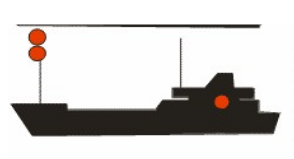
A vessel engaged in fishing, making way through the water.
A vessel restricted in her ability to manoeuvre, making way through the water.
A vessel not under command, but making way through the water.
A vessel at anchor with engines running.
What signal may be given by sound and by light to indicate that a vessel fails to understand the intentions of another vessel, or is in doubt that sufficient action is being taken by the other to avoid collision?
One long blast and one short blast.
Three short blasts.
Two long blasts followed by one short blast.
Five short and rapid blasts (flashes).
You are on a sailing vessel, underway in open water. This vessel is sighted on the starboard bow, on a steady bearing and the distance is closing. By the International Regulations for Preventing Collisions at Sea, what action will you follow?
Alter course immediately to starboard to pass astern of the other vessel.
By Rule 18, a power-driven vessel underway shall keep out of the way of a sailing vessel. I will maintain my course and speed, but continue to monitor the situation to ensure the other vessel takes avoiding action.
Stop engines and make the vessel not under command.
Sound five short blasts immediately and alter to port.
Your vessel is power-driven and making way in open water. This vessel is sighted wide on the port bow. Its bearing is opening, but its distance is closing rapidly. Which of the following is a correct assessment of the situation and the action to be taken?
Risk of collision exists and immediate alteration of course to starboard is required.
Risk of collision exists and engines must be stopped immediately.
Risk of collision is deemed not to exist and I will maintain my course and speed. I will continue to monitor the situation.
The other vessel is not visible on radar and must be ignored.
Your vessel is power-driven and making way in open water. This vessel on the port bow with stealing bearing. What kind of vessel is it, and what will your action be?

This is a fishing vessel engaged in trawling and I will maintain my course and speed.
This is a sailing vessel underway, seen head-on. It is my responsibility to keep clear under rule 18 and I will take appropriate avoiding action.
This is a vessel not under command and I must stop engines immediately.
This is a pilot vessel underway and I should alter course to port.
The vessel with the illustrated lights is sighted ahead and slightly to port. What does the light tell you about the status of the other vessel, and what should happen on your vessel?
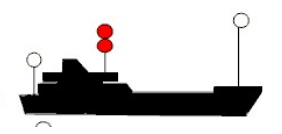
This vessel is restricted in her ability to manoeuvre and my vessel should maintain course and speed.
This vessel is engaged in fishing and I should alter course to starboard only.
This vessel is not under command and I should sound one prolonged blast.
This vessel is aground. My vessel should be navigated with extreme caution given the nature of the hazard.
Your vessel is towing an unmanned barge and restricted in its ability to maneuver. The total length of the tow is 800 meters. What daylight signal are required by the international regulation for preventing collisions at sea?
A diamond shape, where it can best be seen shall be displayed on the tug and the tow. Three shapes shall also be displayed in a vertical line, the upper and lower being balls and the middle one a diamond.
Two black balls in a vertical line shall be displayed on the tug only.
One black cone apex upward shall be displayed on both vessels during daylight.
Three black diamonds in a vertical line shall be displayed on the towing vessel only.
Your vessel is proceeding along a narrow channel in front the vessel behind you. What does it mean?
I am altering my course to port immediately.
I intend to overtake you on your starboard side.
I am unable to manoeuvre and require assistance.
I intend to turn around within the narrow channel.
Your vessel is approaching a port in restricted visibility and you hear this signal. What kind of vessel is it, and what is it doing?
It comes from a vessel at anchor and it is not making way.
It comes from a fishing vessel engaged in trawling and hauling nets.
It comes from a vessel engaged in pilotage duties and it is making way through the water.
It comes from a vessel not under command and drifting in the channel.
You are on a power-driven vessel underway in open water. This vessel is sighted directly ahead. The distance is closing slowly. What action will you take under the international collision regulation and why?
I will maintain my course and speed because I am the stand-on vessel under rule 15.
I will keep out her way. I am the overtaking vessel and am obliged to keep clear under rule 13.
I will alter course to port because the other vessel must give way.
I will stop engines immediately and sound five short blasts.
What type of vessel is identified by the displayed shapes?
A vessel engaged in fishing.
A pilot vessel underway.
A vessel constrained by her draught.
A vessel not under command.
Give the meaning of the following symbol.

Emergency fire pump.
Line throwing appliance.
Lifebuoy with self-igniting light.
Rocket parachute flare station.
Give the meaning of the following symbol.
Liferaft stowage position.
Emergency fire control plan location.
Location of embarkation ladder.
First aid station onboard.
Give the meaning of the following symbol.

Fire main isolation valve.
Emergency bilge pump operation.
Start water-spray.
Activate CO2 flooding system.
Give the meaning of the following symbol.

Lifeboat engine start procedure.
Survival craft distress pyrotechnic signals.
Fire detection control panel location.
Emergency steering gear operation point.
Give the meaning of the following symbol.
Start air supply.
Emergency fire pump activation point.
Engine room ventilation shutdown.
Fuel oil transfer pump stop.
Give the meaning of the following symbol.
Emergency steering gear control.
Survival craft portable radio.
EPIRB activation switch.
Lifeboat engine fuel selector.
Give the meaning of the following symbol.
Emergency escape route.
Lifejacket must be worn at all times.
No entry in this area.
Fasten seat belts.
What is the meaning of this symbol?
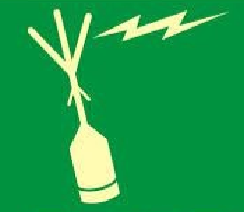
Emergency power isolation breaker.
Emergency Position Indicating Radio Beacon.
Engine protection and inspection bypass relay.
Emergency propulsion internal reset button.
What is the meaning of this symbol?
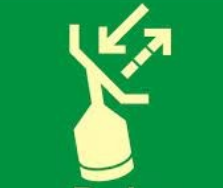
Search and Rescue Transponder.
Safety Alarm Response Terminal.
Ship Automatic Radar Tracker.
Signal and Rescue Transmission unit.
Give the meaning of the following symbol.

Hand-held smoke signal.
Rocket parachute flare.
Emergency lifeboat engine starter.
Distress whistle activation point.
What is the meaning of this symbol?

Lifejacket stowage location.
Emergency fire hose station.
Immersion suit.
Lifeboat launching control switch.
Give the meaning of the following symbol.

Emergency engine stop.
Release gripes.
Lifeboat fuel shut-off valve.
Fire door release mechanism.
What is the meaning of this symbol?
Stop lifeboat engine immediately.
Lower liferaft manually.
Lower lifeboat to water.
Activate EPIRB signal.
Give the meaning of the following symbol.
Survival craft portable radio.
Emergency fire control panel.
Lifeboat engine cooling system.
EPIRB test switch.
Welcome to the website where you can pass online the CES test on the subject «Survival Craft Assistance Techniques». Practice like this will help you as a marine specialist improve your knowledge with the help of online studying and appraisal practice. CES based on practical information and marine specialists experience.
About this test
- Total questions447
- DepartmentDeck
- LevelOperational
- SubjectSurvival
Other tests
Seagull CBT Gangway Security Answers (CD 0501, Deck, Operational) Else Seagull CBT ECDIS Display Feature Answers (CD 0212, Deck, Operational) Else Seagull CBT Common Bulk Cargoes Answers (CD 0342, Deck, Operational) Bulk carrier Тренировочный онлайн CES тест для палубного департамента, уровень управление, на балкерных судах Bulk carrier
Did you find mistake? Highlight and press CTRL+Enter

About
Senior Mate with 12+ years of experience in the international merchant marine.
- Development and implementation of navigation and on-board safety plans.
- Supervising the work of the crew and assisting the captain in managing the vessel.
- Participation in training of junior crew, ensuring compliance with safety standards.
All materials have been checked by our marine expert.
Personal data is not disclosed for security and contract confidentiality purposes.
October, 17, 2026 405 0
5/5 - (3 votes)
Social 


