* Some questions may have more than 1 correct answer.
Use the search below to find question.
Amount of questions: 34.
Right answers marked with this sign .
Which of the following hazards might the examiner be exposed to?
Bloodborne pathogens.
Working over water.
Working at height.
Simultaneous operations.
According to ILO 152, how often should ship mounted lifting appliances be retested?
Every 5 years.
Every 10 years.
Every 2 years.
If lifting appliances are removed from service or there is a delay in completing the examination, this can have a significant impact on operations and profit.
True.
False.
What type of survey and examination services are used for lifting appliances?
Certification.
Classification.
Coronation.
Correction.
Most maritime countries have introduced requirements similar to which of the following conventions in relation to lifting appliances and loose gear?
ILO 152.
IMO 155.
ISO 111.
The examiner is not required to wear personal protective equipment while on board.
True.
False.
To ensure that the appliance and its associated equipment is in the correct place, the examiner should review which of the following?
ECDIS charts.
The ship's general arrangement diagram.
Block lists.
Reeving diagrams.
The ship's logbook.
Manufacturer's manuals.
A risk assessment should be carried out before every examination.
True.
False.
When should the examiner inspect the register of the ship's lifting appliances and cargo handling gear (form one)?
After the examination is complete.
Before the examination takes place.
During the examination.
What are the three common types of slewing bearings found on ship's cranes?
Three roller bearing.
Rotor bearing.
Twin ball bearing.
Triplet bearing.
Single ball bearing.
The sheave and block unit on a ram-luffed crane can be easily dismantled for inspection.
True.
False.
Which of the following are examples of protective devices?
Rope terminations.
Luffing-in limiters.
A slack rope switch.
The examiner may be required to inspect which of the following types of crane?
Ram-luffed cranes.
Cable-luffed cranes.
Engine room cranes.
Rope-luffed cranes.
Control room cranes.
Deck fittings must be examined to ensure which of the following?
The paintwork has no chips or cracks.
They show no signs of excessive wear, deformation or corrosion.
The welds attaching the eye plates and cleats to the deck are sound.
Masts that are permanently attached to the deck, do not need to comply with the regulations.
True.
False.
When examining derrick systems, which of the following should be inspected?
Pedestal.
Bridge.
Derrick boom.
Mast.
Gooseneck and derrick heel assembly.
Derricks must be fitted with protective devices.
True.
False.
Which of the following are examples of deck fittings?
Wire rope stoppers.
Blocks.
Cleats.
Hooks.
Eye plates.
All loose gear must be clearly and permanently marked with which of the following?
It's manufacturer's or surveyor's stamp.
It's safe working load.
It's date of purchase.
It's steel grade.
The name of the vessel.
What type of shackle is being shown?
Dee shackle.
Bow shackle.
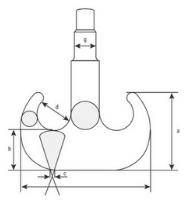
What type of hook is being shown?
Ramshorn.
C shaped.
In general, the ____ is considered as the breaking load of a component, divided by a safety factor, to provide a safe load that can be lifted or carried in a given condition.
Safe working load.
Working load limit.
In general, the ____ is the maximum load (as specified by the manufacturer) that the gear can safely lift.
Working load limit.
Safe working load.
Loose gear is any equipment that is used to attack a load to the lifting appliance, but which does not form an integral part of the appliance.
True.
False.
What tools can the examiner use when examining ropes?
A steel spike.
A pair of clamps.
Callipers.
A grinder.
For normal lifting appliances, terminations must be proof tested to which of the following?
Twice the SWL of the rope.
Five times SWL of the rope.
Ten times SWL of the rope.
A rope failure will almost never result in an accident.
True.
False.
What are valley breaks evidence of?
The rope is too thick for the block.
That the centre of the rope is no longer supporting the strands.
The rope is rubbing against the sheave.
To assess the levels of deterioration in wire ropes, the examiner will do which of the following?
Count the number of visibly broken wires.
Dip the rope in water.
Measure the decrease in the rope's diameter from external wear or abrasion.
Run the rope through their hands and guess the diameter.
Visually assess signs of damage.
What should the proof load be for appliances with an SWL of up to twenty tonnes?
1,1 times the SWL.
1,5 times the SWL.
1,25 times the SWL.
Loose gear does not have to be retested while it satisfies which of the following conditions?
It is clearly identifiable.
It has an appropriate colour code.
It cannot be clearly identified.
It has an appropriate test certificate.
It is in good condition.
Proof testing is designed to evidence that the appliance, gear and attachments are structurally sound and capable of withstanding the operational loads required of them.
True.
False.
Once testing is complete, all lifting equipment must be re-examined to ensure that nothing was damaged during the test.
True.
False.
When must proof testing be carried out?
Before new equipment is introduced into service.
After modifications or repair.
Monthly.
At set periods as required by national regulations.
Six months after equipment has been introduced into service.
Welcome to the website where you can pass online the Mintra test on the subject «Examining Lifting Appliances and Loose Gear». Practice like this will help you as a marine specialist improve your knowledge with the help of online studying and appraisal practice. Mintra based on practical information and marine specialists experience.
The Mintra Test Online about Examining Lifting Appliances and Loose Gear covers safety principles and regulatory requirements related to inspection and testing of lifting equipment on ships, including hazard awareness, survey and certification procedures, and compliance with international standards such as ILO conventions. It also addresses operational impacts of inspection delays and the frequency of mandatory retesting.