* Some questions may have more than 1 correct answer.
Use the search below to find question.
Amount of questions: 5.
Right answers marked with this sign .
Which of the following are precautions that should be implemented to help to control any risks from working with hazardous substances?
Storing chemicals according to the SDS.
Keeping only the minimum quantity of substance necessary.
Ensuring employees are properly trained in the storage and handling of hazardous substances.
Storing compatible substances separately.
Safety Data Sheets, often referred to as SDS, provide detailed information on substances that have the potential to cause harm to people or the environment.
True.
False.
In which ways hazardous substances can enter the body?
1. Inhalation; 2. Absorption; 3. Ingestion; 4. Contact with eyes.
1. Absorption; 2. Inhalation; 3. Ingestion; 4. Contact with eyes.
1. Absorption; 2. Inhalation; 3. Contact with eyes; 4. Inhalation.
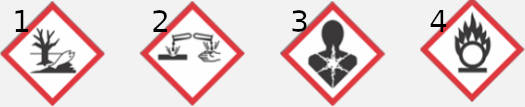
Select the answer which is correct:
1. Dangerous to the Environment; 2. Corrosive; 3. Long term health hazards; 4. Oxidising.
1. Dangerous to the Environment; 2. Oxidising; 3. Long term health hazards; 4. Corrosive.
1. Dangerous to the Environment; 2. Long term health hazards; 3. Oxidising; 4. Corrosive.
Choose the correct order in the control hierarchy, starting with the most preferred option through to the least preferred option.
Welcome to the website where you can pass online the Mintra test on the subject «Handling and Storage of Hazardous Substances». Practice like this will help you as a marine specialist improve your knowledge with the help of online studying and appraisal practice. Mintra based on practical information and marine specialists experience.
The Mintra Test Online about Handling and Storage of Hazardous Substances covers the safe handling, storage, and control of hazardous substances in the workplace, including risk assessment, Safety Data Sheets (SDS), routes of exposure, hazard identification, and the hierarchy of control measures. It also assesses knowledge of safe storage practices, employee responsibilities, and the proper use of protective measures to prevent accidents and health risks.