* Some questions may have more than 1 correct answer.
Use the search below to find question.
Amount of questions: 130.
Right answers marked with this sign .
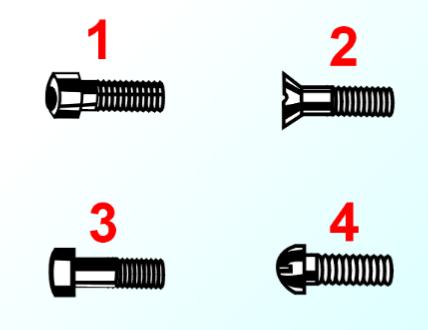
What type of screw is number 2?
A hexagon head screw.
A round head screw.
A countersunk screw.
A cheese head screw.
What type of screw is number 3?
A button head screw.
A hexagon head screw.
A fillister head screw.
A countersunk screw.
What type of screw is number 4?
A hexagon head screw.
A cheese head screw.
A countersunk screw.
A round head screw.
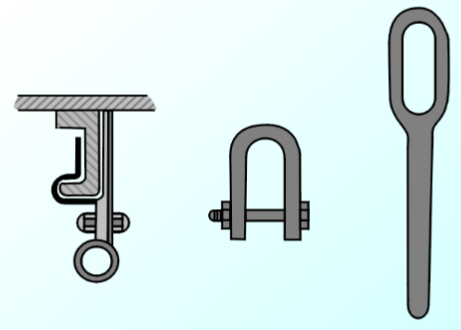
What is the device shown in the centre of the picture?
A connecting bolt.
A U-connector.
A shackle.
A bend connector.
What do you call the lifting device shown on the right side of the picture?
An eye lifter.
An elongated eye lifter.
An elongated bolt lifter.
An elongated eye bolt.
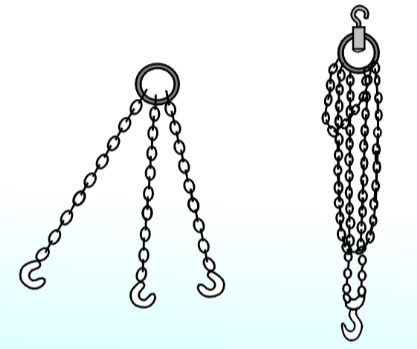
What is shown on the left side of the picture?
A triple hook chain lifter.
A cylinder head lifter.
A cylinder liner pulling chain.
An oil drum lifting chain.
What is shown on the right of the picture?
A chain lifter.
A rattle chain.
A lifting block.
A chain block.
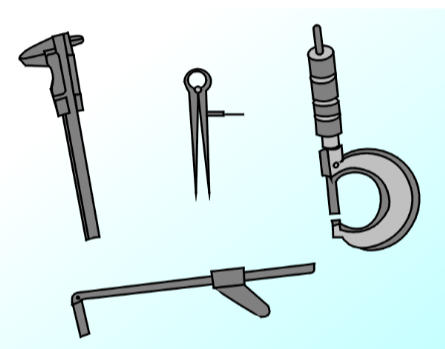
What do you call the measuring device shown top centre?
A metal worker's compass, with spring tension adjustable by screw.
A ship's compass used only on board ship.
A workshop compass found in any workshop, any profession.
A plane level compass.
What is the measuring device shown top right?
A micrometer.
A microcalipre.
A clamp metre.
A stress meter.
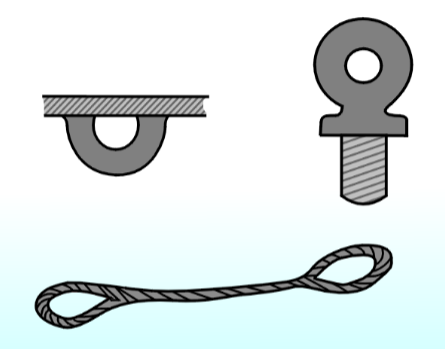
What is shown top left?
An overhead bulkhead eye.
A strop connection.
A loop welding.
A chainblock clamp.
What rigging device is shown at the bottom?
A strop.
A wire sling.
A double loop wire.
A double eye wire strop.
What is shown top right?
An eye bolt.
A connecting bolt.
A shackle bolt.
A strop bolt.
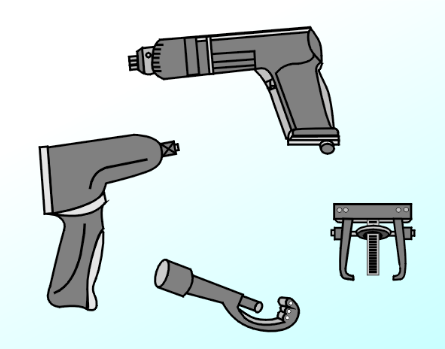
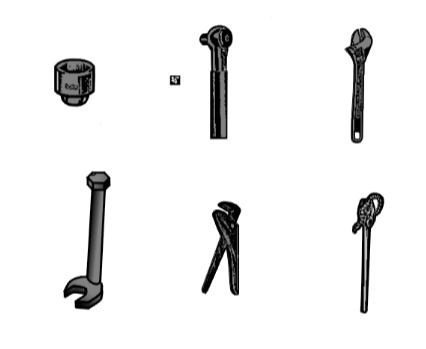
What kind of tool is shown bottom centre?
A pipe flating tool.
A pipe fitting tool.
A pipe cutting tool.
A pipe bending tool.
What is the purpose of the tool shown bottom right?
To extract ball bearings, roller bearings or needle bearings.
To extract pulleys and sleeves from shafts.
To extract bushes and gears from shafts.
All of these.
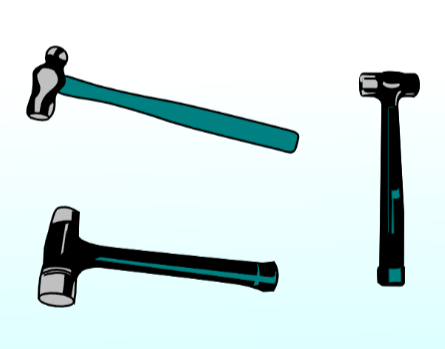
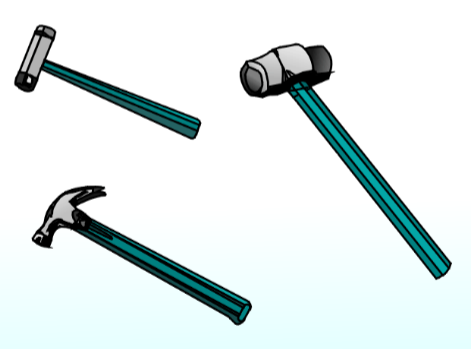
What is the tool shown top left called?
A carpenter's hammer.
Engineer's hammer.
A ball head hammer.
A carpenter's ball hammer.
What kind of hammers are shown bottom left and right side?
Lead hammers.
Recoil-less hammers.
Plastic hammers.
Assemblers hammers.
What kind of hammer is shown top left and for what is it used?
Bell hammer / To knock split pins in place.
Lead hammer / For heavy hammering of frozen nuts and bolts.
Aluminium hammer / For testing tightness of motor covers.
Plastic or Teflon hammer / For light assembly work.
What kind of hammer is shown bottom left and for what is it used?
A common hammer / All purpose engineer's work.
A carpenter's hammer / Used for all purpose work on deck.
A curved hammer / Used for hammering and removing rust.
A claw hammer / For carpentry and wood work, nail removal.
What kind of hammer is shown right side and for what is it used?
Sledge hammer / For all-purpose grudgingly and powerful hammering.
Heavy hammer / For use on large size forged ring spanners.
Moker hammer / To loosen or fastened cylinder head nuts.
Striking hammer / To loosen or fastening torque rings.
What kind of tool is shown top right?
A pocket spanner.
An adjustable pipe spanner.
An adjustable spanner.
A shifter.
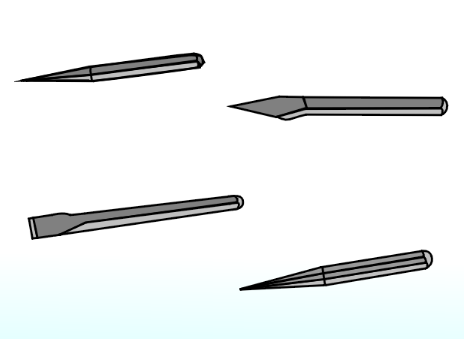
What is the tool shown top left and for what is it used?
Dopper punch / To chisel a small hole trough metal sheets.
Pointed chisel / To chisel a tracing groove.
Centre punch / To mark a point on metal.
Drivel / To push small pins out of their fastening.
What kind of tool is shown top right and what is its purpose?
Cross cut chisel / To chisel grooved profiles in metal.
Sharp cut chisel / For inside piping cutting.
Seam cut chisel / To remove welds and protruding objects.
Traverse cut chisel / To break bolts and nuts.
If you are an engine room rating, what basic technical knowledge must you posses as far as tools and equipment are concerned?
Be able to identify and select the proper tool for each job.
Be able to operate the gas welding equipment.
Be able to operate the drilling machine.
Be able to operate the milling machine.
Before leaving the engine room workshop, you are to ensure that:
The entrance to the shop is secured by padlock.
The inventory of all parts used is filled up.
The lighting is switched off.
All tools are in place, power tool supply is off, all is sea fast.
Auxiliary boilers found on motor ships are usually:
Fire or smoke tube type.
Used to start the main engine.
Used to supply electrical power.
Used to supply electrical power for the ship.
Plate or tubular heat exchangers are used for which of the following?
Heating steam while still in the boiler.
Cooling the main engine fresh cooling water.
Cooling the water for the fire main.
Heating the galley range.
Auxiliary diesel engines on motorships supply:
Electricity for use onboard.
Electricity for use ashore.
Fresh water for drinking.
Lubricating oil for use in the main engine.
Pneupress tanks supply:
Water for the fire main.
Water for the evaporator.
Compressed air to power hand tools.
Water to the accommodation.
Temperature can be measured by a:
Bourdon tube.
Manometer.
Galvanometer.
Pyrometer.
Pressure can be measured by the use of a:
Bourdon tube.
Bimetal strip.
Flowmeter.
Liquid in glass thermometer.
Controllable or variable pitch propellers are:
Propellers that act as a rudder.
The rotary part of a centrifugal pump.
Used to supply fresh water to condensers.
Propellers whose blades are adjustable.
The abbreviation LO stands for:
Left Out.
Lower Outer main engine.
Lubricating Oil.
Lock Out.
The ship's steering gear uses:
Hydraulic power to turn the rudder.
Hydraulic power to turn the propeller.
Compressed air to turn the rudder.
Hydraulic power to drive the bow thruster.
A Bourdon Tube is used to assist the measurement of which of the following?
Pressure.
Temperature.
Length.
Light.
Main air compressors on motorships supply air to which of the following?
Fresh air ventilations.
Main and auxiliary diesel engines.
Turbochargers.
Control room blowers.
Compressed air to operate air powered tools is supplied by which of the following?
Centrifugal pumps.
Pneupress tanks.
Boilers.
Working air compressors.
Onboard ship an evaporator performs which one of the following functions?
It supplies fresh water to the accommodation from the engine room.
It desalinates sea water to make fresh water.
It treats raw sewage by biological degradation.
It dries compressed air after leaving the air compressor.
Centrifugal purifiers are used to remove:
Oil from bilge water.
Dirt and water from compressed air lines.
Small amounts of water from fuel or lubricating oil.
Dirt from accommodation air.
In an auxiliary diesel engine the connecting rod would join which of the following items?
Piston and crosshead bearing.
Crankshaft and crosshead bearing.
Camshaft and exhaust valve.
Piston and crankshaft.
Onboard ship which piece of equipment removes water from fuel and lubricating oil?
A purifier.
An evaporator.
An oily water separator.
A bilge pump.
On a modern ship the main engine lubricating oil is cooled by which of the following?
Air flowing over a radiator.
Sea water in a tubular heat exchanger.
Refrigeration circuit.
Main engine cooling water.
Propellers used to assist the berthing of a ship by pushing it sideways are called:
Steerable propellers.
Bow and stern thrusters.
Controllable pitch main propellers.
Fixed pitch thrusters.
In auxiliary diesel engines timing of the exhaust valve opening and closing is accomplished by:
The crankshaft.
The pushrods.
The camshaft.
The pistons.
Bow and stern thrusters are:
Propellers that force the ship sideways when docking.
Deflectors which thrust the bow or stern into the water.
Rudders at the fore and aft ends of the ship.
Another name for bulbous bows.
Propellers that have adjustable blades are called:
Rotating propellers.
Controllable pitch propellers.
Fixed pitch propellers.
Adjustable propellers.
The majority of auxiliary engines on modern ships are:
Gas turbines.
Four stroke diesel engines.
Large two stroke diesel engines.
Steam turbines.
Working air compressors supply which one of the following?
Compressed air at 7 bar for starting diesel engines.
Compressed air at 30 bar for starting diesel engines.
Compressed air at 30 bar for powering hand tools such as needle guns.
Compressed air at 7 bar for powering hand tools such as needle guns.
Rotary vane and 4 Ram are two types of:
Air compressors.
Purifiers.
Diesel generators.
Steering gear.
In which part of a refrigeration circuit is the low temperature produced?
The condensers.
The compressor.
The evaporator.
The receiver.
Which of the following concerning auxiliary boilers is not true?
They are fitted with gauge glasses to enable a check on the water level.
It is essential that the feed water is completely pure.
They all have at least 2 safety valves.
The steam they generate is not usually superheated.
Diesel engine exhaust flanges will have joints made from:
Paper.
Rubber.
Metal.
Compressed fibre.
Bell or wad punches are used for which of the following duties?
Making round holes in wood.
Cutting round holes in jointing.
Cutting round holes in packing.
Cutting round holes in sheet metal.
Which of the following arrives in drums as well as in bulk?
Lubricating oil.
Fuel oil.
Diesel oil.
Fresh water.
Which of the following is the preferred method of storing large "O" rings?
Hung in a set position in the stores.
Laid across convenient pipe work.
Hung from a hook in the stores.
Laid flat between boards and labeled.
When cleaning or overhauling purifiers, which of the following applies?
The inside must only be cleaned with lubricating oil.
The separation discs must be kept in their correct order.
The discharge ports must be blocked before cleaning.
The water supply should be left on during the whole operation.
With regard to the fuel system of a diesel engine which of the following applies?
The hp fuel pump needs no maintenance during the life of the engine.
The fuel injectors need checking and adjusting at regular intervals.
After a short period the injectors are replaced and the old ones thrown away.
The injectors never need attention during the life of the engine.
Maintenance to a diesel engine's jacket cooling water system consists of:
Chemical analysis and treatment at regular intervals.
Replacement of the water every month.
Topping up the header tank only.
Nothing during the life time of the engine.
Which of the following is true when maintaining air compressors?
The lubricating oil is not changed during the life time of the compressor.
Air filters are changed every day.
Regular changing of the suction and discharge valves is not necessary.
Suction and discharge valves have to be changed frequently for good performance of the compressor.
Before dismantling any equipment, first make sure that it is:
Thoroughly clean on the outside.
Well painted.
Topped up with oil.
Well greased.
With regard to pumps in general which of the following is true?
Corrosion of sea water pumps never happens during the life of the pump.
Bilge pumps do not suffer considerable wear.
Older type material packing is superior to the modern mechanical counterpart.
Main lubricating oil pumps would only normally have to be opened for survey.
The oil lubrication schedule:
Describes the type of oil required by machinery.
Describes when machinery has to be oiled.
Can be found near the generators.
Can be found on the side of each drum of oil.
The name given to the material placed in a valve stuffing box is:
Packing.
Jointing.
Plastic.
Sealant.
On a ship operating the UMS system, entry into the engine room would only be under which of the following conditions?
During the day, on your own, without permission.
During the day, with another person, without special permission.
At night without permission.
When a blue light is flashing and a klaxon is sounding.
A watchkeeping engineer normally works in the engine room for which of the following periods?
4 hours on 8 hours off.
12 hours on 12 hours off.
Has every weekend off.
For 24 hours in every 72 hours.
Which of the following is carried out every day on main boilers to keep them running efficiently?
Cooling down then starting up again.
Blowing the soot from the tubes.
Changing to a lighter grade of fuel.
Draining the water out.
Indicate which of the following systems needs regular chemical analysis and treatment?
The fuel oil system.
The bilge water system.
The jacket cooling water system.
The purification system.
Which of the following diesel engine components require the most frequent maintenance?
Lubricating oil filters.
Exhaust valves.
Inlet valves.
Cylinder heads.
Before beginning maintenance on a valve, what is the first action you should take?
Close the valve.
Isolate the valve.
Remove the packing from the valve gland.
Slack off the flange bolts.
When taking on fuel which of the following does not apply?
Scuppers in the immediate area of pipelines on deck should be plugged.
The flexible pipelines should be watched during the operation.
There should be efficient two-way communication between the ship and the fuel tender.
Fuel tank air vents should be blocked off.
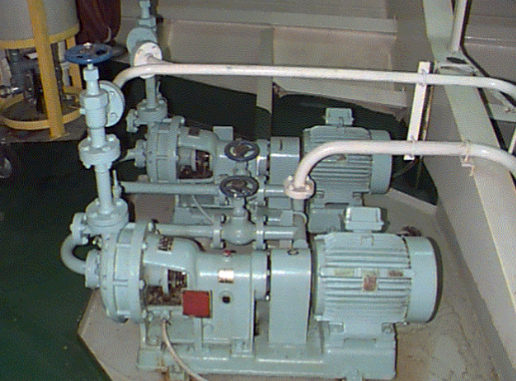
What is shown in this picture?
A compressor with an electric motor.
A pump with an electric motor.
A generator.
A fresh water generator.
Which of the following regarding separation discs is true?
They are found in air compressors.
They form part of a purifier and should be kept in the correct order.
They are only found on diesel engines.
Separation discs are stationary when in operation.
For good reliable service from air compressors which of the following needs to be changed on a regular basis?
Lubricating oil.
Piston rings.
Lubricating oil filter.
Suction filter.
The person in charge of the day to day running of the engine room is most often:
The second engineer.
The watchkeeping engineer.
The chief engineer.
The junior engineer.
The part of the valve which stops leakage around the valve spindle is called:
The stuffing box.
The body.
The spigot.
The bridge piece.
Ship's bunkers are:
Another name for the ship's beds.
A name to describe the spare gear held onboard.
The stores that arrive on board when a ship is newly built.
The fuel and lubricating oil used for the operation of the ship.
To ensure a continuous routine check of the machinery, which of the following is carried out?
The watchkeeper reports to the chief engineer every hour.
A verbal report is made to the chief engineer after the working day.
An official document called the engine room log is completed at regular intervals.
The engineering watchkeeper is trusted to carry out this task without recording the fact.
In the modern cross-head type diesel engine, the main purpose of the piston rod stuffing box is:
To keep the piston rod straight.
To reduce the risk of scavenge fires.
To protect the cross head bearing.
To prolong the life of the piston rings.
Various valves and fittings attached to the pressure parts of the boiler are called the "boiler _____".
Attachments.
Controls.
Mountings.
Fittings.
Which of the following materials would be most suitable for flange jointing of pipework carrying lubricating oil?
Rubber.
Metal.
Compressed fibre.
Reinforced compressed fibre.
Marine diesel engines are which type of engines?
Spark ignition engines.
Steam powered.
Gas powered.
Compression ignition engines.
An air compressor driven by the exhaust gases is called:
A forced draught fan.
A turbo-charger.
An induced draught fan.
A super charger.
A boiler fitting known as a gauge glass, is used for which of the following reasons?
To measure the water flow to the boiler.
To allow the easy reading of the pressure gauge.
To indicate water level.
To indicate fuel flow.
In a marine diesel engine , what cools the cylinder liner?
The lubricating oil.
Circulating fresh water.
Circulating sea water.
Heat is carried away via the piston.
The boiler part known as the feed check valve, performs which of the following functions?
It controls the steam leaving the boiler.
It protects the boiler from the effects of over-pressure.
It controls the amount of fuel entering the boiler.
It has final control over the water entering the boiler.
Modern high pressure water tube boilers have which of the following:
Water in the tubes and are roof fired.
Water on the outside of the tubes with the burners at the bottom.
Small and compact in size and are inefficient.
The capability to power the diesel engines.
Which of the following types of main propulsion units is the slowest turning?
HP steam turbines.
LP steam turbines.
Medium speed trunk piston types.
Cross head 2 stroke diesel engines.
On a boiler the main steam outlet is called:
The main stop valve.
The air vent.
The feed check valve.
The blow down valve.
The type of main engine known as a trunk piston type engine is usually which of the following?
A steam engine.
A slow speed diesel engine.
A gas turbine engine.
A medium speed diesel engine.
The term "compression ignition engine" defines:
A petrol engine.
A steam engine.
A steam turbine.
A diesel engine.
Which of the following is true of large two stroke slow speed engines?
They are not turbo-charged.
They are of the trunk piston type.
They have a special bearing called a crosshead bearing.
They only run at 400-500 rpm.
During the 4-stroke cycle of a diesel engine, which of the following is true?
The exhaust stroke comes immediately before the power stroke.
The compression stroke is the power stroke.
Air is drawn into the cylinder during the induction stroke.
Fuel is injected immediately after the exhaust stroke.
Superheated steam is used:
To start diesel engines.
To keep gas turbine engines warm.
To provide power for conventional steam turbines.
To provide heat for the accommodation.
Engine clutches are used with which type of main engine?
Medium speed engines.
Slow speed engines.
High pressure steam turbines.
Low pressure steam turbines.
What is supported by the main shaft bearings?
The turbocharger.
The camshaft.
The propeller shaft.
The ventilation shaft.
Turbocharging an engine is the operation providing extra intake air to the engine using which of the following?
A compressor driven from the crankshaft.
An electruically driven air compressor.
A compressor driven by an exhaust gas powered turbine.
A steam driven turbine.
Modern cross head marine diesel engines are:
Very small and compact.
Fitted with many small cylinders.
Never used as direct drive engines.
Large 2-stroke slow speed engines.
Rubber jointing is used for the flanges of pipework carrying which of the following?
Water.
Superheated steam.
Corrosive chemicals.
Oil.
The connecting rod on a cross-head diesel engine is attached to which of the following?
Piston and crankshaft.
Piston and cross-head bearing.
Cylinder head and exhaust valve.
Cross-head bearing and crankshaft.
A boiler mounting is:
The bed plate on which the boiler is mounted.
Equipment external to the boiler.
The various valves and fittings attached to the pressure part of the boiler.
The boiler burner.
On a boiler, the valve fitted to protect the boiler from the effects of over pressure is called:
The blow down valve.
The main stop valve.
The safety valve.
The feed check valve.
In a marine diesel engine, the piston runs up and down inside which of these?
The cylinder conductor.
The cylinder aperture.
The cylinder facing.
The cylinder liner.
The bilges in a ship are:
The floor plates at the bottom of the engine room.
Another name for sludge tanks.
The division bulkheads in an engine room.
The lowest part of the ship retaining dirty water from leaks.
Which of the following is NOT a boiler mounting?
Air vent.
Gauge glass.
Blow down valves.
Burner air flaps.
Fresh water on board a modern ship is produced by which of the following?
Purifiers.
Evaporators.
Alternators.
Pneupress tanks.
Which part of a marine diesel engine can be inspected through the crankcase doors?
The piston crown.
The bottom end.
The exhaust valve.
The inlet valve.
Saturated steam is produced:
To power steam turbines.
To heat fuel in tanks or to heat accommodation.
To start diesel engines.
To power turbo alternators.
During the four stroke cycle, which of the following is true?
The injection of the fuel is immediately after the induction stroke.
The exhaust stroke takes place immediately after the power stroke.
After the exhaust stroke the next cycle begins with the compression of the gases.
Injection of fuel takes place at the end of the power stroke.
Which of the following applies to main medium speed engines?
They are fast engines requiring reduction gearing before driving the propeller shaft.
They are usually two stroke engines.
They are never used to power ships.
They supply compressed air to drive high-speed engines.
Indicate which of the following main propulsion engines is the largest?
Steam turbines.
Slow speed diesel engines.
High speed diesel engines.
Medium speed diesel engines.
Indicate which of the following main propulsion engines has the fastest rotation speed?
Slow speed diesel engines.
Medium speed diesel engines.
Steam turbines.
Steam reciprocating engines.
A hacksaw blade is placed in the body of the hacksaw with the teeth facing:
Up and towards the handle.
Down and away from the handle.
Up and away from the handle.
Down and towards the handle.
The diameter of a hole in a piece of metal can best be measured using:
Feeler gauges.
Inside calipers.
Outside calipers.
An engineer's square.
A tool should be used:
For a variety of functions according to circumstances.
For at least 2 different functions.
Only for the function for which it was designed.
With regard to the correct shape of its handle.
Which of the following spanners is best to use in most cases?
The correct size ring spanner.
A parallel jaw adjustable spanner.
The correct size open-ended spanner.
A pair of stillsons.
A machine tool used for reducing the diameter of a round bar is called:
A pillar drill.
A centre lathe.
A bench grinder.
A milling machine.
The diameter of round bar is best measured with the aid of:
Feeler gauges.
Inside calipers.
Outside calipers.
An engineer's square.
In a set of thread taps the plug tap has:
A slight taper at its end.
No thread at all.
The full thread to the end.
A larger taper at its end.
The part of the centre lathe which holds the cutting tool is called:
The saddle.
The tailstock.
The compound slide.
The tool post.
Drilling a hole with a drill in the end of a piece of round bar is best carried out using which of the following?
A pillar drill.
A centre lathe.
A milling machine.
A shaping machine.
After using hand or power tools, they should be:
Left beside the job for use next time.
Returned to their allotted stowage position.
Returned to the workshop bench.
Returned to the duty engineer.
Side cutters are used:
To cut the side of metal.
To hold metal while it is being cut.
To hold cold metal.
To cut electrical wiring.
The tool used for scoring lines on metal surfaces is called a:
A scriber.
A centre punch.
A pin punch.
A hammer.
A hammer with one flat end to its head and one half round end is called:
A chipping hammer.
A half round hammer.
A claw hammer.
Engineer's hammer.
The file known as a "bastard" file is which of the following?
One that is extremely smooth.
One having an edge with no teeth.
One that is rough and flat.
One having a side rounded so it is half round.
Spanners which have one end as a ring spanner and the other end an open ended spanner are called:
Half ring spanners.
Combination spanners.
Half open ended spanners.
Socket spanners.
The tool used for marking out a circle on steel is called:
A pair of dividers.
Oddleg calipers.
Inside calipers.
Outside calipers.
Twist drills can be sharpened with the aid of which of the following?
A pistol drill.
A wire brush.
The bench grinder.
A file.
A tool used to mark the centre for a twist drill is called:
A pin punch.
A pair of dividers.
A scriber.
A centre punch.
The part of a hand drill which holds the drill bit is called:
The spindle.
The chuck key.
The handle.
The chuck.
Die nuts are used for which of the following?
Cutting a new thread in a hole.
Cutting a thread on a round bar.
Cleaning an existing thread.
Holding and turning dies.
Welcome to the website where you can pass online the SETS test on the subject «ES3: Maintenance and Repair of Machinery». Practice like this will help you as a marine specialist improve your knowledge with the help of online studying and appraisal practice. SETS based on practical information and marine specialists experience.
SETS tests developed for evaluating seaman basic knowledge by company “Naval Education Services” is an evaluating online-tool, used for revealing any professional preparation needed in specific fields of knowledge, defined by STCW Section A-V/1-2.
SETS tests have proven themselves as good tools for the selection and recruitment process, as well as advancing the level of knowledge of the current officers and crew.
Current test contains SETS questions in area «Maintenance and Repair of Machinery». Those questions can be used for competence verification specialist capable of preventing accidental situations related with transporting safety, or also for self-examination.
«Maintenance and Repair of Machinery» subject includes theoretical and practical information about advanced training for work on any type of vessel. This comprehensive test evaluates a candidate’s systematic understanding of both planned maintenance systems (PMS) and corrective repair procedures for shipboard machinery. It requires examinees to identify the appropriate tools, safety protocols and personal protective equipment (PPE) for specific maintenance tasks on various engine room systems. A significant part of the assessment focuses on interpreting manufacturer’s manuals and technical data sheets to determine correct tolerances, clearances and lubrication specifications. Practical, scenario-based questions test the ability to diagnose common machinery failures, such as abnormal pump vibrations or loss of pressure in a refrigeration system. Sailors must demonstrate knowledge of correct dismantling, inspection, overhaul and reassembly sequences for critical components like centrifugal pumps or air compressors. The test assesses the understanding of different maintenance strategies, including predictive, preventive and condition-based maintenance, and their application in a maritime context. It includes questions on material science, such as selecting the correct gasket material, weld type, or replacement part based on its properties and the operating environment. Successful completion verifies the advanced practical competency required to plan, execute and document machinery repairs, ensuring operational safety and reliability at sea.