Resume for seaman encompasses their professional profile – including qualifications, experience, and skills – and is designed to attract greater attention from crewing agencies and prospective employers.
A seafarer has returned from another voyage, gained new work experience, possibly upgraded their qualifications or renewed the necessary documents. It may seem that they can simply send their previous CV to crewing agencies. However, the CV used before the last contract may already contain outdated information.
The dates of the latest employment have changed, sea service has increased, and a new vessel entry may need to be added. Certificates, the medical certificate or visa details may also have been updated. If the seafarer has been promoted, their new rank and experience in that position must also be properly reflected.
That is why it is worth taking some time to review your CV after every sign-off. This allows you to prepare an up-to-date resume in advance rather than rushing to make corrections when a suitable vacancy has already become available.
Why You Should Update Your CV After Every Contract
A seafarer’s CV is not a document that is prepared once and used throughout their entire career without any changes. It should reflect the seafarer’s current professional status:
- Their rank;
- Sea service;
- Experience on specific vessel types;
- Qualifications and readiness for the next contract.
After returning from a voyage, several important details may have changed:
- A new period of sea service has been added;
- The dates of the latest contract have changed;
- More experience has been gained on a particular vessel type;
- A promotion has taken place;
- New certificates have been obtained or existing ones renewed;
- The validity periods of the medical certificate and visas may have changed;
- A new availability date has been established.
Even if a seafarer continues working in the same position, the details of the latest vessel and the duration of the contract must be added to the CV.
An up-to-date CV is important not only when applying for a specific vacancy. Many crewing companies maintain candidate databases to find suitable specialists for future contracts as well. If the information in a profile has not been updated, a recruiter may assess a candidate based on their previous experience and overlook their recent professional achievements.
What to Change in Your CV After Returning from a Voyage
Updating your CV is best done systematically. First, add the details of your latest contract, then review your qualifications and documents, and finally update your personal information and availability for the next employment opportunity.
1 Add Your Latest Vessel
In the Sea Service/Work Experience section, enter the vessel on which you worked during your latest contract.
Check the following details:
- Vessel name;
- Vessel Type;
- Rank held during the contract;
- Shipowner or operating company, if required by the CV format;
- Main vessel specifications, if relevant to your position.
Do not limit the entry to the vessel’s name alone. Employers are interested in the nature of your previous experience. For example, working on a container ship, oil tanker, bulk carrier or gas carrier involves different professional responsibilities and crew training requirements.
2 Check Your Sign-on and Sign-off Dates
After completing your contract, enter the actual dates of joining and leaving the vessel.
These details must match the documents confirming your sea service, such as the entries in your Seaman’s Book, a sea service letter or another document issued by the shipowner or an authorised organisation.
Do not round the dates to whole months or enter the expected contract duration instead of the actual period worked. Even a minor discrepancy between your CV and supporting documents may raise additional questions when your experience is verified.
If your contract was extended, include the entire actual period of employment on board.
3 Update Your Rank and Include Any Promotion
If you were promoted during your latest contract, this is one of the most important changes to make to your CV.
For example, if a Second Officer (2nd Officer) was promoted to Chief Officer, the CV should correctly show both periods of employment:
- Previous contracts – showing the rank of 2nd Officer;
- Latest contract – showing the rank of Chief Officer.
Do not simply replace your previous rank with the new one throughout the CV. A seafarer’s CV should show their actual career history and verified experience in each rank.
It is also important to distinguish between obtaining a higher-level CoC and actually being appointed to the corresponding position. Having a new certificate of competency does not automatically mean that a seafarer has already gained experience in the new rank.
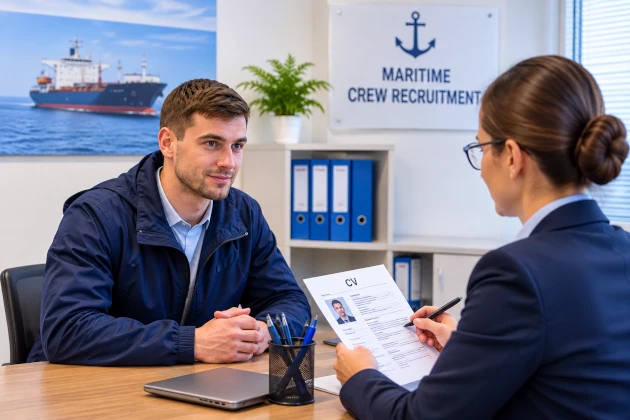
How to Write a Seafarer’s CV: What Crewing Really Looks at When HiringRecruiter reviewing a seafarer’s CV and reviewing the CV of a seafarer applying for a job.
If you have not yet been promoted but have obtained the required qualifications and are ready to be considered for the next rank, you can mention this separately in your profile or cover letter.
4 Check the Vessel Specifications
After completing another contract, check whether the specifications of your latest vessel are correctly listed. Depending on your rank and specialisation, the following details may be important:
- Vessel Type – type of vessel;
- DWT – deadweight;
- GT – gross tonnage;
- Cargo Type – type of cargo carried.
For example, for deck officers, experience on specific types of tankers, bulk carriers or container ships may be important when applying for similar vessels. For marine engineers, the type of main engine, its manufacturer and the characteristics of the propulsion plant are also relevant.
These details help recruiters determine how closely a candidate’s previous experience matches the requirements of a particular vacancy.
This is particularly relevant when selecting candidates for vessels with specific technical characteristics. Christiania Shipping‘s internal procedure, Christiania Shipping Crew Recruitment and Processing (document CRW-010, version 08, dated 1 April 2025), requires every candidate’s CV to be checked by a crewing agent.
During the selection process, particular attention is paid to cargo type experience, experience with specific main engine types, sea service on vessels with deadweight comparable to the company’s fleet, and experience in a particular rank on chemical and other tankers.
The requirements for cargo experience and engine experience depend on the position. For example, Cargo Type Experience is considered for deck officers and pumpmen, while Main Engine Experience is relevant to marine engineers and electro-technical officers.
If the exact DWT, GT or engine power figures are unknown, it is better to check the vessel’s documents rather than try to remember them.
5 Recalculate Your Total and Rank-Specific Sea Service
After adding your latest contract, check your total sea service.
It is important not only to increase the overall number of months or years but also to correctly allocate your experience by rank and vessel type.
For example, a CV may include separate entries for:
- Total Sea Service – total sea service;
- Sea Service in Rank – experience in a specific rank;
- Tanker Experience – experience working on tankers;
- Container Vessel Experience – experience working on container ships;
- Engine Experience – experience with specific engine types.
Do not automatically add the duration of your latest contract to every category. Include only the experience actually gained on the relevant vessel type or in the specific rank.
Also check for overlapping periods, calculation errors and discrepancies with supporting documents.
6 Add New CoC, STCW and Additional Certificates
After returning from a voyage, review the Certificates section. During the contract, you may have completed training, obtained a new document or renewed an existing certificate.
Your CV should include:
- Certificate of Competency (CoC);
- Documents confirming completion of STCW training;
- Certificates related to working with specific vessel types and cargoes;
- Additional professional certificates;
- Special endorsements and authorisations required for your position.
For each document, check its title, number, date of issue and expiry date, where applicable.
Pay particular attention to certificates required for specific vessel types. For example, working on tankers may require relevant cargo operations training certificates. The list of required documents will differ for other specialisations.
If a certificate has been renewed or replaced, your CV must contain the updated information. Do not leave the old dates in place even if the document itself has already been renewed.
7 Check the Validity of Your Medical Certificate
The medical certificate is one of the documents that must be checked before looking for a Common Errors in a Seafarer’s CV Before Submitting It to a Crewing Agencynew contract.
Check the following:
- Date of the medical examination;
- Certificate expiry date;
- Organisation or doctor who issued the document;
- Any restrictions listed on the certificate.
The validity period of a medical certificate is governed by Regulation I/9 of the STCW Convention and the related requirements of Section A-I/9 of the STCW Code.
According to Regulation I/9, the maximum validity period is two years for seafarers aged 18 and over and one year for seafarers under 18. However, a doctor may issue a certificate for a shorter period if a seafarer’s health condition requires additional medical monitoring or a shorter period of fitness for duty.
There are also exceptional circumstances. If a medical certificate expires during a voyage, it remains valid until the next port of call where a recognised medical practitioner is available, but for no longer than three months. In emergency situations, the Administration may also permit a seafarer to work without a valid certificate for up to three months if the document has only recently expired.
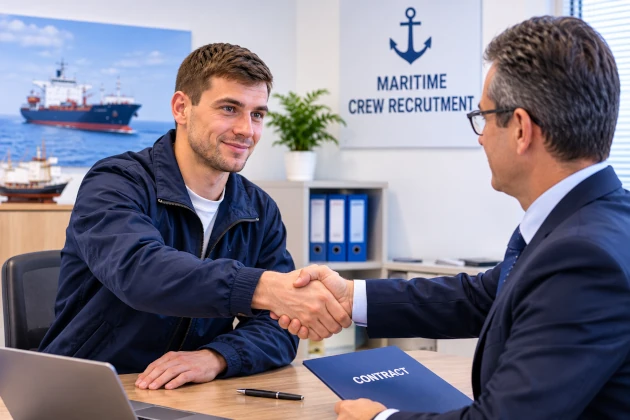
Seafarer’s employment contract approved.
The employment contract has been concluded – the seafarer’s CV has been approved.
Therefore, before looking for a new contract, you should check not only the expiry date of your Medical Certificate but also any restrictions specified in it. The requirements of the flag State and employer should also be taken into account when preparing for the next voyage.
8 Update Your Visas, Endorsements and Other Documents
Check your visas, endorsements and additional documents that may be required for your next contract.
Depending on the vessel’s trading routes, flag State, seafarer’s nationality and employer requirements, these may include:
- A valid US Visa;
- Visas for other countries, if required;
- Flag State Endorsement;
- Documents confirming recognition of your CoC;
- Seaman’s Book;
- International passport;
- Other permits and professional documents.
Not all this information necessarily needs to be included directly in your CV. Some companies collect these details in a separate application form or candidate profile.
The main thing is to ensure that the information in your CV, application and supporting documents does not contradict itself. If a visa or endorsement has expired, do not list it as valid.
9 Specify Your Current Availability
After completing your contract, make sure to update the date when you will be ready to join another vessel.
In international practice, this parameter is often referred to as Availability or Earliest Availability Date.
Do not automatically use your sign-off date. After returning home, a seafarer may need time to rest, arrange documents, undergo a medical examination or deal with family matters.
Enter the actual date when you will be ready to start your next contract.
Why is this important? Even a candidate with suitable experience and qualifications may not meet the joining schedule for a particular vacancy.
10 Check Your Contact Details and Additional Skills
After spending several months at sea, it is also worth checking your contact details. In addition, if your English proficiency has improved or you have gained new experience working in an international crew during your latest contract, this information should also be reflected in your CV.
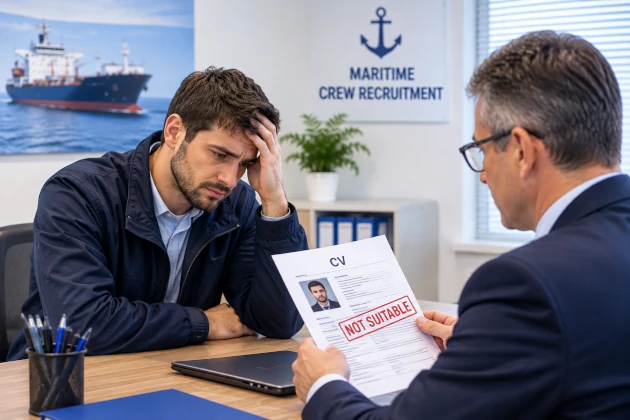
Seafarer rejected for a job.
The seafarer’s CV has not been approved.
Make sure your CV includes:
- A current phone number with the international country code;
- An active email address;
- Your country and city of residence, if required by the CV format.
Check that your email account is accessible and that messages from crewing companies are not being sent to your spam folder. If your phone number or email address has changed, update your details in all application forms and profiles where you previously registered.
Also review the information about your additional professional skills:
- English Knowledge – specify your current level of English proficiency. If you have completed a language assessment or obtained a relevant certificate, include the results or document details.
- Mixed Crew Experience – if you worked in an international mixed crew for the first time during your latest contract or gained additional experience communicating with seafarers of different nationalities, include this in your CV.
These details may be relevant during the candidate selection process. For example, Christiania Shipping’s internal procedure requires a preliminary CV screening for every candidate. English proficiency and experience working in a mixed crew (English Knowledge + Experience Sailing with Mixed Crew) are specifically listed among the screening criteria.
Therefore, do not limit your CV to a list of certificates and sea service. Show the professional skills and experience you have gained during your latest contract.
How Crewing Companies Use Up-to-Date Seafarer Information
The need to update a CV regularly is supported not only by practical considerations but also by the recruitment practices of major companies involved in maritime personnel selection.
Let’s look at three examples.
1 OSM Thome: Updated CV and Supporting Documents
OSM Thome uses a candidate registration system where seafarers can create a profile, upload their CV and apply for suitable vacancies.
The company’s published vacancies include requirements to provide:
- Updated CV;
- Passport;
- Seaman’s Book;
- CoC;
- STCW Certificates;
- A valid medical certificate and other documents.
For example, in an Expression of Interest vacancy for passenger fleet specialists, the company lists an up-to-date CV and supporting documents among the materials required for an application.
This shows that updating a CV should go hand in hand with checking the documents that confirm the qualifications and experience stated in it.
2 Columbia Shipmanagement: Experience and Availability Date
Columbia Shipmanagement accepts CVs not only for advertised vacancies but also through its General Application form.
Candidates can submit their CV for consideration for future vacancies and provide additional information about their qualifications, experience and earliest availability date.
Therefore, information about the latest contract and readiness to join a vessel must be up to date even if the seafarer is not currently applying for a specific vacancy.
3 Danica: The Ability to Keep Your Profile Updated
Danica Crewing Specialists uses an online platform where seafarers can create CVs, browse vacancies and update their details.
The company explicitly states that candidates can regularly update their information in its database. This allows their qualifications and professional experience to remain current.
Therefore, it is not necessary to submit a completely new CV from scratch every time. If a company uses a candidate profile, it is important to update the information in that profile promptly.
Checklist: What to Check in Your CV After Every Voyage
Before sending your CV to a crewing company, go through this short checklist:
- Last Vessel – the latest vessel has been added.
- Rank – the actual position held is specified.
- Sign-on/Sign-off – contract dates have been checked.
- Vessel Type – vessel type has been confirmed.
- DWT/GT – technical specifications have been checked.
- Engine/Cargo – relevant engine and cargo details have been added.
- Total Sea Service – total sea service has been recalculated.
- Sea Service in Rank – experience in each rank has been updated.
- CoC – certificate details have been checked.
- STCW/Additional Certificates – new documents have been added and validity periods updated.
- Medical Certificate – validity period has been checked.
- Visas/Endorsements – information about valid documents has been updated.
- Availability – the actual date of readiness for the next contract has been specified.
- Contact Details – phone number, email and WhatsApp details have been checked.
After completing the review, save the new version of your CV as a PDF. Use a clear and understandable file name.
It is better not to send the old version together with the new one, as this may cause confusion during the application review process. Also check that the information in the PDF matches the details in your online profiles with crewing companies.
Keep Your CV Up to Date with Sea-Man
Don’t want to update your CV yourself every time you return from a voyage or renew your documents?
Sea-Man can help you keep your CV up to date:
- Add details of your latest contract;
- Recalculate your sea service;
- Update your rank;
- Add certificates and check your information before your next job search.
An up-to-date CV will help you avoid wasting time making urgent corrections when a suitable vacancy becomes available. After every sign-off, all you need to do is check the changes and prepare your documents for the next stage of employment.


