Seafarers may be required to pass iTEST when applying for a job or undergoing a selection process at a crewing company. The test helps assess a candidate’s professional knowledge and readiness to work on board a vessel.
In this guide, you will learn how to prepare for iTEST, which topics to review before the assessment, and how to approach the questions. We will also look at sample questions with answers and explanations. This will help you assess your knowledge, identify gaps in your preparation, and approach the test with greater confidence when applying for a job.
What You Need to Know Before Taking iTEST
What is iTEST?
iTEST is a computer-based assessment system developed by IDESS IT specifically for maritime education, training, and the assessment of seafarers’ competencies. The system is designed for use by maritime academies, shipping companies, and organisations that assess maritime professionals. It is based on a question bank containing more than 5 000 questions related to STCW competencies.
Before taking iTEST, it is important to find out exactly which test you will be required to complete. The questions you receive depend on:
- your position on board;
- the crewing company’s requirements;
- the purpose of the assessment.
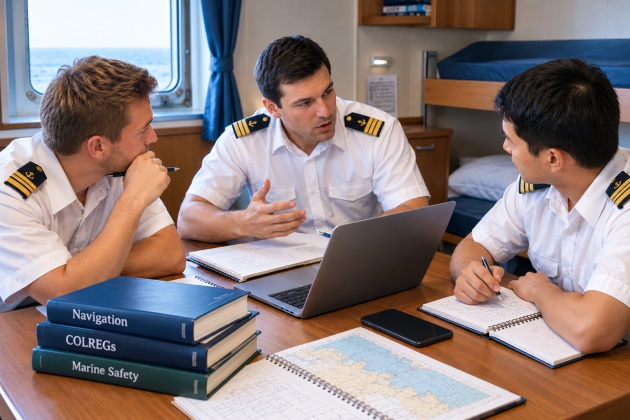
For example, candidates applying for Port State Control: a Deck Officer’s Field Guidedeck officer positions may be expected to demonstrate knowledge of:
- navigation;
- the International Regulations for Preventing Collisions at Sea (COLREGs);
- onboard safety.
For members of the engine department, relevant areas of knowledge include:
- the operation of machinery and equipment;
- maintenance and repair;
- engine room safety.
Ask the company’s representative in advance which topics you should review, how much time you will have to complete the test, and how the assessment will be conducted – online or at a designated testing centre. You should also find out whether you can return to previous questions and whether reference materials are permitted.
Do not assume that all the questions will be familiar or that the test will be identical to the ones you have completed before. It is better to revise the main professional subjects and understand the rules and procedures on which the correct answers are based.
How to Prepare for iTEST: a Step-by-Step Plan
Preparation does not necessarily have to take a long time. The key is to study systematically and focus more attention on topics you are less confident about. Use the table below as a brief preparation plan before taking iTEST.
| Preparation stage | What to focus on |
| Company requirements | Your position, test format, and topics being assessed |
| Professional knowledge | Navigation, marine machinery, or other subjects relevant to your specialisation |
| Safety procedures | Actions to take in the event of a fire, an emergency, or another hazardous situation |
| Practice | Practice questions and timed exercises |
| Reviewing mistakes | Revisiting topics that caused difficulties |
| Technical preparation | Device, internet connection, and access to the testing system, if the test is conducted online |
Step 1. Clarify the company’s requirements. Start by finding out about the upcoming assessment. Ask which position you are being assessed for, what knowledge will be evaluated, and whether the company provides any preparation guidelines. This will help you avoid wasting time on topics that are not relevant to your job.
Step 2. Review your professional knowledge. First, refresh your memory of the rules and procedures you use on board. Deck officers should review:
- navigation;
- COLREGs;
- emergency response procedures;
- safety requirements.
Engine department personnel should focus on the operation of marine machinery, maintenance procedures, and the correct actions to take when equipment malfunctions.
Read also: CES Test for Engine Cadet (Questions and Answers): Complete 2026 Guide & Exam Prep
Do not limit yourself to memorising answers. Try to understand why one option is correct and the others are not. This will help you deal with questions worded differently from those in your study materials.
Step 3. Practise with test questions. Work through questions relevant to your specialisation and check your answers after each set. If the actual test is timed, practise under similar conditions. This will help you get used to reading questions carefully and selecting answers without rushing unnecessarily.
Step 4. Review your mistakes. Do not move straight on to new questions if you made mistakes in the previous set. Find out why an answer was incorrect: did you forget a rule, misunderstand the question, or confuse similar answer options? Review the relevant topic and complete several additional practice questions.
Step 5. Check your technical readiness. If the test is conducted online, check the following in advance:
- your computer or another permitted device;
- your internet connection;
- your access to the testing system.
Find out whether you need any special software, a login, or a password. Before starting the assessment, read the organiser’s instructions carefully.
iTEST Practice Questions with Answers and Explanations
To prepare more effectively for the assessment, it is useful to work through several practice questions in advance. They will help you check your knowledge and understand which details to consider when selecting an answer. The questions below are examples for self-study. They are not confirmed questions from the iTEST question bank. Actual questions depend on the position and the company’s requirements.
Example 1. A professional knowledge question: «What should a navigator do if a risk of collision with another vessel is detected?»
A Continue on the same course if the other vessel is still far away.
B Wait for the other vessel to alter course.
C Stop the vessel immediately under all circumstances.
D Assess the situation and act in accordance with COLREGs.
Correct answer: D.
Explanation: The officer responsible for navigation must assess the situation, determine whether a risk of collision exists, and take the necessary action in accordance with the International Regulations for Preventing Collisions at Sea (COLREGs). The appropriate action depends on the specific circumstances, so there is no single solution that applies to every situation.
Example 2. An onboard safety question: «What should you do if you discover a fire on board?»
A Attempt to extinguish the fire yourself without informing anyone.
B Report the fire, raise the alarm in accordance with the vessel’s procedures, and follow the established instructions.
C Leave your workstation and abandon the vessel on your own.
D Wait for other crew members to notice the fire.
Correct answer: B.
Explanation: If you discover a fire, you must report it immediately and follow the vessel’s emergency procedures. If the situation permits and you are trained to use firefighting equipment, you may take appropriate action within the scope of your duties, provided you do not put yourself in danger.
Example 3. A situational question: «While working in the engine room, you notice an unusual noise coming from operating machinery. What should you do?»
A Continue working and inspect the machinery at the end of your shift.
B Dismantle the machinery yourself without authorisation.
C Report the issue to the responsible officer or engineer and follow the vessel’s procedures.
D Shut down all equipment in the engine room.
Correct answer: C.
Explanation: Unusual noise may indicate a malfunction. You should report it to the responsible officer or engineer and follow their instructions in accordance with established procedures. Taking action without properly assessing the situation may damage equipment or cause injury.
It will be interesting: CES Test for Seafarers – Complete Guide 2026
These examples show that effective preparation involves more than memorising rules. You also need to understand how to apply them in practice. If you are unsure about an answer, review the relevant topic and revise it before taking the test.
iTEST Questions and Answers for a Third Officer
Let us look at some examples for a Third Officer. They cover navigation, collision avoidance, and related subjects. The following questions and answers are from the iTEST question bank.
Question 1. «Your power driven vessel is following а traffic separation scheme. Risk of collision exists with this vessel. Which of these statements is соrrесt?»
A Own ship is the stand оn vessel.
B Own ship is the give way vessel.
C Own ship should not impede the passage of the vessel ahead.
D Own ship should not impede the safe passage of the vessel ahead.
Correct answer: B.
Explanation: If your vessel is overtaking another vessel, Rule 13 of COLREGs applies. The overtaking vessel must keep out of the way of the vessel being overtaken.
Question 2. «The compass bearing of this vessel is steady and range is decreasing. Which of these actions should you take?»
A Sound one short blast аnd alter course to Starboard.
B Maintain course and speed.
C Call the vessel on VHF and ask what her intentions are.
Correct answer: A.
Explanation: A steady bearing combined with decreasing range indicates a possible risk of collision. If the situation requires a manoeuvre to avoid collision, you must act in accordance with COLREGs. One short blast indicates that a vessel is altering course to starboard. However, a sound signal does not replace the manoeuvre itself, and any alteration of course must be made in good time and be sufficiently substantial to be readily apparent to the other vessel.
Question 3. «You are proceeding along а narrow channel. Risk оf collision exists with this vessel. Which statement is correct?»
A Own ship is the stand оn vessel.
B The other vessel is the stand оn vessel.
C The other vessel must not impede the passage of own ship.
D Own ship must not impede the passage of the other vessel.
Correct answer: C.
Explanation: Under Rule 9 of COLREGs, a vessel of less than 20 metres in length or a sailing vessel must not impede the passage of a vessel that can safely navigate only within a narrow channel or fairway.
When What is iTEST by IDESS: a Seafarer Testing Systempreparing for iTEST, a Third Officer should not only memorise rule numbers but also understand how to apply the rules in practice. It is therefore useful to alternate questions that test knowledge of the wording of the regulations with scenario-based exercises that require you to identify the correct action.
The question set will differ for other positions. For example, a Second Engineer would be more likely to encounter questions on the operation of marine machinery, maintenance, and the procedures to follow when equipment malfunctions. Choose practice questions that match your specialisation and the company’s requirements.
How to Take iTEST: Tips for the Test
Even a well-prepared seafarer can make mistakes by rushing or overlooking important details. During the assessment, try to remain calm and follow a few simple rules.
If a question seems difficult, do not panic. Read it again and try to identify the professional rule or procedure being tested. This approach is more useful than choosing an answer at random.
What to Do After the Test
After completing iTEST, ask the organiser or a representative of the crewing company about your result if it is not displayed automatically. Find out whether your score is sufficient to pass the selection stage and what steps you need to take next.
If you do not pass the test, there is no need to start preparing again from scratch across every topic. If possible, find out which sections caused difficulties. Review those areas, complete additional practice questions, and reassess your knowledge.
If detailed results are not available, think about which questions you found most challenging. This will help you develop a plan for further preparation.
To pass iTEST successfully, clarify the company’s requirements in advance, review your professional knowledge, and practise answering test questions. Pay particular attention to reviewing mistakes and revising safety procedures. The better you understand the material, the easier it will be to work through the questions and the more confidently you will approach the assessment when applying for a job.

- IDESS Interactive Technologies. iTEST: Assessment System [Online resource].
- International Maritime Organization. Assessment, Examination and Certification of Seafarers: Model Course 3.12. – 2017 ed. – London: IMO, 2017. – 166 p.
- International Maritime Organization. STCW Convention and Code: International Convention on Standards of Training, Certification and Watchkeeping for Seafarers, 1978. 2026 ed. London: IMO.
- International Maritime Organization. COLREG: Convention on the International Regulations for Preventing Collisions at Sea, 1972. 2026 ed. London: IMO.
- Swift A. J., Bailey T. J. Bridge Team Management: A Practical Guide. 2nd ed. London: The Nautical Institute, 2004.
- International Maritime Organization. International Convention on Standards of Training, Certification and Watchkeeping for Seafarers (STCW) [Online resource].
- International Maritime Organization. IMO Model Courses [Online resource].
- International Maritime Organization. Training and Certification [Online resource].
Did you find mistake? Highlight and press CTRL+Enter


