Modern shipping and crewing companies use not only interviews and document verification but also specialized digital systems to assess seafarers’ professional knowledge. One such system is iTEST by IDESS IT, a computer-based platform for testing and competency assessment. iTEST for seafarers can be used to assess knowledge related to STCW requirements, create tests for different positions, and analyze test results.
- What is iTEST and What is it Used For?
- How is a Test Created in iTEST?
- iTEST in Seafarer Recruitment
- What Does iTEST Look Like for a Seafarer in Practice?
- What Questions are Used in iTEST and How are Results Assessed?
- iTEST, sEaLearn and mysEaLearn: Their Place in the IDESS Ecosystem
- Can You Prepare for iTEST on Your Own?
For a seafarer, iTEST may be part of the recruitment process, a professional competency assessment, or ongoing knowledge monitoring. Depending on the company’s requirements, a test may include questions related to a specific position, specialization, and ship type. Therefore, iTEST is not simply an online question-and-answer practice tool. It is an assessment tool used by employers and training organizations to evaluate a specialist’s level of competence objectively.
iTEST is also part of the IDESS IT ecosystem of digital solutions, which includes tools for e-learning, training management, and access to educational materials for seafarers. In this article, we will look at what iTEST is, how testing works, what types of questions are used in the system, where it is applied, and how it differs from conventional tests used by seafarers for self-study.
What is iTEST and What is it Used For?
What is iTEST?
iTEST is a computer-based knowledge assessment system developed by IDESS IT specifically for maritime education, training, and seafarer competency assessment. The system is designed for maritime academies, shipping companies, and organizations that assess maritime professionals. It is based on a database of more than 5 000 questions related to STCW competencies.
However, iTEST should not be viewed simply as a ready-made test that is identical for every seafarer. The system allows an organization to create and manage its own tests using questions from the common database. The number of questions and the time allowed can be adjusted for each test, while questions are selected from the iTEST database. In addition, a company can add its own questions and create additional modules to meet its specific requirements.
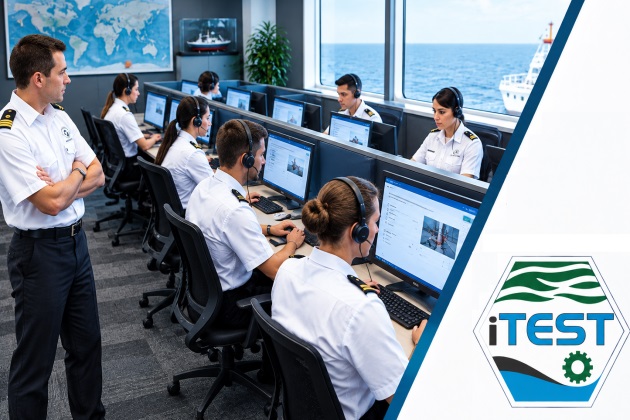
The first major application of iTEST is candidate assessment during the hiring process (Recruitment Screening). A company can include testing as part of an interview and assess an applicant’s knowledge in relation to a specific position. The assessment may take into account both mandatory requirements and the company’s own standards. The result is generated immediately and presented in a format that makes it easier to assess the candidate’s level of preparation.
The second application is Measuring Learning Outcomes. After a course or training program, a company can assess how well a seafarer has understood the material. Such testing helps identify the gap between what a specialist was expected to learn and their actual level of knowledge. If gaps are identified, the company can determine what additional training is required.
The third function is Performance Monitoring of personnel who are already employed. iTEST can store test results, analyze them, and track knowledge gaps. Results can be compared and sorted, for example, by:
- position,
- department,
- subject and other parameters.
This helps a company monitor the level of crew competencies and plan further training.
Thus, iTEST is not a conventional online practice tool for individual study. It is a system that enables a company or training organization to create and administer its own tests, assess seafarers’ knowledge, and analyze the results. The ready-made iTEST question database serves as the basis for creating tests, while an organization can supplement it with its own questions when necessary.
How is a Test Created in iTEST?
Once an organization determines which specialist needs to be assessed, an administrator creates a specific test for that person. iTEST provides a dedicated Test Manager for creating and CES 6.1 – Where to Find Answers and How to Prepare Properlymanaging tests. The administrator specifies the required number of questions and the test duration and then creates the test using the available questions.
During testing, questions can be selected randomly from the database, while answer options can also be shuffled. As a result, the order of both questions and answers may differ from one user to another. The system also provides a separate Practice Test mode, which allows users to become familiar with the testing interface in advance. This approach makes it possible to assess knowledge without relying on a single fixed test version.
At the same time, a company is not limited to the standard iTEST questions. IDESS provides a Question Generator Wizard that allows organizations to create their own questions, including questions with images and animation. Custom question modules can be used across different departments within the company. In this way, the common iTEST database can be supplemented with materials reflecting the requirements of a particular employer.
It will be interesting: Seafarer Test Answers in PDF — CES, CBT, SETS, Mintra & Delta
The content of a test may therefore vary depending on who is being assessed and for what purpose. For example, when screening a candidate, a company may create a test containing questions related to the candidate’s position and the professional knowledge required for the job. Once the test has been completed, the system automatically creates a record of the candidate’s result, and the results can be analyzed individually or compared with those of other candidates.
This is one of the distinctive features of iTEST: it is not simply a ready-made question database but a system that allows an organization to create, administer, and analyze assessments. A company can use both questions from the general STCW database and its own questions when required by its standards or specific operational needs.
iTEST in Seafarer Recruitment
A seafarer may encounter iTEST even before joining a vessel – during the job search and recruitment process at a shipping or crewing company. Companies and crewing organizations that use iTEST include:
- Wallem Group;
- Peter Döhle Schiffahrts-KG;
- Epic Kosan;
- European Training & Competence Centre (ETCC) / Columbia Shipmanagement;
- Jebsen / Abojeb-Jebsen.
IDESS explicitly lists Recruitment Screening among the main applications of the system. In this case, the test becomes part of the candidate assessment process alongside other stages of the interview and professional screening.
Salary of Seafarers in the Marine IndustryFor the seafarer, the process is relatively straightforward: after submitting documents and completing the required stages of the recruitment process, the candidate is asked to take a computer-based test. The questions are related to the professional field in which the candidate is expected to work. Therefore, for example, the assessment for a marine engineer will differ from that for a deck officer, and the requirements may also take into account the specific nature of the intended job.
The company receives the test result immediately after completion. iTEST presents the results in a format that facilitates assessment, making it easier for a recruitment specialist or another responsible employee to determine whether the candidate’s knowledge meets the requirements of a particular position. The system can also help identify areas where the seafarer has knowledge gaps.
At the same time, taking an iTEST assessment should not be viewed as an ordinary practice test that a seafarer opens online independently for preparation. In this case, the assessment is initiated by an organization and forms part of its internal evaluation process. For the candidate, this means that the assessment is intended to measure not only familiarity with the question format but also the professional knowledge required to perform the future duties. This approach can be clearly seen in actual Wallem test result reports. An example is reviewed below.
What Does iTEST Look Like for a Seafarer in Practice?
In practice, the content of an iTEST assessment depends on the specialist being evaluated. A good example can be found in a published iTEST test result for Wallem. The document relates to a test for a Chief Engineer and is titled Oil/Chem Tanker – Engine – Management. The test level is marked as CUSTOMIZED, indicating that it was created to meet specific requirements.
In this case, the test contained questions covering a range of professional topics, including:
- engine operation;
- cylinder liners;
- auxiliary machinery;
- air compressors;
- electrical equipment;
- fire safety;
- MARPOL;
- cargo operations.
Therefore, the seafarer was not assessed on one narrow subject. Instead, the test covered several areas of knowledge that may be required of a Chief Engineer working on a tanker.
The test had a time limit of 69 minutes. According to the published result, the candidate completed the test in 53,88 minutes and initially scored 49 correct answers out of 69, or 71,01 %. The report also displays individual test questions and the selected answers, making it possible to see exactly which areas of professional knowledge were assessed.
This example clearly demonstrates how iTEST differs from a conventional self-study test. A seafarer does not simply select a general test from the internet. Instead, the assessment has already been designed around the candidate’s position, field of work, and Guidelines on Conversion of Ship to LNG as Fuelship type. The result is recorded in the system and can be used by the company to assess the candidate’s professional competence.
It is important to note that this example relates to a specific Wallem test published previously and should therefore not be regarded as a universal template for all current iTEST assessments. Nevertheless, it clearly demonstrates the basic principle behind the system: separate tests can be created for different specialists, with professional questions, a time limit, and an individual assessment of the result.
What Questions are Used in iTEST and How are Results Assessed?
iTEST supports several types of assessment tasks. In addition to multiple-choice questions, the system provides:
- questions with images and animation;
- open-ended questions;
- matching tasks;
- classification tasks.
This makes it possible to assess not only whether a user knows the correct answer but also their understanding of different professional subjects.
Let’s look at two examples from published Wallem results, which demonstrate how different the content of individual tests can be. For example, one test for a Chief Engineer assessed knowledge of:
- technical aspects of the main engine and auxiliary machinery;
- electrical equipment;
- fire safety;
- MARPOL;
- chemical cargo operations;
- ISGOTT requirements.
The report indicates 69 questions, a completion time of 53,88 minutes against a 69-minute limit, and a score of 49 out of 69, or 71,01 %.
Read also: CES Test for Engine Cadet (Questions and Answers): Complete 2026 Guide & Exam Prep
In another published test for a Chief Engineer, the set of questions was noticeably different. It included topics related to:
- chemical and oil tanker operations;
- COW;
- properties of chemical cargoes;
- air compressors;
- bilge water treatment systems;
- electrical generators;
- incinerators;
- MARPOL;
- main engine maintenance.
In this case, the seafarer answered 43 out of 69 questions correctly, achieving 62,32 %, and used the full 69 minutes allowed for the test.
These two reports demonstrate one of the important features of iTEST: even when the position is the same, the content of the assessment may differ. The question set depends on the CES Test for Seafarers – Complete Guide 2026specific test and the professional areas that the organization has decided to assess. Therefore, iTEST should not be regarded as a single fixed examination with an unchanging list of questions.
Once the test has been completed, the system automatically records the result. For each test, the answers submitted by the seafarer are recorded, and the final score is calculated based on the completed tasks. At the same time, iTEST does not establish one universal passing score for all seafarers. The specific performance requirements are determined by the organization conducting the assessment. Therefore, the same percentage of correct answers cannot automatically be considered a universal «pass» or «fail» criterion.
This type of report shows that an iTEST result may contain not only the final percentage but also detailed information about the assessment:
- number of questions;
- correct answers;
- time taken.
For the company, these data provide a basis for further assessment of the candidate according to its own requirements.
In addition to the overall result, iTEST allows organizations to analyze performance on individual questions and professional areas. The system includes a Data Analyser that enables an organization to review results by position, subject, and level, as well as identify questions and topics that caused the greatest difficulties. This makes it possible to see not only the seafarer’s overall result but also the specific areas in which additional training may be required.
Thus, assessment in iTEST consists of two stages: first, the system records the result of a particular test, and then the organization interprets that result according to its requirements for the position. For this reason, the percentage of correct answers is not the only important factor for a seafarer. It is also important to understand what professional knowledge was assessed and what requirements the company established for the particular test.
iTEST, sEaLearn and mysEaLearn: Their Place in the IDESS Ecosystem
iTEST is not an isolated IDESS product used solely for examinations. It is part of a broader digital ecosystem that brings together tools for training, knowledge assessment, and management of seafarer professional development. The official IDESS website lists the following solutions among its products:
- iTEST,
- sEaLearn,
- sEaLearn+,
- mysEaLearn,
- sEaComms,
- CASYS.
The main differences between them are related to their purpose:
- iTEST is primarily focused on assessment. It enables a company or training organization to assess a seafarer’s knowledge and competencies, analyze results, and identify gaps.
- sEaLearn is designed specifically for training and provides access to electronic learning modules related to STCW standards and other industry requirements. The training modules include knowledge checks, while the user’s progress can be monitored by the system.
- sEaLearn+ extends the capabilities of the LMS and combines training functions with training management. The system allows modules to be assigned according to position, ship type, or individual user, tracks training completion, manages certification, and generates reports. Its purpose therefore goes beyond the individual training course: it helps companies organize and monitor personnel training.
- mysEaLearn is aimed directly at seafarers and provides access to the sEaLearn training library through a mobile application. IDESS describes it as a tool for self-directed professional development, allowing users to access structured maritime training and study at a convenient time.
The main characteristics of the IDESS products can be summarized as follows:
| System | Main Purpose | Target Users | Role in Training |
| iTEST | Knowledge and competency assessment | Candidates, seafarers, companies, training organizations | Assess knowledge |
| sEaLearn | E-learning | Seafarers and company personnel | Acquire knowledge |
| sEaLearn+ | Training and training management | Seafarers, Training Managers, companies | Organize and monitor training |
| mysEaLearn | Mobile learning | Individual seafarers | Self-study |
The relationship between these solutions can therefore be understood as different functions within the same overall process: sEaLearn and mysEaLearn help users acquire knowledge, sEaLearn+ enables companies to manage training, while iTEST is used to assess how well the required knowledge and competencies have been acquired. The specific combination of systems depends on the organization and its requirements – a seafarer does not necessarily use all IDESS products.
In addition to these solutions, IDESS offers specialized systems such as sEaComms for assessing Maritime English proficiency and CASYS for managing and documenting professional competencies. Thus, iTEST occupies a specific position within the IDESS ecosystem as a knowledge assessment tool rather than a universal platform covering the entire seafarer training process.
Can You Prepare for iTEST on Your Own?
There is no single universal iTEST question bank that would allow a candidate to memorize the entire test in advance. The content of the assessment depends on the position, professional field, and requirements of the particular company. Therefore, self-study should focus not on memorizing answers but on reviewing relevant professional knowledge.
First of all, it is worth revising the subjects related to the intended position and applicable regulatory requirements. It is also useful to take professional maritime tests in order to become familiar with the question format and learn to analyze the available answer options quickly.
When working with test questions, it is important to understand why one option is correct rather than simply memorize its position in the list. This approach provides better preparation because the specific set of iTEST questions may differ from those encountered during self-study.
It is possible to prepare for iTEST independently by focusing on actual professional competencies and regularly checking your knowledge with relevant maritime tests. At the same time, conventional maritime tests should be used as a preparation tool rather than as an official iTEST question bank.

- IDESS Interactive Technologies. iTEST: Assessment System [Online resource].
- International Maritime Organization. Assessment, Examination and Certification of Seafarers: Model Course 3.12. – 2017 ed. – London: IMO, 2017. – 166 p.
- International Maritime Organization. International Convention on Standards of Training, Certification and Watchkeeping for Seafarers (STCW) [Online resource].
- International Maritime Organization. IMO Model Courses [Online resource].
- International Maritime Organization. Training and Certification [Online resource].
Did you find mistake? Highlight and press CTRL+Enter


