Welcome to the website where you can find answers for the CES test on the subject «Deck, Support, Container Vessel». This site will help you as a marine specialist improve your knowledge with the help of open information, where you can find questions as well as answers for them. CES/CBT based on practical information and marine specialists experience.
CES tests developed for evaluating seaman basic knowledge by Seagull Company (rebranded as «OTG»), is an evaluating online-tool, used for revealing any professional preparation needed in specific fields of knowledge, defined by STCW.
Test type: STCW.
Version: 5.2.7, 6.0.8.
Department: Deck.
Level: Support.
Vessel type: Container Vessel.
CES tests have proven themselves as good tools for the selection and recruitment process, as well as advancing the level of knowledge of the current officers and crew. Ocean Technologies Group use various subjects for question creation, which includes:
Crowd and Crisis Management;
Integrated Navigation System (INS);
Ballast water management;
Handling and Stowage;
Vessel operation management and safety;
Marine engineering;
Maintenance and repair, etc.
Current test contains Seagull CES questions on the subject «Work on Container Vessel». Those questions can be used for competence verification specialist. Knowledge of this information directly shows employee’s competence who holds a relevant post on a vessel. A sailor working on a container ship requires a high level of professionalism and physical endurance. Their primary task involves overseeing the loading and unloading of containers, necessitating precise distribution of weight loads to ensure the vessel’s stability. Sailors must also be well-versed in all technical aspects of the ship and capable of promptly responding to any emergency situations.
Furthermore, container ships often operate on international routes, entailing extended periods at sea and limited time ashore. This demands a high level of resilience to stress and adaptability to varying onboard living conditions. Sailors must adhere to strict international safety and environmental protection standards, as container ships carry substantial cargo volumes, making it crucial to avoid any potential accidents or mishaps. Overall, the job of a sailor on a container ship is challenging but vital for global trade and commerce.
This page contains answers to Seagull CES (Crew Evaluation System) test about Deck, Support, Container Vessel, and serve as a database of questions and answers, using which seafarer can prepare to exams for getting certificate of competence, or just to challenge yourself with knowledge in this theme.
CES – Deck, Support, Container Vessel
Try online
Use the search below to find question.
Amount of questions: 445.
Right answers marked with this sign .
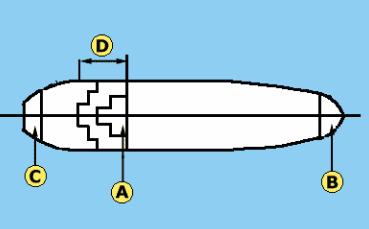
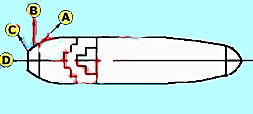
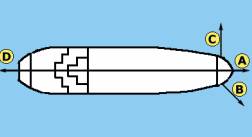
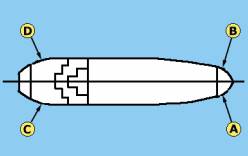
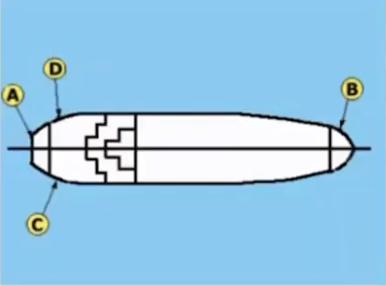
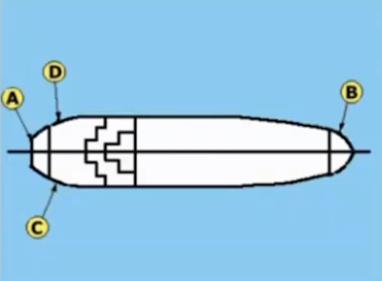
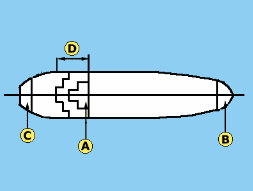
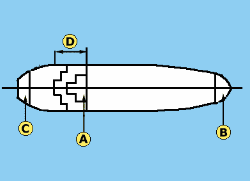
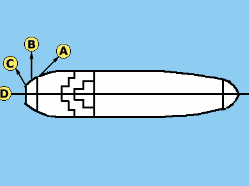
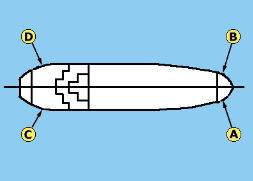
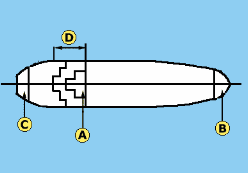
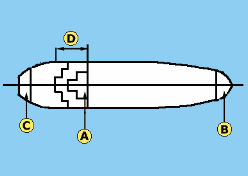
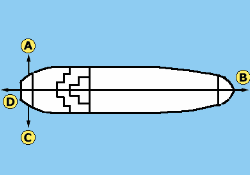
Code: EODR On the figure there are four (4) possible definitions of the term “AFT” shown. Which one is the correct one?
Aft is defined as A on the figure.
Aft is defined as C on the figure.
Aft is defined as B on the figure.
Aft is defined as D on the figure.
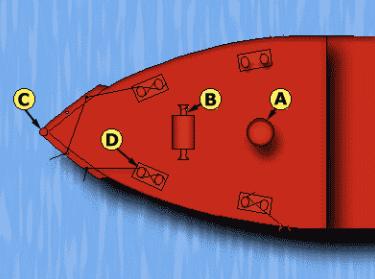
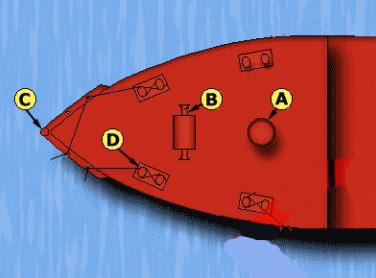
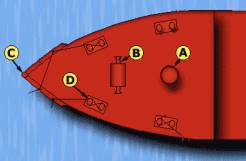
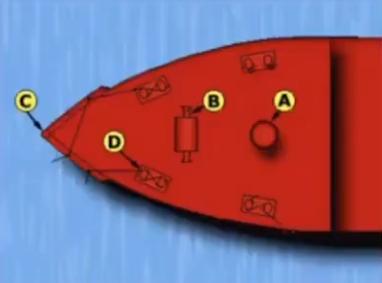
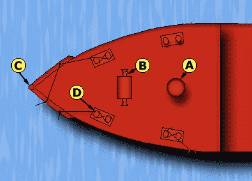
Code: DBSU On the figure there are four (4) possible definitions of the term “BOLLARD” given. Which one is the correct one?
Bollard is given by D on the figure.
Bollard is given by C on the figure.
Bollard is given by B on the figure.
Bollard is given by A on the figure.
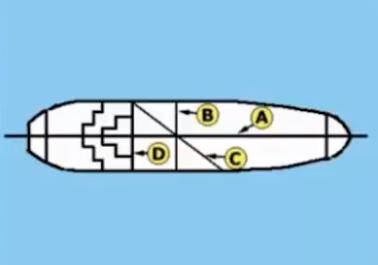
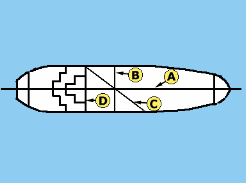
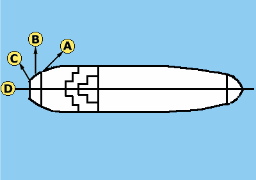
Code: KBJS In the diagram, which arrow is pointing at the position known as the “Bridge”?
The Bridge is indicated by A in the figure.
The Bridge is indicated by D in the figure.
The Bridge is indicated by B in the figure.
The Bridge is indicated by C in the figure.
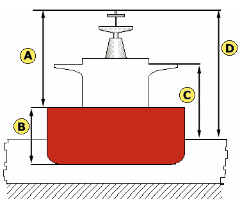
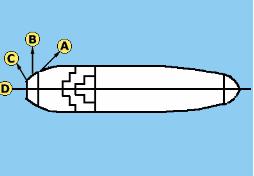
Code: AXYU On the diagram, which letter indicates what is meant by the word “DRAUGHT” of the ship?
Draught is indicated by D, in the figure.
Draught is indicated by B, in the figure.
Draught is indicated by C, in the figure.
Draught is indicated by A, in the figure.
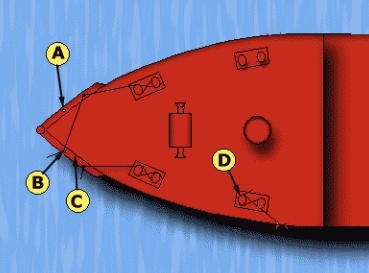
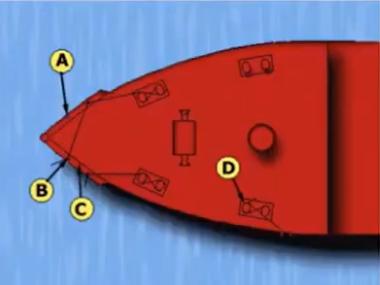
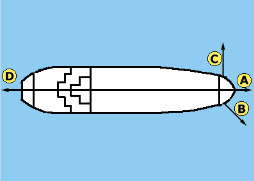
Code: IVGQ On the figure there are four (4) possible directions, shown by the arrowed lines, which could be the correct direction associated with the term “HEAD LINE”. Which one is the correct one?
Head line is given by B on the figure.
Head line is given by C on the figure.
Head line is given by D on the figure.
Head line is given by A on the figure.
Code: ICYJ On the figure there are four (4) possible definitions of the term “WINDLASS”. Which one is the correct one?
Windlass is given by B on the figure.
Windlass is given by C on the figure.
Windlass is given by D on the figure.
Windlass is given by A on the figure.
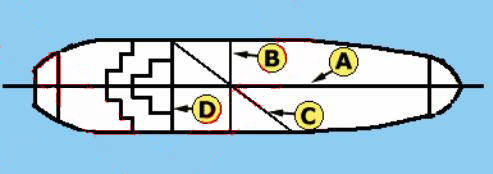
Code: HHIJ On the figure there are four (4) possible definitions of the term “CENTRE LINE”. Which one is the correct one?
Centre line is given by B on the figure.
Centre line is given by C on the figure.
Centre line is given by D on the figure.
Centre line is given by A on the figure.
Code: OWGN“Overshoot” is an expression we use when talking about a ship’s steering ability. What is the definition of this expression?
It is how many degrees a ship continues to turn after you apply counter rudder.
It is the way a ship turns when you put the helm in a hard over position.
It is the way a ship shoots forward when you give “a kick ahead”.
It is the way a ship continues to turn when the helm is put amidship.
Code: WTWR Read the text in and answer the question: “What should be given to prospective seafarers”? It is recommended that every prospective seafarer should, before being employed in a sea-going ship, receive proper training in personal survival techniques. In respect of such training several recommendations are made.
Approved training in survival techniques.
Passport and visa.
Recommendations.
Survival and protective clothing.
Code: YXWW When acting as helmsman would you expect the reading of the gyro compass to be the same as the magnetic compass?
Very seldom would they be the same.
They would always be the same.
They would always be within 1 or 2 degrees of each other.
They would never be the same.
Code: TCQW What does the term “Hard a Starboard” or “Hard to Starboard” mean?
Put the wheel fully over to starboard.
The wheel is difficult to turn to starboard.
Do not allow the vessel to swing to port.
Start the ship swinging to starboard.
Code: OSDQ Who is authorised to operate lifting equipment around the ship?
Those ship’s personnel who have been assessed as competent and are duly authorised to do so by the master as per the procedures as outlined in the ship’s SMS system.
Stevedores, manufacturer’s maintenance engineers and senior ratings only.
All deck officers and ratings.
Deck officers and ratings, engineering officers and ratings, GP crew if applicable, who are in possession of crane operation training certificates issued by the company.
Code: ELPO When two ships are lying alongside each other in a ship to ship operation and one ship is lying at anchor, anchor watch duties must be carried out as follows:
Both ships have normal anchor watch responsibility in addition to watching ship to ship fendering, mooring etc.
Anchor watches are not kept as the duty officers will be on deck conducting the cargo operations.
Anchor watch responsibility rests with the vessel which has its anchor down and the ship to ship connections is the responsibility of the other vessel.
Code: BFIR Breathing apparatuses is an important piece of equipment for being able to fight a fire onboard a vessel. What routine precautions to be observed with regard to use and maintenance of such equipment?
All the mentioned alternatives.
That personnel having a beard are not selected as smoke divers.
That personnel that are appointed as smoke divers, primarily are given a shore based proper basic education and training.
That the equipment always to be kept cleaned, checked and bottles are recharged immediately upon use, and frequently inspected.
Code: TKRN What kind of extinguishing-remedy would you choose to put out an electrical fire?
Dry extinguishing remedy.
Water.
Combination of powder and water.
Foam.
Code: QYUD What kind of safety clothing should be worn during a mooring operation?
Helmet, safety shoes, gloves and protective clothes.
Gloves and helmet.
Safety shoes and boiler suit.
No particular safety clothes are required.
Code: KLAP What is the meaning of “Make Fast”?
Make Fast means to secure a rope.
Make Fast means to avoid all meals.
Make Fast means to act very quickly.
Make Fast means to coil a rope.
Code: FNCM What is understood by the term “Boat Drill”?
“Boat Drill” means the practical training in the various aspects of getting all the people onboard safely off the ship, in the event of abandoning ship.
“Boat Drill” is an exercise to launch the lifeboats and move the boats clear of the ship.
“Boat Drill” is an exercise in the practical and safe methods to secure a boat alongside the ship.
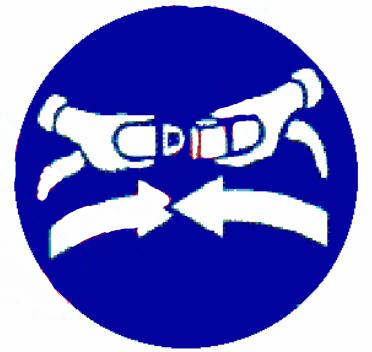
Code: HFRA, KEKN Give the meaning of the following symbol:
Fasten seat belts.
Fasten lifejacket belt.
Secure hatches.
Secure buoy line to the ship.
Code: FUKP, HDKP How much food per person is supplied on a liferaft?
Not less than 10 000 kJ.
Not less than 20 000 kJ.
Not less than 5 000 kJ.
None, only barley sugar sweets supplied.
Code: AECJ A drip tray containing oil is on fire. The only fire-fighting equipment available is water hose with spray jet/spray nozzle. How, if at all, should you attempt to put out this fire using water?
The water can be applied in a fine spray starting from the front in a sweeping motion.
Water should be applied in a jet to the back of the fire.
Water should be applied to the oil in a single jet only.
Water should not be used on any type of oil fire.
Code: SKFX Which of the following are frequent causes of fires in accommodation?
1. Smoking in bed. Covering of electric fires with blankets. 3. Overloading electric plugs.
Covering of electric fires with blankets.
Smoking in bed.
Overloading electric plugs.
Code: AIGK What is the main responsibility of a bridge lookout at night?
Inform the bridge of any new lights when they appear over the horizon or any other items observed which may affect the ship.
Inform bridge of changing weather patterns.
Inform bridge of any lights when they appear over the horizon.
Inform bridge of any other ships observed, which appear to be getting closer to your own ship.
Code: VPHS During restricted visibility, you are posted as bridge lookout and you hear 1 long blast at intervals of about 2 minutes on your port bow. What will you report to the OOW (officer on watch)?
Fog signals of one long blast heard on the port bow.
Power driven vessel under way and making way on the port bow.
A vessel at anchor on port bow.
Power-driven vessel making no way on port bow.
Code: RXCL What will you do if you are helmsman and the OOW (officer on watch) gives you the order: “Starboard ten”?
Fog signal of one long blast heard on the port bow at regular intervals of about 2 minutes.
Repeat the command back and then change course 10 degrees to starboard of present course.
Repeat the command back and then put the wheel over sufficiently for the ship to swing at a rate of 10 degrees per minute to starboard.
Code: IIES How will you act if you are helmsman and the OOW (officer on watch) gives you the order: “Nothing to port”?
Don’t let the ship turn to port.
Let the ship turn to starboard.
Alter course to starboard.
Don’t give port rudder.
Code: ITPC What is the signal actuated by a detection system?
A visual and audible alarm signal at the control panel.
An audible signal at the control panel.
An audible and visual signal consisting in 7 short signals followed by a long one.
A visual signal at the control panel.
Code: YJGQ What are the main components of the atmospherical air?
Code: DQKN In which one of the following an oil, the flash point of which only needs to be over 43 °C, may be used?
In emergency generators.
In the main engine.
In the kitchen.
In inert gas generators.
Code: OJHE A stevedore is working in a cargo hold of a bulk carrier while completing discharge of a concentrate cargo. You suddenly notice that he appears to be taken ill. You should:
Assume problem due to lack of oxygen and/or toxic gas and rescue with self-contained breathing apparatus.
The foreman stevedore will deal with this situation.
Immediately enter space and give first aid.
Assume possible heart attack and give CPR.
Code: CTSK On a bulk carrier at the completion of loading and before closing hatch covers, the track ways must be:
Track ways swept and checked clear of obstructions.
No sweeping required.
Track ways washed down.
No specific checks.
Code: NFRF When preparing the hold of a bulk carrier for cargo when that hold has previously been ballasted, which of the following must be checked?
The ballast lines must be blanked off and the bilge lines opened and tested.
Previous cargo swept out.
The heating coils fitted.
Paint coating re-painted.
Code: RUUF What must be done after completion of ballasting operations on a bulk carrier?
All valves closed, tank ventilators in open position and sounding pipe caps replaced.
Sounding pipe caps left off.
All valves and lines left open.
All valves closed and tank ventilators to closed position.
Code: ISUD Which of these series of sizes corresponds to the international standard for nozzles?
12 mm, 16 mm and 19 mm.
10 mm and 20 mm.
10 mm, 20 mm and 30 mm.
5 mm, 10 mm and 20 mm.
Code: NXCC What alarm signal must be sounded by the alarm bells in case of fire?
The signal which is stated in the muster list.
A continuous signal.
Series of short blasts.
One long blast followed by seven short blasts.
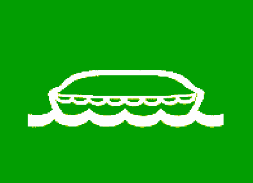
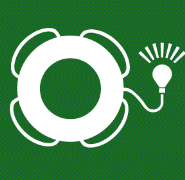
Code: BIWP Give the meaning of this symbol:
Lifebuoy.
Lifebuoy with line.
Lifebuoy with light.
Lifebuoy with light and smoke.
Code: SPAG Which part of the float-free arrangement for inflatable liferafts is made to release the liferaft after being automatically inflated during the ship is sinking?
The weak link.
The lashing strap.
The hydrostatic release unit.
The painter.
Code: HYDL The wearer of a lifejacket can jump into the water without injury and without damaging the jacket from a height of at least:
4,5 m.
7 m.
12 m.
10 m.
Code: YXCS A person wearing an adult lifejacket shall be able:
To swim a short distance through the water and board a survival craft.
To dive half a meter under the water surface.
To jump from any height into the water without being injured or damaging the lifejacket.
To swim half a mile distance and board a survival craft.
Code: OWFT Which of air and water is the fluid that transfers the greatest amount of heat during the same time, given that the fluid is not flowing along the immersed body?
Water.
Air.
Both are transferring equally.
Code: NPLF, RBEN Which one of the following types of rope is the most dangerous to work with?
Nylon.
Manila.
Still wire.
Polypropylene.
Code: NNPQ, NKTF The responsibility for safety and security rests with everybody on board the vessel. General house-keeping rules should be followed. Which of the listed rules is the most important?
Keep your working area clean and tidy.
Keep tools within easy reach during work.
Do not carry lighters or matches when working outdoors.
Code: VVBI Which Security Levels requires the highest security alert?
Security Level 3.
Security Level 2.
Security Level 1.
Code: NVCD What do crew, visitors and contractors all have in common?
They all have opportunity to smuggle drugs.
They’re all employees of the ship.
They’re all onboard the ship for the duration of its voyage.
They’re all trained in ship emergency procedures.
Code: RDHU What is “defrosting” associated with?
Reefer containers.
Fan containers.
Containers carrying IMDG cargoes.
Dry cargo ventilated containers.
Code: KGIV On a container vessel, what would you do if you saw a container being damaged during loading operations?
Note the date and time of occurrence, container number and if possible take photographs.
Inform the relieving watchkeeper.
Inform the master.
Call the duty officer.
Code: ISAH On board a container vessel, which of the following is not likely to be displayed by the loading computer?
Stowage positions of high-cube containers.
Stresses in the sea-going condition.
Fluid GM.
Stack weights incorporating high-cube containers.
Code: KGFM On a container vessel, what indicates the correct weight of a wrongly declared container?
Strain gauges fitted to the shore gantry cranes.
The ship’s loading computer.
The container CSC plate.
The tare weight stamped on the container.
Code: CHTJ On a container vessel, with regard to fire precautions, what must be ensured prior to securing hatch pontoons?
That all cargo clusters have been removed from the hold.
That under-deck cargo operations have been completed.
That the cargo hold fire-fighting system has been checked.
That the duty officer’s permission has been obtained to secure the pontoons.
Code: JKJV On a container vessel, what will attending surveyors inspect when containers have been lost overboard?
Certificates of approval related to lashing equipment used to secure those containers.
The vessel’s Safety Construction certificate.
The on-board cargo lashing inventory.
The vessel’s Class certificate.
Code: JLCJ On a container vessel, what should be done if a twistlock is found cracked at the base?
Remove it from service.
Use it to lock under-deck container stows.
Use it in the lowest tier on deck.
Code: DBRU What will be the consequences of a ship’s failure to correct an unsafe stevedore working practice in the United States?
The ship will be prosecuted.
The master will be arrested.
The port will lodge a protest against the ship.
The duty officer will be arrested.
Code: VMEJ What is a “Fantainer” used for?
Carrying dry cargoes prone to condensation.
Carrying steel coils.
Carrying reefer cargoes prone to condensation.
Carrying dangerous goods prone to condensation.
Code: BCBD On a container vessel, under the IMDG Code what class is assigned to a Fumigated Container?
Class 9.
Class 8.
Class 6.
Class 5.
Code: RHFC On a container vessel, under which IMDG Class is fishmeal carried when not treated with anti-oxidants?
Class 4.2 – Flammable solid.
Class 4.1 – Flammable solid.
Class 9 – Miscellaneous dangerous substances and articles.
Class 5.1 – Oxidizing substances.
Code: QLMC Why must duty crew members supervise the lashing of containers?
Because stevedores often apply container lashings haphazardly or place twistlocks incorrectly.
Because of local port regulations.
Because it is an international requirement under the ISM Code.
Because of time containers on the vessel towards the end of cargo operations.
Code: ABMW What determines how containers should be lashed?
The cargo security manual.
SOLAS 74/78.
OSHA regulations.
Advice from shore planners.
Code: KLHX What does OSHA stand for?
Occupational Safety and Health Administration.
Occupation and Safe Health Association.
Overseas Sea Hazard Association.
Occupational Safety and Health Aids.
Code: MQXC Where do OSHA regulations apply?
United States of America.
European Union.
Australia.
United Arab Emirates.
Code: FNDY What general background colour is used on warning signs which require a specific “mandatory” action, such as one which might require the wearing of goggles during particular work task?
Blue.
Yellow.
Red.
Green.
Code: NYNA What general background colour is used on warning signs that indicate emergency of first-aid features, or indicate a safe condition?
Green.
Yellow.
Red.
Blue.
Code: KLAP What is the meaning of “Make Fast”?
Make Fast means to secure a rope.
Make Fast means to avoid all meals.
Make Fast means to act very quickly.
Make Fast means to avoid all meals.
Code: OVFY What do you understand by “Bitter end”?
The end link of an anchor cable that is secured within the chain locker.
The toggled end of a lifeboat painter.
To the very last moment.
A foul taste at the end of a meal.
Code: WDEJ Which of the following is false when a casualty is bleeding?
Cover the wound with a cloth.
Control bleeding.
Treat for the shock.
Encourage patient to lie quite and re-assure.
Code: PYPE All heat burns should be:
Cooled as quickly as possible with running cold water for at least 10 minutes.
Treated by the doctor only.
Applied with soothing lotion as soon as possible.
Covered with Gauze or bandage immediately.
Code: YSQG Port State Control Officers are authorised to:
Inspect and detain ship that are not meeting the requirements until they are able to demonstrate compliance with the regulations.
Detain ships that are not meeting the requirements for a minimum of 30 days.
Regularly inspect ships known to meet the requirement.
Code: OSOO Which of these emission control requirements is correct?
Low sulphur fuels reduce emissions of volatile organic compounds.
Installation of an exhaust gas cleaning system reduces emission of nitrogen oxide.
Equipment containing ozone-depleting substances may be dumped at sea 50 miles from land.
Incineration of PCB’s is permitted.
Code: OIQO On a container vessel, where should containers with untreated fishmeal cargo be carried?
On deck.
Under deck.
On deck away from sunlight.
Separated from Class 4.2 containers.
Code: DWDH, KMRH On a container vessel, what is the purpose of fixed stacking cones?
To prevent horizontal movement of 20′ containers in 40′ cell guides.
To prevent the horizontal movement of 40′ containers at tank top level.
To prevent movement of 20′ and 40′ containers at deck level.
Code: AJAS On a container vessel, where should a mid-bay guide be positioned?
On the tank top mid-way in 40′ guides to prevent transverse movement of 20′ containers.
On the tank top at the ends of 40′ container bays.
At the base of cell guides.
Code: VWPG When will a hatch pontoon’s side cleat need replacement?
When the rubber washer is compressed and hardened.
When the cleat retainer is rusty.
When the cleat retainer is distorted.
When the cleat has sprung open at sea.
Code: DAMK What is the function of a lashing plate?
As tie down point for turnbuckles on deck or hatch cover.
A means of securing buttresses under-deck.
A means of securing the hatch covers.
Code: GRPM A container vessel must alter her trim to depart even keel from the berth. Select the most appropriate means of altering trim.
By internal shift of ballast.
By altering the cargo disposition.
By discharging ballast from the deepest draught end of the vessel.
Code: QMYB On a container vessel, where will you find the Dangerous Goods List?
In Part 3 of the IMDG Code Volume 2.
In SOLAS 74/78.
In the Cargo Securing Manual.
In Chapter 3.6 of the IMDG Code Volume 2.
Code: NMES On a container vessel, which of these motions is not taken into account when calculating forces on a container stow?
Surging.
Heaving.
Rolling.
Pitching.
Code: GRRY Why should a container with a damaged corner post not be loaded?
Because its strength is weakened.
Because during discharge the ship could be held responsible for the damage.
Because it will not fit properly into a container stack.
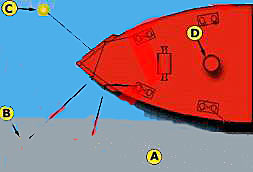
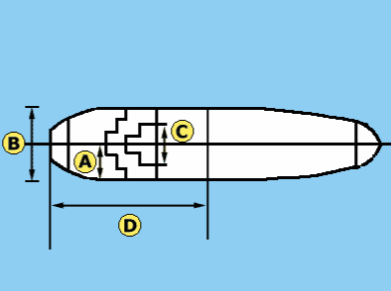
On the figure there are four (4) possible directions shown by the arrowed lines. Which one would correctly show the direction understood by the term «AFTER SPRING»?
After spring is defined as A on the figure.
After spring is defined as B on the figure.
After spring is defined as C on the figure.
After spring is defined as D on the figure.
On the figure there are four (4) possible definitions of the term «BOLLARD» given. Which one is the correct one?
Bollard is given by A on the figure.
Bollard is given by B on the figure.
Bollard is given by C on the figure.
Bollard is given by D on the figure.
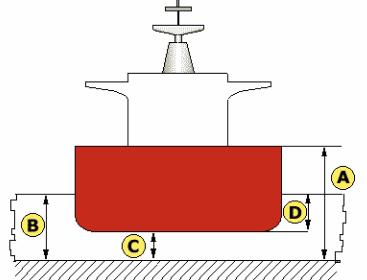
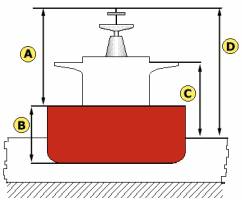
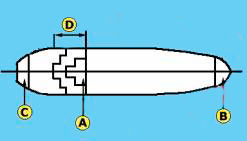
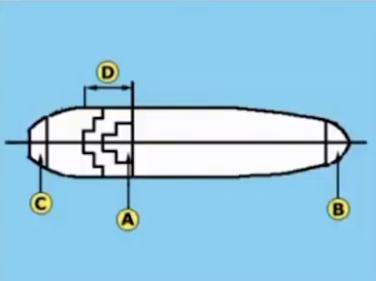
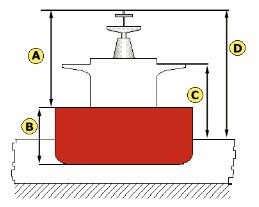
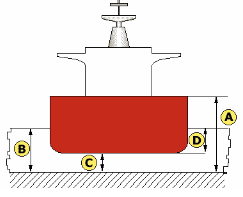
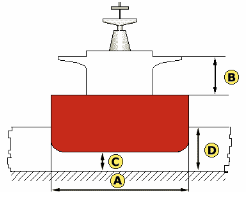
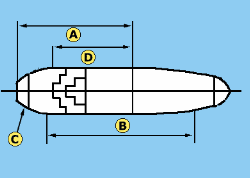
On the figure there are four (4) possible definitions of the term «AIR DRAUGHT» given. Which one is the correct one?
Air draught is given by A on the figure.
Air draught is given by B on the figure.
Air draught is given by C on the figure.
Air draught is given by D on the figure.
On the diagram provided, there are four (4) possible directions indicating the term «AHEAD». Which one is the correct?
Ahead is given by A on the figure.
Ahead is given by B on the figure.
Ahead is given by C on the figure.
Ahead is given by D on the figure.
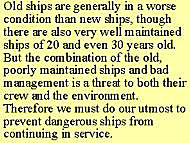
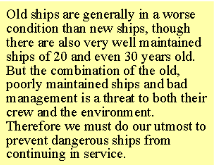
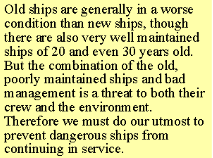
With reference to the text in the frame: what is stated as a threat to lives at sea and the marine environment?
Bad management and poorly maintained older ships.
Overfishing and depletion of marine resources.
Increased tourism and recreational boating activities.
Strict environmental regulations on modern vessels.
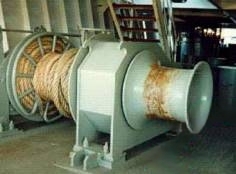
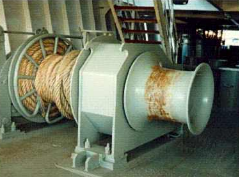
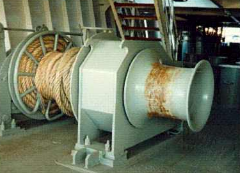
What is the name of the machine shown, used to heave on the ropes during mooring and unmooring?
Capstan.
Winch.
Windlass.
Bollard.
What is the correct understanding of the term «boat drill»?
Practical exercise for the people on board to practice their duties and be prepared in the case of an emergency abandon ship.
Routine maintenance check of lifeboats and davits.
A training course for new crew members on how to operate small boats.
A signal used to call all crew members to the deck.
What are the duties of an effective bridge look out?
Keeping a constant observation around the ship.
Monitoring only the radar and electronic charts.
Communicating with the engine room at regular intervals.
Performing routine maintenance on bridge equipment.
What does the term «Hard a Starboard» or «Hard to Starboard» mean?
Steer the ship directly to the right.
Stop the ship immediately.
Put the wheel fully over to starboard.
Maintain the current course but prepare to turn.
Who is authorised to operate lifting equipment around the ship?
Those ship’s personnel who have been assessed as competent and are duly authorised to do so by the master as per the procedures as outlined in the ship’s SMS system.
Only the chief officer and the bosun.
Any crew member who has received basic training in lifting equipment.
The deck cadet assigned to the operation.
Fuel oil from a leaking fuel pipe has been collected in a drip tray under the boiler furnace. The oil is suddenly ignited by a backflash from the boiler burner. The boiler room is manned and the person present has the choice of various extinguishers. The fire is purely a surface fire. What would be the preferable extinguisher?
CO2.
Foam.
Powder.
Water (with caution).
Having a CO2 alarm during normal working hours, what immediate action should be taken?
Get out of the engine room as soon as possible.
Continue working while wearing a gas mask.
Switch off all machinery and wait for instructions.
Check the CO2 levels and continue work if they are within limits.
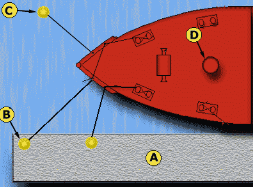
Which is the «QUAY», in the figure?
The Quay is indicated by A, in the figure.
The Quay is indicated by B, in the figure.
The Quay is indicated by C, in the figure.
The Quay is indicated by D, in the figure.
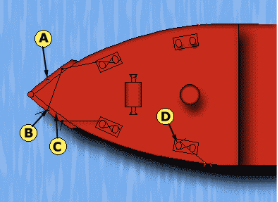
Which is the «STARBOARD BOW», in the figure?
The Starboard bow is indicated by A, in the figure.
The Starboard bow is indicated by B, in the figure.
The Starboard bow is indicated by C, in the figure.
The Starboard bow is indicated by D, in the figure.
During the anchoring procedure, what would the 2nd Officer understand by the following request from the bridge, «How is the chain»?
The bridge would like to know the amount of anchor chain released.
The bridge would like to know the direction of the anchor cable from the hawse pipe.
The bridge would like to know the status of the anchor winch motor.
The bridge would like to know the depth of the water at the anchor location.
What is understood by the term, «The Lee Side»?
Lee Side is the side that faces towards the wind.
Lee Side is the side where the ship’s anchor is deployed.
Lee Side is the side that faces away from the wind.
Lee Side is the side where the ship’s propeller is located.
If you detect a fire on board the ship, dependent on the situation, which of the following actions is the first to be taken?
Raise the fire alarm.
Start fighting the fire immediately without notifying anyone.
Contact the nearest coast guard station for assistance.
Call the engine room to shut down all machinery.
Anyone of the crew who is assigned to watch duties in port has a number of important tasks to carry out. Which one of the listed tasks should be included in the watchman’s duties?
Check the moorings for correct tightness and ensure the gangway remains safe and secure.
Conduct routine engine room inspections during the night.
Ensure all crew members have completed their training for the day.
Carry out a fire drill with the whole crew in the port area.
If the relief for the bridge lookout does not appear at the end of the watch, when required, what should be the actions of the existing lookout?
He should inform the Officer of the Watch and wait for instructions.
Continue the watch until the Officer of the Watch returns.
Leave the bridge immediately and inform the master directly.
Inform the bridge crew and resume other duties.
If you are the helmsman on duty, what would be the correct action if the OOW (Officer on Watch) gives you the order to: «Change over from Automatic pilot to Hand steering»?
Apply the controls to disconnect the Automatic pilot and engage hand steering. Start steering the vessel using the wheel and confirm with the OOW the change-over is complete and the course you are to steer.
Immediately switch to hand steering without confirming with the OOW.
Disconnect the automatic pilot but do not start steering until the OOW provides additional instructions.
Continue using the automatic pilot until the OOW confirms it’s time to switch.
What will you do if you are helmsman and the OOW (Officer on Watch) gives you the order: «Port 20» and after a while the order: «Ease to 10»?
Immediately apply 10 degrees of rudder towards port and wait for further instructions.
Apply 20 degrees of rudder towards port and then after the second command reduce the wheel to 10 degrees of helm.
Apply 20 degrees to port and then continue holding the rudder at 20 degrees until the OOW gives a new order.
Apply 20 degrees of rudder to port and then change the wheel to 10 degrees to starboard.
After smoking, cigarettes should be disposed off as follows:
Disposed of in an ashtray, ensuring that it is extinguished.
Thrown overboard as soon as possible.
Placed on the deck and left to extinguish by itself.
Disposed of in any open container to cool down.
What kind of fuel will originate a class A fire?
A flammable liquid (e. g., gasoline or diesel).
A gas (e. g., methane or propane).
A solid (cardboard or wood…).
A metal (e. g., magnesium or sodium).
For which of the following groups of substances or materials is the use of water as an extinguishing agent dangerous?
Which of the following measures should rather be considered as a prevention measure than as a protection measure?
Installation of fire detection and alarm systems.
Provision of fire extinguishers in all areas of the ship.
Emergency fire drills and crew training.
Restriction in the usage of combustible materials.
What are the main basic components of a portable extinguisher?
The container, the extinguishing agent, the impulsion system.
The trigger, the nozzle, and the safety valve.
The hose, the nozzle, and the pressure gauge.
The handle, the base, and the fire-resistant shell.
What is the «international shore connection» used for?
To connect the ship fire main to the shore lines.
To provide an emergency power supply from the shore.
To establish communication between the ship and the shore during emergencies.
To connect the ship’s plumbing system to shore water supplies.
The container for an inflatable liferaft shall be made:
Watertight, as far as possible, except for drain holes in the container bottom.
Open to allow easy air circulation inside the container.
Ventilated with small holes on the sides for air exchange.
Completely sealed with no drainage holes, to keep the raft dry.
Which of the following actions should be done before throwing this type of inflatable liferaft over the side?
Ensure the liferaft is fully inflated and ready to be used.
Disconnect all safety lines and let the liferaft drop freely into the water.
Ensure the liferaft is not in direct sunlight before releasing it into the water.
Check that the painter is made fast to a secure point and that the sea below is clear.
A lifejacket is so constructed that a person can correctly don it within a period of:
30 secs.
1 min.
5 mins.
10 mins.
A lifejacket must not sustain burning or continue melting after being totally enveloped in a fire for a period of:
2 sec.
5 secs.
10 secs.
30 secs.
In which way shall a survivor be hauled out of the sea?
Horizontal.
Vertical.
Diagonal.
Upward at an angle.
What is the greatest interest of the «help» position?
It prevents the survivor from sinking in the water.
It keeps the survivor’s head above the water surface for easy breathing.
It helps the survivor to float in a more relaxed position.
It lessens the survivor’s heat escape.
What signal, if any, is specified in SOLAS as the «Abandon ship» signal?
The «Abandon ship» signal is not specified, only the general emergency alarm signal is stated.
The signal is a continuous blast of the ship’s horn for 30 seconds.
The signal is a series of seven short blasts followed by one long blast.
The signal is a series of four long blasts with one short blast in between.
What items of clothing should be avoided during mooring operations?
All of the items specified in the alternative answers.
Loose clothing that can get caught in equipment.
Gloves that do not provide a secure grip on ropes.
Long scarves or ties that could be blown by the wind.
Which one of the following types of rope is the most dangerous to work with?
Cotton.
Polyester.
Nylon.
Manila.
Under what circumstances should gangway nets be rigged under the gangway?
Whenever the gangway is rigged between ship and shore.
Only when the weather is rough or stormy.
When the ship is berthed in a port with no other ships around.
Whenever personnel are working on board, even without the gangway being rigged.
Who is the responsible person for the safety of the ship and all those onboard?
The Master.
The Chief Officer.
The Second Officer.
The Ship’s Safety Officer.
The responsibility for safety and security rests with everybody on board the vessel. General house-keeping rules should be followed. Which of the listed rules is the most important?
Keep your working area clean and tidy.
Always wear safety gloves when handling tools.
Ensure all work equipment is put away at the end of each shift.
Report any potential hazards to the officer on watch immediately.
Which of these types of information is considered sensitive?
Voyage itinerary and departure and arrival times.
Ship’s maintenance schedule.
Crew duty rosters.
Daily weather reports.
What is an IED?
A homemade bomb.
An international emergency directive.
An industrial equipment device.
An ignition energy distributor.
The vertical corner structures of a container are called the:
Corner posts.
Corner plates.
Side rails.
End doors.
On a Container vessel, a vessel not carry left and right-handed twistlocks, because:
There will be confusion as to whether or not containers are locked.
Left and right-handed twistlocks are incompatible with certain cargo types.
They increase the cost of the container’s construction.
The twistlocks are not designed for use with ISO containers.
The term «defrosting» on a container ship is associated with:
Reefer containers.
Cargo holds.
Ballast tanks.
Ventilation systems.
Immediately upon loading reefer containers on board a container vessel, they must be:
Connected to the ship’s power supply and their setting temperatures verified.
Checked for proper ventilation and sealed tightly.
Inspected for external damage and tagged with identification numbers.
Moved to the designated storage area for inspection before connection.
Within the context of containerisation, Dangerous Goods are:
Goods that are liable to cause damage to the ship.
Goods that require special packaging to maintain temperature.
Goods that must be loaded in refrigerated containers.
Goods that are prohibited from being shipped by sea.
On a Container vessel, if you saw a container being damaged during loading operations you should?
Note the date and time of occurrence, container number and if possible take photographs.
Immediately report the incident to the chief officer without taking any records.
Inform the shipper about the damage and wait for instructions.
Attempt to repair the container to prevent further damage.
A «Fantainer» is used for:
Carrying dry cargoes prone to condensation.
Carrying hazardous materials that require special containment.
Transporting refrigerated goods at a controlled temperature.
Storing liquid cargoes that need to be kept at a specific pressure.
As per IMDG Code, fishmeal not treated with anti-oxidant, would be carried on a container vessel under:
Class 4.2 – Flammable solid.
Class 3 – Flammable liquids.
Class 5.1 – Oxidizing substances.
Class 9 – Miscellaneous dangerous substances and articles.
The Maximum Securing Load (MSL) for a wire rope lashing connected to an eye plate by means of a shackle is:
The Minimum Securing Load of either the wire rope or shackle or eye plate.
The total combined load of the wire rope, shackle, and eye plate.
The maximum load that the wire rope can withstand without breaking.
The maximum load that the shackle can support before failure.
On a Container vessel, the person responsible for the safe lashing and securing of containers is:
The chief officer.
The master.
The lashing foreman.
The cargo officer.
To ensure compliance with International Regulations, securing of containers on a container ship must be:
Completed before the ship leaves the berth.
Checked only after departure.
Done only in rough weather.
Left to the discretion of the crew during the voyage.
To conform with «best practise», can you drive a crane and stand-by for a colleague who has entered a cargo tank at the same time?
No.
Yes, if you are experienced.
Only if the cargo tank is well-ventilated.
Yes, as long as the operation is quick.
Where is the «BRIDGE», in the figure?
The Bridge is A, in the figure.
The Bridge is B, in the figure.
The Bridge is C, in the figure.
The Bridge is D, in the figure.
What is the meaning of «make fast»?
To secure a rope.
To cut a rope.
To throw a rope overboard.
To untie a rope.
Is it always possible to use the word «ship» instead of the word «boat»?
Normally a small vessel is called a «boat» rather than a «ship», otherwise it is not important.
Yes, the words «ship» and «boat» mean exactly the same thing.
No, «ship» is only used for military vessels.
Yes, «boat» is just an informal way of saying «ship».
What are the lists called that give the position and task during a lifeboat drill for all persons on board the ship?
The Muster List.
The Duty Roster.
The Crew Manifest.
The Passenger Log.
If a patient is bleeding from the nose…
Tilt the head backward and wait for the bleeding to stop.
Pinch soft part of the nose for 10 minutes while keeping the head forward over a basin.
Apply ice directly inside the nostrils.
Lie the patient down flat and cover the nose with a cloth.
All heat burns should be:
Cooled as quickly as possible with running cold water for at least 10 minutes.
Covered immediately with a dry bandage without cooling.
Treated with butter or oil to soothe the pain.
Left exposed to air to heal naturally.
Which of the following substances is ozone-depleting?
Nitrogen.
Halons.
Oxygen.
Carbon dioxide.
The cargo manifold working platform surface should be made of:
Open mesh grating.
Solid steel plating.
Wood planks.
Concrete tiles.
On a Container vessel, containers with untreated fishmeal cargo are carried:
On deck.
Below deck in the refrigerated holds.
In the cargo hold with other dry goods.
In the crew quarters to prevent contamination.
On a Container vessel, a mid-bay guide is positioned:
On the tank top mid-way in 40′ guides to prevent transverse movement of 20′ containers.
On the deck to secure containers against heavy weather.
Near the hatch covers to prevent cargo shifting during loading.
At the stern of the vessel to prevent aft movement of containers.
When you join a new ship, how are you informed about safety rules, alarm instructions and your own duties in case of an emergency?
By muster lists exhibited in conspicuous places.
By oral instructions by the Captain.
By safety manuals distributed to crew members.
By emergency drills conducted weekly.
If a vessel “Overshoots” its heading, what has happened?
When turning, it is when the vessel swings past the required heading.
It is the way a vessel turns when putting the helm in a hard over position.
It refers to the vessel moving faster than its intended speed.
It indicates the vessel has lost its steering control.
With reference to crane operations, the term “slewing” refers to:
Turning or rotating a crane boom.
Making a (travelling) crane move along its rails.
Lifting a load vertically.
Lowering the crane to the ground.
How will you act if you are helmsman and the person conning the vessel gives you the order: ”Nothing to port”?
Don’t allow the ship to swing at all to port.
Alter the ship’s course to starboard.
Increase speed to maintain course.
Turn the ship hard to starboard.
Welding and flame cutting are among the factors which give the highest risk of fire on board ships. Precaution has to be taken to avoid this risk. Which of the following safety rules may be regarded as the most important?
The welder shall have been instructed in the use of the ship’s welding plant.
Only holders of welding certificates shall be allowed to carry out welding on board ships.
All crew members must wear fire-resistant clothing during welding operations.
A fire watch must be present during all welding activities.
For which of the following groups of substances or materials is the use of water as an extinguishing agent dangerous?
Which of the following measures should be applied when hot work is to be undertaken in a harbour?
To have a hot-work permit.
All the answers are good.
To ensure fire-fighting equipment is readily available.
To notify the harbour master before starting work.
What is the greatest interest of the “help” position?
It lessens the survivor’s heat escape.
It lessens the survivor’s fatigue.
It allows for better visibility in the water.
It helps in attracting attention for rescue.
What is advisable for a person entering a padlocked refrigerated room?
He should take the padlock inside the room.
He should never remove any ice or debris as the ice is needed to keep the refrigerated room at the right temperature.
He should ensure the door is left slightly ajar for ventilation.
He should inform someone outside before entering.
Which of these types of information is considered sensitive?
Voyage itinerary and departure and arrival times.
Planned maintenance schedule and emergency response procedures.
Crew member contact information.
Safety equipment inventory.
The lashing of containers loaded in the fourth and fifth tiers on a container ship are lashed with:
The lashing bridge.
Long lashing rods.
Standard lashing chains.
Ratchet straps.
On a Container vessel, fixed stacking cones are positioned:
At the base of cell guides.
Between containers in under-deck stowage locations.
On top of the containers in the upper tiers.
Along the sides of the container holds.
On a Container vessel, when preparing to lift hatch pontoons it is necessary to secure all loose material on it, so as to:
Ensure that pontoons are not fouled by loose material whilst being lifted.
Ensure that vessel is in compliance with this international requirement.
Prevent damage to the hatch cover during lifting.
Facilitate quicker lifting operations.
Within the context of containerisation, Dangerous Goods are:
Goods that are liable to cause damage to the ship.
Substances, materials and articles covered by the International Maritime Dangerous Goods (IMDG) Code.
Items that require special handling during loading and unloading.
Goods that are prohibited from being transported by sea.
Containers carried on multi-purpose or general cargo ships may be lashed with lashing wires and chains, if:
Such provision has been provided for in the vessel’s Cargo Securing Manual (CSM).
This is done together with dedicated container lashing equipment.
The containers are loaded in the lower tiers only.
The ship is equipped with additional lashing points.
On a Container vessel, the person responsible for the safe lashing and securing of containers is:
The master.
The chief officer.
The cargo officer.
The deckhand in charge of lashing.
The term “IMDG” stands for:
International Maritime Dangerous Goods.
Interactive Maritime Dangerous Goods.
International Marine Delivery Guidelines.
Integrated Maritime Dangerous Goods.
If a conscious patient is bleeding from the nose:
Apply pressure (pinch) to the soft part of the nose for 10 minutes while keeping the head forward over a basin.
Ask the patient to lie flat on the floor.
Tilt the patient’s head back to stop the bleeding.
Use a cold compress on the forehead.
When first using a cleaning agent in the machinery space, the crew should:
Confirm that it won’t form an emulsion.
Confirm that it will form an emulsion.
Check the cleaning agent’s expiration date.
Ensure proper ventilation in the machinery space.
When lifting the container vessel’s hatch pontoons, you should stop the operation if the:
Ship has an excessive heel.
Wind and swell are more than force 5.
Visibility is reduced due to fog.
Temperature exceeds safe working limits.
A fibre glass yacht, lifted and loaded on board a container vessel would be expected to be secured with:
The cradle.
Flatrack.
Standard lashing equipment.
Container straps.
Where can it be verified that the ship’s equipment complies with the requirements of MARPOL Annex VI?
The IAPP certificate.
The IOPP certificate.
The ISM certificate.
The SMC certificate.
Where is the “FORECASTLE” in the figure?
The Forecastle is indicated by B.
The Forecastle is indicated by C.
The Forecastle is indicated by A.
The Forecastle is indicated by D.
In the diagram, which letter is indicating the “bitts” which would probably be used by the mooring the ship?
The bits for the Forward Spring is indicated by D, in the figure.
The bits for the Forward Spring is indicated by B, in the figure.
The bits for the Forward Spring is indicated by C, in the figure.
The bits for the Forward Spring is indicated by A, in the figure.
Where is the “PORT QUARTER”, in the figure?
The Port quarter is D in the figure.
The Port quarter is A in the figure.
The Port quarter is B in the figure.
The Port quarter is A in the figure.
Which is the “CAPSTAN” in the figure?
The Capstan is indicated by A in the figure.
The Capstan is indicated by B in the figure.
The Capstan is indicated by C in the figure.
The Capstan is indicated by D in the figure.
In the diagram, which letter is indicating the position “MIDSHIPS”?
Midships is indicated by B in the figure.
Midships is indicated by D in the figure.
Midships is indicated by C in the figure.
Midships is indicated by A in the figure.
Where is “AFT” in the figure?
Aft is A.
Aft is B.
Aft is C.
Aft is D.
Prior to commencing cargo operations on a container ship, with specific regard to the raised deck sockets it must be ensured that:
They must be clean and free of internal debris.
They must be lubricated for easier operation.
They must be painted to prevent corrosion.
They must be marked with hazard signs for safety.
The function of a lashing plate on a container vessel is:
As tie down point for turnbuckles on deck or hatch cover.
To provide a grounding point for the vessel’s electrical system.
To secure the vessel’s steering mechanism during heavy weather.
To mark the cargo hold capacity and weight limits.
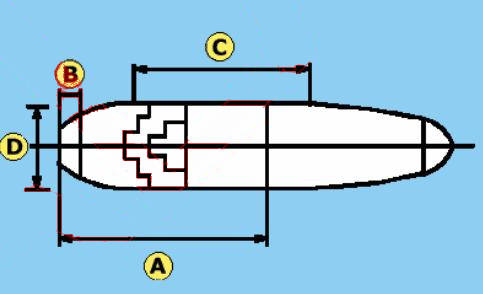
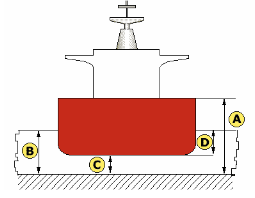
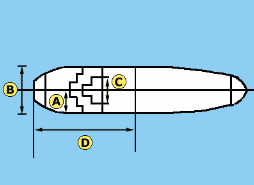
On the figure there are four (4) possible definitions of the term «BREADTH» given. Which one is the correct one?
Don’t know.
Breadth is given by B on the figure.
Breadth is given by A on the figure.
Breadth is given by D on the figure.
On the diagram, which letter indicates what is meant by the word «DRAUGHT» of the ship?
Don’t know.
Draught is indicated by D in the figure.
Draught is indicated by B in the figure.
Draught is indicated by C in the figure.
On the figure there are four (4) possible directions, shown by the arrowed lines, which could be the correct direction associated with the term «HEAD LINE». Which one is the correct one?
Don’t know.
Head line is given by B on the figure.
Head line is given by A on the figure.
Head line is given by C on the figure.
When you join a new ship, how are you informed about safety rules, alarm instructions and your own duties in case of an emergency?
Don’t know.
By muster lists exhibited in conspicuous places.
By listening to the ship’s radio announcements only.
By reading the cargo manifest provided by the captain.
On the figure there are four (4) possible definitions of the term «AIR DRAUGHT» given. Which one is the correct one?
Don’t know.
Air draught is given by D on the figure.
Air draught is given by B on the figure.
Air draught is given by C on the figure.
With reference to the text in the frame: what is stated as a threat to lives at sea and the marine environment?
Severe weather conditions and strong ocean currents.
Bad management and poorly maintained older ships.
Excessive speed of modern vessels.
High fuel consumption on long voyages.
What shall you do if you see a person falling into the sea?
Try to reach the person by swimming.
Throw a lifebuoy over board and report to the bridge immediately.
Wait for instructions from other crew members.
Leave the area and inform the engine room.
What is the meaning of the term «Steady as she goes» when acting as helmsman?
Keep turning the wheel until the ship reaches the next waypoint.
Maintain maximum rudder angle to increase the ship’s swing.
While altering the ships head, the instruction «steady as she goes» means reduce the ships swing as rapidly as possible and steady on present course.
Return the rudder to midship and wait for the next helm order.
Increase the ship’s speed to stabilize the heading.
Where is the acceptable location to smoke while on duty, or working in a cargo deck stowed with containers?
Anywhere on the cargo deck if no dangerous goods are nearby.
The designated smoking area inside the accommodation or on deck.
In the engine control room with permission from the engineer.
On the bridge wing when the officer allows it.
In any open space on deck away from other crew members.
In case of fire in the switch board, what kind of extinguisant to be preferred?
Water.
CO2.
Foam extinguisher.
Sand.
Dry cloth.
What kind of safety clothing should be worn during a mooring operation?
Helmet, safety shoes, gloves and protective clothes.
Only safety shoes and gloves.
Lifejacket and sunglasses.
Ordinary working clothes without special protection.
Helmet and lifejacket only.
In the figure, which letter indicates the «BREADTH» of the vessel?
Breadth is indicated by A in the figure.
Breadth is indicated by C in the figure.
Breadth is indicated by B, in the figure.
Breadth is indicated by D in the figure.
Breadth is indicated by `E in the figure.
In the diagram, which letter is indicating the position «MIDSHIPS»?
Midships is indicated by A in the figure.
Midships is indicated by B, in the figure.
Midships is indicated by C in the figure.
Midships is indicated by D in the figure.
Midships is indicated by E in the figure.
What is a «cargo plan», when applied to a ship?
A document listing the names of all crew members responsible for cargo operations.
A schedule describing when the ship must arrive at each port.
The plan indicating where cargo is to be loaded and in what quantities.
A drawing showing only the external structure of the vessel.
A report describing the condition of the cargo after unloading.
What is a ship’s «Gangway»?
A fixed ladder used only for emergency evacuation.
A «Gangway» is a portable means of access between the ship and the shore.
A passage inside the ship connecting cargo holds.
A crane used for lifting cargo from the dock.
A safety railing installed along the ship’s deck.
What is the correct lifting technique?
Bend your back and keep legs straight while lifting.
Legs bent, back straight, using leg muscles to lift.
Lift quickly without bending knees to save time.
Hold the object away from your body and twist while lifting.
Keep legs straight and pull with arms only.
What will you bring in a lifeboat if the ship is abandoned?
Only a first aid kit and drinking water.
Warm clothes, blankets and lifevests.
Personal electronics and food only.
Just lifejackets without other supplies.
Navigation tools only, without clothing or blankets.
What is the main responsibility of a bridge lookout at night?
Operate the ship’s radar and autopilot systems.
Inform the bridge of any new lights when they appear over the horizon or any other items observed which may affect the ship.
Manage communications with the engine room.
Record the ship’s speed and heading in the logbook only.
Check cargo lashings on deck during their shift.
What is meant by the term «keeping a proper lookout» as applied to the bridge lookout?
Keeping a visual lookout all round the ship and also actively listening out for audio signals.
Focusing only on the radar screen for other vessels.
Monitoring only the ship’s speed and engine instruments.
Observing weather conditions from inside the bridge without checking surroundings.
Relying solely on other crew members to report obstacles.
What will you do if you are helmsman and the OOW (officer on watch) gives you the order: «Starboard ten»?
Turn the wheel immediately without repeating the order.
Repeat the command back and then turn the wheel to make the rudder turn 10 degrees to starboard of amidships.
Ignore the order if the ship seems steady on course.
Turn the wheel 10 degrees to port instead.
Ask the OOW to clarify the order before acting.
How will you act if you are helmsman and the OOW (officer on watch) gives you the order: «Nothing to port»?
Don’t allow the ship to swing at all to port.
Turn the rudder fully to port immediately.
Keep the ship turning slowly to port to maintain speed.
Ignore the order and maintain the previous heading.
Repeat the order back but do not take action.
If you are the helmsman on duty, what would be the correct action if the OOW (officer on watch) gives you the order to: «Change over from Automatic pilot to Hand steering»?
Apply the controls to disconnect the Automatic pilot and engage hand steering. Start steering the vessel using the wheel and confirm with the OOW the change-over is complete and the course you are to steer.
Ignore the order until the next watch change.
Keep the Automatic pilot on and manually adjust the wheel slightly.
Turn off all steering and wait for further instructions.
Call the engine room to steer the vessel instead.
The duty engineer of a UMS ship is approached by a member of the ship’s staff, seeking permission to hang wet working clothes in the engine room to dry. He should:
Allow the clothes to be hung near the fuel lines for quick drying.
Not allow the clothes to be hung anywhere in the unmanned machinery spaces.
Permit the clothes to be hung on machinery as long as it doesn’t interfere with work.
Allow drying only in the engine control room.
Suggest drying the clothes on deck without supervision.
As a general rule, what is the minimum flash point of an oil used as a liquid fuel on board?
50 ºC
70 ºC
60 ºC
80 ºC
100 ºC
According to their physical state, extinguishing agents may be classified in to:
Only liquids and gases.
Solid, liquid and gases.
Solids and liquids only.
Only solids and gases.
Liquids only.
What is the main criterion generally taken into account to classify portable extinguishers?
The size of the extinguisher.
The color of the extinguisher.
The extinguishing agent.
The material of the cylinder.
The weight of the extinguisher.
As a fire fighter, what should you always consider when fighting a fire in a confined space?
That the fire can be extinguished quickly with water only.
The presence of flammable liquids only.
The confined space may have poor ventilation and limited escape routes.
The confined space always has six sides.
That the space can be entered without protective equipment.
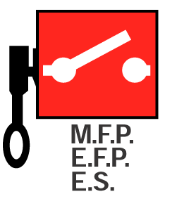
Give the meaning of the following symbol:
Manual fire alarm station.
Fire extinguisher location.
Remote controlled fire pumps.
Fire hydrant position.
Fireman’s outfit location.
If conditions permit, which is the best way to board a liferaft which is floating close to the ship?
Jump directly into the water and swim to the liferaft.
Use a rope ladder close to the raft to climb down and board.
Wait for the liferaft to come alongside the ship.
Throw a rope to the liferaft and pull it closer.
Use a lifebuoy to float to the raft.
An immersion suit will not sustain burning or continue melting after being totally enveloped in a fire for a period of:
5 sec.
10 sec.
3 sec.
2 sec.
1 sec.
An inflatable lifejacket has:
1 separate compartment.
3 separate compartments.
4 separate compartments.
2 separate compartments.
5 separate compartments.
The rescue quoit of a liferaft is attached to a buoyant line whose length is at least:
10 m.
20 m.
25 m.
30 m.
50 m.
How would an enclosed space be defined?
A space that is open to the atmosphere and well-ventilated.
A space used only for storage of food or equipment.
One in which the atmosphere may have a deficiency of oxygen or may have a toxic gas.
Any open deck area on the ship.
A space where no electrical equipment is installed.
What items of clothing should be avoided during mooring operations?
Loose sleeves or ties that can get caught in machinery.
Open footwear such as sandals.
Jewelry or watches that can snag on lines.
All of the items specified in the alternative answers.
Hats or caps without chin straps.
Which one of the following types of rope is the most dangerous to work with?
Manila.
Polypropylene.
Hemp.
Nylon.
Polyester.
How should the painter of a liferaft which is fitted with a hydrostatic release be secured to the ship?
Tied directly to the lifeboat davit without a weak link.
Left loose on the deck ready to deploy.
Secured via a weak link to a secure part of the ship.
Tied to another liferaft for added stability.
Wrapped around the ship’s railing without fastening.
One of the checks during the annual Class survey of the UMS functions is focusing on cleanliness of the engine room. What is the reason for such a check?
To ensure better working conditions for crew members.
To improve the efficiency of machinery operation.
To comply with environmental regulations only.
To reduce the general risk of fire in an unmanned engine room.
To keep a record for insurance purposes.
What is an IED?
A type of fire extinguisher.
An emergency lifeboat.
A homemade bomb.
A navigational device.
A standard engine part.
Which type of equipment can be used to detect explosives?
Metal detector.
X-ray scanner.
Particulate detector.
Thermal camera.
Sonar device.
What are the duties of the «Standby Watch keeper» when he is not on the bridge?
Perform maintenance on the bridge equipment.
Take rest wherever convenient without notifying anyone.
Remain in the expected location, available for immediate call from the bridge.
Supervise engine room operations.
Monitor the weather from any location on deck.
The lashing of containers loaded in the fourth and fifth tiers on a container ship are lashed with:
Manual hooks from the deck.
Standard twistlocks only.
The lashing bridge.
Ropes from the ship’s crane.
Straps from the cargo hold.
On a Container vessel, a vessel does not carry left and right-handed twistlocks, because:
Left and right-handed twistlocks are too expensive to carry together.
They take up too much storage space.
There will be confusion as to whether or not containers are locked.
Right-handed twistlocks are stronger than left-handed ones.
Only one type is compatible with container sizes.
On a Container vessel, fixed stacking cones are positioned:
On top of each container.
Inside the container doors.
At the base of cell guides.
Along the ship’s rails.
On the hatch covers.
On a Container vessel, the purpose of a Bridge Fitting is:
To secure containers to the ship’s deck.
To separate containers for ventilation.
To link the top containers of adjacent stacks.
To attach lashing rods to the containers.
To guide containers into the hatchway.
On board a container vessel conducting loading operations in United States, you notice an unsafe stevedore working practice. If you do not correct this immediately, it may result in:
Minor delays in loading operations.
Damage to the containers only.
Injury to a crew member.
The ship being prosecuted.
A warning from the port authorities only.
As per IMDG Code, fishmeal treated with anti-oxidant, would be carried on a container vessel under:
Class 3 – Flammable liquids.
Class 4 – Flammable solids.
Class 9 – Miscellaneous dangerous substances and articles.
Class 5 – Oxidizing substances.
Class 7 – Radioactive material.
As per IMDG Code, fishmeal not treated with anti-oxidant, would be carried on a container vessel under:
Class 3 – Flammable liquids.
Class 5 – Oxidizing substances.
Class 7 – Radioactive material
Class 4.2 – Flammable solid.
Class 9 – Miscellaneous dangerous substances and articles.
On a Container vessel, containers containing infectious substances are stowed:
Next to the crew accommodation for easy monitoring.
Near the galley for quick disposal of waste.
On deck in open air only.
In a position separated by a complete compartment or hold from living quarters.
Adjacent to other food cargo.
On a Container vessel, containers containing marine pollutants are stowed:
On deck only.
Near the lifeboats.
Under-deck.
Adjacent to crew accommodation.
Next to food containers.
On a Container vessel, if you saw a stevedore starting to lash a container whilst other containers were being stowed above it, you should?
Allow him to continue as lashing can be done anytime.
Tell him to wait until overhead containers have been stowed.
Ask another stevedore to assist immediately.
Ignore it as it is not your responsibility.
Report it to the captain without taking immediate action.
The term OSHA stands for:
Organization for Safety and Hazard Assessment.
Occupational Standards for Health and Accessment.
Occupational Safety and Health Administration.
Office of Safety and Health Affairs.
Organization of Safety and Health Authorities.
To conform with «best practise», can you drive a crane and stand-by for a colleague who has entered a cargo tank at the same time?
Yes, if the crane is stationary.
Yes, but only with another colleague present.
No.
Only if the cargo tank is ventilated.
Only during daylight hours.
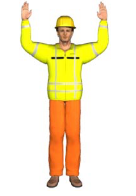
You are driving a crane and the signalman on deck gives this signal. What does it mean? (Hand signals as per the Code of Safe Working Practices for Merchant Seamen)
Hoist the load slowly.
Lower the load carefully.
Danger, or emergency stop.
Swing the crane to port.
Swing the crane to starboard.
Where is the «BRIDGE», in the figure?
The Bridge is B, in the figure.
The Bridge is C, in the figure.
The Bridge is D, in the figure.
The Bridge is A, in the figure.
The Bridge is E, in the figure.
Is it always possible to use the word «ship» instead of the word «boat»?
Yes, «ship» and «boat» are always interchangeable.
No, «boat» refers to large vessels only.
Normally a small vessel is called a «boat» rather than a «ship», otherwise it is not important.
Only ships can be called boats if under 10 meters.
The terms are never interchangeable.
What do you call the wide rung on a pilot ladder that prevents the ladder from twisting?
Stanchion.
Step.
Riser
The wide rung on a pilot ladder that prevents it from twisting is called a «Spreader».
Handrail.
What are the lists called that give the position and task during a lifeboat drill for all persons on board the ship?
Crew Assignment Sheet.
Safety Task Register.
Emergency Response Chart.
The Muster List.
Lifeboat Duty Roster.
In the human body, breathing is controlled by:
The heart.
The lungs.
The diaphragm
The respiratory centre in the brain.
The spinal cord.
What is the most important treatment concerning a foreign body in the eye?
Cover the eye with a bandage immediately.
Rub the eye gently to remove the object.
Seek a doctor without any immediate action.
Rinsing of the eye with water.
Apply eye drops immediately.
Which of the following substances is ozone-depleting?
Water vapor.
Carbon dioxide.
Halons.
Nitrogen.
Oxygen.
The cargo manifold working platform surface should be made of:
Solid steel plate.
Wood planks.
Rubber matting.
Open mesh grating.
Painted concrete.
When lifting the container vessel’s hatch pontoons, you should stop the operation if the:
Crane operator feels tired.
Hatch covers are slightly misaligned.
Ship has an excessive heel.
Weather is cloudy.
Communication is slow but ongoing.
On a Container vessel, a mid-bay guide is positioned:
At the top of the hatch to guide overhead containers.
Along the side of the ship for ventilation.
On the tank top mid-way in 40′ guides to prevent transverse movement of 20′ containers.
Near the crane rails for ease of loading.
Inside the container doors for alignment.
A container vessel’s hatch pontoon quick acting cleat will need to be replaced:
When the cleat paint is chipped.
After every five uses.
When the rubber washer is compressed and hardened.
If the cleat is slightly loose.
Only if the cleat breaks completely.
The function of a lashing plate on a container vessel is:
To guide containers into the hold.
To cover the hatch openings.
As tie down point for turnbuckles on deck or hatch cover.
To lift containers using the crane.
To mark container positions.
On the figure there are four (4) possible directions shown by the arrowed lines. Which one would correctly show the direction understood by the term «AFTER SPRING»?
B on the figure.
C on the figure.
D on the figure.
After spring is defined as A on the figure.
E on the figure.
On the figure there are four (4) possible definitions of the term «AIR DRAUGHT» given. Which one is the correct one?
A on the figure.
B on the figure.
C on the figure.
Air draught is given by D on the figure.
E on the figure.
What is name of the machine shown, used to heave on the ropes during mooring and unmooring?
Capstan.
Winch.
Windlass.
Derrick.
When should the lookout report another vessel?
Only when the vessel is very close.
As soon as it is sighted or heard.
When ordered by the officer on watch.
Only during restricted visibility.
How would you describe the position of the vessel in the picture?
The picture shows a passenger ship moored starboard side alongside a jetty.
The picture shows a passenger ship moored port side alongside a jetty.
The picture shows a passenger ship anchored near a jetty.
The picture shows a passenger ship leaving the jetty.
What is the normal name of the special wire/rope on board the ship used to make a tug fast?
Mooring line.
Towing spring.
Anchor cable.
Breast line.
What is the correct understanding of the term «boat drill»?
A routine inspection of lifeboats and rescue equipment.
Practical exercise for the people on board to practice their duties and be prepared in the case of an emergency abandon ship.
A maintenance procedure for testing the ship’s engines.
A navigation training exercise for steering the ship.
What is the correct understanding of the term «boat deck»?
The deck where cargo is loaded and unloaded.
The deck where the lifeboats davits are positioned.
The deck where the anchor equipment is installed.
The lowest deck inside the engine room.
What is the correct understanding of the term «gangway»?
A permanent staircase inside the ship connecting decks.
Portable bridge arrangement between ship and shore, when alongside.
A passageway used for moving cargo inside the ship.
A rope ladder used only during emergencies.
What is the meaning of the term «Steady as she goes» when acting as helmsman?
Increase the rate of turn to reach the new course faster.
While altering the ships head, the instruction «steady as she goes» means reduce the ships swing as rapidly as possible and steady on present course.
Maintain full rudder until another order is given.
Stop the ship immediately.
What does the term «Hard a Starboard» or «Hard to Starboard» mean?
Turn the wheel slightly to starboard.
Put the wheel fully over to starboard.
Keep the wheel in the midship position.
Put the wheel fully over to port.
What is the necessary protection when you are rust chipping with air tools?
A maintenance check of lifeboats and rescue equipment.
«Boat Drill» means the practical training in the various aspects of getting all the people onboard safely off the ship, in the event of abandoning ship.
A navigation exercise for steering the ship in rough weather.
A communication drill with the port authorities.
What is understood by the term, «The Lee Side»?
The side that faces into the wind.
Lee Side is the side that faces away from the wind.
The side that is facing the sun.
The side closest to the shore.
An alarm signal consisting of seven short blasts followed by one prolonged blast is sounded by the ship’s whistle and alarm bells. What are you to do?
Ignore the signal if nothing seems wrong.
Go to your lifeboat station.
Evacuate immediately by any available exit.
Wait for instructions from the captain only.
What kind of safety equipment must be worn during anchoring?
Helmet and gloves only.
All of the mentioned equipment.
Safety shoes and life jacket only.
Goggles and protective clothing only.
What will you bring in a lifeboat if the ship is abandoned?
Only food and water.
Warm clothes, blankets and lifevests.
Only navigation equipment.
Only communication devices.
Which of the following are frequent causes of fires in accommodation?
Smoking in bed.
Covering of electric fires with blankets.
Overloading electric plugs.
Leaving doors open at night.
If you detect a fire on board the ship, dependent on the situation, which of the following actions is the first to be taken?
Try to extinguish the fire immediately without alerting anyone.
Raise the fire alarm.
Close all doors and hatches.
Call the captain on the intercom.
Which one of the listed fire-extinguishing medium is to be preferred to fight a fire in an electric installation (for example the main switchboard)?
Water.
Powder.
Foam.
Carbon dioxide (CO2).
Anyone of the crew who is assigned to watch duties in port has a number of important tasks to carry out. Which one of the listed tasks should be included in the watchman’s duties?
Monitor the ship’s engine room only.
Check the moorings for correct tightness and ensure the gangway remains safe and secure.
Only report to the captain any unusual activity.
Supervise cargo loading exclusively.
What is the correct way that the lookout should report the appearance of a light, in clear visibility, on the port side of the ship in a direction half way between right ahead and abeam?
The lookout should state «Light right ahead».
The lookout should state «Light 4 points to port».
The lookout should state «Light abeam to starboard».
The lookout should state «Light on the starboard bow».
What is meant by the term «keeping a proper lookout» as applied to the bridge lookout?
Monitoring only the radar and navigation instruments.
Keeping a visual lookout all round the ship and also actively listening out for audio signals.
Observing the weather conditions only.
Reporting only when another vessel is sighted.
Apart from steering the helmsman should also:
Only maintain the rudder angle as ordered.
Regularly check the gyro against the magnetic compass.
Handle engine controls when needed.
Monitor cargo operations on deck.
How should you, as helmsman, give feedback to the OOW (officer on watch) that his orders are understood?
By nodding silently.
By repeating the order.
By taking immediate action without any acknowledgment.
By writing the order down.
What is the factor that makes the difference between a deflagrating and a detonating explosion?
The temperature at which the explosive ignites.
The speed of the shock wave created by the initial combustion.
The amount of fuel used in the explosion.
The duration of the combustion process.
What is the name given to a devastating explosion that may occur when a rigid container containing a liquefied gas is exposed to a very high temperature?
Detonation.
BLEVE.
Deflagration.
Gas flare.
Which of the following hose lengths corresponds best to the most common ones found onboard?
10 m.
20 m.
30 m.
50 m.
We must clean the spots of oil on hot surfaces because:
Oil spots can cause slippery surfaces.
Oil on hot surfaces may ignite easily.
All the answers are correct.
Oil spots can damage equipment.
In case of a fire on the line of an oxyacetylene gas-welding equipment, what action should be taken?
Blow on the fire to extinguish it quickly.
Close the valves on both bottles, first the acetylene and then the oxygen bottle.
Turn off only the oxygen bottle.
Remove the hoses and leave the bottles open.
Give the meaning of the following symbol:
Fire extinguisher.
Foam release station.
Lifeboat station.
Emergency exit.
The container for an inflatable liferafts shall be made:
Open at the top for easy access.
Watertight, as far as possible, except for drain holes in the container bottom.
Made of metal mesh.
Completely sealed with no openings.
How many ‘thermal protective aids’ are required to be carried on passenger vessels with open lifeboats?
One for each lifeboat.
One for every 10 passengers.
One for each person on board who is not provided with an immersion suit.
One for each crew member only.
The wearer of a lifejacket can jump into the water without injury and without damaging the jacket from a height of at least:
2,00 m.
3,00 m.
4,50 m.
5,50 m.
How many rocket parachute flares are carried in each liferaft with SOLASB pack?
1.
2.
3.
4.
The minimum number of lifebuoys required for a passenger ship cannot be less than:
4.
8.
6.
12.
What is the minimum distance between the helmet and the head of the wearer supposed to be?
1 cm.
3 cm.
2 cm.
5 cm.
What is advisable for a person entering a padlocked refrigerated room?
He should inform the bridge after entering.
He should take the padlock inside the room.
He should leave the door slightly open.
He should switch off the refrigeration system before entering.
Which of these procedures should crew follow when conducting a bomb search?
Open and inspect every package immediately after finding it.
Stand quietly in various spots around the space, listening for unusual sounds like the tick tock of a clock mechanism.
Move all suspicious items to a central location for inspection.
Shake suspicious objects gently to determine their contents.
What is the purpose of the Ship Security Plan?
To organize daily maintenance and repair schedules on the ship.
Protect your ship from risks posed by security threats or incidents.
To manage cargo loading and unloading procedures.
To regulate crew working hours and rest periods.
The vertical corner structures of a container are called the:
Corner beams.
Side pillars.
Corner posts.
Frame supports.
On a Container vessel, a vessel not carry left and right-handed twistlocks, because:
They are heavier and difficult to install.
They are more expensive to maintain.
There will be confusion as to whether or not containers are locked.
They reduce the cargo capacity of the vessel.
The function of a raised deck socket on a container vessel is:
To secure hatch covers during heavy weather.
To house base twistlocks or stacking cones.
To guide containers during crane lifting operations.
To drain water from the deck area.
The lashing plate on a container vessel will crack or buckle when:
The containers are loaded below their maximum weight.
The lashings are tightened too slowly.
The lashings and plate are not in the same plane.
The deck temperature is very low.
On a Container vessel, the purpose of a Bridge Fitting is:
To secure containers to the deck.
To link the top containers of adjacent stacks.
To guide containers into the hold during loading.
To prevent water ingress between containers.
The term «defrosting» on a container ship is associated with:
Refrigerated holds.
Ventilation systems.
Reefer containers.
Ballast tanks.
When preparing the cargo hold of a container ship to receive containers, it is important to:
Ensure all hatches are closed and sealed.
Check for cracks in tank top plating in areas where stack loads are transmitted.
Remove all twistlocks from the hold.
Lubricate container guides before loading.
On board a container vessel conducting loading operations in United States, you notice an unsafe stevedore working practice. If you do not correct this immediately, it may result in:
Minor delays in cargo operations.
Injury to the stevedore only.
The ship being prosecuted.
Loss of cargo insurance coverage.
Within the context of containerisation, Dangerous Goods are:
Goods that are perishable and require refrigeration.
Goods that are liable to cause damage to the ship.
Goods that are oversized and require special lifting equipment.
Goods that are to be loaded last and unloaded first.
A «Fantainer» is used for:
Carrying refrigerated cargo only.
Carrying dry cargoes prone to condensation.
Transporting liquids in bulk.
Storing hazardous materials temporarily.
As per provisions of MARPOL 73/78, chemicals spilled inside container ship cargo space would be considered as:
Dangerous Goods only.
Marine Pollutants.
Perishable Cargo.
Solid Wastes.
On a Container vessel, containers containing infectious substances are stowed:
On the top deck near the bridge for monitoring.
Next to refrigerated containers.
In a position separated by a complete compartment or hold from living quarters.
Adjacent to hazardous goods for quick access.
To conform with «best practise», can you drive a crane and stand-by for a colleague who has entered a cargo tank at the same time?
Yes, if the tank is empty.
Yes, but only with permission from the officer.
No.
Yes, if wearing proper safety equipment.
What might safely be used to prevent a load swinging when lifted by a crane?
Additional crane hooks.
Guide or tag lines, tended from a safe location.
Extra personnel pushing the load.
Crane operator manually balancing the load.
Where is the «BRIDGE», in the figure?
The Bridge is B, in the figure.
The Bridge is C, in the figure.
The Bridge is A, in the figure.
The Bridge is D, in the figure.
What is the objective of the merchant navy?
To enforce maritime law at sea.
To safely transport goods by sea.
To conduct naval warfare operations.
To maintain lighthouses and navigation aids.
What is «DRAUGHT», in the figure?
Draught is A, in the figure.
Draught is B, in the figure.
Draught is D, in the figure.
Draught is C, in the figure.
What is shown in the picture, a crane or a derrick using what loading gear?
A derrick using cargo slings.
A deck crane using grabs.
A shore crane using spreader bars.
A derrick using hooks and chains.
In the human body, breathing is controlled by..
The heart.
The respiratory centre in the brain.
The lungs only.
The diaphragm exclusively.
You must not attempt to move a casualty carelessly, if you suspect patient with:
A minor cut or bruise.
A sprained ankle.
Fractured spine.
A mild burn.
The emergency oil pollution equipment locker must be:
Locked at all times.
Located in the engine room only.
Prominently marked and easily accessible.
Accessible only by the Chief Officer.
To prevent inadvertent leaks, bunker manifold not in use should:
Be left open for ventilation.
Have blank flanges fitted with gaskets and tightened with all bolts in place.
Be disconnected from the pipeline.
Be covered with a temporary plastic cap only.
A fibre glass yacht, lifted and loaded on board a container vessel would be expected to be secured with:
Ropes and chains only.
Tarpaulin covers.
The cradle.
Lashing straps around the hull.
On a Container vessel, the purpose of fixed stacking cones is:
To support the weight of refrigerated containers only.
To prevent horizontal movement of 20′ containers in 40′ cell guides.
To assist in lifting containers with the ship crane.
To secure containers during rough weather only.
On a Container vessel, a mid-bay guide is positioned:
At the ends of the tank top only.
Above the top containers on deck.
On the tank top mid-way in 40′ guides to prevent transverse movement of 20′ containers.
Around the hatch coaming to guide the crane.
On the figure there are four (4) possible directions shown by the arrowed lines. Which one would correctly show the direction understood by the term «AFTER SPRING»?
After spring is defined as B on the figure.
After spring is defined as C on the figure.
After spring is defined as A on the figure.
After spring is defined as D on the figure.
On the figure there are four (4) possible definitions of the term «BOLLARD» given. Which one is the correct one?
Bollard is given by A on the figure.
Bollard is given by B on the figure.
Bollard is given by C on the figure.
Bollard is given by D on the figure.
On the diagram provided, there are four (4) possible directions indicating the term «AHEAD». Which one is the correct?
Ahead is given by B on the figure.
Ahead is given by C on the figure.
Ahead is given by A on the figure.
Ahead is given by D on the figure.
With reference to the text in the frame: what is stated as a threat to lives at sea and the marine environment?
Adverse weather conditions only.
Bad management and poorly maintained older ships.
Piracy incidents.
Collisions with floating debris.
What is name of the machine shown, used to heave on the ropes during mooring and unmooring?
Capstan.
Winch.
Windlass.
Derrick.
What is the correct understanding of the term «boat drill»?
Inspection of lifeboats by officers only.
Practical exercise for the people on board to practice their duties and be prepared in the case of an emergency abandon ship.
Routine maintenance of the ship’s equipment.
Safety briefing in the crew mess without using lifeboats.
What are the duties of an effective bridge look out?
Navigating the ship alone during night time.
Keeping a constant observation around the ship.
Operating the ship’s engines.
Preparing meals for the crew on watch.
What does the term «Hard a Starboard» or «Hard to Starboard» mean?
Turn the ship slightly to port.
Put the wheel fully over to starboard.
Stop the ship immediately.
Reverse the ship’s engines to slow down.
Who is authorised to operate lifting equipment around the ship?
Any crew member on deck at the time.
Those ship’s personnel who have been assessed as competent and are duly authorised to do so by the master as per the procedures as outlined in the ship’s SMS system.
Only the chief engineer.
Visitors or inspectors onboard.
Fuel oil from a leaking fuel pipe has been collected in a drip tray under the boiler furnace. The oil is suddenly ignited by a backflash from the boiler burner. The boiler room is manned and the person present has the choice of various extinguishers. The fire is purely a surface fire. What would be the preferable extinguisher?
Water.
Powder.
Foam.
CO2 (Carbon Dioxide).
Having a CO2 alarm during normal working hours, what immediate action should be taken?
Ignore the alarm and continue work.
Get out of the engine room as soon as possible.
Wait for the chief engineer to investigate before leaving.
Open all windows and continue normal operations.
Which is the «QUAY», in the figure?
The ship’s hull.
The crane on the dock.
The Quay is indicated by A, in the figure.
The mooring ropes.
Which is the «STARBOARD BOW», in the figure?
The port side of the stern.
The starboard side of the stern.
The Starboard bow is indicated by A, in the figure.
The port bow.
During the anchoring procedure, what would the 2nd Officer understand by the following request from the bridge, «How is the chain»?
The tension on the anchor windlass.
The weight of the anchor.
The bridge would like to know the direction of the anchor cable from the hawse pipe.
The speed of the ship while anchoring.
What is understood by the term, «The Lee Side»?
The side facing into the wind.
The side facing the sun.
Lee Side is the side that faces away from the wind.
The side nearest the shore.
If you detect a fire on board the ship, dependent on the situation, which of the following actions is the first to be taken?
Attempt to extinguish the fire immediately without alerting anyone.
Raise the fire alarm.
Evacuate the ship immediately.
Call the nearest port authority before taking any action.
Anyone of the crew who is assigned to watch duties in port has a number of important tasks to carry out. Which one of the listed tasks should be included in the watchman’s duties?
Prepare cargo documents for the port authorities.
Check the moorings for correct tightness and ensure the gangway remains safe and secure.
Navigate the vessel while entering the harbor.
Operate the main engine during cargo operations.
If the relief for the bridge lookout does not appear at the end of the watch, when required, what should be the actions of the existing lookout?
Leave the position and report the situation after finishing the watch.
He should inform the Officer of the Watch and wait for instructions.
Go to find the replacement lookout somewhere on the ship.
Stop the watch duties until the relief arrives.
If you are the helmsman on duty, what would be the correct action if the OOW (officer on watch) gives you the order to: «Change over from Automatic pilot to Hand steering».
Switch off the autopilot system and wait for further orders without touching the wheel.
Reduce the vessel’s speed before switching to manual steering.
Apply the controls to disconnect the Automatic pilot and engage hand steering. Start steering the vessel using the wheel and confirm with the OOW the change-over is complete and the course you are to steer.
Inform the engine room to change the steering mode.
What will you do if you are helmsman and the OOW (officer on watch) gives you the order: «Port 20» and after a while the order: «Ease to 10»?
Turn the wheel 10 degrees to starboard and maintain the course.
Keep the rudder at 20 degrees to port until another command is given.
Apply 20 degrees of rudder towards port and then after the second command reduce the wheel to 10 degrees of helm.
Return the rudder to midships immediately after the second command.
After smoking, cigarettes should be disposed off as follows:
Throw them overboard immediately.
Disposed of in an ashtray, ensuring that it is extinguished.
Leave them on deck to cool down.
Put them in a paper bin without checking.
What kind of fuel will originate a class A fire?
Flammable liquids such as gasoline or oil.
a solid (cardboard or wood…).
Flammable gases such as propane or butane.
Electrical equipment under voltage.
For which of the following groups of substances or materials is the use of water as an extinguishing agent dangerous?
Which of the following measures should rather be considered as a prevention measure than as a protection measure?
Installation of automatic fire sprinklers.
Use of portable fire extinguishers during a fire.
Restriction in the usage of combustible materials.
Wearing fire-resistant protective clothing.
What are the main basic components of a portable extinguisher?
The nozzle, the hose, and the safety pin.
The container, the extinguishing agent, the impulsion system.
The pressure gauge, the handle, and the mounting bracket.
The regulator, the valve, and the spray head.
What is the «international shore connection» used for?
To fill the ship’s fuel tanks from shore supply.
To connect the ship fire main to the shore lines.
To supply fresh water to the ship’s potable water system.
To charge the ship’s batteries from shore power.
The container for an inflatable liferafts shall be made:
With open sides to allow quick access to the raft.
Entirely perforated to allow ventilation.
Watertight, as far as possible, except for drain holes in the container bottom.
Made of metal without any drainage holes.
Which of the following actions should be done before throwing this type of inflatable liferaft over the side?
Ensure that all passengers are already on board the liferaft.
Check that the painter is made fast to a secure point and that the sea below is clear.
Inflate the liferaft while still inside the ship.
Remove all survival equipment from the liferaft before deployment.
A lifejacket is so constructed that a person can correctly don it within a period of:
30 seconds.
1 Min.
2 Min.
5 Min.
A lifejacket must not sustain burning or continue melting after being totally enveloped in a fire for a period of:
1 sec.
2 sec.
5 sec.
10 sec.
In which way shall a survivor be hauled out of the sea?
Vertical, head first.
Horizontal.
Sitting upright.
Feet first, standing position.
What is the greatest interest of the «help» position?
It allows the survivor to swim faster.
It lessens the survivor’s heat escape.
It keeps the survivor fully submerged.
It increases the survivor’s visibility in the water.
What signal, if any, is specified in SOLAS as the «Abandon ship» signal?
A continuous ringing of the ship’s bell.
the «Abandon ship» signal is not specified, only the general emergency alarm signal is stated.
Three short blasts on the ship’s horn followed by one long blast.
Waving a red flag from the bridge.
What items of clothing should be avoided during mooring operations?
Loose sleeves and scarves.
Open-toed shoes and sandals.
All of the items specified in the alternative answers.
Heavy coats and jackets.
Which one of the following types of rope is the most dangerous to work with?
Manila.
Polyester.
Nylon.
Polypropylene.
Under what circumstances should gangway nets be rigged under the gangway?
Only during rough weather conditions.
Whenever the gangway is rigged between ship and shore.
Only at night time.
When passengers are not allowed to use the gangway.
Who is the responsible person for the safety of the ship and all those onboard?
The Chief Officer.
The Master.
The Chief Engineer.
The Bosun.
The responsibility for safety and security rests with everybody on board the vessel. General house-keeping rules should be followed. Which of the listed rules is the most important?
Always wear personal protective equipment, even when not required.
Keep your working area clean and tidy.
Never operate machinery without permission.
Report any unsafe acts immediately to the Master.
Which of these types of information is considered sensitive?
Ship’s fuel consumption records.
Weather reports received onboard.
Voyage itinerary and departure and arrival times.
Engine maintenance schedules.
What is an IED?
An improvised communication device.
A homemade bomb.
An industrial electronic detector.
An international emergency distress signal.
The vertical corner structures of a container are called the:
Side panels.
Top rails.
Corner posts.
Bottom runners.
On a Container vessel, a vessel not carry left and right-handed twistlocks, because:
They are too expensive to stock.
There will be confusion as to whether or not containers are locked.
Left-handed twistlocks are obsolete.
Right-handed twistlocks are stronger and preferred.
The term «defrosting» on a container ship is associated with:
Dry containers.
Reefer containers.
Open-top containers.
Tank containers.
Immediately upon loading reefer containers on board a container vessel, they must be:
Left disconnected until departure.
Connected to the ship’s power supply and their setting temperatures verified.
Covered with tarpaulin for insulation.
Loaded on deck only.
Within the context of containerisation, Dangerous Goods are:
Goods that are perishable and require refrigeration.
Goods that are liable to cause damage to the ship.
Goods that are oversized and difficult to stow.
Goods that are fragile and need careful handling.
On a Container vessel, if you saw a container being damaged during loading operations you should?
Ignore it and continue working.
Immediately repair the container yourself.
Note the date and time of occurrence, container number and if possible take photographs.
Report it only at the end of the voyage.
A «Fantainer» is used for:
Carrying refrigerated goods only.
Carrying dry cargoes prone to condensation.
Transporting liquids in bulk.
Storing hazardous chemicals.
As per IMDG Code, fishmeal not treated with anti-oxidant, would be carried on a container vessel under :
Class 2 – Gases.
Class 4.2 – Flammable solid.
Class 3 – Flammable liquids.
Class 1 – Explosives.
The Maximum Securing Load (MSL) for a wire rope lashing connected to an eye plate by means of a shackle is:
The breaking strength of the wire rope only.
The Minimum Securing Load of either the wire rope or shackle or eye plate.
Twice the Minimum Securing Load of the weakest component.
The average strength of all components used in the lashing.
On a Container vessel, the person responsible for the safe lashing and securing of containers is:
The Chief Officer.
The Master.
The Bosun.
The Chief Engineer.
To ensure compliance with International Regulations, securing of containers on a container ship must be:
Completed after the ship departs the berth.
Completed before the ship leaves the berth.
Completed only for containers on the top deck.
Completed only if the weather is rough.
To conform with «best practise», can you drive a crane and stand-by for a colleague who has entered a cargo tank at the same time?
Yes, if the cargo tank is empty.
No.
Yes, if the crane is stationary.
Yes, if another colleague is also standing by.
What is the meaning of «make fast»?
To release a rope quickly.
To secure a rope.
To coil a rope neatly.
To cut a rope to a required length.
Is it always possible to use the word «ship» instead of the word “boat”?
Yes, the words are always interchangeable.
Normally a small vessel is called a «boat» rather than a «ship», otherwise it is not important.
No, «boat» is used only for fishing vessels.
Only when referring to military vessels.
What are the lists called that give the position and task during a lifeboat drill for all persons on board the ship?
The Crew Roster.
The Muster List.
The Emergency Log.
The Lifeboat Manifest.
If a patient is bleeding from nose:
Tilt the head backward and apply a cold compress.
Pinch soft part of the nose for 10 minutes while keeping the head forward over a basin.
Pack the nostrils with cotton and lie down.
Give the patient a hot drink to stop bleeding.
All heat burns should be:
Covered immediately with a thick cloth or bandage.
Cooled as quickly as possible with running cold water for at least 10 minutes.
Treated with butter or ointment immediately.
Exposed to air and left to dry.
Which of the following substances is ozone-depleting?
Carbon dioxide.
Halons.
Nitrogen.
Oxygen.
The cargo manifold working platform surface should be made of:
Solid steel plates.
Open mesh grating.
Wooden planks.
Non-slip rubber mats.
On a Container vessel, containers with untreated fishmeal cargo are carried:
In the holds only.
On deck.
In refrigerated containers below deck.
Mixed with other dry cargoes in the holds.
On a Container vessel, a mid-bay guide is positioned:
On the deck edge to support 40′ containers longitudinally.
On the tank top mid-way in 40′ guides to prevent transverse movement of 20′ containers.
At the corner posts to secure 20′ containers.
Inside the hold to separate hazardous cargoes.
Prior to commencing cargo operations on a container ship, with specific regard to the raised deck sockets it must be ensured that:
They are painted for corrosion protection.
They are lubricated with grease.
They must be clean and free of internal debris.
They are pre-filled with locking pins.
The function of a lashing plate on a container vessel is:
To separate hazardous cargoes from general cargo.
As tie down point for turnbuckles on deck or hatch cover.
To support mid-bay guides for 20′ containers.
To attach the ship’s mooring lines.
In the diagram, which arrow is pointing at the position known as the «Bridge»?
The Bridge is indicated by B, in the figure.
The Bridge is indicated by C, in the figure.
The Bridge is indicated by A, in the figure.
The Bridge is indicated by D, in the figure.
On the figure there are four possible definitions of the term «STARBOARD BOW» given. Which one is the correct one?
Starboard bow is given by B on the figure.
Starboard bow is given by C on the figure.
Starboard bow is given by A on the figure.
Starboard bow is given by D on the figure.
When could there be a demonstration of how to start a lifeboat engine?
Only during maintenance checks in the engine room.
A demonstration could be arranged during a lifeboat drill.
Only when new crew members join the vessel.
Anytime during cargo operations.
What could the wheelman be asked to do, to help in the preparations to leave the berth and go to sea?
Check the engine room gauges only.
Test the steering by putting the wheel hard over both ways.
Sound the ship’s horn to warn nearby vessels.
Prepare the lifeboats for inspection.
«Overshoot» is an expression related to a ship’s steering ability. What is the correct understanding of this expression?
It is the maximum angle the rudder can be turned.
It is the speed at which the ship can safely turn.
It is how many degrees of the compass a ship continues to turn after applying counter-rudder.
It is the distance a ship drifts while steering.
What do you understand by the term «Let Go» when applied to mooring and unmooring?
«Let Go» means to secure the mooring ropes and wires.
«Let Go» means to cast off the mooring ropes and wires.
«Let Go» means to tighten the mooring lines.
«Let Go» means to attach the ropes to the bollards.
What class of fire involves gas?
Class A fire.
Class B fire.
Class C fire.
Class D fire.
If you have to carry out hot work close to a smoke detector in the engine room, what precautions should be taken?
Only wear heat-resistant gloves and a mask.
Notify Master, Deck officer and Engineer in charge. The loop for this special sensor to be switched off and take normal precautions for hot work.
Cover the smoke detector with a cloth.
Work quickly without informing anyone to avoid alarm.
What is recognized as the main hazard when entering a void space?
Excessive light.
Lack of oxygen.
High noise levels.
Cold temperatures.
Which of the mooring lines shown in the figure is known as the «AFT BREAST LINE»?
The Aft Breast Line is A, in the figure.
The Aft Breast Line is C, in the figure.
The Aft Breast Line is B, in the figure.
The Aft Breast Line is D, in the figure.
Where is the «FORECASTLE», in the figure?
The Forecastle is indicated by A, in the figure.
The Forecastle is indicated by C, in the figure.
The Forecastle is indicated by B, in the figure.
The Forecastle is indicated by D, in the figure.
What is the meaning of this symbol?
Lifejacket.
Lifeboat.
Liferaft.
Rescue boat.
A class «D» fire involves what type of material?
Wood and paper.
Flammable liquids.
Metals.
Electrical equipment.
Which of the following are frequent causes of fires in accommodation?
Poor ventilation in cabins.
Smoking in bed. Covering of electric fires with blankets. Overloading electric plugs.
Leaving portholes open at night.
Storing lifejackets in cabins.
If you detect a fire on board the ship, dependent on the situation, which of the following actions is the first to be taken?
Attempt to extinguish the fire immediately.
Raise the fire alarm.
Close all ventilation openings.
Inform the engine room only.
What is meant by the term «keeping a proper lookout» as applied to the bridge lookout?
Checking the radar screen at regular intervals.
Keeping a visual lookout all round the ship and also actively listening out for audio signals.
Observing only the bow of the ship while underway.
Reporting to the officer only when another vessel is seen.
What will you do if you are helmsman and the OOW (officer on watch) gives you the order: «Starboard ten»?
Turn the wheel hard to starboard without repeating the command.
Repeat the command back and then turn the wheel to make the rudder turn 10 degrees to starboard of amidships.
Turn the wheel 10 degrees to port and report when completed.
Wait for confirmation from the captain before turning the wheel.
What will you do if you are helmsman and the OOW (officer on watch) gives you the order: «Port 20» and after a while the order: «Ease to 10»?
Turn the rudder 10 degrees to starboard and maintain that position.
Apply 20 degrees of rudder to port and keep it there until further orders.
Apply 20 degrees of rudder towards port and then after the second command reduce the wheel to 10 degrees of helm.
Move the rudder 10 degrees to port immediately without first applying 20 degrees.
Proteinic foams have the feature of being?
Of high expansion and very light.
Highly resistant to contamination by hydrocarbons.
Of low expansion, viscous and solid, easily contaminated by hydrocarbons.
Completely ineffective against flammable liquids.
What is the minimum volume of air contained in the cylinders of a SOLAS compliant self-contained compressed-air operated breathing apparatus (SCABA)?
600 litres.
900 litres.
1 200 litres.
1 500 litres.
In the fire fighting of fires of a type C with dry chemical powder extinguishers, the application is performed …
Intermittently, aiming away from the flames.
In a continuous way so that the powder spray is in the same direction as the one of the flame.
Only after disconnecting the electrical supply.
From a safe distance, without directing the powder towards the flame.
Give the meaning of the following symbol:
Lifejacket with light.
Lifebuoy with light.
Liferaft with light.
Rescue boat with light.
Which one of the listed requirements regarding the stowage of liferafts corresponds to present SOLAS regulations?
Liferafts shall be stowed upside down to prevent water ingress.
Liferafts shall be stowed with its painter permanently attached to the ship.
Liferafts can be stowed without securing them to the deck.
Liferafts should be stowed inside the cabins for easy access.
An inflatable lifejacket has:
1 compartment.
3 separate compartments.
2 separate compartments.
4 compartments.
You have abandoned ship in a liferaft. In most cases, which of the following actions should you generally take?
Paddle randomly to find land immediately.
Organise a lookout system. Join up with other survival craft if possible. Stream the sea anchor.
Use the liferaft only for rest and avoid any signalling.
Detach the sea anchor and drift freely without coordination.
How many hand held distress flares are carried in each liferaft with SOLAS A pack?
2.
4.
6.
8.
What method shall be used when hauling survivors out of the sea (state of survivors is critical)?
Using ropes only.
Using nets.
Hoisting with a crane directly from the deck.
Pulling survivors by hand from the water.
When fighting fire, why shall you never pour water into hot fat?
The water will cool the fat too quickly, solidifying it and smothering the fire.
The water will explode into steam causing hot fat to be thrown far away thus possibly causing severe burns or fire.
The water will mix with the fat, producing a non-flammable foam.
It will have no effect on the fire.
Which of these actions should crew take if a suspicious object that may be a bomb is located during a search?
Move the object to a safe location immediately.
Confirm with their search partner that the object found is suspicious.
Ignore the object and continue the search.
Attempt to open the object to verify its contents.
Ship Security Plans all look the same.
TRUE.
FALSE.
They are all identical in format.
Only plans for passenger ships look different.
What are the duties of the «Standby Watch keeper» when he is not on the bridge?
Patrol the deck and cabins at all times.
Remain in the expected location, available for immediate call from the bridge.
Operate the engine room unattended.
Take rest in the crew mess until called.
A container ship cargo hold may be considered not ready to accept containers, if it is noted to have:
Excessive lighting.
Fully functional ventilation.
Damaged cell guides.
Properly secured hatch covers.
If you notice a container with a damaged corner post being loaded, you must:
Ignore it and let the stevedores load the container.
Wait until the vessel is at sea to report the damage.
Inform the OOW immediately about this matter, because this container must not be loaded on the vessel.
Attempt to repair the container yourself before loading.
The vertical corner structures of a container are called the:
Side walls.
Roof beams.
Corner posts.
Base frame.
On a Container vessel, fixed stacking cones are positioned:
On top of the hatch covers.
Along the side walls of the hold.
At the base of cell guides.
Under the deck cranes.
On board a container vessel conducting loading operations in United States, you notice an unsafe stevedore working practice. If you do not correct this immediately, it may result in:
The cargo being damaged.
Delays in unloading operations.
The ship being prosecuted.
Increased insurance premiums.
Immediately upon loading reefer containers on board a container vessel, they must be:
Placed in the shaded area of the deck.
Inspected for physical damage only.
Loaded last to avoid delays in other cargo operations.
Connected to the ship’s power supply and their setting temperatures verified.
Containers carried on multi-purpose or general cargo ships may be lashed with lashing wires and chains, if:
The crew decides it is convenient during loading.
The ship is docked in calm waters only.
Such provision has been provided for in the vessel’s Cargo Securing Manual (CSM).
Lashing is optional and can be done with ropes instead of chains.
On a Container vessel, the person responsible for the safe lashing and securing of containers is:
The Chief Officer.
The Master.
The Chief Engineer.
The Stevedore Supervisor.
On a Container vessel, containers containing marine pollutants are stowed:
On deck only.
Under-deck.
Next to the engine room.
Near the bridge for quick access.
On a Container vessel, if you saw a stevedore starting to lash a container whilst other containers were being stowed above it, you should?
Ignore the situation and allow the stevedore to continue.
Tell him to wait until overhead containers have been stowed.
Ask him to lash the container faster.
Move to another area and report it later.
On a Container vessel, duty crew members must supervise the lashing of containers, because:
The crew must replace the stevedores during cargo operations.
Stevedores are not allowed to work on deck.
Stevedores often apply container lashings haphazardly or place twistlocks incorrectly.
Containers must only be secured by the ship’s engineers.
To conform with «best practise», can you drive a crane and stand-by for a colleague who has entered a cargo tank at the same time?
Yes.
Only if the tank is well ventilated.
No.
Yes, if the Chief Officer gives permission.
What might safely be used to prevent a load swinging when lifted by a crane?
Holding the load by hand while it is being lifted.
Standing directly under the load to guide it.
Guide or tag lines, tended from a safe location.
Pushing the load with metal bars.
What is the room often called where the crew eat their meals?
The engine room.
The crew mess.
The chart room.
The bridge lounge.
What do you understand by the order: «Move the pilot ladder to the other side»?
Remove the pilot ladder from the ship completely.
Move the pilot ladder to the other side, means: to shift the pilot ladder to the opposite side of the ship.
Lower the pilot ladder deeper into the water.
Secure the pilot ladder on the same side of the ship.
An unconscious casualty who is breathing, should be placed:
Flat on the back with legs raised.
Sitting upright against a wall.
In the recovery position.
Face down on the stomach.
Which of the following is false when a casualty is bleeding?
Apply direct pressure to the wound.
Raise the injured part if possible.
Cover the wound with a cloth.
Call for medical assistance.
Where can ozone depleting substances be found on board?
In ballast water tanks.
In refrigerated systems.
In fresh water tanks.
In cargo hatch covers.
Why is working at height on a moving vessel more risky than working at height ashore? Select the best option.
Because there is less wind at sea.
Because the vessel may be moving which causes extra loads on a person.
Because there are more tools available on a vessel.
Because the deck is always slippery.
In the diagram, the depth of water under the keel is indicated by the letter «C». Which bridge instrument would indicate this depth?
Compass.
Radar.
Echo Sounder.
GPS.
When acting as helmsman would you expect the reading of the gyro compass to be the same as the magnetic compass?
Always the same.
Often the same.
Very seldom would they be the same.
Never the same.
When two ships are lying alongside each other in a ship to ship operation and one ship is lying at anchor, anchor watch duties must be carried out as follows:
Only the anchored ship has anchor watch duties.
Only the mooring ship has anchor watch duties.
Both ships have normal anchor watch responsibility in addition to watching ship to ship fendering, mooring etc.
Neither ship is required to maintain anchor watch during the operation.
What is the first thing you are doing when having a lifeboat drill?
Go directly to the lifeboat.
Put on the life jacket.
Check the engine room.
Inform the bridge.
In the figure, which arrow indicates the direction «ASTERN»?
Astern is indicated by A, in the figure.
Astern is indicated by D, in the figure.
Astern is indicated by B, in the figure.
Astern is indicated by C, in the figure.
In the diagram, which letter is pointing to the area of the ship known as the «STERN»?
The Stern area is indicated by A, in the figure.
The Stern area is indicated by B, in the figure.
The Stern area is indicated by C, in the figure.
The Stern area is indicated by D, in the figure.
Would there ever be the need for two lookouts on the Bridge watch?
No, one lookout is always sufficient.
Yes, possibly when there is dense fog and heavy traffic.
Only during daylight navigation.
Only when entering a port.
What is the meaning of the term «Make Fast», when mooring the ship?
Make Fast means release the ropes from the bits.
Make Fast means secure the ropes to the bits.
Make Fast means throw the ropes into the water.
Make Fast means move the ropes to another winch.
What is understood by the term, «The Lee Side»?
Lee Side is the side that faces towards the wind.
Lee Side is the side that faces away from the wind.
Lee Side is the forward part of the ship.
Lee Side is the side where the anchor is located.
What equipment is provided in a liferaft to help you keep warm in cold weather?
The liferaft contains electric heaters to keep the occupants warm.
The floor of the raft has a second layer which can be inflated to help insulation, in addition to the thermal protective aids (10 % of complement, minimum 2).
The liferaft is equipped with wool blankets for every person.
The liferaft has built-in hot air blowers for cold conditions.
The diagram shows the direction that a rope runs during a mooring operation and a possible place where it may break. Where would be considered the safest position to stand?
Inside the blue coloured zone.
Close to the rope where it is under tension.
Outside the blue coloured zone.
Directly behind the winch drum.
Anyone of the crew who is assigned to watch duties in port has a number of important tasks to carry out. Which one of the listed tasks should be included in the watchman’s duties?
Supervise cargo loading operations at all times.
Check the moorings for correct tightness and ensure the gangway remains safe and secure.
Operate the main engine during cargo operations.
Navigate the ship when leaving the port.
What is the main responsibility of a bridge lookout at night?
Steer the ship according to the captain’s orders.
Inform the bridge of any new lights when they appear over the horizon or any other items observed which may affect the ship.
Adjust the radar settings continuously.
Record the ship’s speed and course every minute.
How is a EPIRB (Emergency Position Indicating Radio Beacon) activated?
EPIRBs are activated manually only by pressing a hidden button.
Most EPIRBs are automatically activated when they enter the water.
EPIRBs are activated by turning on the ship’s main power supply.
EPIRBs are activated when a distress flare is fired nearby.
The fire point is:
The temperature at which a combustible material melts.
The minimum temperature at which a combustible gives off vapours that may burn in contact with oxygen in air, and at which combustion persists once the source of ignition has been removed.
The temperature at which a combustible evaporates without burning.
The temperature at which a combustible produces smoke but does not ignite.
Which of the following may cause a fire in the accommodation spaces?
Faulty electrical equipment.
Smoking materials left unattended.
Combustible materials placed near heat sources.
All the mentioned alternatives.
What type of nozzles for fire hoses can be provided aboard ships?
Single purpose spray type only.
Dual purpose (jet/spray) type incorporating a shutoff.
Jet type without shutoff only.
Spray type with adjustable pressure only.
Before extinction of an electric fire we need …
To use water immediately on the fire.
To disconnect the power source.
To ventilate the area first.
To alert the crew before any action.
How many lifebuoys can you expect to find on board a cargo ship of 190 metres in length (including those of the quick-release system)?
At least 8 distributed on both sides of the ship.
At least 10 distributed on both sides of the ship.
At least 12 distributed on both sides of the ship.
At least 15 distributed on both sides of the ship.
Where do you find instructions for tasks and duties in case of an emergency?
In the ship’s logbook.
Posted on the bridge walls.
In the muster list.
In the engine room manual.
What material should boiler suits be made of?
Polyester.
Nylon.
Cotton.
Wool.
When going aloft in a bosun’s chair what kind of shackle should be used to attach the chair to the mast stay and how should it be used?
Any available shackle, attached randomly.
A temporary shackle attached with the pin running on the stay.
An approved shackle attached with bow of shackle running on the stay.
A shackle attached to the backstay only.
When is a visitor onboard required to present an ID?
Only on SECURITY Level 3.
Only on SECURITY Level 2 and 3.
On SECURITY Level 1, 2 & 3.
Only when boarding during nighttime.
Which of these are indicators that an individual may be a drug smuggler?
The individual is carrying a small handbag.
The individual wears bulky or out of season clothing.
The individual is wearing sunglasses indoors.
The individual has a valid passport.
On a Container vessel, twistlocks may be used to lift containers:
Always, regardless of certification.
Only if they have been approved and certified for this purpose.
Only when containers are empty.
Only under supervision of the chief officer.
On a container ship, a load-equalising device is used:
With diagonal lashing rods only.
With parallel lashing rods.
To secure the hatch covers.
Only for empty containers.
If your ship is in the tropics and you are going to be working out on deck during the day, what is the recommended daily intake of water for you to avoid the effects of dehydration?
2 litres.
3 litres.
4,5 litres.
6 litres.
What are the people probably doing in the picture?
The people are painting the cargo hold.
The people are inspecting the cargo hold for damage.
The people are hosing down the cargo hold to clean it.
The people are loading cargo into the hold.
What do you understand by: Rig the accommodation ladder in combination with the pilot ladder?
Raise the accommodation ladder without using the pilot ladder.
Lower the accommodation ladder and rig the pilot ladder right next to it.
Use only the pilot ladder for boarding.
Lower the pilot ladder away from the accommodation ladder.
The upper airway consists of:
Lungs and trachea.
Mouth, nose and throat.
Bronchi and alveoli.
Diaphragm and chest muscles.
When first using cleaning agent in the machinery space, the crew should:
Use it immediately without checking.
Confirm that it won’t form an emulsion.
Mix it with fuel before use.
Apply it only in the engine room exhaust area.
Which of these emission control requirements is correct?
Using heavy fuel oils increases efficiency and reduces all emissions.
Low sulphur fuels reduce emissions of volatile organic compounds.
Emissions are not affected by the type of fuel used.
Only diesel engines are subject to emission control regulations.
The function of a twist lock on a container vessel is to:
Lift containers from the deck.
Secure/lash containers.
Measure container weight.
Open container doors safely.
Тест CES – Deck, Support, Container Vessel
Try online
Did you find mistake? Highlight and press CTRL+Enter