
Electric Pod Drives: Killer App for Marine Electrification 2025
For over a century, mariners have been stuck with two main propulsion choices: inboard engines linked to propeller shafts or outboard motors mounted at the stern. Both have major drawbacks, as highlighted by James Edwards, Marine Chief Engineer at the British firm Helix. Outboards gobble up precious deck space – the vessel’s prime real estate – while blasting noise and raising the center of gravity. Inboards, meanwhile, demand dedicated engine rooms, propeller shafts, ventilation systems, fuel lines, and exhaust management, all eating into interior space and adding complexity.
Enter a fresh alternative: the next-gen electric pod drives, an evolution of azimuth thrusters. These systems house the propeller in a submerged “pod” that rotates 360° around a vertical axis, directing thrust precisely without needing rudders. This slashes fuel use significantly and frees up deck space, unlike bulky outboards. Traditional azimuth setups still tether the engine directly above (L-drive) or via shafts (Z-drive), but electric pods integrate the motor right into the pod itself, powered by onboard batteries or generators.
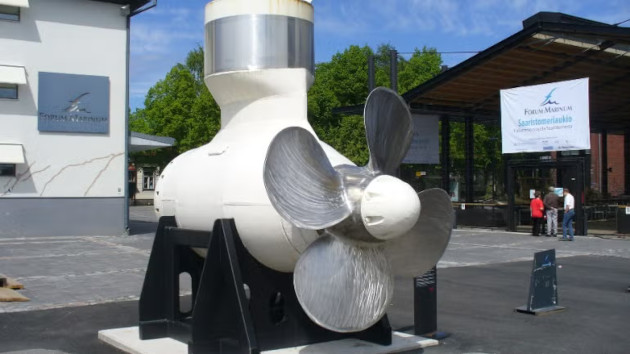
Source: Wikimedia Commons
Electric motors thrive without constant oxygen—just electricity—ditching those mechanical links entirely. The perks? No idling waste, quieter operation, lower maintenance, and the full maneuverability of azimuth tech.
Yet, pods aren’t flawless. Their Achilles’ heel has been drag—the hydrodynamic resistance from the pod’s cross-sectional area, which scales with motor size and power. Early examples, like the 2004 Toyota Prius motor (1.1 kW/kg power density), meant a 100 kW unit weighed 90.9 kg with a ~500 cm² profile, creating drag that offset efficiency gains, especially on smaller vessels. The square-cube law amplifies this: drag grows with the square of the pod’s diameter, while power scales cubically, so bigger motors fare better relatively, but small craft suffered.
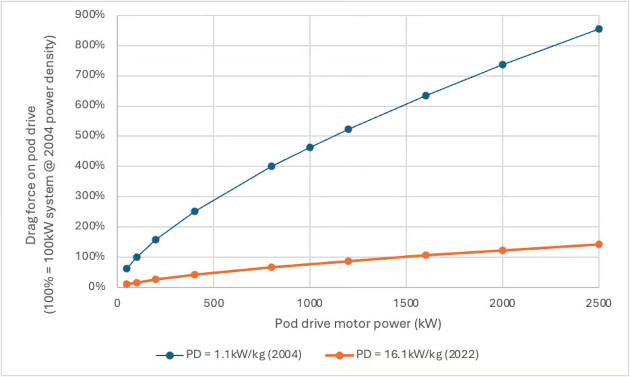
Fast-forward to today: EV tech leaps have skyrocketed power density. The 2022 Lucid Air motor hits 16.1 kW/kg, shrinking that 100 kW unit to just 3.1 kg and 85 cm² (~17 % of the Prius size). This slashes drag by 83 %, unlocking pods for mid-sized ships and longer ranges—up to 500+ nautical miles.
Pods are now electrification’s “killer app” for marine use, akin to spreadsheets revolutionizing PCs in the ’80s: they redefine vessel design, banish noise/vibration, boost fuel economy by 20–30 %, and pave the way for hybrids with hydrogen or batteries.
In short, electric pod drives flip the script on age-old trade-offs, making sustainable, efficient propulsion viable across vessel sizes. As 2025 trends toward decarbonization, they’re set to dominate, especially in regions like the Baltic and North Seas. Helix and innovators like ABB (with their pioneering Azipod in Finland) are leading the charge.