Egypt’s Journey to Green Shipping: National Action Plan and GreenVoyage2050
Egypt is developing a National Action Plan (NAP) to decarbonize its shipping industry, supported by the International Maritime Organization’s (IMO) GreenVoyage2050 Programme. The NAP aims to reduce greenhouse gas emissions from ships and ports.
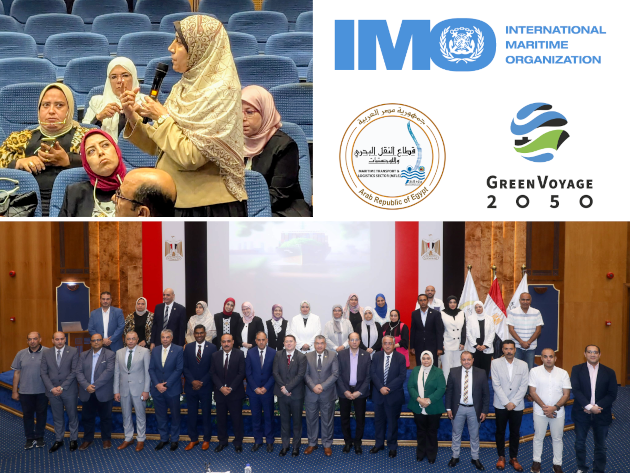
A workshop held in Alexandria from July 21 to 25 brought together stakeholders from Egypt’s maritime, energy, and transport sectors. Participants, including representatives from the Ministry of Transport, Ministry of Environment, Ministry of Petroleum and Mineral Resources, Ministry of Electricity and Renewable Energy, as well as the Suez Canal Authority, ports, shipping companies, and fuel suppliers, discussed priority actions, financing, and capacity-building for maritime decarbonisation.
Source: IMO
The GreenVoyage2050 team shared expertise on NAP development and presented case studies from partner countries. Breakout sessions focused on sector-specific challenges in shipping, ports, and energy, alongside cross-cutting discussions on finance and regulation. The workshop concluded with a commitment to ongoing inter-agency collaboration, with a draft NAP framework expected for consultation later this year.
Rear Admiral Sherif Zakaria, Deputy Head of Maritime Transport and Logistics Sector, emphasized the workshop as a step toward practical actions for sustainable shipping. Subaskar Sitsabeshan from GreenVoyage2050 highlighted Egypt’s potential, driven by the Suez Canal, to shape sustainable trade routes and attract investment.
The GreenVoyage2050 Programme, launched by IMO, supports developing countries in reducing shipping-related greenhouse gas emissions. Its second phase (2024–2030) aids countries like Egypt, Ghana, Kenya, Mexico, and Nigeria in developing NAPs, and runs pilot projects in Türkiye, India, Indonesia, and Vietnam. Funded by Denmark, Finland, France, Germany, the Netherlands, and Norway, the program will open applications for new countries in Q3 2025.