
Iceberg A23a Moves 60 km East: Changes and Implications for the Giant Iceberg
In the early days of June, the iceberg A23a, often referred to as the “ice wanderer,” shifted 60 km to the east due to the influence of ocean currents. It is currently located 74 km from the uninhabited Annennkov Island. Over the past three months, while the iceberg was grounded, its area has decreased by 7 %, bringing its current size to 2 730 square kilometers, which is comparable to the area of Moscow.
Polina Soloshchuk, the chief specialist in ice and hydrometeorological information at the Arctic and Antarctic Research Institute, reported that A23a has already lost 35 % of its original size since it calved from the outer edge of the Filchner Ice Shelf in 1986. At the time of its formation, the iceberg had an area of 4 170 square kilometers.
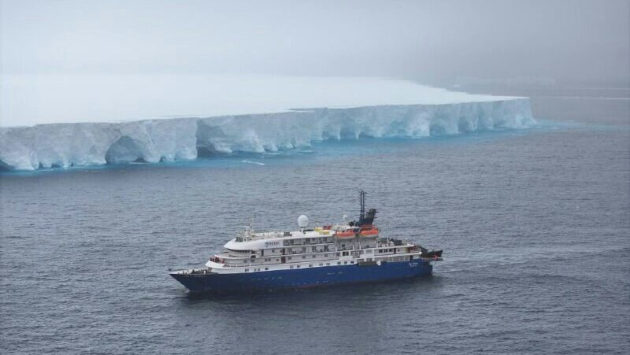
Source: AANII
For more than 30 years, A23a remained grounded in the central part of the Weddell Sea. It then began to move along the Antarctic coastline, and by mid-November 2023, it had drifted into open water. The iceberg continued to drift northward and, by mid-January 2025, it approached South Georgia Island. In early March, it ran aground 80 km from the island and maintained its position until the end of May.
Looking ahead, Polina Soloshchuk emphasized that the future of this giant iceberg will continue to depend on the prevailing winds and ocean currents in the region. As pieces of the iceberg break off, they will be gradually eroded by the warmth of the ocean and the currents. Despite its melting, the iceberg is not expected to have a significant impact on sea level, as the process occurs gradually over an extended period rather than instantaneously. This ongoing situation makes A23a a subject of interest for scientists and researchers monitoring its movements and changes in the Antarctic region.