Russian Government Announces Major Strategy for Fleet Modernization and Shipbuilding Growth
The Russian government has outlined its ambitious plans to modernize and expand its national fleet in response to foreign sanctions and restrictions. The shipbuilding industry has been significantly affected by the limitations on the export of advanced technology and machinery to Russia since the onset of the war in Ukraine.
Prime Minister Mikhail Mishustin addressed the efforts to implement the plans proposed by President Vladimir Putin. On May 12, during a meeting with regional leaders, Mishustin presented what he referred to as an updated strategy for the development of the shipbuilding sector. A key objective, alongside expansion and modernization, is to enhance domestic capabilities to replace foreign shipboard equipment and establish a local supply chain.

Source: ULUS Media
Mishustin announced that over the next six years, the government will allocate more than 500 billion rubles (approximately $6,2 billion) in federal funding for these initiatives, marking a record investment for the industry. He emphasized the importance of supporting freight traffic along the Northern Sea Route and establishing logistics routes with friendly countries, as well as promoting inland navigation and expanding river tourism.
First Deputy Prime Minister Denis Manturov provided further details, highlighting the need to replace the aging fleet built in the 1970s and 1980s. The strategy aims to construct over 1 600 ships by 2036 and more than 2,600 by 2050, with earlier reports indicating plans to build 713 vessels by 2030.
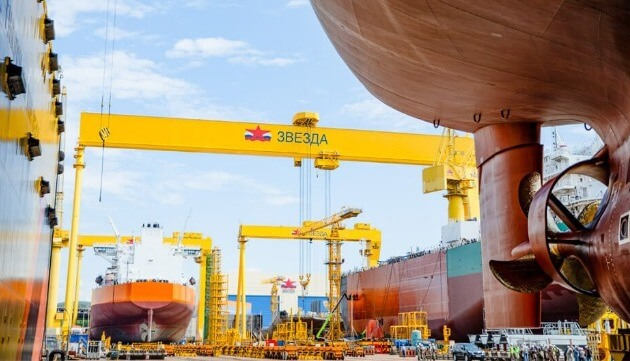
Source: Zvezda Shipyard
The focus of the plan is on large-capacity projects, including crude oil tankers, gas carriers, shuttle tankers, and bulk carriers. Reports indicate that 51 of the vessels will be designated for the Northern Sea Route, with additional emphasis on icebreakers and the fishing fleet, which will add 279 vessels. The plan also aims to support the North-South route, which encompasses shipping in the Caspian Sea.
To realize these ambitious construction goals, Mishustin stated that new shipyards will need to be built, production capacity expanded, and research and development undertaken to attract investors. Overcoming “structural barriers” within the industry will also be necessary.
The priority remains on meeting the defense needs of the state, with a new plan being developed for the Russian Navy. The government aims to align the Navy’s requirements with the objectives of expanding the merchant fleet.