Russia Sets New Record with 22 Million Tonnes of LNG Shipped Through Arctic in 2024
Russia is continuing to utilize the Arctic as an expanding transport corridor for its hydrocarbon resources. In the past year, it transported 21,86 million tonnes of liquefied natural gas (LNG) along the Northern Sea Route, the primary shipping lane, marking an increase of 8,6 percent or 1,73 million tonnes compared to the previous year.
LNG remains the dominant cargo exported through the Arctic seaway, accounting for nearly 58 percent of the total volume.
Source: Atomflot
Crude oil exports also rose by four percent to 8,1 million tonnes, equivalent to approximately 61 million barrels. This figure is expected to grow significantly in the next decade as Rosneft’s Vostok Oil project is set to commence operations within the next 12-24 months. By the 2030s, it could contribute up to 100 million tonnes of cargo annually.
Gas condensate experienced a notable increase of 22 percent, reaching 1,32 million tonnes. Unlike crude oil and LNG, Russian gas condensate has not yet garnered much public or official scrutiny regarding sanctions.
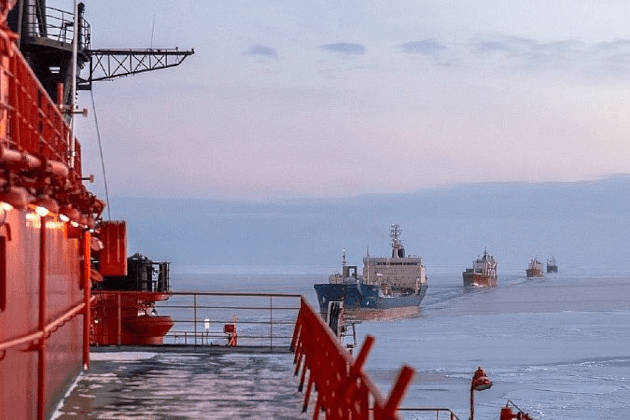
Ice-class shuttle tankers continue to make around 35 shipments per year from Novatek’s Yamal LNG plant to Western Europe. Additionally, Russia successfully loaded three cargoes from the sanctioned Arctic LNG 2 plant in the fall of 2024, delivering them to the Russian port of Vitino in the White Sea. This facility is connected to Russia’s rail network, facilitating further transport, including potential exports to Western markets.
While the total cargo volume of 37,9 million tonnes along the Northern Sea Route sets a new record, it remains significantly below the initial projections outlined in Russia’s ambitious Arctic resource development plan. Before the invasion of Ukraine and the subsequent Western sanctions, Arctic LNG 2 was expected to ship up to 20 million tonnes of LNG by 2026. Its export figures are now likely to remain at or near zero if Western sanctions persist.
In a decree from 2018, President Putin had originally anticipated that cargo flow along the Northern Sea Route would reach 80 million tonnes by 2024 and 110 million tonnes by 2025.
A shortage of ice-capable LNG carriers and oil tankers is expected to hinder transport capacity in the coming years, as Russian shipyards face challenges in replacing lost capacity from Asian yards due to sanctions. Nevertheless, cargo traffic is projected to increase during the summer months when low ice-class or even conventional oil tankers, LNG carriers, and container ships are able to navigate the Arctic.
During the summer of 2024, a Panamax containership successfully traversed the 5 000 nautical miles of the Northern Sea Route in a record time of 6 days, encountering no ice, which allowed it to connect the port of Saint Petersburg in the Baltic Sea to Shanghai in China in just over three weeks.