
Solar Technologies in Shipping: Innovations for Decarbonization
Despite being the most carbon-efficient mode of freight transport per tonne-kilometer, global trade’s vast scale results in significant environmental impact, with shipping contributing about 3 % of annual global CO2 emissions. Achieving substantial emissions reductions requires coordinated efforts across the value chain, involving shipbuilders, engine manufacturers, fuel producers, port authorities, and shipping companies.
Though a hard-to-abate sector, shipping is seeing increased adoption of clean technologies. Solar energy is gaining traction due to its abundance, reliability, and zero-emission profile. Advances in materials science and engineering have produced lightweight, flexible, and corrosion-resistant solar panels tailored for maritime use. Improved storage and energy management systems allow ships to use solar energy more efficiently, reducing reliance on fossil fuels.
Grafmarine’s NanoDeck system is a modular solar energy platform designed for harsh marine conditions. Made of interlinked tiles using advanced silicon- and perovskite-based photovoltaic materials, it transforms flat surfaces like vessel decks or port structures into smart energy hubs. Combining solar power generation with hybrid storage, the tiles are durable, corrosion-resistant, and easily retrofitted or integrated into new vessels. Each tile functions as an independent energy node, enabling scalability and individual replacement without system disruption.
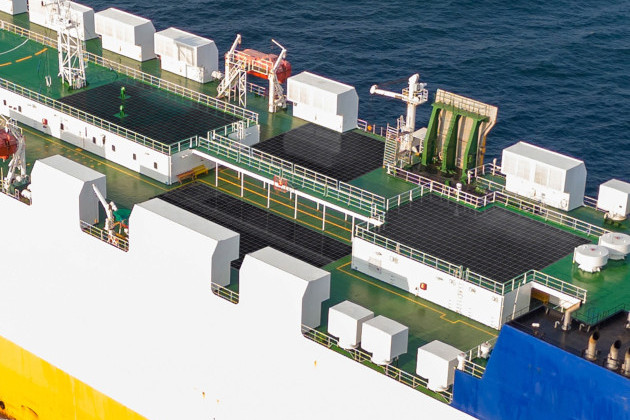
Source: Grafmarine
NanoDeck delivers up to 600 volts of continuous power at sea or in port, cutting operating costs and emissions. Digital testing indicates it could save up to 10 % of fuel on an oil tanker (about 10 tonnes of heavy fuel oil daily), with potential to reach 40 % savings in five years through scaling and technological improvements. The system complements other decarbonization strategies, including green fuels and wind-assisted propulsion.
Ports, where up to 85 % of tanker emissions occur while docked, are critical for emissions reduction. NanoDeck’s solid-state, plug-and-play design can be installed on port infrastructure, enabling ships to draw clean power and shut off engines.
Artificial intelligence enhances efficiency. Grafmarine’s NanoPredict platform uses over two decades of global weather data to forecast conditions and optimize energy use at sea. This predictive system ensures efficient power deployment, supports compliance with emissions regulations, and improves cost predictability.
With around 100 000 active ships producing nearly 940 million tonnes of greenhouse gas emissions annually, solar technologies like NanoDeck offer a promising path to meet climate goals while enhancing operational resilience in the shipping sector.