Stena Line and Electric Orkney Project Unveil Groundbreaking Ferry Designs for a Sustainable Future
Stena Line and the Electric Orkney project are key players in the maritime sector, advancing innovative ferry designs that are expected to significantly reduce carbon emissions and enhance efficiency.
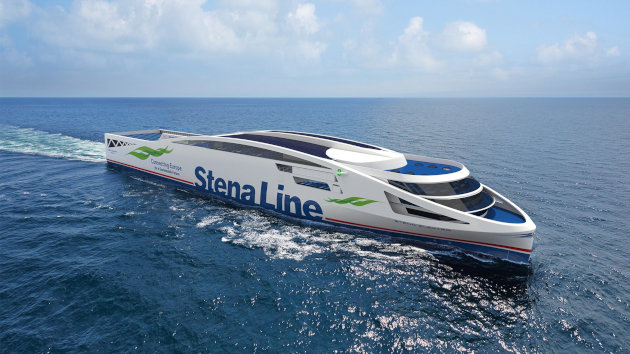
The Stena Futuro, a 240-meter roll-on/roll-off (ro-ro) concept vessel intended for transporting semi-trailers and cars, is projected to lower overall energy consumption by over 20 %, with the goal of achieving the “lowest fuel consumption on the market.”
Source: stenaline.com
This concept features 40-meter retractable wing sails and incorporates various technologies aimed at minimizing the vessel’s environmental impact, including:
- Hybrid propulsion with batteries and energy-efficient engines capable of running on multiple fuel types.
- Battery power for partial electric operation, such as during port maneuvers.
- Solar panels to meet the vessel’s energy requirements.
- An air lubrication system that uses small air bubbles beneath the hull to reduce drag.
- A waste heat recovery system that captures engine heat to provide onboard heating and electricity.
Johan Live, Stena Line’s Public Relations and Media Manager for Scandinavia, emphasizes that all technologies used in the design are “state of the art” and have been proven in practice.
He notes that air lubrication has already been installed on over 150 vessels, with around 300 more systems on order. Regarding the sails, he mentions that while this specific model may not yet be commercially mature, a functioning prototype has been developed, and the first model will soon be installed on a ship. Currently, about 60 vessels are equipped with some form of wind-assistance system.
Live also highlights that sails and air lubrication are technologies being considered for other vessels, with plans to install sails on one of their new ro-ro ships.
Another striking aspect of the design, for which a shipbuilder has yet to be determined, is its low and streamlined profile, with the hull and superstructure optimized for maximum cargo space efficiency. The ferry’s lightweight construction, along with optimized hydrodynamics and aerodynamics, is expected to play a crucial role in achieving low fuel consumption.
“Efforts have been made to reduce both hydrodynamic and aerodynamic drag while maintaining cargo capacity. Detailed studies were conducted on access to various parts of the vessel, emergency exits, and logistical flow,” Live concludes.
In Orkney, the Electric Orkney Project has reached a significant milestone with the delivery of the Belfast-built Artemis EF-12 Workboat XL to its base in the Scottish Isles for trials.
Named Zevi 1, the vessel was developed through a partnership between Artemis Technologies, Orkney Ferries, and the European Marine Energy Centre. The project aims to showcase the advantages of electric-powered hydrofoil workboats and passenger ferries for inter-isle routes in Orkney, supporting decarbonization and island connectivity over a three-year trial period.
With a capacity of 12 passengers, the vessel features “revolutionary” Artemis eFoiler technology, which is said to:
“Significantly reduce emissions, operating costs, and noise pollution while providing a smoother, more comfortable experience for everyone onboard.”
Mellissa Thomson, Chair of Orkney Ferries and a councillor, describes the arrival of the hydrofoil vessel as an “important moment for Orkney and our community, one that we’ve all been looking forward to.”
“Now the exciting work begins, and we will soon see the vessel on the water undergoing necessary tests. I am confident that the Electric Orkney project will provide islanders with a service that is smoother, quieter, and built for the future,” she concludes.
Dr. Iain Percy, CEO of Artemis Technologies, adds, “Bringing the Artemis EF-12 Workboat XL to the islands supports Electric Orkney’s ongoing goal of decarbonizing transport while improving service quality for residents and visitors.”
To support the Zevi 1, an ultra-fast charger is being installed in Kirkwall, which will fully charge the 12-meter vessel in under one hour. The Electric Orkney project is also preparing to deploy the second of its two trial vessels, the Artemis EF-24 Passenger, as part of its ambitious plans for future ferries.