
Selling Yacht Donations has emerged as a popular way for charitable organizations to generate funds while providing yacht owners with a hassle-free way to part with their vessels. When individuals choose to donate their yachts, they not only receive potential tax benefits but also contribute to meaningful causes. This process allows charities to sell the donated yachts and utilize the proceeds for their programs and initiatives.
Furthermore, yacht donations can help owners avoid the costs associated with maintenance and storage. By engaging in this altruistic endeavor, yacht owners can make a significant impact while easing their own responsibilities.
When It’s Time to Sell
For whatever reason – the desire for a larger boat, reverses in family fortunes, changing interests, old age (of the boat or her owner), a move from one part of the country to another – sooner or later every boat will go up for sale. When that time comes, every boat owner wants to sell his boat quickly and easily, and for as much money as possible.
Of course, most boats are always «for sale», assuming that the price is right. Boats, after all, are not like pets or children, despite what we may feel in the way of comparable affection. Rare is the boat owner who never yearns for a more perfect boat than the one he already owns. And few of us would turn down a gratuitously offered sum of money in excess of the value we place on the boat, particularly if it allowed us to purchase a more nearly perfect replacement.
With these premises in mind, let’s consider some ways to make selling as quick and painless as possible, as well as a few ideas for maximizing the sale price.
A Matter of Value. Start by developing a firm notion of the probable value of your boat. The value of a used boat is neither what you paid for her (unless, of course, you bought her yesterday) nor an amount that reflects your emotional involvement over the years.
If the boat is fairly new, say six years old or less (older if a substantial number of units were built), you can get an estimate of the value by keeping track of the asking price in classified advertising, class newsletters, and brokerage listings. It may be worthwhile to invest in a few phone calls to inquire about the experiences of sellers of similar boats.
A second alternative, given the disparity between asking prices and sale prices, is to check periodically in the BUC book, a record of actual sales over recent years.
A third alternative is to sit down with a calculator and figure out what you have invested in the boat, and from that information, formulate an idea of what the resale value might be. Take the original sale Compact Sailing Boats – Key Specifications, Innovative Designprice of the boat, add the cost of major additions, modifications, and replacements, assuming about a 20-percent depreciation per year on these upgrades. Next add an appropriate amount for items such as the dinghy, prepaid dockage, cradle, and so forth. Don’t endeavor to be too precise; some of these items will be of little or no value to the prospective buyer. The point is to arrive at a figure that you yourself might be willing to pay for the boat and its equipment.
For the average fiberglass boat built within the last 10 to 12 years, this figure is likely to be between 105 percent and 110 percent of the original base price of the boat. On well-built boats, those with a reputation as «classics», those with extraordinary local appeal, the «appreciation» may be greater. On boats of lesser quality, unusual or highly stylized boats, and special-purpose boats (racing boats, replicas, etc.), the figure may have to be adjusted downward.
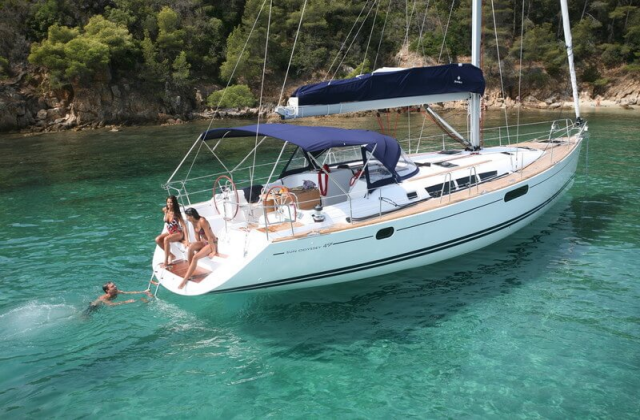
Source: wikipedia.org
What this figure does not reflect is the degree of care the boat has received. A boat that has been carefully maintained is worth more – by as much as 25 percent or more – than a boat that has been neglected or abused. There is no better reason to maintain a boat well.
Once you have a dollar amount that you regard as the value of your boat, you must decide what, if anything, should be done to enhance her value or to make her more attractive to a prospective buyer. Would a $ 3 000 polyurethane paint job bring $ 3 000 more in the sale price and more interest from potential buyers? The answer is probably not. It is usually better to clean up a boat, rather than to dress her up. The cost of major upgrades are difficult, if not impossible, to recover in the sale price. Thus there is little sense in replacing a serviceable 10-year-old gas engine with a new diesel engine to the tune of $ 5 000. To do so might make the boat more attractive to a buyer, but it is doubtful that the selling price could be increased enough to cover the cost.
While upgrading may not be worthwhile, repairing damage probably is, especially if you can do the repairs yourself. Most boat buyers are not interested in acquiring someone else’s problems. Most buyers assume that they will find things that need to be done, but few will want to buy a half-completed repair or renovation project.
Sell Her Yourself or Use a Broker? Most of us have limited sales skills and a limited amount of time to spend developing sales leads and pursuing potential buyers. Instead, we turn the boat over to a broker in the hope that he can sell her for more money than we could, in part defraying the 10-percent commission he will take before we see any money.
Nevertheless, unless there is some other compelling reason, there is no reason not to take a stab at selling the boat yourself. The key issue is to make an earnest, honest effort. Earmark funds for advertising, up to about three percent of the asking price, and set up an advertising schedule. Prepare a detailed prospectus. Put the boat in shape to be shown. Have some notes handy on how to reply to telephone inquiries. And dredge up some enthusiasm with which to discuss the boat, the reasons you are selling her, and why she makes a good buy at the price you are asking. After all, this is almost exactly what a boat broker is doing to earn his 10 percent.
Write an ad that attracts attention and gives enough basic information to encourage a prospective buyer to call. Once a prospect asks to see your boat, assume that you have a «live one», but try to weed out the tire kickers and the merely curious over the phone. Prior to a visit from a possible buyer, send him a copy of your prospectus. Don’t hesitate to follow up with a phone call to answer questions he might have and to confirm a date to look at the boat. Remember, all this effort is designed to make you money as well as to produce a quick sale.
If this sounds like too much effort, then sign with a broker. Plan to spend some time shopping around for a good broker; the good ones charge the same commission as the lazy ones. The difference is that the good ones will advertise your boat, treat prospects with enthusiasm, and be conscientious in their dealings with you and your boat.
In most states, boat brokers are not licensed, regulated, or formally trained. Many, even the best ones, are in the business because they like boats and the folks who own them. In shopping for one to list your boat, you have a right to ask to see the listing of the boats they are currently brokering, a record of recent sales, and a list of other brokers with whom they have a co-broker arrangement. The broker should give you a good idea how reasonable your asking price is, and should be able to tell you about how long it should take to find a buyer.
Once the boat is listed, don’t just disappear. Check periodically to see what response the broker has received, whether comparable boats are selling, and how his prospects have reacted to your boat.
Even when using a broker, we like the idea of being on hand when a good prospect inspects the boat, especially if it is a second visit. There is no need to give the potential buyer a sales pitch, but it may help close the sale if you are available to answer the buyer’s questions.
What About Trading In? As with automobiles, many new boat dealers offer owners a trade-in allowance on their present boats toward the price of a new boat. On the assumption that no one in his right mind wants to be the owner of two boats at once, this may be a highly appealing means of moving up. Whether it is as appealing economically is another matter.
Dealers routinely offer a trade-in allowance that lets them make a profit off the sale of both boats; on your new one and on the one you trade in. The allowance in thus not likely to be as much as you would make on your boat if you sold her yourself, and probably less than you would realize if a broker sold her. The trade-in amounts largely to a convenience.
On the other hand, the dealer may know of several hot prospects for your boat. He may therefore offer you a reasonable trade-in allowance if he thinks he can sell your old boat quickly.
Negotiating the Sale Price. The selling price of a boat is likely to remain somewhat flexible right up until the check is turned over to you. From the outset, there are probably going to be series of offers and counteroffers including terms and compromises over what will and will not be part of the agreed price. For a lower figure, you may decide you don’t want to sell a VHF radio or Loran, even though it usually pays to sell a boat as is, where is, with all such equipment. (Haggling over a $ 300 radio on the sale of a $ 30 000 boat usually represents a misplaced priority.) Similarly, the buyer may not be interested in your mooring or buying the remainder of the time on your insurance policy. These details constitute the tools of negotiation. You decide how much such exclusions are worth, and whether you can dispose of them separately to make up any difference. The buyer decides how much he is willing to pay for what total package.
Before negotiations reach this point, it is time to have some token of good faith from the prospect. This may be a binder in the form of a few hundred dollars for which you agree not to sell the boat to another party without giving the first buyer a chance to meet the price. Or it may be a deposit equivalent to five to ten percent of the asking price that limits the sale of the boat to the depositor for an agreed-upon period of time. Before permitting the boat to be surveyed, you should have a deposit and you may want to insist on a deposit before allowing a sea trial.
Should the deal fall through after the exchange of deposit money, you are entitled to keep any out-of-pocket expenses incurred in trying to sell the boat to that buyer. Only with a prior agreement can you keep the rest of the deposit with the argument that you lost chances to sell the boat during the time covered by the deposit. For this reason, the deposit should be placed in an escrow account. In short, until the final transaction, it is not your money.
Resolving the Deal. You or your broker should have a sales agreement ready for signing. This agreement itemizes every piece of gear you are ready to turn over to the buyer, its location, and enough of a description so that it is identifiable. Include anything not permanently fixed to the boat, including sails, spars, and dinghy, as well as odds and ends such as spare parts that are considered part of the sale price.
Payment in full for the boat may not take place until the boat is actually delivered to the buyer, assuming that agreed upon repairs may be underway, purchase may be contingent upon commissioning, financing, delivery, and so forth. In some cases, payments might be made in installments. This is a sticky time for buyer and seller alike, and our suggestion is that both work through a third party such as a cooperative bank or a lawyer. Of course, if either party is working through a broker, the broker should ease these awkward situations.
Whether a broker is involved or not, buyers and sellers would do well to behave during this time in a businesslike manner, regardless of how friendly they may have become. Changes in the sales agreement should be initialed, detailed notes on phone calls and discussions kept, and cashiers checks in lieu of personal checks should be used to exchange funds.
The buyer may suggest that there be a reasonable amount of money kept in escrow if the seller assumes any obligation for work to be done after the final agreements are executed. For instance, the seller may have signed the contract with the boatyard for storage, the balance to be due upon launching. Since this is the seller’s contract, but because there is no loss to him if he does not meet that payment, he should agree to put enough of the sale price in escrow to cover that obligation.
With a measure of luck, cooperation, and good faith, the worst is over; but often, there are residual complaints. The buyer cannot find this or that bit of gear on the boat; the broker does not send the check to the seller as soon as the seller thinks he should; the boatyard sends the seller a bill for helping the buyer get aboard to look at the boat; and so forth.
These are usually resolved amicably, however; after all, the boat is simply a toy, albeit an expensive one. Nevertheless, there are times when even the thought of a sale going through simply on the handshake of a couple of strangers has to be regarded as a small miracle.
Tips on Preparing to Sell. Clean the boat up. Avoid the need to apologize for (or to pointedly ignore) several years’ accumulation of dirt, mildew, odds and ends, and pack-rat clutter.
Fix her up. Repair the broken drawer, the locker with the loose hinge, and the split seam in the berth cushion. Do as many of the small jobs as possible, starting perhaps as much as a year before you plan to put the boat on the market. Remember, you want the condition of the boat to justify the asking price; not to give a buyer an excuse to offer less.
Have as complete an inventory as possible. The longer the list, the more impressive the package.
Be ready to sell. Don’t make the buyer feel he is depriving you of a cherished heirloom, or that you will be offended by a low offer. It is one thing to speak warmly of your boat, quite another to treat a buyer with ill-disguised resentment.

Source: wikipedia.org
Make the boat available. Have a ladder handy. If the boat is under cover, make sure it is easy to get into and have lights rigged. Make the boat readily identifiable; a buyer may want to reconnoiter on his own a half-hour before your appointment.
Yacht Donations
With the current buyer’s market, more and more owners will consider donation as a way of unloading a used boat. If a tax write-off is not enough of an incentive, we now have institutions advertising that they will pay you cash on top of your deduction if you donate to them.
The current buyer’s market not only makes most Buying and Selling Making – a Sound Investment In a New or Used Boatused boats a bargain, but it has also lowered the prices at which institutions will sell the boats that were donated to them. Remember that an institution has little or no investment in a boat. It does not hurt them to sell cheap.
The IRS. Controlling this arena from afar is the agency that makes it all possible – the Internal Revenue Service. And as the incentive to donate has gotten stronger, so has the strength of the IRS, thanks to new rules passed by Congress.
Of course, there have always been obstacles to yacht donation. For several years there have been potential penalties for those who write their yachts off for more than they are really worth. For example, if the person who appraises your boat conspires with you to overvalue it, he is subject to a $ 1 000 fine; $ 10 000 if he conspires with a corporation. This is called «aiding and abetting an understatement».
Under those same rules is the «over valuation penalty». If you, the taxpayer, write off your boat for 150 to 200 percent of what the IRS says it is really worth, then expect a penalty of 10 percent on top of the the amount you owe them. If you value the boat at 200 to 250 percent, the penalty is 20 percent of the tax owed, and so on.
Since 1983, donors have had the prospect of a «substantial understatement penalty» hanging over their heads as well. This is in addition to the other penalties. If you understate the total amount of taxes owed by more than $ 5 000 or 10 percent of the correct tax due, then you can be assessed a penalty of 10 percent of the amount understated. If you are «negligent», which means you knew better, or should have known better, the IRS will add more penalties.
While this may seem like a lot of potential problems for the taxpayer, they are nothing compared to the potential for gain by cheating the system. It was not long ago that donation was considered the normal way to get rid of an obsolete IOR boat. The reasoning was that a boat that cost $ 300 000 to build could certainly be written off for $ 200 000, even though she would not bring $ 75 000 on the open market.
The IRS put a stop to that with the Tax Reform Act of 1984. Now the problem is not so much one of premeditated cheating – most of that has been curtailed. However, in today’s market some donors might wonder if they could be accused of cheating when they had no intention to do so. How do you prove that an appraisal was valid if the IRS challenges it after a few years of vicious depreciation? What was truly worth $ 100 000 two years ago may only sell for $ 70 000 today.
The donor should not worry; if the appraisal was valid when it was done, it does not matter what the boat is worth when the charity sells it. It is a good thing that the BUC used boat guide is lagging behind the drop in actual selling prices; it is one of the tools the IRS uses to determine the value of a boat.
Another potential problem is the documentation required by the Tax Reform Act. The Act includes several requirements for «non-cash» donations like boats that are written off for more than $ 5 000. First, you must fill out a special section of Tax Form 8283 (Noncash Charitable Contributions). That section has to be signed by both the appraiser and the charity to which you are donating. You have to attach a copy of the appraisal to the form.
The appraiser has to give his address and tax number. He has to acknowledge that he is not related to nor an employee of the donor or donee. He cannot have a relationship with either of the two parties that «would cause a reasonable person to question his independence». Finally, he must acknowledge that his fee is not a percentage of the appraised value. Otherwise there would be an incentive for him to pad the appraisal.
The Two-Year Rule. Elsewhere on Tax Form 8283, you are asked to explain any conditions attached to the donation. This is because the Tax Reform Act requires that, for two years after the donation, the charity tell the IRS when it «disposes» of anything that was appraised for more than $ 5 000. That means that if they sell your boat within two years of the day you offered it to them, the IRS has to know. If the boat is sold for substantially less than it was written off for, you can be almost certain that you will be hearing from the IRS.
It is common for the donation to be made on the condition that the boat not be sold for two years. However, you are supposed to explain any condition on your tax form, and such a condition is likely to arouse suspicion on the part of the IRS. Some donors try to set up a deal where they are still allowed to use the boat after it has been donated. That is a «condition» and the IRS is not going to like it.
Looking at it from the charitable institution’s point of view, they want to unload your boat as soon as possible, as it is costing them money to store, maintain, and insure it. To try to beat the two-year rule, some institutions arrange charters with prospective buyers. The charter fee is applied to a purchase option at the end of the two-year holding period. The final price may be renegotiated when due.
With a charter/purchase option, the boat is not actually sold until two years after the donation. In the IRS’s eyes, however, it has been disposed of from the day it was chartered. Again, they are going to insist that the charity report it.
Read also: Yacht Financing: Your Complete Guide to Funding Your Dream Boat
A «bargain sale» is also likely to catch the eye of the IRS. With a bargain sale, the charity offers you money as an incentive to donate your boat. Your tax write-off is reduced by the amount you are paid. Even so, you come out of the transaction richer than you would have with a straight donation. Because a bargain sale involves a cost to the charity to acquire the boat, they won’t want to keep it in storage for two years. Hence, they are more likely to sell it immediately or charter it with a purchase option.
The Charities. The more «clean cut» the charity, the less likely you are to be audited. The IRS keeps files on possible tax dodges, and institutions that advertise tax benefits for donations are more likely to be scrutinized. The less attention the charity draws, the less careful you have be in getting an accurate appraisal.
On the other hand, the buyer does not have to worry whether the boat he is considering was donated legitimately. The IRS is not going to come after the boat; they will go after the person who donated her. While it goes without saying that a donor should choose his appraiser with care, he also should be just as careful about choosing the charity he donates to. It is usually the ones that offer him the best «deal» that are most likely to get him into an IRS audit. Here is a sampling of the charities you are likely to run across:
The Naval Academy. United States Naval Academy is nearly ideal as a charity for donated boats. It is a government-supported, high-profile institution that is unusual in that they actually use the boats they receive for training their students. This puts them on much more solid ground with the IRS.
The Navy currently has more than 20 donated yachts in their training program, most of which were IOR grand prix racers that were donated because obsolescence made them almost unmarketable. The Navy prefers racing boats in the 43- to 50-foot range because they get the maximum number of students on the water in boats that are not too difficult to sail.
Before the Tax Reform Act of 1984, the Navy used to take cruising boats as donations. However, they would not use them for training; instead they would charter them with a purchase option. Because this is now viewed as improper, they have since turned down all donations except for racing boats on which they can train students.
With the recent glut of used cruising boats, the Navy plans to begin accepting cruising boats again. As they do with all their boats, they will agree not to sell or otherwise «dispose» of them for two years. Such an agreement constitutes a condition that should be reported by the owner to the IRS, but the Navy does not see it that way. They say it is expected; we are not sure the IRS would agree.
Other Schools. The Naval Academy may set the example, but there are few schools that follow it. Most have little intention of using the boats that are donated to them for academic purposes; they simply want to turn them into cash as soon as possible.
We talked to two typical schools with boat donation programs – New York Maritime College at Fort Schuyler, and the University of Rhode Island. Fort Schuyler is famous for being the foundation that has administered the fund raising for several America’s Cup Campaigns. It is not surprising that they have several used 12-meters for sale.
Fort Schuyler does use some of the boats that are donated to them for training students. However, they also do three things that makes them look less like a charity in the eyes of the IRS. They accept two-year restrictions, charters with options to buy, and occasionally do bargain sales.
Rhode Island is not a maritime academy, so they have less instructional use for the boats they receive. With them, raising money is the primary consideration. They also take two-year restrictions, but they do not do bargain sales or charter/purchase options. When they put a boat on the market, they intend to sell it quickly; no matter what the price, the best offer takes it.
Marginal Operations. Both accountants and institutions like the Naval Academy warned us to avoid certain types of charities. They say to watch out for ones that advertise heavily for donations, especially when words like «bargain sales», «cash for donation», and «maximum tax write-off» are used. IRS employees regularly clip advertisements like these and send them to the central office for filing. Remember, the charity must be named on your tax form.
Some of these charities are hardly a charity at all. The donor deals with a middleman, not the charity he represents. The charity will see only a percentage of the money raised from your donation; the middleman takes a healthy profit. One outfit we called claimed its charitable status was based on awarding grants to oceanographic projects.
These operations make their money by disposing of the boat as quickly as possible. They will either sell it or arrange a charter/purchase option. If they tell you they reserve the right to arrange a charter/purchase option, you have to report that on your tax form. If they do not tell you beforehand, or the IRS when they do it, they are going to get into hot water. And you may get dragged into the pot with them.
The prospect of a bargain sale, getting money plus the write-off, may seem attractive. If you are going to donate to such an institution, however, make sure you get any conditions of the donation in writing and be sure your appraisal is rock solid. Even so, it is better to get two or three appraisals and take the average or even the lowest.


