Yacht Anchor Systems play a crucial role in ensuring the safety and stability of your vessel while at anchor. Understanding the various types of anchors and their applications can help you choose the right one for different conditions. Proper sizing is essential to ensure that the anchor holds securely in various seabed types. In addition, maintaining anchor rode and understanding how to use equipment like windlasses can enhance your anchoring experience.
Knowing how to manage anchor lockers and rollers will also improve efficiency during anchoring and retrieval. By mastering these elements, you can enjoy a more secure and pleasant time on the water.
Anchors and Ground Tackle
The importance of the anchor and anchor line (rode) cannot be overstated. The anchor is called upon to fasten a boat securely to the bottom (often while those aboard are sleeping or have gone ashore in the dinghy) in spite of shifting winds, tides, and currents. If the engine fails, the anchor is often the last line of defense that prevents a boat from washing onto the beach or a rocky reef. The anchor can secure a boat to a fixed, reported position while awaiting help. In hurricane-prone areas, some owners of larger yachts are more comfortable riding out a monster storm at anchor than tied to a fixed dock. With so many vital functions to perform, it is often alarming to observe the large numbers of anchors of dubious suitability mounted on the bow rollers of powerboats.
Almost any anchor will do in calm conditions in a protected harbor. But many boaters discover that their anchor system isn’t adequate the first time it faces a stiffer challenge. Unfortunately there is seldom a marine supply store handy in the middle of the night when a 40-knot gale begins to blow. Just because a boat carries an anchor, the first-time powerboat buyer cannot assume that it is of proper design for the intended cruising, or of sufficient size to safely anchor the boat. Cost-cutting manufacturers often supply anchors of minimal capability. And if the previous owner of a boat ever lost an anchor, there’s no assurance that it wasn’t replaced on the cheap with an insufficiently sized bargain.
Proper Size
Anchors are sized by weight, but it is not weight that holds the boat to the seabed but rather the efficiency with which the anchor digs into the:
- mud;
- sand;
- gravel;
- grass;
- or catches among rocks on the bottom.
Most manufacturers have information regarding the length or tonnage displacement that their various-sized anchors are intended for, and prudent boaters will select one size too large rather than one size too small.
Anchor Styles
Danforth Anchors. Anchor designs today are typically one of three distinct styles: the Danforth, the plow, or the Bruce. Danforth anchors feature two triangular, flat flukes on opposite sides of a central shank. They are very effective in muddy or sandy bottoms where the shovel-like flukes dig in firmly. Danforth anchors are not as reliable on rocky, clay, or grassy bottoms, as the presence of two anchor flukes effectively halves the pressure on each fluke and creates some difficulty in penetrating more resistant surfaces.
Plow Anchors. Plow anchors are typified by a single, pointed fluke similar in shape to an old-fashioned field plow. The shank is often hinged where it connects to the fluke allowing a boat to swing without pulling out of the sea floor. Plow anchors are very effective in clay, grass, rocks, and hard-packed mud or sand.
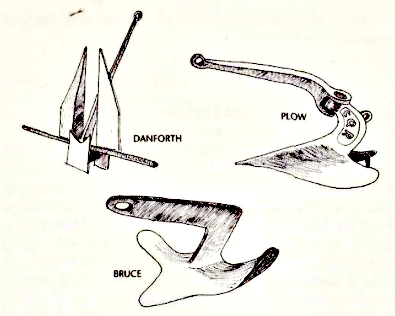
Plow anchors are less effective than Danforths in soft mud bottoms since the single fluke takes all of the strain from the anchor rode, and the anchor’s greater ability to penetrate a surface can work against its capacity to hold bottom. Perhaps for this reason, most anchor manufacturers specify a plow-style anchor of almost double the weight of a Danforth for the same-sized boat.
Bruce Anchors. Bruce anchors are a one-piece unit with an L-shaped shank and a single, semi-flat, scoop-style fluke of exceptionally abstract geometry. Bruce anchors are very effective on rocky bottoms, as well as clay and hard-packed mud or sand. Bruce anchors are more effective than plow anchors in very soft mud or sand.
Number of Anchors Aboard
A second anchor is essential to have aboard should the Inspecting the Primary Systems – A Comprehensive Approach to Marine Maintenance and Performance on Yachtsprimary anchor become lost or irretrievably stuck on the bottom. Boaters who will be cruising into areas with diverse seabeds are well advised to have two different varieties of anchor. The spare anchor can be deployed from the stern of a boat in crowded harbors to minimize a boat’s swinging around the bow anchor and thereby reduce the risk of colliding with nearby boats. When anchoring to ride out a storm, many boaters set two anchors, about 30 degrees to port and starboard of the bow. The load is then evenly divided between the two hooks, and the chances of pulling free are greatly reduced. A boat with a second anchor (particularly if it isn’t buried under two hundred pounds of gear in a lazarette) has probably been owned by an experienced sea person.
Anchor Rode
The type and length of material used in an anchor rode will determine how easily and securely a vessel can be anchored.
Rode Types by Boat Size. Boats under 25 feet frequently use an all-rope anchor rode. A rode of 3/8n diameter is considered adequate for most boats in this size category, but 1/2n is better. Medium-sized power boats between 25 and 60 feet often use a combination chain- and-rope rode, with at least one foot of chain per foot of boat length connecting the anchor to the rope. Boats from 25 to 36 feet should use a minimum of 1/2n rope (larger is better), and boats 36 feet and above should use no less than 5/8n anchor line. Boats over 60 feet almost always use an all chain rode. As anchor chain will often weigh a pound or more per foot, a few hundred feet of all chain rode stowed in the bow has a significant effect on the sea-keeping abilities of a small- to medium-sized powerboat.
Read also: DIY Yacht Survey: Hull, Deck, and Below Deck Inspections Explained
Rode Length and Available Scope. Length of anchor rode becomes important when considering the concept of scope, the relationship between the amount of anchor rode deployed and the depth of the water, Anchors are most secure when the pull of the boat against the anchor is as close to horizontal as possible. Under ideal conditions, it is wise to use five to seven times as much anchor rode as the depth of an anchorage at high tide. Seasoned boaters remember to include the height of the anchor roller above the waterline when calculating depth. Anchoring in a crowded harbor on a holiday weekend may require a boater to compromise between enough scope to hold bottom in practically any condition and reduced scope to minimize the swinging arc as wind and/or tide changes. An all-chain rode can often hold effectively at a 3:1 or 4:1 scope, great for crowded conditions or for anchoring in a fjord-style inlet with deep water right up to the shoreline. While most boaters won’t find themselves in situations where 300 feet or more of anchor rode is required, it is better to have it and not need it than to ever need it and not have it.
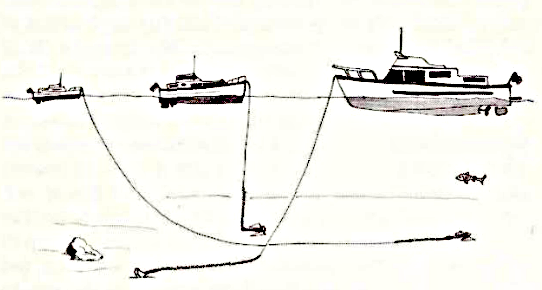
concept of scope
When examining an anchor locker, it is common to see brightly colored plastic strips attached to an anchor rode in various places. The previous owner has marked the rode at regular intervals to indicate the amount of rode payed out in anchoring, a worthwhile effort indeed. By consulting a chart or asking experienced boaters, the first-time boat buyer can find out the range of depths at typical local anchorages (as well as the daily tidal ranges) to determine whether the vessel contains enough rode.
Anchor Lockers
While the anchor is typically stowed on deck, the rope and/or chain will stow below deck in the anchor locker. Some anchor lockers are only accessible from the deck, while others may be opened below decks and accessed horizontally. Below-deck access allows a spare hand to stack or coil the rode as the anchor is retrieved and minimize the chance of any tangles during the next anchor setting. Anchor lockers are easier to maintain if there is a drain incorporated into the design. Mud, sand, and bits of sea-weed and shell brought aboard by the chain portion of the rode in particular tend to dry up and fall into the bottom of the locker, and there will be some water brought into the locker by a wet rode as well. A drain connecting the anchor locker to the bilge or routing the drainage overboard near the waterline at the bow has obvious utility.
Anchor Rollers and Windlasses
For deploying and recovering, anchor rollers and windlasses are both important items. Self-Survey Criteria for Essential EquipmentAnchor rollers, mounted on bow pulpits, allow an anchor to be raised or lowered with reduced risk of banging into the hull. The rollers also provide a smooth surface for the anchor rode to rest against when the anchor is deployed, reducing chafing which weakens the rode. If forced to retrieve an anchor by hand, anchor rollers allow a horizontal pull of the rode across the deck to be converted to a vertical lifting of the anchor so that boaters can pull with their legs rather than with their backs!
No boater who anchors a boat of any appreciable size would want to be without a windlass, either manual or electric. Windlasses are literally winding tools that allow a boater to use the laws of physics rather than brute strength to haul an anchor. The manual variety are operated with either a crank or a lever with the anchor rode wrapped around a drum, while the electric type use a motor similar to an automotive starting motor to turn the drum and recover the anchor. The most versatile windlasses incorporate both a drum (capstan) for hauling rope and a gypsy (a set of cogged teeth on a wheel) to haul chain. Smaller boats often have no room for a windlass, but with shallower drafts allowing anchoring in shallower depths and lighter-weight anchors being sufficient to hold lighter craft, most adults can haul the anchors involved unassisted.
Other Anchor Considerations
Rarely found on boats is a wash-down system with which a boater, using a short length of hose connected to a fitting near the windlass, can blast mud from an anchor chain before it comes across the bow roller (thereby eliminating most of the muddy buildup in the anchor locker and on the foredeck). Adequate deck space in the anchor area and a decent safety rail will be appreciated by a boater attempting to deploy or retrieve an anchor in rough seas or on a rain-slickened deck. Some boats feature a samson post at the bow to tie off the anchor rode, but a minimum of one heavy-duty cleat will also suffice.

- Everett Collier, The Boatowner’s Guide to Corrosion. International Marine, 2001, hardcover, 314 pages.
- Fernec Mate, Shipshape: The Art of Sailboat Maintenance. Albatross Publishing, 1986, hardcover, 416 pages.
- John Payne, Understanding Boat Corrosion, Lightning Protection, and Interference. Sheridan House, 2005, 90 pages.
- Edwin Sherman, The 12-Volt Bible for Boats. International Marine, 2002, paperback, 208 pages.
- Nigel Warren, Metal Corrosion in Boats. Sheridan House, Inc., 2006, 229 pages.
- Charlie Wing, Boatowner’s Illustrated Electrical Handbook, Second Edition. International Marine, 2006, paperback, 280 pages.
- Don Casey, Canvaswork and Sail Repair. International Marine, 1996, hardcover, 140 pages.
- Jim Grant, The Complete Canvasworker’s Guide, Second Edition. International Marine, 1992, paperback, 186 pages.
- Karen Lipe, The Big Book of Boat Canvas. International Marine, 1988, paperback, 242 pages.
- Emiliano Marino, The Sailmaker’s Apprentice, International Marine, 1994, paperback.
- Philip W. Conkling, Green Islands, Green Sea: A Guide to Foraging on the Islands of Maine. Down East Books, 1980.
- Euell Gibbons, The Beachcombers Handbook. David McKay, 1967, 230 pages.
- Janet Groene, Cooking on the Go. Sail Books, 1980, 234 pages.
- Peter Howorth, Foraging Along the California Coast. Consortium, 1977.
- Ken Neumeyer, Sailing the Farm. Ten Speed Press, 1981, paperback, 256 pages.
- Lin Pardey, The Care and Feeding of the Offshore Crew. Paradise Cay Publications, 1999, 414 pages.
- Linda Frederick Yaffe, Backpack Gourmet. Stackpole Books, 147 pages.
- Peter Hunn, The Old Outboard. International Marine, 2002, paperback, 320 pages.
- Jean-Luc Pallas, Outboard Motors Maintenance and Repair Manual. Sheridan House, 2006, 125 pages.
- Edwin Sherman, Outboard Engines. International Marine, 2008, hardcover, 176 pages.
- W. D. Booth, Upgrading and Refurbishing the Older Fiberglass Sailboat. Cornell Maritime Press, 1988, 287 pages.
- Paul and Myra Butler, Fine Boat Finishes. International Marine, 1987, paperback, 160 pages.
- Paul and Myra Butler, Upgrading the Small Sailboat for Cruising. International Marine, 1988, paperback, 224 pages.
- Nigel Calder, Boatowner’s Mechanical and Electrical Manual. International Marine, 2005, hardcover, 818 pages.
- Don Casey, Sailboat Hull and Deck Repair. International Marine, 1996, hardcover, 128 pages.
- Don Casey, Sailboat Refinishing. International Marine, 1996, paperback, 144 pages.
- Don Casey, This Old Boat, Second Edition. International Marine, 2009, hardcover, 576 pages.
- Fernec Mate, The Finely Fitted Yacht. W. W. Norton & Company Limited, 2005, 606 pages.
- Dan Spurr, Spurr’s Guide to Upgrading Your Cruising Sailboat, Third Edition. International Marine, 2006, hardcover, 400 pages.
- Fred Bingham, Boat Joinery and Cabinetmaking Simplified. International Marine, 1993, paperback, 265 pages.
- Michael Naujok, Boat Interior Construction. Sheridan House, 2002, paperback, 176 pages.
- Larry Brown, Sailing America: A Trailer Sailor’s Guide to North America. Seven Seas Press, 1990, paperback.
- Larry Brown, Sailing on a Micro-Budget. Seven Seas Press, 1985, 163 pages, paperback.
- Robert Burgess, The Handbook of Trailer Sailing. International Marine, 1992, paperback, 227 pages.
- Don Casey and Lew Hackler, Sensible Cruising: The Thoreau Approach. International Marine, 1986, paperback, 364 pages.
- Ronald Florence, The Optimum Sailboat: Racing the Cruiser and Cruising the Racer. Harper and Row, 1986, hardcover, 374 pages.
- Annie Hill, Voyaging on a Small Income. Tiller Publishing, 1993, paperback, 208 pages.
- J. C. Jenkins, The Humanure Handbook: A Guide to Composting Human Manure. Chelsea Green Publishing Co., 2006, 302 pages.
- Elbert Maloney (editor), Chapman’s Piloting, Seamanship, and Small-Boat Handling, (65th edition). Sterling Publishing Company, Inc., 2007, hardcover, 928 pages.
- Tom Neale, All in the Same Boat. International Marine, 1997, hardcover, 376 pages.
- Lin and Larry Pardey, The Capable Cruiser. Pardey Books, 1995, hardcover, 400 pages.
- Lin and Larry Pardey, The Cost-Conscious Cruiser. Pardey Books, 1999, hardcover, 352 pages.
- John Rousmaniere, The Annapolis Book of Seamanship (revised edition). Simon and Schuster, 1989, hardcover, 402 pages.
- Daniel Spurr, Your First Sailboat: How to Find and Sail the Right Boat for You. International Marine, 2004, paperback, 288 pages.
- Donald M. Street, The Ocean Sailing Yacht. W. W. Norton, 1973, hardcover, 703 pages.
- USCG Auxiliary, Boating Skills and Seamanship. International Marine, 2007, paperback, 404 pages.
- Thomas Ask, Handbook of Marine Surveying. Sheridan House, Inc., 2007, 246 pages.
- Don Casey, Inspecting the Aging Sailboat. International Marine, 1996, paperback, 144 pages.
- Andrew Douglas, Practical Sailor’s Practical Boat Buying, 2 volumes. Belvoir Books, 1998, paperback.


