
Dinghy Purchase Guide offers essential insights for anyone looking to buy a dinghy. Whether you’re considering a rigid-hull or an inflatable model, understanding their differences is crucial. This guide will help you navigate the factors that affect used-boat values and offer tips on making an informed purchase.
It’s important to consider your feelings and preferences throughout the buying process, as they play a significant role in your satisfaction. With the right information and a clear understanding of your needs, you can make a confident decision in selecting the perfect dinghy for your adventures.
Dinghies and Davits
For most boats larger than 24 feet or so, the prospective boat buyer has two boats to consider: the primary vessel and the dinghy. When considering a used boat, it is important to clarify with the listing broker or the owner whether or not any dinghy on board at the time of inspection is included in the sale. Ditto for any outboard motors which may be attached to a dinghy or stowed elsewhere. If not specifically included in the vessel’s listing manifest, it may not be the seller’s intention to include them.
Rigid-Hull Dinghies
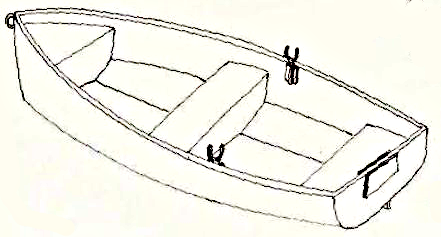
Experienced boaters have preferences for various types of dinghies, with the two general categories consisting of rigid and inflatable hulls. Rigid-hull dinghies are usually built of fiberglass or aluminum rather than wood, and some are even constructed by molding thick plastic. Rigid-hull dinghies are easier to row than most inflatables, and can have higher freeboard to help keep the dinghy and its occupants dry if the water gets choppy. The higher freeboard also makes a rigid dinghy better for towing on a line between anchorages, since it is less likely to be swamped by a large wave or wake. If a dinghy must be dragged across a gravelly beach, a rigid bull will withstand such treatment far better than am inflatable (although the inflatable may be light enough to carry, anyway ). Rigid-hull dinghies can handle a higher horsepower outboard than similar-sized inflatables. Disadvantages to rigid-hull dinghies include heavier weight, the reduced number of options for stowing aboard the boat, and the potential to damage the mother ship’s hull as the dinghy knocks against it while loading or unloading passengers and supplies.
Inflatable Dinghies
Inflatable dinghies are usually lighter in weight than a well- constructed rigid hull of similar size. Inflatables are virtually unsinkable so long as the integrity of the air chambers is intact. An inflatable boat filled completely with water is still buoyant and can be hailed out, githougs flotation of an inflatable or any boat when swamped is affected by the weight of any non-buoyant items aboard (such as an out-board). Some inflatables have no detectable keel and can be difficult to row or to maintain course with an outboard (some models attempt to resolve this problem with an inflatable keel). Hybrid inflatables combine an inflatable boat and a rigid Comprehensive Guide to Hull Design Choices and Materials for Every Boatfiberglass hull. Modern inflatable boats are built of extremely tough materials and durable construction techniques, but the possibility of a disastrous puncture can never be eliminated. inflatables dinghies can be deflated and rolled up to a fairly compact size, creating some alternatives for stowing that would not be possible with a rigid hull.

Inflatable dinghies should not be operated at the highest speeds obtainable with a rigid full. Due to light-weight design and because it rides high in the water, an inflatable with only one person aboard operating an outboard in the stern cat be susceptible t© flipping pack-wards when a stout wind gets under the bow.
Launching, Recovering and stowing dinghies. Most boats have systems for launching and recovering a dinghy and tor stowing it. Same trawler-style yachts incorporate mast-and-boom systems with compound blocks (pulleys). Some larger boats use an electric crane with a swiveling arm to pick the dinghy up from the water and swing, it aboard onto chocks on the boat deck. Many boaters mount a dinghy vertically on the swim step and use a line from the transom to control raising or lowering from the fulcrum point created by the swim step attachments. (On many boats the white stern running light is obscured when the dinghy is up on the swim step davits and should be relocated to make the boat safe and legal.) Another system on many boats relies on manual or electric winching to hoist the dinghy, on a bridle, up the transom of the boat to be left suspended there during transit.
Let’s Make a Deal
After evaluating your plans for the boat’s usage, prioritizing your wants and wishes, taking the budget into consideration, and examining a boat thoroughly to appreciate the strengths and weaknesses of its design as well as the type and condition of its equipment … «have you found the perfect boat?» Most likely not, but you may have found the «right» boat, all the same.
Drawing Conclusions
Unless a boat is brand new, it is realistic to expect that A gee of the systems aboard will be suffering from wear and tear. Most boats are cosmetically perfect for about the first ten minutes of the first cruise. Any problems turned up through preliminary inspection should be evaluated as to the potential cost to remedy or replace. Obviously there’s a great degree of difference between «the curtains in the galley are stained» and «the starboard fuel tank is leaking.» Even a boat with a serious problem might be a good candidate, if the problem is an isolated situation on an otherwise decent boat, and the seller will agree to have it professionally repaired as a condition of sale (or allow an adequate price adjustment to enable the buyer to have it repaired). Frequently buyers use most of their cash for the down payment on a financed boat. So it is more practical to have the seller make the repair than reduce the price, since the buyer may be financially inconvenienced to have to pay for a repair immediately upon closing the deal.
Feelings are Important, Too
Buying a Boat – The Ten Minute SurveyBuying a boat is a bit like getting married: it can be a longterm commitment and an expensive situation to undo!
Make certain to listen to your heart as well as to your head when deciding whether or not to make an offer on a specific boat. Even if a boat passes muster on all of the major points on a checklist, it’s important to consider how well you simply like the boat. A common folktale describes a landlubber asking an old seafarer, «How do you know if you’ve bought the right boat?» The old seafarer replies, «When I get in my dinghy and pull for shore and look back at her … if she calls out to me and I feel like my heart is anchored right out there with her, then that’s the right boat.»
Spouses and partners who will be part of the boat-buying process and boat-owning experience must be encouraged to express themselves without reservation during the selection phase. Nothing can ruin the boating experience more than a spouse or partner announcing on the second or third cruise «I hate the boat, can’t understand how it was ever purchased in the first place, and never plan to go out on it again.»
Making an Offer
If design and concept are right, the subject-to-survey condition seems okay, and your significant other likes the boat, the time may have arrived to make an offer.
Elements of an offer. An offer to purchase a boat can be structured a number of different ways. The more elaborate and costly the vessel, the more complex the offer is likely to be. «I’ll give you six hundred dollars for your dinghy» is technically an offer to purchase a boat and is probably completely appropriate for a transaction of that magnitude. An offer to purchase a megamillion-dollar commercial passenger vessel may be half an inch of paper thick and require a couple of attorneys.
For most recreational boats the offer will have the following characteristics:
- be in writing;
- indicate a price the purchaser is willing to pay;
- and state that the offer is subject to sea trial, survey, and acceptable financing.
An offer will usually be accompanied by a cash deposit, and this «earnest money» will revert to the seller and/or broker should the buyer refuse, without good cause, to complete the sale.
About price. There is seldom a reason to agree to pay the full asking price of a new or used boat. Exceptions do occur, of course. If you’ve done enough shopping to discover that a used boat which has just entered the market is seriously underpriced, with a number of interested buyers sniffing around, it can be better to settle for an excellent deal on the right boat than to lose out by pressing for a miracle deal instead.
New Boat Prices. Determining the price to offer can be approached from at least a semi-informed standpoint. New boats from production manufacturers will often have 20-30 percent or more markup incorporated into the list price. When buying a boat, it’s seldom appropriate to adopt the «show me your invoice and I’ll give you another hundred dollars» approach that seems so prevalent in the new-car market. Some larger-volume new-car dealers might sell 30-50 new cars in a weekend, while many boat dealers would be ecstatic to sell eight new boats in a month. Profit isn’t a dirty word, but rather the ingredient in the economic mix which allows a dealer to provide outstanding customer service. Some buyers of large-ticket items get too distracted by trying to determine how much profit the dealer is making (vs. how much profit they believe the dealer’s entitled to). They should be more interested in paying a fair price and receiving competent, professional service.
Many new boats are priced with enough of a fudge factor to allow the broker to flatter, with an inflated trade-in value, the ego of a buyer who owns an older boat. A first-time buyer doesn’t have a trade-in and shouldn’t be expected to foot the bill for those who do.
Out-of-Town Dealers. There are a number of excellent ways to obtain a general feel for a fair price on a new boat. A phone call to an out-of- town broker may give you additional insight on prices at which a boat might be available. Some out-of-town brokers may roll out the old «sorry, we don’t price over the phone» routine, but many will be willing to discuss a serious discount on a particular make and model to give a prospective buyer an incentive to make the trip to their location. There’s a good chance that a boat buyer who lives in Whoville and calls a broker in Slipknot may be given a very good price. (Maybe even the same price that a buyer from Slipknot might have been quoted by the Whoville brokerage with the situation reversed!) It is almost always preferable to buy from, and establish rapport with, the local broker.
Boat Show Specials. Boat Show Specials can offer fairly decent values, but it would be a mistake to assume that the boat show price is always the absolutely best available deal. A yacht broker displaying and selling boats in a boat show is aware that all competitors will be at the same show and marketing to the same bargain-hunting customers. Many of the sale prices at boat shows are about as low as the yacht broker is willing to go without a little more incentive (such as a ready and willing buyer seriously offering something even slightly less).
Asking the Bank. Price research may be effectively conducted at the local bank. The bank may very well provide inventory financing for a boat dealer and know exactly what the wholesale cost of various boats are, but don’t expect the bank to share this confidential information with you. Helping you make an informed buy on a boat wouldn’t be worth alienating the yacht broker and his multimillion-dollar inventory loan. What a banker can ethically tell you is what the loan value is on a particular boat. Most banks will only loan a maximum of wholesale cost on a boat and would prefer to loan a little less. The theory is that in the event of a default on a boat loan, the collateral can be disposed of without the bank having to price the used boat so high that it is an unattractive value compared to the same vessel new.
Commissioning Costs. When making an offer on a new boat, keep the cost of commissioning the boat in mind.
- Dock lines;
- fenders;
- life jackets;
- tool sets;
- spare parts;
- flares;
- first-aid kits,
an anchor and rode will all need to be brought aboard before the maiden voyage commences, as well as a suitable dinghy. A new boat will usually be delivered without any canvas to cover the bridge, windows, and hatches and may be lacking interior curtains or blinds as well. Commissioning costs can easily add at least a few thousand dollars to a new boat, and substantially more when a new dinghy and outboard motor are factored in.
Emotional Control. When making an offer on a new boat there is an aspect of negotiation to bear in mind. It is no more likely that the yacht brokerage or seller will accept the first low-ball offer than it is likely the buyer will have to pay full sticker How to Choose the Best Selling Price for Your Boatprice for a boat. Making an outrageously low offer is an excellent way to begin the price negotiation, but many buyers fall into the psychological trap of becoming emotionally involved with their offer once it has been presented. The buyer suddenly considers every dollar spent above what began as a calculated, deliberately unrealistic bargaining ploy as a personally defeating slap to the ego. Maintain your cool. The negotiating advantage usually accrues to the party with the most emotional control. The purchase of the boat is ordinarily just the first of many transactions which can take place with the local brokerage for a particular manufacturer. Make a deal without making any enemies.
Read also: Buying a Used Boat: What to Look for, Tips for the Buyer
Used-Boat Values
Determining a value on a used boat is more complex. While the year of production may be of some minor interest in the equation, and the manufacturer is certainly important, no two 10-year-old Northern Explorer sportfishermen will ever be worth exactly the same. Overall condition will vary widely from one vessel to another, as will engine hours and optional equipment. It can be useful to compare pricing on a large number of similar-sized and general-type boats and thus develop a feel for the going prices in a certain category. Some boats are popular enough and so widely available on the used market that it is practical to get a brand-specific education on used boat values. But knowing that «15-year- old 40-foot trawlers are typically advertised for between $ 80 000 and $ 120 000 in my local market» may establish an adequate range with which to establish a relative value. Pay little attention to anecdotal evidence such as «my next door neighbor works with a guy whose brother-in-law just bought a 3-year-old, 36-foot Goldenray for $ 35 000.» It is remarkable just how predictably conversations regarding the fantastic deal just made (due to the low price paid or the high price collected) will allow the deal to become even more fantastic with each retelling.
Used-Boat Prices and Replacement Cost. A very broad market generalization finds most 5-year-old used boats selling for 60 percent of their current replacement prices, 10-year-old boats bringing about 40 percent, and 20-year-old boats commanding about 25 percent of current replacement costs. The three factors which affect this equation most prominently are condition, condition, and condition!
Effects of Time on Used-Boat Prices. Prices of used boats tend to decrease as a boat remains unsold. The seller’s boundless optimism in the early weeks of the sales process may give way to a more realistic attitude as an initially overpriced boat garners no offers. Sellers who have already purchased another boat and who are possibly making two marine mortgage payments, paying two moorage fees, and insuring two boats may become particularly flexible as time advances. In climates where there is a particular boating season, an offer to purchase as the summer or fall cruising season is ending – and the present owner is facing the prospect of a winter’s storage and/or financing costs – might buy a boat for a lower price than waiting until the buyer brigade begins walking the docks again in late winter and early spring.
Effect of Financed Balance on Price. Most used boats will have a marine mortgage that needs to be paid off when the new owner acquires the boat, and this is usually handled when the purchaser obtains new financing. The outstanding dollar balance of the loan on a vessel may affect the amount of room a particular seller feels he or she has in the price. Sellers who are only a few years into the payment schedule on a late-model boat with small down payments may owe so much that they will actually be unable to sell at or below fair market value. Many sellers are financially unable to take cash out of pocket at the time of sale to pay off the outstanding balance of the boat loan.
Using a Broker. Start low when determining an initial offering price on a used boat, but bear in mind that the seller has ego as well as money invested in the boat. A buyer who offers a price 40-50 percent under market value may so offend the seller that negotiations break down entirely. When making a very low offer on a used boat, the services of a yacht broker can be very valuable. The broker becomes the third party and can function as an emotionally uninvolved mediator to keep negotiations flowing smoothly.
Terms for Any Offer
As previously noted, conditions which should be written into the offer include making the vessel available for sea trial, having the boat surveyed, arranging financing, and establishing a time line by which the buyer and seller must each complete their respective obligations. Be certain that adequate time is allowed for this. An offer should contain language specifying under what circumstances the buyer may call the transaction off and receive a refund of the initial deposit. From the buyer’s perspective, the more broadly the terms are stated, the better. Some offers have even been written that allow the «purchaser to withdraw this offer at any time, for any cause or for no cause, up until the moment of closing and receive a full refund of purchaser’s deposit.» (A buyer might well question why a seller would agree to take a boat off the market without a firm commitment from the prospective purchaser.) Typically, an unsatisfactory sea trial, incurable defects discovered during survey, or the inability of the buyer to secure acceptable financing are considered reasonable conditions under which a buyer may withdraw from a sale. Most sellers are willing to correct the minor irregularities which will almost inevitably be discovered by a survey, rather than lose the sale entirely.
Legal Advice. An offer to purchase a boat is an important legal document, and it can be prudent to enlist the services of your attorney to review the terms and conditions before finalizing the offer. This is especially true when dealing directly with a private seller on a used boat, as any local or federal laws which would constrain certain questionable practices by brokers will not apply in a transaction between private individuals.

- Everett Collier, The Boatowner’s Guide to Corrosion. International Marine, 2001, hardcover, 314 pages.
- Fernec Mate, Shipshape: The Art of Sailboat Maintenance. Albatross Publishing, 1986, hardcover, 416 pages.
- John Payne, Understanding Boat Corrosion, Lightning Protection, and Interference. Sheridan House, 2005, 90 pages.
- Edwin Sherman, The 12-Volt Bible for Boats. International Marine, 2002, paperback, 208 pages.
- Nigel Warren, Metal Corrosion in Boats. Sheridan House, Inc., 2006, 229 pages.
- Charlie Wing, Boatowner’s Illustrated Electrical Handbook, Second Edition. International Marine, 2006, paperback, 280 pages.
- Don Casey, Canvaswork and Sail Repair. International Marine, 1996, hardcover, 140 pages.
- Jim Grant, The Complete Canvasworker’s Guide, Second Edition. International Marine, 1992, paperback, 186 pages.
- Karen Lipe, The Big Book of Boat Canvas. International Marine, 1988, paperback, 242 pages.
- Emiliano Marino, The Sailmaker’s Apprentice, International Marine, 1994, paperback.
- Philip W. Conkling, Green Islands, Green Sea: A Guide to Foraging on the Islands of Maine. Down East Books, 1980.
- Euell Gibbons, The Beachcombers Handbook. David McKay, 1967, 230 pages.
- Janet Groene, Cooking on the Go. Sail Books, 1980, 234 pages.
- Peter Howorth, Foraging Along the California Coast. Consortium, 1977.
- Ken Neumeyer, Sailing the Farm. Ten Speed Press, 1981, paperback, 256 pages.
- Lin Pardey, The Care and Feeding of the Offshore Crew. Paradise Cay Publications, 1999, 414 pages.
- Linda Frederick Yaffe, Backpack Gourmet. Stackpole Books, 147 pages.
- Peter Hunn, The Old Outboard. International Marine, 2002, paperback, 320 pages.
- Jean-Luc Pallas, Outboard Motors Maintenance and Repair Manual. Sheridan House, 2006, 125 pages.
- Edwin Sherman, Outboard Engines. International Marine, 2008, hardcover, 176 pages.
- W. D. Booth, Upgrading and Refurbishing the Older Fiberglass Sailboat. Cornell Maritime Press, 1988, 287 pages.
- Paul and Myra Butler, Fine Boat Finishes. International Marine, 1987, paperback, 160 pages.
- Paul and Myra Butler, Upgrading the Small Sailboat for Cruising. International Marine, 1988, paperback, 224 pages.
- Nigel Calder, Boatowner’s Mechanical and Electrical Manual. International Marine, 2005, hardcover, 818 pages.
- Don Casey, Sailboat Hull and Deck Repair. International Marine, 1996, hardcover, 128 pages.
- Don Casey, Sailboat Refinishing. International Marine, 1996, paperback, 144 pages.
- Don Casey, This Old Boat, Second Edition. International Marine, 2009, hardcover, 576 pages.
- Fernec Mate, The Finely Fitted Yacht. W. W. Norton & Company Limited, 2005, 606 pages.
- Dan Spurr, Spurr’s Guide to Upgrading Your Cruising Sailboat, Third Edition. International Marine, 2006, hardcover, 400 pages.
- Fred Bingham, Boat Joinery and Cabinetmaking Simplified. International Marine, 1993, paperback, 265 pages.
- Michael Naujok, Boat Interior Construction. Sheridan House, 2002, paperback, 176 pages.
- Larry Brown, Sailing America: A Trailer Sailor’s Guide to North America. Seven Seas Press, 1990, paperback.
- Larry Brown, Sailing on a Micro-Budget. Seven Seas Press, 1985, 163 pages, paperback.
- Robert Burgess, The Handbook of Trailer Sailing. International Marine, 1992, paperback, 227 pages.
- Don Casey and Lew Hackler, Sensible Cruising: The Thoreau Approach. International Marine, 1986, paperback, 364 pages.
- Ronald Florence, The Optimum Sailboat: Racing the Cruiser and Cruising the Racer. Harper and Row, 1986, hardcover, 374 pages.
- Annie Hill, Voyaging on a Small Income. Tiller Publishing, 1993, paperback, 208 pages.
- J. C. Jenkins, The Humanure Handbook: A Guide to Composting Human Manure. Chelsea Green Publishing Co., 2006, 302 pages.
- Elbert Maloney (editor), Chapman’s Piloting, Seamanship, and Small-Boat Handling, (65th edition). Sterling Publishing Company, Inc., 2007, hardcover, 928 pages.
- Tom Neale, All in the Same Boat. International Marine, 1997, hardcover, 376 pages.
- Lin and Larry Pardey, The Capable Cruiser. Pardey Books, 1995, hardcover, 400 pages.
- Lin and Larry Pardey, The Cost-Conscious Cruiser. Pardey Books, 1999, hardcover, 352 pages.
- John Rousmaniere, The Annapolis Book of Seamanship (revised edition). Simon and Schuster, 1989, hardcover, 402 pages.
- Daniel Spurr, Your First Sailboat: How to Find and Sail the Right Boat for You. International Marine, 2004, paperback, 288 pages.
- Donald M. Street, The Ocean Sailing Yacht. W. W. Norton, 1973, hardcover, 703 pages.
- USCG Auxiliary, Boating Skills and Seamanship. International Marine, 2007, paperback, 404 pages.
- Thomas Ask, Handbook of Marine Surveying. Sheridan House, Inc., 2007, 246 pages.
- Don Casey, Inspecting the Aging Sailboat. International Marine, 1996, paperback, 144 pages.
- Andrew Douglas, Practical Sailor’s Practical Boat Buying, 2 volumes. Belvoir Books, 1998, paperback.


