Marine Engine Monitoring on yachts is vital for maintaining the performance and safety of your yacht. By keeping a close eye on engine alarms and critical gauges, you can quickly identify any potential issues before they escalate. Understanding engine-hour meters allows you to track usage and schedule necessary maintenance effectively.
Additionally, integrating electronics and navigation aids enhances your overall boating experience, providing real-time information on engine status. Utilizing VHF radio for communications adds an extra layer of safety, ensuring you stay connected while at sea. With proper monitoring, you can enjoy peace of mind and focus on the journey ahead.
Analog VS, Digital
Engine instrumentation allows the boater to monitor the vital signs of a vessel’s power plant and thereby helps assure reliable operation. Each helm station should have a number of important instruments in working condition. Instrumentation on modern powerboats may be either analog type with needle- and-dial readouts or the digital style with lighted numeric displays. Analog instruments in particular should be backlit for visibility at night, and digital instruments should have a brightness control for the same purpose. Many experienced boaters prefer analog instruments since there is a lower chance of a false reading due to electronic malfunction. Automotive-type idiot lights – as in «you just fried the engine, idiot» – have no place aboard a boat, unless they are redundant to a standard digital or analog gauge.
Engine Alarms
On multiple-engine boats, each engine must have a complete set of gauges and instruments. As a backup system to the engine instrumentation, a boat should have an engine alarm for each engine (with an alarm indicator at each helm) to alert an otherwise distracted boater that the engine oil pressure has dropped to a dangerous level or that the coolant is becoming overheated. Some boats incorporate other warnings such as «bilge flooding» into the alarm system.
Three Essential Gauges
The most important trio of instruments on a powerboat are the temperature gauge, the oil-pressure gauge, and the tachometer. As you become familiar with your vessel, you’ll begin to recognize the normal temperature and oil-pressure readings associated with various engine speeds. If the temperature or oil-pressure readings begin to vary the wise mariner will waste little time before determining why. A clogged raw-water intake can cause radical overheating of a marine engine in a matter of minutes. Noticing a climbing temperature before the engine alarm sounds may well make the difference between shutting down long enough to clear the water intake or shutting down long enough to rebuild an engine! A severed oil-return line from the turbo to the crankcase (or similar condition) will show up as a steadily decreasing oil-pressure reading long before the pressure gets low enough to seriously damage the engine. On twin-engine vessels, the readings between both engines should be very close to identical for temperature and oil pressure at any given rpm. Any abnormal indicators can be the earliest warning of impending problems.
When underway, experienced boaters avoid letting more than a minute or so elapse between glances at the engine instrumentation.
Fuel gauges. Fuel gauges are also important, but a large percentage of boaters place very little trust in them. They prefer to calculate remaining fuel by subtracting the amount of fuel used since the last fill-up (engine hours × average gallons/hour fuel consumption) from the tankage available. Seasoned boaters know how many engine hours have been accumulated at the last refueling and have a predetermined hour reading by which time they plan to refuel. Fuel-gauge indicators may bounce through a wide range when a planing hull is pounding through whitecaps, and there is always the possibility that the sending unit could become stuck in any fuel tank. A fuel gauge is an excellent backup to a disciplined awareness of the amount of fuel aboard.
Voltmeters. Voltmeters monitor the effectiveness of a boat’s charging system when the engine is running, as well as the level to which a battery bank has been charged or discharged when the engine is not running. A properly functioning alternator will create readings of 14-15 volts when cruising. Readings consistently under 12 volts are the first indication of a failed alternator, a broken drive belt, or something amiss with the wiring or the batteries.
Speedometers. Many boats have been built without speedometers aboard. The typical marine speedometer (speed log) uses a paddle-wheel device which protrudes through the hull and turns at a rate which changes with the speed of the vessel through water. The inaccuracies occur because the water itself beneath the boat is commonly moving as well due to tidal or river currents. A boat achieving 12 knots through the water with a 4-knot current will actually be making 16 knots for navigational purposes. An oncoming boat in the same current with an identical 12-i knot speedometer reading will in reality be achieving a speed over the bottom of only 8 knots. Boaters tend to rely more on the knowledge that «at 1 800 rpm this boat makes 10 knots before wind or current considerations» than on speedometer readings, and will be aware of the speed and direction of prevailing currents where they are cruising. On boats with GPS or Loran systems (see «Electronics and Navigation Aids», next chapter) the SOG (speed-over-ground) readings are far more useful and accurate than a marine speedometer.
Engine-Hour Meters
An engine-hour meter on a boat performs many of the same functions as an odometer does in a car. Hour meters report the number of hours on an engine and are useful in scheduling service intervals and refueling stops. Unlike an automotive odometer, there aren’t strict federal sanctions regarding changing hour meter readings. By the same token, there are ordinarily not a lot of boats around where any engine-hour fraud has taken place. When an engine is replaced with a new, never previously run engine, an argument with some merit can be made for replacing the hour meter with a fresh unit that reads zero. But many boaters prefer to simply make a note in the maintenance log, recording the date and hour reading when an engine is changed. Maintaining the original hour meter will help track the hours on related equipment such as transmissions, pumps, or alternators which may have been transferred from an old engine to the new.
Some boats have had the hour meters replaced when an engine has been subjected to a major overhaul. If considering a used boat with a replaced hour meter following an overhaul, press for a complete documentation of the work done, and consult a Engines and Their Systems – Key Pointsmarine engine mechanic for a second opinion as to the actual extent of the work. A note in the maintenance log that reads «3 655 hours … rebuilt injector pump, injectors, ground the valves, replaced the head gasket, replaced the oil and fuel pumps and the raw-water pump» is a more ethical and accurate method of recording the periodic rejuvenation of an engine than installing a zero-reading hour meter and claiming a major overhaul.
Source: wikipedia.org
Mismatched hour meters. When considering a twin-engine boat, it can be important to note any differences between the readings on the hour meters. A difference of under a hundred hours on a used boat with a thousand or more engine hours is probably not significant and may represent nothing more serious than time spent trolling for fish or an incident where a prop was lost halfway between two remote ports and the engine shut down until a replacement was obtained. For example, if two engines have readings of «2 400 hours» and «50 hours» (and the 50-hour reading is explained because the starboard engine has been recently replaced), it is not ridiculous to question whether the port engine might be approaching the end of its career as well. The new engine may have been required due to some incident which wouldn’t necessarily affect the other engine, such as the sudden loss of coolant or lubrication. The new engine may have been installed due to a condition such as insufficient maintenance or accumulated general wear, and either is likely to have affected the remaining engine as well. What’s causing the current owner to place the boat on the market so soon after replacing one engine? It could be purely coincidental, but you should proceed with eyes wide open and a thorough mechanical survey.
Oil-temperature gauges. A useful gauge not always found on powerboats is an oil-temperature gauge. Being aware of oil temperature is particularly helpful when operating a turbo-charged diesel engine, The turbo will benefit from the oil being slightly warmed before the engine reaches a speed where the turbo becomes active, and it is good practice to allow the engine oil to cool a little below its normal operating temperature before shutting a turbo-diesel engine down. Boaters with turbo-diesel powerplants needn’t rely strictly on an oil-temperature gauge. Operational practices like allowing the engine to warm up before taking off and to cool down a few minutes before hitting the stop switch accomplish the goal without a gauge. Oil coolers are an important item on many marine engines, turbo charged or not, and an oil-temperature gauge can be an early indicator of a malfunctioning oil-cooling system.
On a boat equipped with an AC generator, it is important to have, at the helm, at least an oil-pressure and temperature gauge for the gen-set motor as well.
Electronics and Navigation Aids
Boating has become computerized. The array of electronics available to the pleasure boater today for satellite navigation and charting purposes is more informative than anything aboard a billion-dollar ocean liner a couple of decades ago. The downside of all of the electronic flash and dazzle is that one does not simply «reboot» after hitting a rock («reboat» might be a more accurate term).
Charts and compass are still essential. Boaters should regard the electronic conveniences as accessories to, rather than substitutes for, traditional chart and compass navigation. The regulations requiring boaters to have adequate charts for their cruising area and to refer to those charts during navigation have not been suspended or modified in response to the numerous computerized charting systems now available. In the event of an accident, failure to use official charts could conceivably create a situation in which insurance coverage is denied. Look for adequate space at the helm station to lay out a chart and some provision to keep it flat, dry, and secure from wind. A well-calibrated compass at the wheel is essential as well. Many boats are now equipped with electronic compasses, but at least one compass aboard should be a traditional, liquid-filled, card-style compass. The earth’s magnetic field is infinitely more reliable than any solid-state circuitry ever invented.
VHF Radio
An electronic item which must be considered an absolute essential on any powerboat is a VHF (Very High Frequency) radio. The VHF is a boater’s tool for contacting other boats in the area, listening to NOAA weather forecasts, and communicating with the Coast Guard or a private tow service in case of emergency. Boats operated solely in US waters no longer need to obtain an FCC license for VHF radios (a license is required for US, boaters broadcasting in many foreign countries, including Canada), but strict regulations as well as customary courtesies must be observed when operating a VHF. One VHF at each helm should provide adequate redundancy, and boaters with only one helm should consider carrying a second, hand-held VHF as an emergency backup. Sanitation Systems on Yachts – Guide to Marine Waste Management and Freshwater SupplyBoats operating in offshore conditions where a liferaft is advisable often keep a VHF in the raft’s survival equipment as well.
Read also: Introduction and Overview of Loran-C
Many VHF radios incorporate a hailing feature which allows the operator to broadcast through an externally mounted speaker and communicate directly with fuel-dock attendants, line handlers, or nearby boaters without a VHF radio. On some of the upper-end VHF units, a provision for generating fog horn signals through the hailing speaker at regular intervals can make safe operation slightly easier in restricted visibility. Boaters who operate more than 10 or 15 miles from shore will require a longer antenna so that the boat can pick up signals originating on land despite the curvature of the earth.
Fathometers. In addition to a VHF radio, another must for safe operation of a powerboat is a fathometer or depth sounder. A depth sounder is not a substitute for knowing one’s position on a chart and the indicated depth in that location, but it is an indispensable supplement. A depth sounder can also help establish a boat’s position when operating in dense fog or darkness by comparing depth changes in the water below the keel to recorded depth changes on a chart. Virtually all depth sounders manufactured in the last several years are digital units which display a number representing feet, meters, or fathoms between the depth-sounding transducer’s (the sensor’s) position on the hull and the sea floor. When navigating through shallow waters it is important to remember that the displayed number represents less than the actual clearance between the hull and the bottom when a hull component, such as a keel, extends below the point where the transducer is mounted. Many fathometers incorporate a video display which informs a boater about the shape of the bottom contour, the temperature of the water at the transducer, and the presence or absence of fish in the area. An alarm feature on most depth sounders will alert a skipper when the depth drops below a predetermined minimum or exceeds a predetermined maximum. Such an alarm may call attention to an error in navigation or to a dragging anchor in time to take corrective action and avoid serious consequences. Boats with more than one helm station should have a fathometer at each.
GPS. GPS (Global Positioning System) receivers have become commonplace on boats. By receiving signals from a group of satellites orbiting the earth and comparing the strength of their signals, a GPS receiver calculates with astonishing accuracy the speed, course, and precise longitude and latitude of a vessel. In the interest of national security, the US government tweaks the GPS signals so that recreational boaters or terrorist missile launchers can only receive signals accurate to within about 100 yards or so. GPS should never be relied upon for charting a course very near shore or through a restricted channel. GPS accuracy can be improved by purchasing a differential GPS that supposedly gives a more accurate reading by receiving an additional signal from a land-based transmitter which corrects the signal from the federal detuning. Apparently we must only hope that missile-launching terrorists don’t invest the extra dollars in the differential system.
GPS Plotters. GPS signals are used by electronic charting devices which can produce a video screen facsimile of a nautical chart and indicate a vessel’s position thereon. These plotters are becoming increasingly popular and more affordable, and provide an excellent tool for confirming your navigational accuracy when using official government charts.
Autopilots. Autopilots are a popular feature for boaters who make long runs in n water. When a course has been set and the autopilot adjusted and activated, a skipper need not keep a hand on the wheel at all times. Autopilots should never substitute for maintaining a constant lookout when underway, since the autopilot is unable to detect and avoid other boats, fish nets, or floating debris.
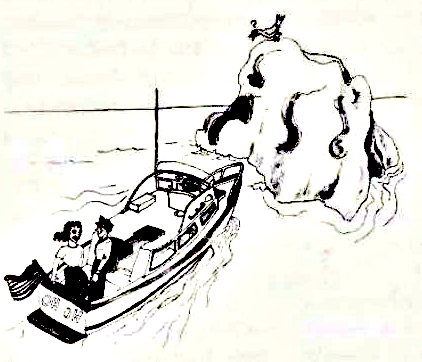
Even the most veteran boaters have an occasional incident of miscalculated position, and the first indication that the boat isn’t where it was thought to be is usually that landmarks and buoys do not some-how look right. A boat steaming along with all aboard eating dinner in the saloon is an impending disaster. Autopilots perform a valuable task by often allowing a boat to steer a straighter course than most helmsmen could accomplish unassisted. Many of the newer autopilots will interface with a plotter to allow a boater to program course changes for the autopilot at predetermined positions.
Loran. Some used boats will be equipped with Loran-C. Loran is a navigational system similar to GPS but uses dedicated radio signals broadcast from land instead of orbiting satellites. Loran units have not been in general manufacture since the mid-1990s, when the US government concluded that the GPS system was reliable enough to replace it. Sometime early in the 21st century the Loran-C plug will be pulled, and Loran-C receivers will become obsolete.
Radar. Radar is very useful for navigation after dark or in foggy conditions. In coastal and inland areas, the image of the shoreline will appear on the radar screen and assist a mariner in getting his bearings and determining position on the appropriate chart. Most radar displays have a range feature showing approximate distance from any radar target displayed, and this is also extremely helpful in charting a vessel’s position and course. While GPS will produce a sufficiently accurate position for charting purposes, radar allows a boater to visually detect nearby boats, buoys, etc. and avoid a possible collision. Radar is more costly than a standard GPS receiver, but if a boater can afford only one system, radar takes priority in most situations. When considering a boat with radar, note whether the radar antenna is mounted in such a manner that people on deck or on the fly bridge will not be exposed to potentially harmful radiation while the radar is in use. Radar should never be operated in crowded areas like marinas, fuel docks, or locks to avoid exposing any- body to the radiation emitted.
Recreational electronics. Recreational electronics aboard most vessels include a stereo system, with the stereo components being largely a matter of personal preference. Buyers should note whether a marine stereo system has been installed. Most typical automobile stereo systems don’t hold up well in the marine environment.
Many CD players tend to skip in moderate or heavier seas, so cassette tapes remain very popular among music-loving boaters. As the size of the required receivers has been reduced to a workable level, more boaters are installing satellite TV receivers.
CB Radios, Phones, and Computers. Additional electronics often found on boats include CB radios and cellular phones, neither of which is an adequate substitute for a VHF radio. Small portable computers are finding their way aboard in increasing frequency to handle such chores as vessel record keeping and assisting in navigation. Very deluxe boats often incorporate direct satellite-link telephone systems, allowing a boater to place a phone call to virtually any telephone on the planet from any place the vessel happens to be.
Intercoms. On boats with a fly bridge, an intercom to communicate between the bridge and the main saloon can eliminate a lot of the yelling, thumping on the cabintop, or scrambling up and down from the bridge. Another handy onboard communication system which a boater might want to acquire soon after purchasing a boat is a set of two or more hands-free, headband-style walkie-talkies. For the first several dozen dockings with a newly acquired boat, the helmsman and the deck crew will be developing an understanding of how the boat behaves in different types of close quarters and learning to work together to dock safely and gracefully. The docking process can be stressful enough without having to shout at one another in order to be heard above the engines. A few important comments such as «you’re coming in way too fast, reverse!» successfully communicated by the walkie-talkies will quickly justify the modest investment in the devices.

- Everett Collier, The Boatowner’s Guide to Corrosion. International Marine, 2001, hardcover, 314 pages.
- Fernec Mate, Shipshape: The Art of Sailboat Maintenance. Albatross Publishing, 1986, hardcover, 416 pages.
- John Payne, Understanding Boat Corrosion, Lightning Protection, and Interference. Sheridan House, 2005, 90 pages.
- Edwin Sherman, The 12-Volt Bible for Boats. International Marine, 2002, paperback, 208 pages.
- Nigel Warren, Metal Corrosion in Boats. Sheridan House, Inc., 2006, 229 pages.
- Charlie Wing, Boatowner’s Illustrated Electrical Handbook, Second Edition. International Marine, 2006, paperback, 280 pages.
- Don Casey, Canvaswork and Sail Repair. International Marine, 1996, hardcover, 140 pages.
- Jim Grant, The Complete Canvasworker’s Guide, Second Edition. International Marine, 1992, paperback, 186 pages.
- Karen Lipe, The Big Book of Boat Canvas. International Marine, 1988, paperback, 242 pages.
- Emiliano Marino, The Sailmaker’s Apprentice, International Marine, 1994, paperback.
- Philip W. Conkling, Green Islands, Green Sea: A Guide to Foraging on the Islands of Maine. Down East Books, 1980.
- Euell Gibbons, The Beachcombers Handbook. David McKay, 1967, 230 pages.
- Janet Groene, Cooking on the Go. Sail Books, 1980, 234 pages.
- Peter Howorth, Foraging Along the California Coast. Consortium, 1977.
- Ken Neumeyer, Sailing the Farm. Ten Speed Press, 1981, paperback, 256 pages.
- Lin Pardey, The Care and Feeding of the Offshore Crew. Paradise Cay Publications, 1999, 414 pages.
- Linda Frederick Yaffe, Backpack Gourmet. Stackpole Books, 147 pages.
- Peter Hunn, The Old Outboard. International Marine, 2002, paperback, 320 pages.
- Jean-Luc Pallas, Outboard Motors Maintenance and Repair Manual. Sheridan House, 2006, 125 pages.
- Edwin Sherman, Outboard Engines. International Marine, 2008, hardcover, 176 pages.
- W. D. Booth, Upgrading and Refurbishing the Older Fiberglass Sailboat. Cornell Maritime Press, 1988, 287 pages.
- Paul and Myra Butler, Fine Boat Finishes. International Marine, 1987, paperback, 160 pages.
- Paul and Myra Butler, Upgrading the Small Sailboat for Cruising. International Marine, 1988, paperback, 224 pages.
- Nigel Calder, Boatowner’s Mechanical and Electrical Manual. International Marine, 2005, hardcover, 818 pages.
- Don Casey, Sailboat Hull and Deck Repair. International Marine, 1996, hardcover, 128 pages.
- Don Casey, Sailboat Refinishing. International Marine, 1996, paperback, 144 pages.
- Don Casey, This Old Boat, Second Edition. International Marine, 2009, hardcover, 576 pages.
- Fernec Mate, The Finely Fitted Yacht. W. W. Norton & Company Limited, 2005, 606 pages.
- Dan Spurr, Spurr’s Guide to Upgrading Your Cruising Sailboat, Third Edition. International Marine, 2006, hardcover, 400 pages.
- Fred Bingham, Boat Joinery and Cabinetmaking Simplified. International Marine, 1993, paperback, 265 pages.
- Michael Naujok, Boat Interior Construction. Sheridan House, 2002, paperback, 176 pages.
- Larry Brown, Sailing America: A Trailer Sailor’s Guide to North America. Seven Seas Press, 1990, paperback.
- Larry Brown, Sailing on a Micro-Budget. Seven Seas Press, 1985, 163 pages, paperback.
- Robert Burgess, The Handbook of Trailer Sailing. International Marine, 1992, paperback, 227 pages.
- Don Casey and Lew Hackler, Sensible Cruising: The Thoreau Approach. International Marine, 1986, paperback, 364 pages.
- Ronald Florence, The Optimum Sailboat: Racing the Cruiser and Cruising the Racer. Harper and Row, 1986, hardcover, 374 pages.
- Annie Hill, Voyaging on a Small Income. Tiller Publishing, 1993, paperback, 208 pages.
- J. C. Jenkins, The Humanure Handbook: A Guide to Composting Human Manure. Chelsea Green Publishing Co., 2006, 302 pages.
- Elbert Maloney (editor), Chapman’s Piloting, Seamanship, and Small-Boat Handling, (65th edition). Sterling Publishing Company, Inc., 2007, hardcover, 928 pages.
- Tom Neale, All in the Same Boat. International Marine, 1997, hardcover, 376 pages.
- Lin and Larry Pardey, The Capable Cruiser. Pardey Books, 1995, hardcover, 400 pages.
- Lin and Larry Pardey, The Cost-Conscious Cruiser. Pardey Books, 1999, hardcover, 352 pages.
- John Rousmaniere, The Annapolis Book of Seamanship (revised edition). Simon and Schuster, 1989, hardcover, 402 pages.
- Daniel Spurr, Your First Sailboat: How to Find and Sail the Right Boat for You. International Marine, 2004, paperback, 288 pages.
- Donald M. Street, The Ocean Sailing Yacht. W. W. Norton, 1973, hardcover, 703 pages.
- USCG Auxiliary, Boating Skills and Seamanship. International Marine, 2007, paperback, 404 pages.
- Thomas Ask, Handbook of Marine Surveying. Sheridan House, Inc., 2007, 246 pages.
- Don Casey, Inspecting the Aging Sailboat. International Marine, 1996, paperback, 144 pages.
- Andrew Douglas, Practical Sailor’s Practical Boat Buying, 2 volumes. Belvoir Books, 1998, paperback.


