
Marine HVAC Systems are essential for maintaining a comfortable and safe environment aboard ships and offshore platforms. These systems regulate temperature, humidity, and air quality, ensuring the well-being of crew members and passengers. Designed to withstand harsh maritime conditions, marine HVAC systems incorporate specialized components that are resistant to corrosion and vibration.
Additionally, they are energy-efficient, helping to reduce operational costs while minimizing environmental impact. Proper maintenance and regular inspections are crucial to ensure the reliability and efficiency of these systems. Overall, investing in high-quality marine HVAC systems is vital for enhancing the operational effectiveness of maritime vessels.
Heat, Ventilation, and Air Conditioning
There are certainly many components of a boat far more glamorous than its heaters, vents, and air conditioning. But few will have any greater impact on the overall physical comfort of captain and crew or the ability of all aboard to enjoy boating throughout the entire season.
Regional Considerations
When considering a new boat which may not have been fully commissioned, the local dealer should be able to make some informed recommendations about the type of heating and/or air conditioning that works well for that particular model in the local climate.
When looking at a Buying and Selling Making – a Sound Investment In a New or Used Boatused boat, you will ordinarily find systems appropriate for the boat and the local climate, with the important exception of boats which have been relocated from other parts of the country. Boats brought to the Pacific Northwest from Florida or the Gulf Coast may be configured with a special emphasis on cooling the boat rather than warming it up – exactly the opposite of what the Northwest climate calls for (where it isn’t unheard of to ward off an early morning chill in July or August by firing up the heater). Boats headed east from many West Coast ports may have little or no air conditioning aboard, and the heaters may be overspecked for the new climate. In some areas of climatic extremes and subzero winter temperatures, it is customary to haul out and winterize most pleasure boats. Storing a boat ashore between the onset of cold weather and spring eliminates the need for a monster furnace.
BTU’S
Heating and cooling capacities of any system are expressed in BTU‘s (British thermal units). A rough formula appropriate for all except the most extreme climates states that 15 or 16 BTU’s will be needed to control the temperature of each cubic foot of air. A cabin space 8 feet long, 10 feet wide, and 7 feet high would require a capacity of approximately 8 500 BTU’s. By determining the BTU capacity of the climate-control equipment on board, a prospective buyer can make an informed guess as to whether the heating and/or air conditioning are up to the task at hand. Some manufacturers or some previous owners may have installed undersized equipment to save money. A unit too small for the job may run so continuously that it becomes worn out prematurely and still fails to provide adequate comfort.
Reverse-Cycle Air Conditioning
On medium and larger boats, one of the most popular approaches to comfort control in climates where air conditioning is justified is a reverse-cycle heater and air conditioner. Similar to a household heat pump, the reverse-cycle system uses a condenser, evaporator, and compressor to either extract heat from or transfer heat to seawater. Even cold water contains heat energy. The cooled or heated air is distributed throughout the boat by designated ductwork. Reversible systems often seem to cool a little more effectively than they heat. A reversible system draws as much as 15 amps of 110-volt AC current, so access to a generous amount of shore power or the operation on an on-board AC generation device is essential.
Other Air-Conditioning Options. Air-conditioning systems which are not reversible and are strictly for cooling purposes are also available. Smaller beats on which air conditioning is desired and which lack enough space to contain a built-in system can utilize portable air conditioners which mount in hatchways. A portable system will usually be adequate for cooling about 300 cubic feet below decks.
Heaters and Furnaces
Heating a boat can be accomplished by many methods. Dockside, many boaters rely on electric space heaters (either portable or permanently mounted). When a boat is underway or swinging at anchor a number of nonelectrical alternatives are often employed.
Hot-Water Radiators. Hot-water radiators produce free heat underway by circulating hot engine coolant through a heater core and blowing the warmed air around the cabin with a fan. This system is identical in concept to heaters used in automobiles and trucks. There is a practical limitation to the amount of heat which can be extracted from the engine coolant, and a large boat with a single engine might be inadequately heated if relying solely on hot-water radiation based upon the engine’s cooling system.
Diesel Furnaces. Diesel fuel is oil-furnace fuel. Diesel-powered boats operating in colder climates frequently are equipped with a diesel furnace. It isn’t purely coincidental that some of the more commonly used marine diesel furnaces are marketed by Scandinavian companies. With few moving parts, a diesel furnace can be a low-maintenance and reliable source of fast heat in great abundance. A diesel furnace operates on the vessel’s 12-volt system.
Propane Heaters. Propane heaters are not unheard of on boats with other propane appliances such as galley stoves or propane-powered refrigerators. Propane heaters are available in both free-standing or surface-mounted designs.
Free-Standing Fireplaces. Free-standing furnaces and fireplaces can pump out serious amounts of heat and will utilize either solid fuels (wood, coal, wood pellets, etc.) or liquid fuel such as diesel or propane. Free-standing furnaces typically require a generous amount of clearance from combustible material on all sides and a stovepipe-style chimney. Such requirements impose rather unacceptable styling compromises on many designs, and in many boats under 45 feet or so might just use too much space. With a free-standing furnace, some-times areas nearest the heat source can become uncomfortably warm, while areas farther forward or aft remain inadequately heated. While keeping firewood aboard can present a hassle, on boats of grand enough scale to accommodate a fireplace, there is a certain romantic charm to the notion – although the concept that «fire aboard a boat is usually not a good thing» should not be ignored either.
Ventilation
Keeping a boat heated or cooled to an agreeable temperature is only part of making a vessel’s interior comfortable. Ventilation is required to remove stale or damp air, galley steam, bilge and engine-room odors, and to prevent the accumulation of explosive concentrations of gasoline vapors or propane. Moisture will build up inside a boat from human respiration and perspiration and from cooking and bathing. It will create condensation on cool surfaces such as windows or the interior of the hull when the air on board is more humid than the air surrounding a boat. A complete exchange of air about once an hour is adequate for normal ventilation and will prevent mold, mildew, and other general unpleasantness that thrive in damp, inadequately ventilated environments.
If a boat under consideration seems to be inadequately ventilated (a damp mustiness might be the first clue), additional vents are not too difficult to add. The most common areas with this need are the galley and the heads. Increasing a Complete Guide to Below Deck Sailboat Systems: Ventilation, Marine Heads, Water Systems and moreboat’s ventilation almost always involves cutting holes in the superstructure or hull of a boat, a task not wisely undertaken by a new boat owner.
Active and Passive Vents. Vents on a boat are either active (driven by a fan) or passive (such as a clamshell vent positioned to scoop airflow into the cabin or bilge). Active vents can be driven either by a boat’s 12-volt system or by electricity generated in tiny solar-electric cells mounted on the external housing of the vent. Some active vents use both systems, relying on the sun’s energy on brighter days and drawing off the boat’s batteries on cloudy days and after dark. A typical active vent will circulate between 700 and 1 000 cubic feet per hour when operating at full speed. On gasoline boats, engine-room areas will have both passive and active vents. The passive vents insure that no accumulation of explosive vapors occurs when the vessel is underway, and the active vents are used before starting the engine when docked or anchored.
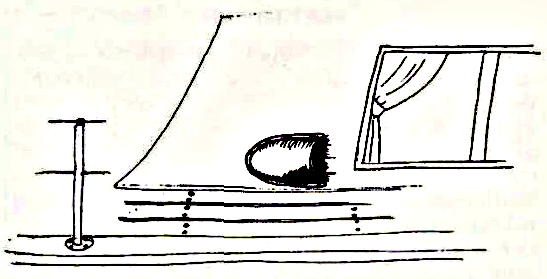
When ventilating a boat it is just as important to consider how to let air out of the boat as it is to bring air aboard. A few passive vents face aft on most boats, with the theory being that as the vessel moves forward a low pres- sure area is created immediately behind the vent and air from the cabin, engine room, or bilge will flow out of the boat as a result.
Ventilated Lockers. Many boats have doors with integrated louvers on various lockers. These louvers are functional as well as stylish when placed on cabinet doors below sinks in the head and galley, as well as on any locker along the perimeter of the hull. By permitting air flow through these otherwise enclosed spaces, you eliminate the possibility of creating an environment where mold, mildew, odors and rot can breed.
Read also: Mastering the Boat Buying Process – Essential Steps from Negotiation to Ownership
At this point, you’ve completed an examination of some of the most fundamental systems of a powerboat. If you didn’t find a deal-breaking defect that could not be reasonably corrected, it’s time to move to other points of interest around the vessel. Should you make an offer on the boat, your surveyor will double- and triple-check everything examined thus far, and as a buyer you will be better prepared to appreciate and interpret any observations the surveyor might make.
It remains important to maintain perspective as the examination of a potential boat continues. Any boat will have compromises in design and execution. So remember, the goal is not to discover a vessel in which no compromise has been made, but rather a boat in which the compromises made are acceptable. For those of us whose personal fortunes inspire us to shop used rather than new, we must also deal with the reality that on the boats we examine most, if not all, of the systems will be partially worn. When considering a used boat it is important to qualify the concept of «partially worn» to differentiate between those things which are in nearly new condition and the things which are nearly (or completely) worn out.

- Everett Collier, The Boatowner’s Guide to Corrosion. International Marine, 2001, hardcover, 314 pages.
- Fernec Mate, Shipshape: The Art of Sailboat Maintenance. Albatross Publishing, 1986, hardcover, 416 pages.
- John Payne, Understanding Boat Corrosion, Lightning Protection, and Interference. Sheridan House, 2005, 90 pages.
- Edwin Sherman, The 12-Volt Bible for Boats. International Marine, 2002, paperback, 208 pages.
- Nigel Warren, Metal Corrosion in Boats. Sheridan House, Inc., 2006, 229 pages.
- Charlie Wing, Boatowner’s Illustrated Electrical Handbook, Second Edition. International Marine, 2006, paperback, 280 pages.
- Don Casey, Canvaswork and Sail Repair. International Marine, 1996, hardcover, 140 pages.
- Jim Grant, The Complete Canvasworker’s Guide, Second Edition. International Marine, 1992, paperback, 186 pages.
- Karen Lipe, The Big Book of Boat Canvas. International Marine, 1988, paperback, 242 pages.
- Emiliano Marino, The Sailmaker’s Apprentice, International Marine, 1994, paperback.
- Philip W. Conkling, Green Islands, Green Sea: A Guide to Foraging on the Islands of Maine. Down East Books, 1980.
- Euell Gibbons, The Beachcombers Handbook. David McKay, 1967, 230 pages.
- Janet Groene, Cooking on the Go. Sail Books, 1980, 234 pages.
- Peter Howorth, Foraging Along the California Coast. Consortium, 1977.
- Ken Neumeyer, Sailing the Farm. Ten Speed Press, 1981, paperback, 256 pages.
- Lin Pardey, The Care and Feeding of the Offshore Crew. Paradise Cay Publications, 1999, 414 pages.
- Linda Frederick Yaffe, Backpack Gourmet. Stackpole Books, 147 pages.
- Peter Hunn, The Old Outboard. International Marine, 2002, paperback, 320 pages.
- Jean-Luc Pallas, Outboard Motors Maintenance and Repair Manual. Sheridan House, 2006, 125 pages.
- Edwin Sherman, Outboard Engines. International Marine, 2008, hardcover, 176 pages.
- W. D. Booth, Upgrading and Refurbishing the Older Fiberglass Sailboat. Cornell Maritime Press, 1988, 287 pages.
- Paul and Myra Butler, Fine Boat Finishes. International Marine, 1987, paperback, 160 pages.
- Paul and Myra Butler, Upgrading the Small Sailboat for Cruising. International Marine, 1988, paperback, 224 pages.
- Nigel Calder, Boatowner’s Mechanical and Electrical Manual. International Marine, 2005, hardcover, 818 pages.
- Don Casey, Sailboat Hull and Deck Repair. International Marine, 1996, hardcover, 128 pages.
- Don Casey, Sailboat Refinishing. International Marine, 1996, paperback, 144 pages.
- Don Casey, This Old Boat, Second Edition. International Marine, 2009, hardcover, 576 pages.
- Fernec Mate, The Finely Fitted Yacht. W. W. Norton & Company Limited, 2005, 606 pages.
- Dan Spurr, Spurr’s Guide to Upgrading Your Cruising Sailboat, Third Edition. International Marine, 2006, hardcover, 400 pages.
- Fred Bingham, Boat Joinery and Cabinetmaking Simplified. International Marine, 1993, paperback, 265 pages.
- Michael Naujok, Boat Interior Construction. Sheridan House, 2002, paperback, 176 pages.
- Larry Brown, Sailing America: A Trailer Sailor’s Guide to North America. Seven Seas Press, 1990, paperback.
- Larry Brown, Sailing on a Micro-Budget. Seven Seas Press, 1985, 163 pages, paperback.
- Robert Burgess, The Handbook of Trailer Sailing. International Marine, 1992, paperback, 227 pages.
- Don Casey and Lew Hackler, Sensible Cruising: The Thoreau Approach. International Marine, 1986, paperback, 364 pages.
- Ronald Florence, The Optimum Sailboat: Racing the Cruiser and Cruising the Racer. Harper and Row, 1986, hardcover, 374 pages.
- Annie Hill, Voyaging on a Small Income. Tiller Publishing, 1993, paperback, 208 pages.
- J. C. Jenkins, The Humanure Handbook: A Guide to Composting Human Manure. Chelsea Green Publishing Co., 2006, 302 pages.
- Elbert Maloney (editor), Chapman’s Piloting, Seamanship, and Small-Boat Handling, (65th edition). Sterling Publishing Company, Inc., 2007, hardcover, 928 pages.
- Tom Neale, All in the Same Boat. International Marine, 1997, hardcover, 376 pages.
- Lin and Larry Pardey, The Capable Cruiser. Pardey Books, 1995, hardcover, 400 pages.
- Lin and Larry Pardey, The Cost-Conscious Cruiser. Pardey Books, 1999, hardcover, 352 pages.
- John Rousmaniere, The Annapolis Book of Seamanship (revised edition). Simon and Schuster, 1989, hardcover, 402 pages.
- Daniel Spurr, Your First Sailboat: How to Find and Sail the Right Boat for You. International Marine, 2004, paperback, 288 pages.
- Donald M. Street, The Ocean Sailing Yacht. W. W. Norton, 1973, hardcover, 703 pages.
- USCG Auxiliary, Boating Skills and Seamanship. International Marine, 2007, paperback, 404 pages.
- Thomas Ask, Handbook of Marine Surveying. Sheridan House, Inc., 2007, 246 pages.
- Don Casey, Inspecting the Aging Sailboat. International Marine, 1996, paperback, 144 pages.
- Andrew Douglas, Practical Sailor’s Practical Boat Buying, 2 volumes. Belvoir Books, 1998, paperback.


