Boat Design Choices are crucial for anyone looking to invest in a new vessel. Understanding the various types, such as trawlers and motoryachts, can help you make an informed decision that suits your lifestyle. Each design has its own strengths and weaknesses, impacting everything from space allocation to cruising comfort.
- Welcome Aboard!
- The Fine Art of Compromise
- Introspection Precedes Boat Inspection
- Effects of Friends and Family on Design
- Consider the Cruising Environment
- Time and Money Issues
- Allocation of Space
- How Large a Boat?
- Challenges of a Large Boat
- Problems of a Small Boat
- A Starter Boat?
- Effects of Boat Design on Length
- Common Powerboat Varieties
- Day Cruisers or Cuddy Cabins
- Express Cruisers
- Fly bridge cruisers
- Sportsfishermen and Convertibles
- Trawlers
- Motoryachts
Additionally, factors like family needs and the intended cruising environment play a significant role in the selection process. By carefully considering your options, you can ensure that your choice aligns with both your practical requirements and your boating aspirations. Ultimately, making the right design choice enhances your overall boating experience.
Welcome Aboard!
If you are considering the purchase of your first powerboat, congratulations! With the possible exception of a home, most of us will never make a purchase that requires a larger financial commitment or can make such a positive difference in our lifestyles. As a boater, you will quickly discover that some of the nicest people just happen to spend their spare time on the water. Many boaters shopping for their second boat are doing so much sooner than they ever anticipated, and can be heard to exclaim, «Gee, I sure wish we’d known about that before we bought a boat!»
This article enables the first-time boat buyer to select a boat without risking the potentially catastrophic expense of purchasing (and having to quickly resell) an unsuitable boat. New boaters have been known to drop out of boating entirely because of disappointment with their choice of a boat. Considering that boating is one of the most incredible ways to occupy leisure time, missing out as the result of an underinformed decision would certainly be a shame.
The Fine Art of Compromise
By its very nature, any boat is a floating compromise. Even with an unlimited budget, a blank draftsman’’s sheet, and a degree in naval architecture, most experienced boaters would still be unable to design a single craft to fulfill all their needs and desires. Some characteristics a boater might desire, such as «able to cruise easily at 15 knots» or «easily docked by two people», will always conflict with other possible priorities such as «exceptional fuel economy» or «space for a grand piano in the saloon». Combining the priorities of a second party, such as a spouse, will create the need for even more compromises and evaluations. Just as there is no perfect home, car, occupation, or haircut that will be best for everyone, there is no secret boat so clearly superior in concept and execution that every wise and experienced boater would always choose above any other option.
One Definition of Success. The most successful boat purchases are those that reflect the right combination of compromises, and that, by virtue of appropriate design, initial construction, and present condition, allow the maximum boating experience by the owners, their family, or guests.
Introspection Precedes Boat Inspection
The Friends and Family Factor. Boats have, without a doubt, been successfully purchased by people who gave more thought to the color of the upholstery than to the actual manner in which they anticipated cruising. Fortunes have also been won in Las Vegas on a single roll of the dice, but Dad’s advice was right: «Don’t count on it». Some self and family evaluation will play an essential role in selecting a vessel that will be a proper fit.
Children, Teenagers, and Adults. How many people will customarily cruise with you, and how many are children? Kids on a boat present special joys and challenges. Any nonswimmers and especially the very young benefit from features such as adequate side decks and sturdy railings, as well as enough wiggle room aboard to allow for the wearing of personal flotation devices while underway. With kids, space for some type of activity aboard, whether reading, playing cards, watching a video, or coloring with crayons, can be important. Most children are fascinated with «just being on a boat» for about the first two hours but require some diversion thereafter. Teenagers (prepare to be shocked) appreciate adequate shower and grooming facilities and will guard whatever shred of privacy they can establish on a boat just as jealously as at home. Kids of all ages will often ask to bring a friend along on a weekend outing, and some of your landlocked adult friends may express an increased interest in spending time with you as well (just to prevent you from becoming too «lonely» on your new boat, you understand). So it might be well to plan for a cruising crowd of up to twice the size of your family on occasion. In general, boaters are a social crowd, and unless you intend to lock yourself on board and draw the curtains when visiting a marina, there’s a real probability that you will meet more new friends and genuinely interesting acquaintances when boating than in any other activity. Be prepared to entertain.
Effects of Friends and Family on Design
Younger kids may tolerate sleeping arrangements created by dropping the galley table and covering it with cushions, or pulling out a sofa sleeper in the saloon. But should you be likely to cruise frequently with other adults, at least one semi-private area per couple is a preferred arrangement. Beginning with boats in the low to mid 30-foot range, second heads are commonly available and should be given consideration when cruising with adults or teenagers.
Getting on and off some boats can be difficult for the very young or for the most senior family members. A boat design that requires everyone to scale a ladder up a tall transom may allow for a larger aft stateroom and additional deck space, but might not be the best choice for a family with members who are less than able or comfortable in climbing. One of those compromises, again.
The Concept of Self-Containment. A boat is a self-contained environment. The greater the number of people aboard and the longer the anticipated cruise, the more capacity will be needed to store freshwater, food and fuel, and to contain waste. Cruising with six people for a week on a boat with a 50-gallon freshwater tank and a 20-gallon holding tank could put you at the dock for purposes of refilling the freshwater and using the pump-out more often than you might prefer.
Additional Recreational Activities. What other activities will you pursue when boating? Fishing, diving, entertaining large groups, sunbathing, etc. may all require boats with design elements emphasizing different allocations and priorities of deck layout and design.
Seasonal Considerations. When will you use the boat? If you will be doing your boating primarily on two-day weekends and your intended cruising grounds are any great distance from your permanent moorage, it may be well to consider a vessel with a greater speed potential. If you plan to use your boat year-round, adequate cabin heat both dockside and underway is a must in northern climates, as well as a sturdy hull with freeboard adequate to ride out moderate storms. Winter boaters appreciate boats with an inside helm station. Boat builders with large warm weather markets often supply boats with helms on the fly bridge only, and consider an inside helm station to be optional. In addition to allowing operation of the boat from a warm and dryenvironment, the inside helm increases safety by establishing a second set of controls for engine, transmission, and steering in the event of the failure of either set of controls (a rare, but possible situation).
Consider the Cruising Environment
Under what conditions will you be boating? For safety considerations a boat should be capable of withstanding the roughest conditions to which it will ever be subjected, rather than be merely suitable for its «normal» usage. Boaters who venture once a year from sheltered in land waters out into the open ocean in search of salmon, tuna, or sailfish are wise to select a vessel that is suitable for the open ocean, even though they might be considered over-equipped (an oxymoron on a boat) for customary inland cruising.
Tides and Currents. If a boat will ever be operated in areas known for strong currents, such as in a river or narrow inter-island passages in strong tidal areas, adequate power will be required. Unless a boater heads downstream or can wait for either a slack or favorable tide, the speed of the opposing current must be deducted from the normal cruising speed of the boat when calculating actual velocity made good. A boat with a top speed of seven knots running against a 6-knot current would need all afternoon to get out of sight of the dock.
Time and Money Issues
How much time will you enjoy devoting to noncruising activ-ities such as cleaning and repair? The gleaming, classic, mahogany-hulled cruiser that turns heads and garners compliments in every marina is in that condition due to the probable expenditure of one or two hours cleaning, sanding, or varnishing for every hour spent underway. If acquired by a skipper with a tendency to procrastinate on maintenance,the same vessel will cause the same turned heads to shake in a chorus of «isn’t it a shame». Generally the older the boat, the more wood will be found on the exterior. Whether sanded and paintéd or sanded and coated with 8 to 10 hand-laid coats of varnish, nothing looks better when it’s well cared for (or worse, when neglected) than wood on a boat. Fiberglass requires cleaning and waxing as well to protect the gelcoat finish and to maintain the appearance of the boat.
New or Used? Once the inevitable bugs have been worked out, purchasers of new boats can expect at least a brief period when nearly every system on the boat is working correctly almost all of the time. Buyers of older boats can expect to plow some of the savings realized by purchasing a partially depreciated vessel back into the boat, as many of the bugs worked out of the boat when new have worked their way back again and brought along some relatives as well. The first economic rule of recreational boating states, «Money not spent to get afloat will be spent to stay afloat». And so it shall.
Allocation of Space
Space on most Choosing the Right Boat – Your Ultimate Guide to Selecting the Ideal Vesselcruising power boats can be divided into the following areas. The exterior will typically consist of a foredeck, port and starboard side decks, the aft deck or cockpit, and the flying bridge. Interior spaces will usually feature a main saloon, a master stateroom, one or more heads, and a galley. Additional guest staterooms increase in number as a boat increases in length and beam, and other areas become larger and more lavishly equipped on larger vessels. The engine room and the anchor locker are important areas below decks as well. Without multi-story superstructures there is a difficulty in maximizing both interior and exterior spaces on a boat. Too much superstructure, however, may create a craft that is either top heavy or provides too large an area for unfavorable winds to impact. Imagine trying to dock a billboard in a cross wind.
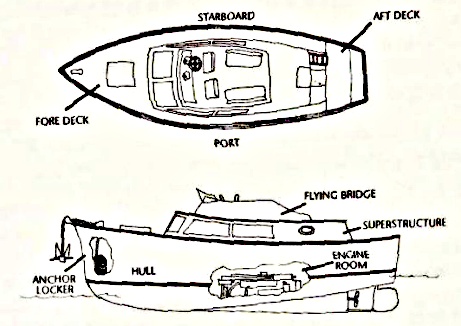
Some contemplation of the who, what, where, and when questions will assist the novice boat buyer in imagining a general allocation of spaces itemized in the previ- ous paragraph. For example, sunworshipers (who may possibly be entertaining onlooking boaters by baking themselves to a tan) will prefer more deck space, while a gourmet chef who will be entertaining visitors by baking a soufflé for eight will allocate a greater amount of space to the galley and the main saloon.
For most people the perfect boat does not exist, but identifying the relationship between the allocation of space and the boater’s own cruising agenda will be of great benefit when considering the wide variety of boat designs available.
How Large a Boat?
Cost Vs. Fun. For many people, the answer to the question of how large a boat to buy is automatically «the largest one we can afford!» There is an often painfully obvious relationship between a boat’s size and the exponentially increasing cost of owning one. In the fantasies of most boaters, we see Our selves lounging with a bottle of the finest champagne on the deck of our immaculately maintained 120-foot ocean-traversing yacht, anchored in an exotic tropical harbor, where warm tropical breezes waft slowly across the water. While for a fortunate few this may represent reality, the majority of us powerboaters seem to be opening a can of peer on a 25- to 42-foot boat, at the public dock, while hoping it doesn’t rain again this weekend. Luckily, for most boaters it is possible to enjoy boating in 3 mible runabout with a canvas top almost as much as in a megamillion-dollar luxury liner. In fact some who could experience both might actually prefer the closer-to-nature experience of the smaller boat.
Challenges of a Large Boat
Factors other than cost and affordability should enter into a full consideration of size. Larger boats require more expensive monthly moorage. Slips longer than 40 feet are often hard to find, making it difficult to change the boat’slocation, and the marina manager may feel no great urgency to price a rarely available slip in a competitive manner. Larger boats will consume more time and/or money for cleaning and maintenance tasks. Too large a vessel may tax the docking and maneuvering skills of a new boater or the physical capabilities of a post-retirement couple to a potentially disastrous degree. At any marina, it is possible to observe boats of 60 feet or larger being successfully and adeptly docked by a cruising cou- ple, but it is unfortunately also common to see boats of 36 feet or less pinballing around and clearly beyond the boat-handling skills of skipper and crew. When perusing broker or private-party ads for larger boats it is not unusual in the least to see a comment, «Willing to accept smaller boat as partial payment».
Problems of a Small Boat
A boat needs to be large enough to safely handle the worst weather which it will ever encounter. The smaller the boat, the more optimistic the weather forecast must bebefore deciding to leave the dock or launch from the trailer. While no boat is large enough to intelligently begincruising under gale or storm conditions, sometimes the weather can change more quickly than expected, and those out in the smaller boats suffer the worst. If you have a small boat, better carry a big barometer (and keep men- tal track of the closest available shelter at all times). Smaller boats present special challenges in stowage of gear and supplies. The recent purchaser of a new boat was heard to complain that «by the time we got all of the Coast Guard-required equipment aboard, there was no room for groceries!»

A Starter Boat?
Buying too small a boat will put a boater back into the market very quickly, with all of the hassle and expense of trading in or selling the small boat. It can be a mistake to conclude that stepping up to the next size of boat will necessarily be as easy or inexpensive as trading up to a larger Chevy, or from a Honda to a Lexus. Used boats can stay on the market for a matter of hours or as long as several years. Purchasing a much smaller boat than required as a starter boat («to see if we like boating») is no more advisable than moving the entire family into a one-bedroom cabin to try out home ownership. Cramming everybody and everything into a tiny space on a hull of inadequate seaworthiness is more likely to result in the entire family developing a quick and enduring disdain for boating than to spark a life-long love affair with spending time at sea. Mastering the Boat Buying Process – Essential Steps from Negotiation to Ownership
Chartering a boat is an excellent way to give boating a trial before buying a boat, and is much less expensive than buying a vessel acknowledged to be inadequate from the beginning.
Effects of Boat Design on Length
By taking a thorough look at the answers to the previously considered who, when, what, how questions and examining a few boats on the market in various styles, a boat buyer will begin to formulate an opinion on a range of suitable sizes. Size requirements will vary between design concepts. A boater seeking two large staterooms might be fairly content with a 34- to 36-foot tricabin design. But if the same boater desires a roomy cockpit for fishing, he or she might need to consider a 42-foot sportfisherman to achieve the same amount of usable interior space.
Effect of Beam on Size. A longer boat isn’t always a larger boat. The beam (width) of a boat will have a significant influence on the overall size of the craft. While boats are not rectangular in shape, a relatively rough size comparison can still be achieved by multiplying the length of the hull by the beam. For example, a 34-foot boat with a 10-foot beam (34 × 10 = 340) would not really be larger than a 32-foot boat with an 11-foot beam (32 × 11 = 352). A 36-foot boat with a 12-foot beam would factor out to 432, while a 40-foot boat with a 14-foot beam would multiply to 560 – a case where a boat only 11 percent longer is actually about one-third bigger. Boat builders have been offering vessels with more beam in recent years, leaving some 20- and 30-year-old boats looking almost skinny by comparison.
Confusing Manufacturer Claims. Boats can be measuredby different standards. One manufacturer may build a hull 28-foot long down the center, hang a two-foot swim step off the stern, add two feet of pulpit to the bow and market the boat as a 32 footer. Another manufacturer may label a boat as a «Pileknocker 44» but actually deliver a craft that will take every bit of 50 feet of dock space when pulpits and swim steps are accounted for. (Owners of such vessels often emphasize the 50-foot length when describing the boat to friends and the 44-foot designation when paying per foot for an evening at a marina.)
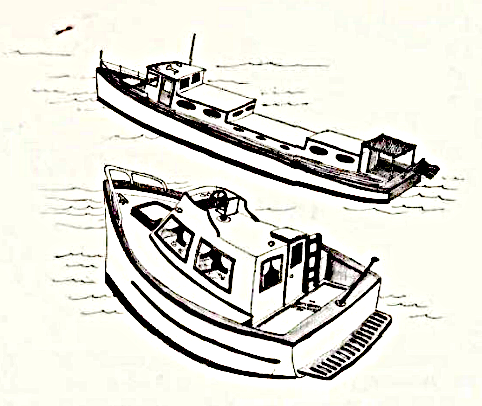
To a casual observer the non-standardization of boat measurement is reminiscent of the story of the traveling rug merchant. When a customer entered the rug merchant’s tent, the merchant called out to his assistant to bring the measuring stick. The assistant was heard to reply, «Which stick, master? The one for buying or the one for selling?» When comparing boats it is well to understand whether the measurement being used is the LWL (length of water line), LOA (length overall), or some other measurement entirely.
Common Powerboat Varieties
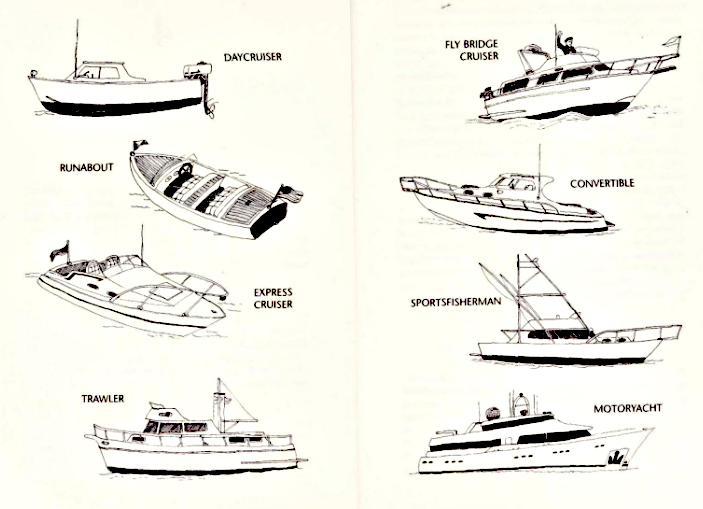
Manufacturers use different terminology to identify the boats in their product lines. Some consistent definitions have emerged for various configurations and hull designs, but the use of these terms is not completely universal and endless hair-splitting arguments could (and do) take place regarding the appropriate categorization for individual boats.
Runabouts. The smallest practical powerboats, with the exception of motorized dinghies, are in the category known as runabouts. These boats are primarily in the 16-24 feet range and are very open, with planing hulls and designs emphasizing the achievement of high speeds under reasonably calm conditions. Runabouts are often powered by Boat Outboard Motorsoutboard motors, but the larger sizes are frequently inboard/outboard configurations. Many runabouts maximize seating capacity with an open-bow design in which the foredeck has been replaced with installed seating. With no cooking, sleeping, or toilet provisions aboard, most runabouts are suitable for short duration only and are commonly selected for general sightseeing, waterskiing, or short-term, near-shore fishing trips. It is far more common to transport a runabout to the boating destination on a trailer and launch it at a nearby ramp than to attempt to cruise any great distance in such a vessel.
Common runabout examples – Three well known manufacturers of runabouts include Bayliner, Sea Ray, and Four Winns. There are several other major runabout builders, some of whom build very good boats. The 1997 ABOS Marine Blue Book lists the following suggested retail prices for new runabouts:
- Bayliner 1851 Capri at $ 14 095, Sea Ray 175 Bowrider at $ 13 923;
- and Four Winns 170 Horizon at $ 14 903.
Bayliner and Sea Ray are both divisions of the Brunswick Corporation, and Bayliner is the largestselling brand name in powerboating. As with any product, there are many opinions regarding the integrity and intrinsic quality (or lack thereof) of any boat builder in the mass production business.
Day Cruisers or Cuddy Cabins
Beginning with boats around 19 feet or so, many manufacturers provide a small, enclosed area ahead of the helm and under a raised foredeck known as a cuddy cabin. The navalarchitect may even have engineered a method of squeezing a small alcohol stove, a porta-potti, and a bunk or two into this area. Cuddy cabins allow boaters to seek shelter fromthe midday sun or a sudden rainstorm, and provide enoughprivacy that changing into or out of a swimsuit in a crowded area doesn’t have to become an exercise in advanced contortionism and creative towel holding. Some cuddy cabins share the same hull designs that their respective manufacturers use for their runabout line. The rudimentary cooking and sanitation facilities allow more extended use than is practicable with a runabout, but the boats are often called day cruisers as they are ordinarily too sparsely appointed for overnighting. Most day cruisers are less than 24 feet, and it is common to store and transport them on trailers.
Common day cruiser examples – Bayliner has a 2052 Capri model listed in the 1997 ABOS Marine Blue Book at $ 15 895, and Sea Ray is shown with a 215 Express at $ 28 692. Some marketers like to crowd the category, and Sea Ray’s designation of their 22-foot cuddy cabin boat as an «Express Cruiser» is an excellent example of this. Express Cruiser is a term more commonly applied to a larger family of boats, discussed immediately following. Remember that if the Bow Spring Boatworks introduces a 26-foot boat and calls it the «Bow Spring Trans-Oceanic Liner», merely naming the model as such doesn’t suddenly make it magically correct for the implied purpose. The 215 Express Cruiser may indeed be an excellent boat, and it has a fairly generous amount of cuddy cabin, but it is certainly ambitiously named.
Express Cruisers
In most product lines, somewhere in the 25-foot category, day cruisers disappear and their big sisters, the express cruisers, appear. The smallest express cruisers are among the largest boats typically associated with trailer boating. Express cruisers ordinarily incorporate an open cockpit at the stern, but this cockpit area is proportionately smaller than on a day cruiser, and far more of the boat is devoted to enclosed cabin accommodations. The helmsman is seated on deck in an express cruiser design, and the entire main deck may be somewhat raised in order to facilitate engine room and cabin architecture. A frequent addition on an express cruiser is a removable canvas or permanent fiber-glass hardtop to protect the skipper from the elements and allow the living space to expand and include the aft deck. Most utilize planing hulls and top speed is a major consideration for many express cruiser buyers. Technical Recommendations for Choosing Engines for a BoatsInboard/outboard drive systems are common on express cruisers.
Express cruisers typically have adequate bunk, galley, and sanitation facilities to allow a cruising couple or small family to spend several days aboard the boat.
Express cruiser examples – One of the names associated with popular express cruisers is Carver, and they offer a 310 Express at $ 92 440 (again, according to the ABOS book). Four Winns markets a 258 Vista at $ 42 017; Bayliner, a 2859 Express Cruiser at $ 57 000; and Sea Ray, a 300 Sundancer at about $ 138 000.
Fly bridge cruisers
At about 30 feet and above, the number of express cruisers offered begins falling off and the next largest boat type, the fly bridge cruiser, becomes more commonly available. Fly bridge cruisers feature a much higher upper deck than express cruisers, and allow more spacious cabin accommodations with greater provision for cabin headroom and larger windows providing a better view outside the boat. The helm is moved farther forward to the front of the fly bridge, and this position affords the helmsman maximum visibility. Semi-displacement hulls and twin engines are common in this category, and designers often place a great emphasis on achieving a decent turn of speed. Fly bridge cruisers are usu- ally powered by inboard, fixed-prop engines as their taller design allows the engines to be installed under the cabin sole.
The majority of fly bridge cruisers have an open cockpit aft, but a significant number are built as aft cabins, where the cockpit has been eliminated and a raised deck used to create space for (typically) an elaborate master stateroom. The cockpit designs are easier to fish from and provide easier access to and from a dock or a dinghy, but nobody will dispute that the aft cabin configuration dramatically increases the usable interior space.
Fly bridge cruiser examples – The 1997 ABOS Marine Blue Book lists a Bayliner 3788 Command Bridge at $ 165 000, a Mainship 34 Motor Yacht (another example of crowding the category)at $ 159 000, and a Carver 370 Aft Cabin at $ 190 000, A great many builders offer fly bridge cruisers, and, as with the examples listed above, a buyer will find that some prove to be more suitable than others.
Sportsfishermen and Convertibles
For many boaters, one of the primary motivations for owning a boat is the thrill of pursuing large game fish in the open ocean. The boats that serve well for this purpose have large open cockpits, often with specialized «fighting chairs», and plenty of room for rigging lines and hauling gaffed fish aboard. When equipped primarily as a fishing platform (with outriggers, tuna towers, built-in bait tanks, etc.), such boats are commonly called sportsfishermen. Trophy angling is often a high-dollar activity, and many of the sportsfishermen have evolved into a dual-purpose category of boat referred to as a Convertible. Convertibles incorporate both a functional fishing cockpit and yachtlike interior accommodations and amenities in the cabin. Some of the costliest boats in the under-50-foot size are convertibles.
Sportsfishermen and convertibles ordinarily feature high output twin engines and semi-displacement hulls, allowing a quick run to fishing grounds 20 or 30 miles offshore. A flying bridge is a universal characteristic of convertibles and sportsfishermen. Seaworthiness is important in this classification. A boat caught in a sudden storm a considerable distance from the nearest harbor needs to be thoroughly equipped and well designed to withstand the punishment that a boat used strictly in inland waterways rarely encounters.
Well-known sportfisherman examples – Many manufacturers of convertibles and sportsfishermen have earned popular reputations for high quality and excellent craftsmanship. Egg Harbor, a perennial favorite, offers a 34-foot Golden Egg for as little as $ 211 000 (95 price, according to the 97 ABOS book) and a 42-foot Golden Egg for $ 433 000. Hatteras, also considered a blue-ribbon builder, offers a 39-foot Convertible for $ 376 000 and a 46-foot version for $ 749 000. Bertram competes in this market with a 46-foot. Convertible at $ 718 000, and a 54-foot model that lists at over $ 1 million. Lest you conclude that the entire group of sportsfishermen and convertibles is out of the question for all but the wealthy, the ABOS book lists a 32-foot Convertible by Luhrs with a suggested retail price of just $ 134 600; certainly not an exorbitant price for a boat of that size.
Trawlers
Trawlers incorporate displacement or semi-displacement hulls with high, flaring bows patterned after the sturdy commercial fishing boats from which the category derives its name. Trawlers are virtually 100 percent diesel powered, many of them use a single engine, and their designs traditionally emphasize fuel economy and range rather than speed. Due to their rugged design and the potential in some cases to travel several thousand miles on a single load of fuel, larger trawlers have long been a favorite of transoceanic voyagers. The greater number of trawlers have aflying bridge, but some are designated as pilot house models and feature a well-appointed interior helm station only.
Trawlers are a popular choice among boaters with previous sailing experience who (for whatever reason) have decided to take up powerboating.
Read also: Buying and Selling Making – a Sound Investment In a New or Used Boat
The majority of trawlers are 32-foot and longer, with much of the group clustered between the 36-foot and 45-foot ranges. Trawlers provide opportunity for spacious cabin interiors with two basic designs: the tricabin which features a V-berth forward, a saloon and galley amidships, and an owner’s stateroom aft, and the sedan (with an elaborate owner’s stateroom forward and a larger saloon and galley aft.
Some well-known trawlers – The original trawler, the Grand Banks, is perhaps the most universally recog- nized trawler brand name, and it has earned an excellent low $ 300 000s, and a good supply of used trawlers from various manufacturers exists with prices well under $ 100 000. The majority of trawlers, including the Grand Banks line, have traditionally been built in Asia: Nordhavn, Krogen, and Sabreline are other names well known to trawler enthusiasts.
Motoryachts
Motoryachts are the largest and most luxurious powerboats. Few boats under 45 feet truly deserve the title, and custombuilt, megamillion-dollar megayachts in the 150-foot range are still considered members of the motoryacht class. Many of the larger motoryachts are too large to be safely handled by a couple and require an experienced crew to be quartered and provisioned for in addition to the owners and their guests. With an almost unlimited budget to work with, naval architects have created many custom motoryachts which combine world cruise capability with virtually unrestrained opulence and comfort. Vessels produced in this category are built in such small numbers that individual boats can be highly customized as well. Most readers of this book will not begin their boating experiences on a motoryacht.
Common motoryacht examples – Not every boat in the motoryacht category is beyond the means of the merely wealthy. As usual, Bayliner offers one of the lower priced motoryachts available with a 4 788 Motoryacht which the 1997 ABOS Marine Blue Book lists at $ 343 000. More typically priced examples might be the Carver 455 listing at $ 448 000, the Mainship 47 at $ 510 000, the Sea Ray 550 Sedan Bridge at $ 798 000 and the Hatteras 65-foot Motoryacht at $ 1,75 million.

- Everett Collier, The Boatowner’s Guide to Corrosion. International Marine, 2001, hardcover, 314 pages.
- Fernec Mate, Shipshape: The Art of Sailboat Maintenance. Albatross Publishing, 1986, hardcover, 416 pages.
- John Payne, Understanding Boat Corrosion, Lightning Protection, and Interference. Sheridan House, 2005, 90 pages.
- Edwin Sherman, The 12-Volt Bible for Boats. International Marine, 2002, paperback, 208 pages.
- Nigel Warren, Metal Corrosion in Boats. Sheridan House, Inc., 2006, 229 pages.
- Charlie Wing, Boatowner’s Illustrated Electrical Handbook, Second Edition. International Marine, 2006, paperback, 280 pages.
- Don Casey, Canvaswork and Sail Repair. International Marine, 1996, hardcover, 140 pages.
- Jim Grant, The Complete Canvasworker’s Guide, Second Edition. International Marine, 1992, paperback, 186 pages.
- Karen Lipe, The Big Book of Boat Canvas. International Marine, 1988, paperback, 242 pages.
- Emiliano Marino, The Sailmaker’s Apprentice, International Marine, 1994, paperback.
- Philip W. Conkling, Green Islands, Green Sea: A Guide to Foraging on the Islands of Maine. Down East Books, 1980.
- Euell Gibbons, The Beachcombers Handbook. David McKay, 1967, 230 pages.
- Janet Groene, Cooking on the Go. Sail Books, 1980, 234 pages.
- Peter Howorth, Foraging Along the California Coast. Consortium, 1977.
- Ken Neumeyer, Sailing the Farm. Ten Speed Press, 1981, paperback, 256 pages.
- Lin Pardey, The Care and Feeding of the Offshore Crew. Paradise Cay Publications, 1999, 414 pages.
- Linda Frederick Yaffe, Backpack Gourmet. Stackpole Books, 147 pages.
- Peter Hunn, The Old Outboard. International Marine, 2002, paperback, 320 pages.
- Jean-Luc Pallas, Outboard Motors Maintenance and Repair Manual. Sheridan House, 2006, 125 pages.
- Edwin Sherman, Outboard Engines. International Marine, 2008, hardcover, 176 pages.
- W. D. Booth, Upgrading and Refurbishing the Older Fiberglass Sailboat. Cornell Maritime Press, 1988, 287 pages.
- Paul and Myra Butler, Fine Boat Finishes. International Marine, 1987, paperback, 160 pages.
- Paul and Myra Butler, Upgrading the Small Sailboat for Cruising. International Marine, 1988, paperback, 224 pages.
- Nigel Calder, Boatowner’s Mechanical and Electrical Manual. International Marine, 2005, hardcover, 818 pages.
- Don Casey, Sailboat Hull and Deck Repair. International Marine, 1996, hardcover, 128 pages.
- Don Casey, Sailboat Refinishing. International Marine, 1996, paperback, 144 pages.
- Don Casey, This Old Boat, Second Edition. International Marine, 2009, hardcover, 576 pages.
- Fernec Mate, The Finely Fitted Yacht. W. W. Norton & Company Limited, 2005, 606 pages.
- Dan Spurr, Spurr’s Guide to Upgrading Your Cruising Sailboat, Third Edition. International Marine, 2006, hardcover, 400 pages.
- Fred Bingham, Boat Joinery and Cabinetmaking Simplified. International Marine, 1993, paperback, 265 pages.
- Michael Naujok, Boat Interior Construction. Sheridan House, 2002, paperback, 176 pages.
- Larry Brown, Sailing America: A Trailer Sailor’s Guide to North America. Seven Seas Press, 1990, paperback.
- Larry Brown, Sailing on a Micro-Budget. Seven Seas Press, 1985, 163 pages, paperback.
- Robert Burgess, The Handbook of Trailer Sailing. International Marine, 1992, paperback, 227 pages.
- Don Casey and Lew Hackler, Sensible Cruising: The Thoreau Approach. International Marine, 1986, paperback, 364 pages.
- Ronald Florence, The Optimum Sailboat: Racing the Cruiser and Cruising the Racer. Harper and Row, 1986, hardcover, 374 pages.
- Annie Hill, Voyaging on a Small Income. Tiller Publishing, 1993, paperback, 208 pages.
- J. C. Jenkins, The Humanure Handbook: A Guide to Composting Human Manure. Chelsea Green Publishing Co., 2006, 302 pages.
- Elbert Maloney (editor), Chapman’s Piloting, Seamanship, and Small-Boat Handling, (65th edition). Sterling Publishing Company, Inc., 2007, hardcover, 928 pages.
- Tom Neale, All in the Same Boat. International Marine, 1997, hardcover, 376 pages.
- Lin and Larry Pardey, The Capable Cruiser. Pardey Books, 1995, hardcover, 400 pages.
- Lin and Larry Pardey, The Cost-Conscious Cruiser. Pardey Books, 1999, hardcover, 352 pages.
- John Rousmaniere, The Annapolis Book of Seamanship (revised edition). Simon and Schuster, 1989, hardcover, 402 pages.
- Daniel Spurr, Your First Sailboat: How to Find and Sail the Right Boat for You. International Marine, 2004, paperback, 288 pages.
- Donald M. Street, The Ocean Sailing Yacht. W. W. Norton, 1973, hardcover, 703 pages.
- USCG Auxiliary, Boating Skills and Seamanship. International Marine, 2007, paperback, 404 pages.
- Thomas Ask, Handbook of Marine Surveying. Sheridan House, Inc., 2007, 246 pages.
- Don Casey, Inspecting the Aging Sailboat. International Marine, 1996, paperback, 144 pages.
- Andrew Douglas, Practical Sailor’s Practical Boat Buying, 2 volumes. Belvoir Books, 1998, paperback.


