
LNG Market Trends are significantly shaping the future of global energy supply. As countries transition towards cleaner energy sources, the demand for liquefied natural gas is expected to rise. This is particularly evident in emerging markets, where infrastructure investments are focusing on natural gas. Africa presents unique opportunities for growth, with several nations exploring their gas resources for both domestic use and export.
Additionally, advancements in shipping technology are facilitating more efficient transport and trade of LNG. Overall, understanding these trends is essential for stakeholders aiming to navigate the evolving energy landscape.
Introduction
Global gas market and history of LNG/LPG consumptionGlobal gas demand has increased over the past decade and is expected to grow rapidly into the future with increased interest in cleaner energy to fuel economic growth. Historically, most natural gas is sold locally or by gas pipeline to adjacent markets. Liquefaction of natural gas, as LNG, allows it to be transported from producing regions to distant countries. There are vast known global natural gas resources that are considered «stranded» as they have not been able to be economically produced and delivered to markets.
LNG History
In 1959, the world’s first LNG, carrier, the Methane Pioneer, set sail from Lake Charles, Louisiana with a cargo of LNG destined for Canvey Island, UK. This first ever US-UK shipment of LNG demonstrated that large quantities of LNG could be transported safely across the ocean, opening the door for what would become the global LNG industry.
As the LNG markets evolved over the decades, they tended to develop in regional isolation from each other, primarily due to the high cost of natural gas transportation. Historically, two distinct LNG trade regions developed – the Asia-Pacific region, and the Atlantic Basin region which included North America, South America and most of Europe. Until Qatar began to export LNG to both regions in the mid-1990s, the two regions were largely separate, with unique suppliers, pricing arrangements, project structures, and terms. In recent years, the increase in inter-regional trade, as well as the development of a more active spot market, has tended to blur the distinction between the two main regions.
There are three main global gas markets: the Asia-Pacific region, the European region, and the North American/Atlantic Basin region which includes North America, South America, and Latin America. The Asia-Pacific region has historically been the largest market for LNG. Japan is the world’s largest LNG importer, followed by South Korea and Taiwan. China and India have recently emerged as LNG importers and could become significant buyers of LNG over time.
The growth of LNG in Europe has been more gradual than that in the Asia-Pacific, primarily because LNG has had to compete with pipeline gas, both domestically produced and imported from Russia. The traditional European importing countries include:
- the UK;
- France;
- Spain;
- Italy;
- Belgium;
- Turkey;
- Greece and Portugal.
More recently, a growing number of European countries have constructed LNG import terminals, including Poland, Lithuania, and Croatia.
In North America, the United States, Canada and Mexico have strong pipeline connections and abundant supplies of natural gas. Historically, this region had been able to supply all of its natural gas requirements from indigenous supplies. During the supply-constrained 1970s, however, the US began importing LNG from Algeria and four LNG import terminals were built between 1971-1980. The 1980s was a period of oversupply and US LNG import terminals were either mothballed or underutilized.
In the late 1990s, the United States was forecasting a shortage of natural gas, which led to the reactivation of the mothballed terminals and the building of additional import terminals, including Cheniere Energy’s Sabine Pass. But by 2010, it became apparent that the US would be a major shale gas producer, making LNG imports unnecessary. The cargoes that were to be sold in the US were then available to be sold on global markets. Many of the existing US import terminals were subsequently re-designed as LNG liquefaction and export terminals.
In February 2016, Cheniere Energy’s Train 1 came online, thus heralding in a new wave of LNG supply. As of early October 2016, DOE had issued final authorizations to export 15,22 billion cubic feet per day (Bcf/d) of US Lower-48 States domestically sourced natural gas to non-FTA countries. The following table shows the US large-scale projects have received regulatory approvals and are under construction or operating.
| Table 1. US large-scale projects | ||
|---|---|---|
| Project | Volume (Bcf/d) | In Operation |
| Sabine Pass Cameron, LA | 4,14 | Feb 2016 |
| Dominion Cove Point Calvert County, MD | 0,77 | 2018 |
| Cameron Cameron, LA | 3,53 | 2018 |
| Freeport Quintana Island, TX | 1,8 | 2018 |
| Corpus Christi Corpus Christi, TX | 2,1 | 2019 |
Supply and Demand Balance
In 2015, Global LNG trade accounted for 245,2 million metric tonnes per annum (MTPA). Also in 2015, there were 34 countries importing LNG and 19 countries that export LNG. In terms of the global supply balance for LNG, the key features of the last few years have been:
- the emergence of the US as a major LNG exporter, potentially adding more than 60 MTPA to global supplies;
- the completion of a number of major LNG export facilities in Australia, which will soon achieve a nameplate capacity of about 85 MTPA;
- slower than expected demand increase from Asian markets, and
- new gas discoveries, particularly large discoveries in frontier regions.
The confluence of these four factors, which continue to evolve, has created a short-to-medium term situation of material LNG oversupply. Oversupply is depressing spot and medium term prices for gas that has not already been contracted. In addition, a major portion of the LNG market has long-term contracts indexed to oil prices which have also dropped significantly. All these factors have created a difficult environment to develop greenfield LNG export facilities.
For excess LNG that has not been contracted on a long term or destination-specific basis, prices in most key consuming markets, such as Europe or Asia, have fallen from a high of $ 10-$ 15 per million british thermal units (MMBtu) to below $ 5/MMBtu, and while this remains above the marginal cost of production for some projects, it typically falls well short of the whole-life costing of an LNG project, once amortization of capital and loan repayments are taken into account.
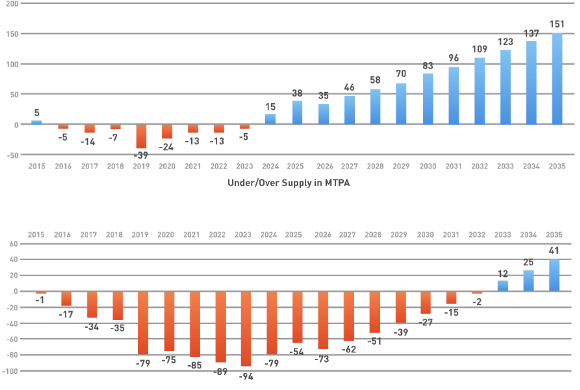
For a gas/LNG project developer/investor or host government, one of the main challenges is to determine when a rebalancing of gas markets might take place, as this would have implications on LNG price projections and the project’s economic viability. Opinions vary on when, and in what manner LNG global markets will rebalance. Even if a number of the existing The Gases and Their Properties, Liquefaction Process (LNG/LPG)LNG liquefaction terminals, either in production or under construction, take steps to rephase their output or delay completion to realign with market demand, it appears likely that an oversupply will continue at least into the early 2020s. Conversely, if development plans continue, based on the completion dates and FID decisions currently quoted in investor’s and press materials, the oversupply could continue through the next decade. While commercial and financial pressures suggest that some kind of shorter term realignment will result, it is not yet apparent how this realignment will happen, and what the implications are for African gas and LNG projects.
The charts below indicate two possible realignment scenarios, based on a prompt (short term) market realignment, or a longer term oversupply. The red bars represent the amount of global LNG oversupply.
Opportunities for Africa Natural Gas
More countries in Sub-Saharan Africa are on the cusp of emerging as major natural gas producers. Mozambique and Tanzania recently have discovered more than 250 trillion cubic feet (TCF) of gas reserves. Nigeria and Angola are also important gas producers. The huge shortfall in power supply in Africa, coupled with the the relatively high cost of electricity based on the high cost of available fuel in many African countries, presents a new opportunity for natural gas and LNG imports to fuel the projected growth of African economies.
In September 2016, the US Power Africa Roadmap report outlined a goal to increase power generation in sub-Saharan Africa by more than 30 000 megawatts (MW) by 2 030. This translates to about 5,5 bcfd of additional natural gas consumption or about 42 MTPA of LNG, assuming natural gas is the fuel of choice. This is equivalent to the growth of LNG observed in China and India during a similar timeframe. Similarly, the African Development Bank Group has set an aspirational vision to achieve universal access to electricity by 2025. This vision is encapsulated in the New Deal on Energy for Africa.
The domestic natural gas prices in many African countries are quite competitive. The prices are mostly established by bilateral negotiation between buyers and sellers and are usually indexed on alternative fuels such as crude oil or petroleum products, as in the case in Ghana, Mozambique, and Nigeria. The natural gas prices range from about $ 1,21/MMBTU in Mozambique for industrial customers to around $ 8,4/MMBtu for power generation in Ghana, with gas prices in Nigeria falling within the range.
Read also: Financing an Liquefied Natural Gas Export Project
The emerging African natural gas markets will attract pipeline gas and LNG in the near-to-medium term. For example, the LNG Floating Regasification and Storage Unit (FSRU) Golar Tundra arrived in Tema port in Ghana in July 2016 to supply gas to the Ghana National Petroleum Company. The natural gas price levels in Ghana and the high cost of imported alternative fuel are adequate to accommodate LNG imports to complement the other gas supply sources.
Nigeria delayed development of LNG liquefaction projects after NLNG Train 6 to give more attention to delivering natural gas to the domestic market. The Nigerian government is focusing on the domestic natural gas market, especially for power generation and gas-based industries. Cameroon has one LNG export terminal under construction with another planned. Mozambique and Tanzania are already making provision for meeting domestic natural gas demand as the terms of the LNG export project are being negotiated. Equatorial Guinea is also one of the LNG exporting nations from sub-Saharan Africa.
Global Shipping Considerations
Similar to the broader LNG supply-demand balance, the LNG shipping sector is currently encountering some major changes that result both from overbuilding of LNG carrier capacity and from technology changes which have substantially improved the fuel efficiency and operating costs of more modern ships.
LNG carriers trended towards a 125 000 cubic meter standard in the 1980s. Economies of scale and newer technology gave rise to increased ship size of 160 000 to 180 000 cubic meters, with the newest generation of Qatari ships being 216 000 to 266 000 cubic meters. The largest ships can carry around 6 billion cubic feet of gas, equivalent to one day’s average consumption for the entire UK, or around 10 % of US daily gas production.
A new build LNG carrier might be expected to cost around $ 200 million to $ 250 million, which would typically require a charter rate of about $ 80 000-$ 100 000 per day to support capital and operating costs. Spot charter rates in the industry are currently only at around a third or a quarter of these levels, so ships without long-term charter arrangements are struggling to find economically viable short-term charters. Also, LNG sellers are passing on many of the cost/revenue pressures created by the gas oversupply. For example, charterers are now typically paying only for the loaded leg of a journey, perhaps augmented by a small fee or bonus for the return ballast (empty) leg of the delivery trip.
The depressed shipping market does have some spin-offs for the gas/LNG development industry. Relatively new Key Systems for LNG Carriers Containment and Safety: Design and OperationLNG carriers (even post 2 000) which have a limited prospect of finding viable future long-term charters are becoming available for conversion to other types of floating facility. Conversion to a floating storage and regasification unit (FSRU) would be the easiest and quickest conversion to carry out. More recently and less frequently, ships have become a candidate for conversion to a floating liquefaction (FLNG) facility. FLNG conversion usually requires more structural alteration of the hull, given the significant additional tonnage of equipment on the topside, but the advantages of an existing hull/cryogenic storage facility can represent a significant cost saving.
It is interesting to note that a converted LNG carrier is to be used for the FLNG facility proposed for Cameroon, as well as the planned Fortuna project in Equatorial Guinea. Benefits claimed in both examples include shorter time to market and lower cost.
African countries may want to capitalize on short-to-medium term low-cost LNG to provide an initial gas stream for power projects and promote local market development using converted LNG carriers as floating storage and import terminals. Later, as domestic markets develop and natural gas development projects are implemented, countries could replace or supplement LNG imports with indigenously-produced gas. Available options include:
- a variety of configurations with a combination of LNG storage;
- regasification;
- or ship-mounted power generation;
- and some proposed configurations even include water desalination in a coordinated package.
In light of these shipping market dynamics, engineering solutions for African gas and LNG projects include a much wider spectrum of options than in recent years.


