Boat Buying Essentials are fundamental for anyone looking to purchase a vessel. Understanding the various financing options and miscellaneous expenses is crucial for budget planning. A thorough sea trial is essential, but it may not reveal all the vessel’s nuances. Knowing how depreciation affects your investment can guide your purchase decision, whether you choose a new boat or explore the used market.
- Where to Find Boat Money
- Miscellaneous Expenses
- First Law of Boating Economics
- Price Range
- Amortization Chart
- Depreciation
- Charter’s a Starter
- Some Experience Required
- Sea Trial May Not be Enough
- Alternatives to Chartering
- The Value of a Broker
- Brokers Role When Shopping Used
- Stay Local When Buying New
- For Sale by Owner?
Engaging a knowledgeable broker can provide invaluable insights, helping you navigate the buying process. Ultimately, being informed will empower you to make a smart and confident purchase.
Where to Find Boat Money
A boat takes shape in the imagination. Prior to actively shopping for the boat, it is useful to identify an amount of disposable income available each month for boating. For most boaters, some of it will be money currently being spent for something else. Since it’s not possible to be two places at once, some of the family entertainment budget which has customarily been spent for sporting events, nights at the pizza parlor, movies and popcorn, weekends spent in a hotel at the shore (being envious of folks who already have a boat), and trips to the video rental store can be painlessly transferred to boating. Many families boat quite handsomely on the same amount of money that others spend on motor homes or owning a summer cabin. A boat is like a waterfront property with an ever changing view. Some of the money can actually come from Uncle Sam. Under the current tax laws, a boat with a galley and a head often qualifies as a second home and money spent for interest on a boat loan is then deductible from your income before calculating taxes due. (Check with your accountant.) Once a figure has been set that the family budget can withstand, a few allowances need to be made before any conclusions can be drawn about the amount of money available each month to service a boat loan.
Miscellaneous Expenses
Unless your preference is for a Buying Trailerable Sailboats: Condition Assessment and Riskstrailerable boat, the first expense to consider will be moorage. While rates vary from region to region, it may not be easy to find decent moorage for much under $ 8-10 per foot per month. Add utilities (shore power, etc.) and any applicable taxes, and it is not difficult to approach $ 350-400 per month for space to dock a medium-sized powerboat. Trailer boaters are not necessarily immune from similar charges, as many residential neighborhoods prohibit parking boats in driveways, and a storage lot will need to be rented. (Not to mention the megathousand-dollar four-wheel-drive truck many trailer boaters buy to tow and launch the vessel!) Insurance will run several hundred or more dollars a year, so a $ 30-50 per month allocation might be a realistic expectation. Soaps, polishes, waxes, miscellaneous spare parts for routine repairs and so forth can consume $ 100 a month, and a prudent boat owner will set aside fifty cents per engine operating hour for lubricating oil and filters. Every fifty engine hours is not too frequent to schedule an oil change, for as the adage states, «Oil is the cheapest thing you’ll ever put into an engine». After spending a few hundred or more annually for haul out and bottom painting, it’s not unusual to allocate a regular monthly budget in excess of $ 500, before making the loan payment or leaving the dock. The older the boat, the greater should be a boater’s expectation that higher than average expenses for maintenance and repairs will be required.
Fuel. Fuel costs need to be taken into account as well. Should a boater’s taste run toward large, high-speed vessels with two big-block gasoline engines, $ 200 or more per weekend would not be a high fuel bill. At the other extreme, eight-knot single-engine diesel boats with a decent fuel capacity may literally only need to stop at a fuel dock once or twice a year, with perhaps $ 20-30 or less being consumed on a two-day cruise.
First Law of Boating Economics
It is not wise to attempt to boat on the cheap. Purchasing a low-priced craft of questionable seaworthiness and allowing it to further deteriorate through continued financial neglect may seem like fiscal prudence to some, but the first law of boating economics still applies: «The less spent to get afloat, the more needed to stay afloat». Few people would consider charging down the highway in a motor vehicle with bad brakes, broken springs, questionable steering, and an over- heating engine. Yet the seagoing equivalents of such vehicles are frequently seen being boarded in marinas by boaters who, unintentionally, plan to place themselves and their families in harm’s way. If a cheap old car breaks, the driver and passengers can at least get out and walk. By allocating sufficient financial resources to obtain and maintain a decent boat (not necessarily an extravagant boat), purchasing and using the craft will be a far more enjoyable experience.
Price Range
After deducting the monthly maintenance, moorage, and fuel costs the remainder of the budget will service the boat loan. Of course, there are those boaters who can pay cash. But for the rest of us, a few minutes on the phone with the bank will give an idea of the prevailing interest rates and amortizations for boat loans and assist in identifying a realistic amount which can be borrowed for a boat. Adding whatever cash is available for a down-payment will indicate the appropriate price range of vessels to consider.
Amortization Chart
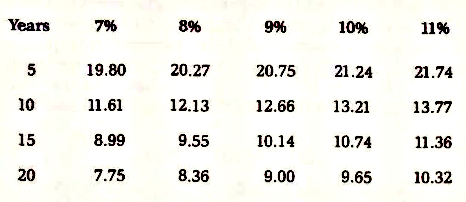
The monthly payment required to retire a loan of $ 1 000 at various interest rates and number of contract years is calculated by multiplying the payments shown by the number of thousands of dollars borrowed. Terms exceeding 15 years for used boats or 20 years for new boats are unusual.
Depreciation
While certainly not a cash expense, an item for consideration when contemplating the economics of How To Choose Your First Powerboatowning a powerboat is the depreciation. For a new boat, in particular, depreciation takes an immediate toll on net worth the moment the engine starts. Various boats depreciate more or less rapidly than others, but no knowledgeable buyer of a used boat would ever pay as much as (or even close to) the price of the same boat in brand new condition. Depreciation is inevitable.
In the broadest terms, five-year-old boats resell for about 60 percent of their current retail replacement cost. Inflation can disguise depreciation, creating an appearance that at least in nominal dollars very little depreciation actually takes place. For example: a new powerboat is purchased at the beginning of year one for $ 100 000. The retail cost of the boat escalates 5 percent per year for five years to $ 127 630. If the boat were resold at the end of year five for 60 percent of the current replacement cost, it would fetch $ 76 580, or only a little over $ 23 000 less than when purchased new.
Ten-year-old boats in excellent condition will generally sell for about 40 percent of the replacement cost for a similar new boat, and bristol 20-year-old boats will often bring about 25 percent of the replacement cost. During decades of high monetary inflation, some used boats appear to appreciate in price, even though the actual market value of the dollars involved continues to decline.
Boats and Money. «Shorebound friends (usually seething with envy) often scold boaters with such clichés» as «a boat is a hole in the water into which one pours money!» and have been known to ask, «How do you justify spending money on a boat?» Some of the happiest boaters around have been heard to reply, «We don’t justify it! We just spend it, forget about it, and enjoy life… a lot!»
Charter’s a Starter
After Careful Consideration and some preliminary visits to local marinas, the style, price range, approximate size, and general configuration of the boat with the most acceptable group of compromises should begin to become apparent.
An excellent way to try on a particular type of boat is to charter one for at least a weekend. Chartering is not inexpensive, but then again neither is purchasing a boat which turns out to be wrong for you.
Some Experience Required
A completely inexperienced boater will not be allowed to just climb aboard and take off with what could easily be a quarter-million-dollar vessel. He or she may need a friend who does have sufficient experience (or even hire a licensed captain to operate the boat), The novice then gar- ners whatever education possible and perhaps spends some time behind the wheel in open water under close supervision. A responsible charter operator will make certain that even an experienced boater knows the idiosyncrasies of a particular vessel and will be capable of safely docking and maneuvering it without damage. So during the check-out session of a chartering experience it is possible to learn a lot about how quickly a boat responds to helm and rudder, how much of a factor windage will be, and so forth.
At-Dock Charters. In the absence of having anybody available to operate a chartered boat, it may be possible (particularly during the off season) to arrange for an at-dock charter. Spending a rainy dockside weekend aboard a boat may stress all but the most devoted domestic relationships, but it will help clarify the rewards and difficulties that cruising aboard a particular boat might represent.
Sea Trial May Not be Enough
When making an offer to How to Purchase the Perfect Boat: Evaluation to Final Salepurchase a boat, it is customary to require that the owner of the boat make it available for sea trial. A typical sea trial is a fairly short, out-around-the-mid- channel-buoy-and-back sort of affair and is ordinarily not undertaken until a prospective buyer has made a conditional commitment. During the sea trial the broker or the owner of the boat is often selling, nonstop, every whistle, bell, gadget, and geegaw aboard. It may be difficult to concentrate on the vessel’s handling characteristics or to experience enough variables in wind and sea conditions during a short run. Ever buy a car after a 10-minute test drive that you might not have selected had you rented it for a couple of days first?
Alternatives to Chartering
An alternative to chartering is available to those who have friends that currently own boats: snag an invitation for at least a short cruise or two, After a couple of cruises on different boats it should be easy to develop an informed opinion about the 34-foot express cruiser, the 38-foot aft-cabin model, and the 36-foot pilot-house trawler. Some careful politicking could be called for, lest one boating friend or another become upset that you have selected someone else’s boat! A couple of hours spent helping a skipper clean up after the cruise and a contribution toward fuel and other expenses is considered good etiquette among nautical guests. One can successfully purchase a boat without chartering first, but it won’t hurt and may help significantly.
Time-Share Boating. In many communities it is possible to participate in time-share boating where a number of different boats are available for occasional use by the participants. Paying a monthly rental fee allows the boating family to use a certain boat a few days a month, subject to schedule coordination with the other time-share members. While most plans call for a minimum commitment of six months to a year, it may be possible during that time to transfer to a couple of different boats and sample a variety of hull types, sizes, and power options.
The Value of a Broker
So after careful analysis and introspection, a cursory preview of the marketplace, a hopefully realistic budgeting session, and possibly a couple of boat rides on charter boats or as the guest of some friends, you have narrowed the choices down to no more than a couple of categories of boats. You’ve maybe even thought specifically about a brand name or builder. It’s time to begin selecting a boat, which can begin by selecting a broker.
Brokers Role When Shopping Used
Finding the right yacht broker is very important when shopping for a used boat. Like real estate agencies, most yacht brokerages share their inventory listings with each other and belong to multiple-listing organizations which can make boats available literally worldwide. If you are lucky enough to encounter a broker or salesperson genuinely interested in helping in the acquisition of a boat reflecting your needs and desires, a salesperson with whom you have a rapport, it is often possible to ask that individual to assist with your purchase of a used vessel even if the inventory and in-house listings of this particular brokerage do not contain just the right boat at the moment. A couple of key questions: Does the broker seem to be a careful listener and make an effort to show you boats that make sense for you, or does he or she seem to be pushing a boat which clearly isn’t what you’re interested in? Is the salesperson more interested in helping you make decisions or in forcing decisions upon you?
Stay Local When Buying New
If shopping for a new boat, a buyer may be stuck with the local brokerage which has an exclusive franchise to represent Squiddiddle Yachts. The advantage of the local broker representing Squiddiddle is that there should be no excuse for having any less than a perfect knowledge and understanding of the product represented, and it is prudent to have a working relationship with the company that may be arranging any warranty repairs or adjustments on a new boat. A buyer who selects a new Squiddiddle may feel compelled to check out of town for a comparison price in order to be confident of making a favorable deal on the boat.
Read also: Yacht Financing: Your Complete Guide to Funding Your Dream Boat
In the larger scheme of boat ownership, if a prospective buyer elects to purchase new, it could well be worth an extra couple of percent in the final price to do business with the local vendor. (Given the opportunity, the local dealer might be willing to meet an out-of-town quote anyway.) When service is required it is so much more pleasant to be treated as an important, priority customer whose future business is worth cultivating than as the «damned cheap-skate who drove 300 miles, cost us the deal, saved almost nothing, and will probably be an even bigger pain when it comes to having the boat serviced!» With a busy holiday weekend looming, it is somehow gratifying to have any required servicing performed with your boat being scheduled ahead of the out-of-town bargain hunters rather than behind the loyal locals.
Ask the Grapevine. Friends or acquaintances who have recently purchased a boat may be able to direct you to (or away from, as the case may be) various brokers in the community. While it may be helpful to consider this free advice, there is a good deal of personal chemistry involved in effective communication: the broker who is extremely helpful to one buyer may have a difficult time with another.
For Sale by Owner?
It is also possible to shop for a used boat «for sale by owner». A buyer needs to be particularly wary when dealing with a private seller. Deliberate misinformation and outright ripoffs perpetrated by established businesses are usually addressable by some government entity or another. When a business commits a fraud, local regulators can be quick to respond. If John Q. Public defrauds John X. Public out of several thousand dollars through either outright ignorance or some devious chicanery, it is probably a one-time event. Therefore it can be hard to bring any official pressure to bear on a dishonest private seller. Private disputes usually wind up in civil court, where the attorneys usually emerge as the only genuine winners. Most private individuals selling a boat aren’t motivated to do so by the altruistic notion of offering a cheaper price. In general they hope to get just as much as a broker and save themselves (not the buyer) the cost of the commission. A boat is far more difficult to find a buyer for than a used car and sometimes more difficult to sell than a house, so a very high percentage of used boats for sale are represented by brokerages.
When buying a first powerboat, the value of a knowledgeable broker will ordinarily far exceed the commission paid. Yes, the majority of private sellers will be more or less honest and there are some brokers who might be unethical at times. But the licensing and legal establishments and a broker’s self-interested desire to perpetuate business and reputation make the use of such an experienced agent a wise course for the first-time buyer.

- Everett Collier, The Boatowner’s Guide to Corrosion. International Marine, 2001, hardcover, 314 pages.
- Fernec Mate, Shipshape: The Art of Sailboat Maintenance. Albatross Publishing, 1986, hardcover, 416 pages.
- John Payne, Understanding Boat Corrosion, Lightning Protection, and Interference. Sheridan House, 2005, 90 pages.
- Edwin Sherman, The 12-Volt Bible for Boats. International Marine, 2002, paperback, 208 pages.
- Nigel Warren, Metal Corrosion in Boats. Sheridan House, Inc., 2006, 229 pages.
- Charlie Wing, Boatowner’s Illustrated Electrical Handbook, Second Edition. International Marine, 2006, paperback, 280 pages.
- Don Casey, Canvaswork and Sail Repair. International Marine, 1996, hardcover, 140 pages.
- Jim Grant, The Complete Canvasworker’s Guide, Second Edition. International Marine, 1992, paperback, 186 pages.
- Karen Lipe, The Big Book of Boat Canvas. International Marine, 1988, paperback, 242 pages.
- Emiliano Marino, The Sailmaker’s Apprentice, International Marine, 1994, paperback.
- Philip W. Conkling, Green Islands, Green Sea: A Guide to Foraging on the Islands of Maine. Down East Books, 1980.
- Euell Gibbons, The Beachcombers Handbook. David McKay, 1967, 230 pages.
- Janet Groene, Cooking on the Go. Sail Books, 1980, 234 pages.
- Peter Howorth, Foraging Along the California Coast. Consortium, 1977.
- Ken Neumeyer, Sailing the Farm. Ten Speed Press, 1981, paperback, 256 pages.
- Lin Pardey, The Care and Feeding of the Offshore Crew. Paradise Cay Publications, 1999, 414 pages.
- Linda Frederick Yaffe, Backpack Gourmet. Stackpole Books, 147 pages.
- Peter Hunn, The Old Outboard. International Marine, 2002, paperback, 320 pages.
- Jean-Luc Pallas, Outboard Motors Maintenance and Repair Manual. Sheridan House, 2006, 125 pages.
- Edwin Sherman, Outboard Engines. International Marine, 2008, hardcover, 176 pages.
- W. D. Booth, Upgrading and Refurbishing the Older Fiberglass Sailboat. Cornell Maritime Press, 1988, 287 pages.
- Paul and Myra Butler, Fine Boat Finishes. International Marine, 1987, paperback, 160 pages.
- Paul and Myra Butler, Upgrading the Small Sailboat for Cruising. International Marine, 1988, paperback, 224 pages.
- Nigel Calder, Boatowner’s Mechanical and Electrical Manual. International Marine, 2005, hardcover, 818 pages.
- Don Casey, Sailboat Hull and Deck Repair. International Marine, 1996, hardcover, 128 pages.
- Don Casey, Sailboat Refinishing. International Marine, 1996, paperback, 144 pages.
- Don Casey, This Old Boat, Second Edition. International Marine, 2009, hardcover, 576 pages.
- Fernec Mate, The Finely Fitted Yacht. W. W. Norton & Company Limited, 2005, 606 pages.
- Dan Spurr, Spurr’s Guide to Upgrading Your Cruising Sailboat, Third Edition. International Marine, 2006, hardcover, 400 pages.
- Fred Bingham, Boat Joinery and Cabinetmaking Simplified. International Marine, 1993, paperback, 265 pages.
- Michael Naujok, Boat Interior Construction. Sheridan House, 2002, paperback, 176 pages.
- Larry Brown, Sailing America: A Trailer Sailor’s Guide to North America. Seven Seas Press, 1990, paperback.
- Larry Brown, Sailing on a Micro-Budget. Seven Seas Press, 1985, 163 pages, paperback.
- Robert Burgess, The Handbook of Trailer Sailing. International Marine, 1992, paperback, 227 pages.
- Don Casey and Lew Hackler, Sensible Cruising: The Thoreau Approach. International Marine, 1986, paperback, 364 pages.
- Ronald Florence, The Optimum Sailboat: Racing the Cruiser and Cruising the Racer. Harper and Row, 1986, hardcover, 374 pages.
- Annie Hill, Voyaging on a Small Income. Tiller Publishing, 1993, paperback, 208 pages.
- J. C. Jenkins, The Humanure Handbook: A Guide to Composting Human Manure. Chelsea Green Publishing Co., 2006, 302 pages.
- Elbert Maloney (editor), Chapman’s Piloting, Seamanship, and Small-Boat Handling, (65th edition). Sterling Publishing Company, Inc., 2007, hardcover, 928 pages.
- Tom Neale, All in the Same Boat. International Marine, 1997, hardcover, 376 pages.
- Lin and Larry Pardey, The Capable Cruiser. Pardey Books, 1995, hardcover, 400 pages.
- Lin and Larry Pardey, The Cost-Conscious Cruiser. Pardey Books, 1999, hardcover, 352 pages.
- John Rousmaniere, The Annapolis Book of Seamanship (revised edition). Simon and Schuster, 1989, hardcover, 402 pages.
- Daniel Spurr, Your First Sailboat: How to Find and Sail the Right Boat for You. International Marine, 2004, paperback, 288 pages.
- Donald M. Street, The Ocean Sailing Yacht. W. W. Norton, 1973, hardcover, 703 pages.
- USCG Auxiliary, Boating Skills and Seamanship. International Marine, 2007, paperback, 404 pages.
- Thomas Ask, Handbook of Marine Surveying. Sheridan House, Inc., 2007, 246 pages.
- Don Casey, Inspecting the Aging Sailboat. International Marine, 1996, paperback, 144 pages.
- Andrew Douglas, Practical Sailor’s Practical Boat Buying, 2 volumes. Belvoir Books, 1998, paperback.


